
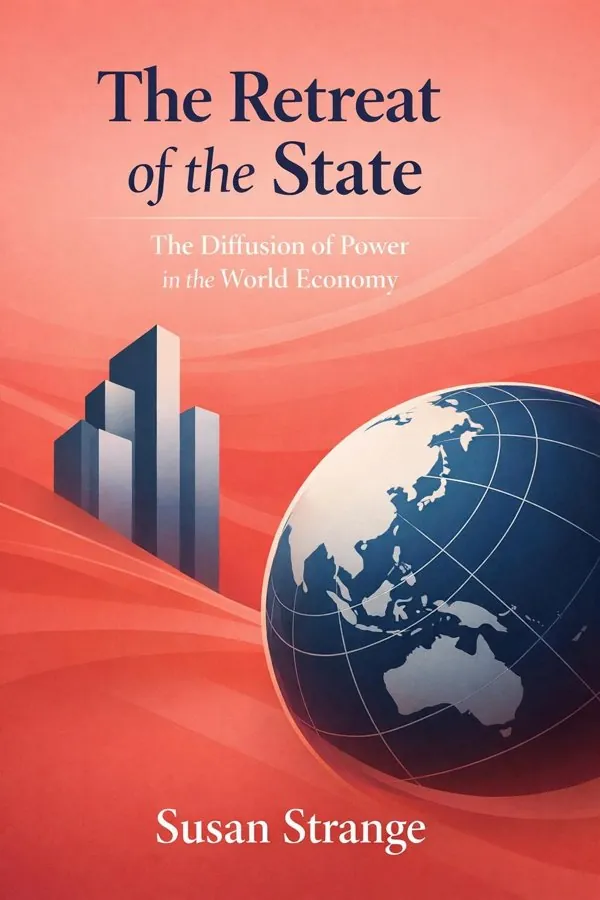
The Retreat of the State: The Diffusion of Power in the World Economy: Summary & Key Insights
 10 min8 chaptersAudio available
What Is The Retreat of the State: The Diffusion of Power in the World Economy About?
The Retreat of the State: The Diffusion of Power in the World Economy by Susan Strange is a economics book spanning 8 pages. In this influential work, Susan Strange argues that the power of the state has been eroded by global economic forces and the rise of non-state actors. She explores how markets, multinational corporations, and international institutions have increasingly shaped the world economy, challenging traditional notions of sovereignty and governance.
This FizzRead summary covers all 8 key chapters of The Retreat of the State: The Diffusion of Power in the World Economy in approximately 10 minutes, distilling the most important ideas, arguments, and takeaways from Susan Strange's work. Also available as an audio summary and Key Quotes Podcast.
The Retreat of the State: The Diffusion of Power in the World Economy
In this influential work, Susan Strange argues that the power of the state has been eroded by global economic forces and the rise of non-state actors. She explores how markets, multinational corporations, and international institutions have increasingly shaped the world economy, challenging traditional notions of sovereignty and governance.
Who Should Read The Retreat of the State: The Diffusion of Power in the World Economy?
This book is perfect for anyone interested in economics and looking to gain actionable insights in a short read. Whether you're a student, professional, or lifelong learner, the key ideas from The Retreat of the State: The Diffusion of Power in the World Economy by Susan Strange will help you think differently.
- ✓Readers who enjoy economics and want practical takeaways
- ✓Professionals looking to apply new ideas to their work and life
- ✓Anyone who wants the core insights of The Retreat of the State: The Diffusion of Power in the World Economy in just 10 minutes
Want the full summary?
Get instant access to this book summary and 100K+ more with Fizz Moment.
Get Free SummaryAvailable on App Store • Free to download
Key Chapters
To understand how the state’s authority eroded, one must see that the state’s preeminence was itself a historical achievement. In the early twentieth century, states exercised dominance over economic life through control of territory, industry, and finance. National boundaries largely determined where production took place and where capital flowed. The two world wars and the subsequent Bretton Woods order reinforced this pattern: reconstruction demanded strong national governments planning and negotiating international arrangements.
Yet embedded within this very order was the seed of transformation. Institutions such as the IMF and the World Bank—founded to manage interdependence—also began institutionalizing it. As trade expanded, technological innovation reduced communication costs, and corporations began to operate transnationally, the very tools that had guaranteed state power became conduits of its diffusion. The growth of global supply chains in the postwar decades transformed the geography of production, while financial liberalization in the 1970s and 1980s untethered capital from state control. What emerged was not a deliberate abdication, but a structural shift: where once states had set the rules of the game, they were increasingly compelled to play by those established by global markets.
Power in the global economy today takes a subtler form than armies or bureaucratic edicts; it is exercised through structures—through the ability to shape the environment in which decisions are made. Financial markets are a prime example. When investors move trillions of dollars at the tap of a keyboard, governments must respond. Policy priorities—from taxation and exchange rates to welfare spending—are constrained by the ever-present possibility that markets will punish policy choices deemed 'irresponsible.' In that sense, the structural power of markets surpasses traditional state authority: markets dictate feasible options, not through overt coercion, but through systemic discipline.
This reconfiguration of power has profound implications. Ministers may still speak of national interest, but their scope of action is bounded by fear of capital flight. Interest rates, currency values, and fiscal deficits are judged not by domestic constituencies, but by global financiers. The market, in this sense, has become a de facto source of governance. It rewards or penalizes, legitimizes or delegitimizes, state behavior. The retreat of the state, therefore, is not simply a political story—it is a reordering of legitimacy itself.
+ 6 more chapters — available in the FizzRead app
All Chapters in The Retreat of the State: The Diffusion of Power in the World Economy
About the Author
Susan Strange (1923–1998) was a pioneering British scholar of international political economy. She served as Professor at the London School of Economics and later at the University of Warwick, and is widely regarded as one of the founders of the field of international political economy.
Get This Summary in Your Preferred Format
Read or listen to the The Retreat of the State: The Diffusion of Power in the World Economy summary by Susan Strange anytime, anywhere. FizzRead offers multiple formats so you can learn on your terms — all free.
Available formats: App · Audio · PDF · EPUB — All included free with FizzRead
Download The Retreat of the State: The Diffusion of Power in the World Economy PDF and EPUB Summary
Key Quotes from The Retreat of the State: The Diffusion of Power in the World Economy
“To understand how the state’s authority eroded, one must see that the state’s preeminence was itself a historical achievement.”
“Power in the global economy today takes a subtler form than armies or bureaucratic edicts; it is exercised through structures—through the ability to shape the environment in which decisions are made.”
Frequently Asked Questions about The Retreat of the State: The Diffusion of Power in the World Economy
The Retreat of the State: The Diffusion of Power in the World Economy by Susan Strange is a economics book that explores key ideas across 8 chapters. In this influential work, Susan Strange argues that the power of the state has been eroded by global economic forces and the rise of non-state actors. She explores how markets, multinational corporations, and international institutions have increasingly shaped the world economy, challenging traditional notions of sovereignty and governance.
You Might Also Like
Business Adventures
John Brooks
10 min
Nudge
Richard H. Thaler, Cass R. Sunstein
10 min
The Hitchhiker"s Guide to the Galaxy
Douglas Adams
10 minThe Muqaddimah
Ibn Khaldun
10 minThe Outsiders
William N. Thorndike
10 min
A Little History of Economics
Niall Kishtainy
10 minBrowse by Category
Ready to read The Retreat of the State: The Diffusion of Power in the World Economy?
Get the full summary and 100K+ more books with Fizz Moment.