
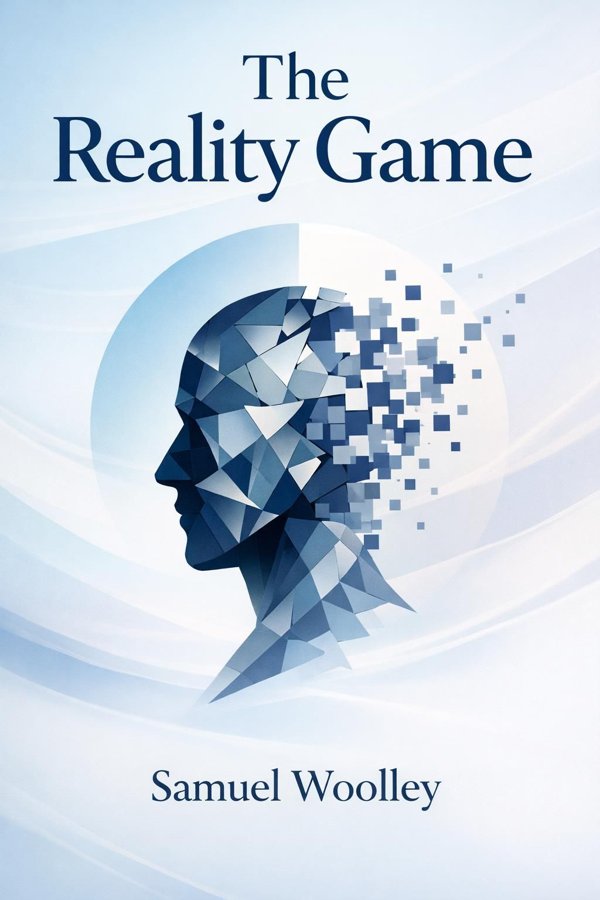
The Reality Game: How the Next Wave of Technology Will Break the Truth: Summary & Key Insights
 10 min9 chaptersAudio available
What Is The Reality Game: How the Next Wave of Technology Will Break the Truth About?
The Reality Game: How the Next Wave of Technology Will Break the Truth by Samuel Woolley is a digital_culture book spanning 9 pages. In The Reality Game, Samuel Woolley explores how emerging technologies such as artificial intelligence, virtual reality, and social media are reshaping truth and trust in the digital age. Drawing on extensive research into computational propaganda and information warfare, Woolley examines how these tools are used to manipulate public opinion and what can be done to safeguard democracy in an era of deepfakes and disinformation.
This FizzRead summary covers all 9 key chapters of The Reality Game: How the Next Wave of Technology Will Break the Truth in approximately 10 minutes, distilling the most important ideas, arguments, and takeaways from Samuel Woolley's work. Also available as an audio summary and Key Quotes Podcast.
The Reality Game: How the Next Wave of Technology Will Break the Truth
In The Reality Game, Samuel Woolley explores how emerging technologies such as artificial intelligence, virtual reality, and social media are reshaping truth and trust in the digital age. Drawing on extensive research into computational propaganda and information warfare, Woolley examines how these tools are used to manipulate public opinion and what can be done to safeguard democracy in an era of deepfakes and disinformation.
Who Should Read The Reality Game: How the Next Wave of Technology Will Break the Truth?
This book is perfect for anyone interested in digital_culture and looking to gain actionable insights in a short read. Whether you're a student, professional, or lifelong learner, the key ideas from The Reality Game: How the Next Wave of Technology Will Break the Truth by Samuel Woolley will help you think differently.
- ✓Readers who enjoy digital_culture and want practical takeaways
- ✓Professionals looking to apply new ideas to their work and life
- ✓Anyone who wants the core insights of The Reality Game: How the Next Wave of Technology Will Break the Truth in just 10 minutes
Want the full summary?
Get instant access to this book summary and 100K+ more with Fizz Moment.
Get Free SummaryAvailable on App Store • Free to download
Key Chapters
Before the internet revolution, propaganda was already a well-practiced art. Governments used radio, print, and television to shape narratives during war and peace. What is new about our era is not propaganda itself, but its automation, personalization, and relentless speed. In the early twentieth century, propaganda was a centralized act—strategists wrote broadcasts or posters aimed at mass audiences. Today, computational propaganda targets individuals one by one, exploiting psychological profiles and behavioral data harvested from our online lives.
In tracing this history, I found striking continuities. The principles developed by propagandists—emotional appeal, repetition, authority—remain intact. What’s changed is their execution. A false message that once took weeks to circulate can now travel globally within minutes, guided by algorithms designed to maximize engagement rather than accuracy. Even in the pre-digital age, citizens were vulnerable to manipulative media, but at least the distortions were visible; newspapers had editors, programs had identifiable sponsors. In the digital sphere, authorship fades. Messages appear organic, shared by “friends,” and disguised as genuine grassroots sentiment.
Understanding this lineage helps us see computational propaganda not as an anomaly but as an evolution of established techniques. It underscores that the current crisis was predictable—and that its roots lie in the same human impulses for persuasion, fear, and control that have always accompanied communication technologies.
When social media ascended, it was heralded as the great democratizer of information. We believed that by giving everyone a voice, truth would flourish through transparency. Instead, it created a fertile ground for manipulation. Computational propaganda, the use of algorithms and automation to spread misleading narratives, emerged as a new political weapon. I witnessed its rise in global elections, from the United States to Brazil and the Philippines, where networks of fake accounts and coordinated data operations distorted public debate.
The shift began when political campaigns realized that social platforms could be used not just to advertise but to deceive. Bots—automated software agents—could impersonate voters, amplify certain viewpoints, or swarm opponents. The illusion of popularity became a strategic asset. A hashtag boosted by thousands of automated accounts could appear genuine, shaping journalistic coverage and voter perception. Platforms, designed for engagement, rewarded this activity; outrage and falsehoods spread faster than fact-based corrections.
This dynamic revealed something profound about digital society: our technologies are not neutral. They embody business models that prioritize attention, not accuracy. Computational propaganda exploits that model efficiently, transforming social networks into ecosystems of emotional manipulation. Recognizing this interdependence is vital for reform. We cannot fix disinformation without addressing the incentives that sustain it.
+ 7 more chapters — available in the FizzRead app
All Chapters in The Reality Game: How the Next Wave of Technology Will Break the Truth
About the Author
Samuel Woolley is a researcher and writer specializing in the study of computational propaganda, political communication, and emerging technologies. He has directed research projects at the Oxford Internet Institute and the University of Texas at Austin, focusing on the intersection of technology, politics, and society.
Get This Summary in Your Preferred Format
Read or listen to the The Reality Game: How the Next Wave of Technology Will Break the Truth summary by Samuel Woolley anytime, anywhere. FizzRead offers multiple formats so you can learn on your terms — all free.
Available formats: App · Audio · PDF · EPUB — All included free with FizzRead
Download The Reality Game: How the Next Wave of Technology Will Break the Truth PDF and EPUB Summary
Key Quotes from The Reality Game: How the Next Wave of Technology Will Break the Truth
“Before the internet revolution, propaganda was already a well-practiced art.”
“When social media ascended, it was heralded as the great democratizer of information.”
Frequently Asked Questions about The Reality Game: How the Next Wave of Technology Will Break the Truth
The Reality Game: How the Next Wave of Technology Will Break the Truth by Samuel Woolley is a digital_culture book that explores key ideas across 9 chapters. In The Reality Game, Samuel Woolley explores how emerging technologies such as artificial intelligence, virtual reality, and social media are reshaping truth and trust in the digital age. Drawing on extensive research into computational propaganda and information warfare, Woolley examines how these tools are used to manipulate public opinion and what can be done to safeguard democracy in an era of deepfakes and disinformation.
You Might Also Like

An Ugly Truth: Inside Facebook’s Battle for Domination
Sheera Frenkel, Cecilia Kang
10 min
Cyber Citizens
Ian Goodfellow
10 min
Digital Minimalism: Choosing a Focused Life in a Noisy World
Cal Newport
10 min
E‑Books & Beyond
Various Authors
10 min
The Future of Media
Various Authors
10 min
This Is Why We Can't Have Nice Things
Whitney Phillips
10 minBrowse by Category
Ready to read The Reality Game: How the Next Wave of Technology Will Break the Truth?
Get the full summary and 100K+ more books with Fizz Moment.