
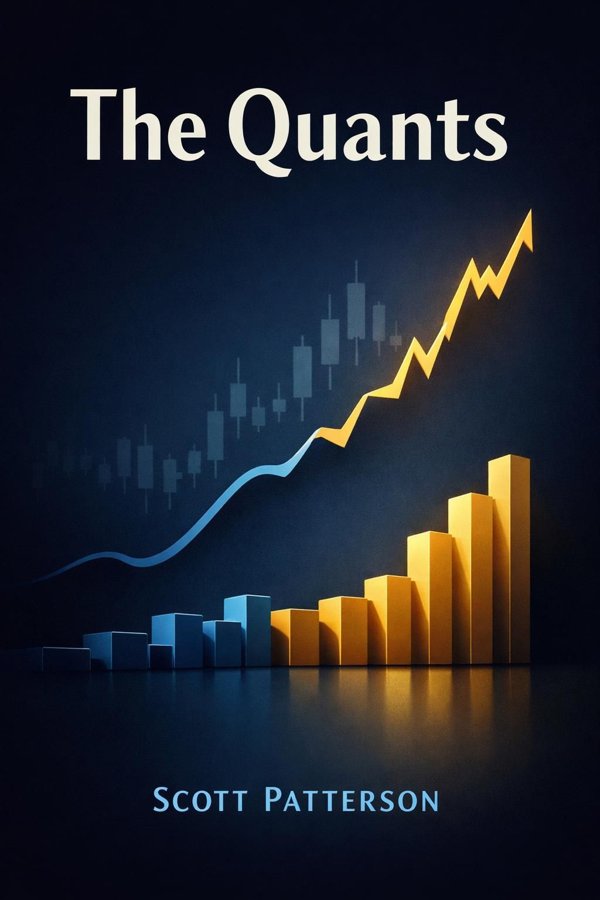
The Quants: How a New Breed of Math Whizzes Conquered Wall Street and Nearly Destroyed It: Summary & Key Insights
 10 min10 chaptersAudio available
Key Takeaways from The Quants: How a New Breed of Math Whizzes Conquered Wall Street and Nearly Destroyed It
A revolution often begins quietly, long before the world notices its consequences.
Sometimes the biggest disruption comes from people who have no interest in doing things the traditional way.
Success on Wall Street rarely remains private for long; once one strategy works, competition turns innovation into an arms race.
A technology becomes truly powerful when it stops being a niche and starts reshaping the mainstream.
History often sends warnings before disaster, but people only recognize them afterward.
What Is The Quants: How a New Breed of Math Whizzes Conquered Wall Street and Nearly Destroyed It About?
The Quants: How a New Breed of Math Whizzes Conquered Wall Street and Nearly Destroyed It by Scott Patterson is a finance book spanning 10 pages. Scott Patterson’s The Quants is a gripping account of how mathematicians, physicists, and computer scientists reshaped modern finance by turning Wall Street into a laboratory of models, algorithms, and statistical bets. The book follows the rise of “quants,” brilliant outsiders who believed markets could be decoded through data and probability rather than intuition or old-school dealmaking. Patterson traces this transformation from the early theorists of risk and portfolio science to elite hedge funds and investment banks, where quantitative strategies generated extraordinary profits and enormous confidence. But the same systems that seemed to tame uncertainty also hid dangerous assumptions, amplified crowd behavior, and helped set the stage for catastrophic losses during the financial crisis. What makes the book so valuable is its blend of financial history, character-driven storytelling, and investigative reporting. As a Wall Street Journal reporter, Patterson brings authority, access, and clarity to a subject that is often intimidating or opaque. The result is a vivid explanation of how intelligence, ambition, technology, and overconfidence combined to change global markets—and why that story still matters today.
This FizzRead summary covers all 10 key chapters of The Quants: How a New Breed of Math Whizzes Conquered Wall Street and Nearly Destroyed It in approximately 10 minutes, distilling the most important ideas, arguments, and takeaways from Scott Patterson's work. Also available as an audio summary and Key Quotes Podcast.
The Quants: How a New Breed of Math Whizzes Conquered Wall Street and Nearly Destroyed It
Scott Patterson’s The Quants is a gripping account of how mathematicians, physicists, and computer scientists reshaped modern finance by turning Wall Street into a laboratory of models, algorithms, and statistical bets. The book follows the rise of “quants,” brilliant outsiders who believed markets could be decoded through data and probability rather than intuition or old-school dealmaking. Patterson traces this transformation from the early theorists of risk and portfolio science to elite hedge funds and investment banks, where quantitative strategies generated extraordinary profits and enormous confidence. But the same systems that seemed to tame uncertainty also hid dangerous assumptions, amplified crowd behavior, and helped set the stage for catastrophic losses during the financial crisis. What makes the book so valuable is its blend of financial history, character-driven storytelling, and investigative reporting. As a Wall Street Journal reporter, Patterson brings authority, access, and clarity to a subject that is often intimidating or opaque. The result is a vivid explanation of how intelligence, ambition, technology, and overconfidence combined to change global markets—and why that story still matters today.
Who Should Read The Quants: How a New Breed of Math Whizzes Conquered Wall Street and Nearly Destroyed It?
This book is perfect for anyone interested in finance and looking to gain actionable insights in a short read. Whether you're a student, professional, or lifelong learner, the key ideas from The Quants: How a New Breed of Math Whizzes Conquered Wall Street and Nearly Destroyed It by Scott Patterson will help you think differently.
- ✓Readers who enjoy finance and want practical takeaways
- ✓Professionals looking to apply new ideas to their work and life
- ✓Anyone who wants the core insights of The Quants: How a New Breed of Math Whizzes Conquered Wall Street and Nearly Destroyed It in just 10 minutes
Want the full summary?
Get instant access to this book summary and 100K+ more with Fizz Moment.
Get Free SummaryAvailable on App Store • Free to download
Key Chapters
A revolution often begins quietly, long before the world notices its consequences. In finance, that revolution started when scholars began to treat markets not as theaters of instinct and personality, but as systems of measurable risk. Thinkers such as Harry Markowitz introduced portfolio theory, arguing that investing should be based on statistical relationships among assets rather than simple guesswork. Later, figures like Fischer Black, Myron Scholes, and Robert Merton developed models that promised to price risk with scientific precision. Their work transformed finance from a craft into something that looked increasingly like applied mathematics.
Patterson shows that this intellectual shift laid the foundation for the quant age. Risk could now be modeled, diversified, hedged, and packaged. On paper, uncertainty became manageable. This attracted a new kind of Wall Street participant: less salesman, more scientist. Instead of relying on market gossip, these people relied on equations, back-testing, and computing power. For banks and hedge funds, this was irresistible. Models offered consistency, scalability, and the alluring belief that human emotion could be engineered out of investing.
In practical terms, this changed everything from portfolio construction to options trading. A pension fund could optimize asset allocation using covariance matrices. A trader could hedge derivatives exposure using formula-driven strategies. An institution could estimate losses through value-at-risk models and convince itself it understood danger better than rivals.
But Patterson also hints at the seed of future trouble: when a model becomes widely trusted, its assumptions can become invisible. Financial science did not eliminate risk; it translated risk into numbers. And numbers, however elegant, can still mislead.
Actionable takeaway: Use quantitative tools as decision aids, not as substitutes for judgment, and always ask what assumptions sit underneath the numbers.
Sometimes the biggest disruption comes from people who have no interest in doing things the traditional way. Jim Simons, the founder of Renaissance Technologies, embodied that principle. A mathematician and former codebreaker, Simons did not arrive on Wall Street as a conventional investor. He came with the mindset that markets contained patterns hidden beneath apparent randomness, and that those patterns could be uncovered through data, statistical inference, and relentless experimentation.
Patterson presents Simons as perhaps the purest expression of the quant ethos. Rather than hiring charismatic traders with market opinions, Simons recruited mathematicians, scientists, and cryptographers. He built a culture where intuition mattered less than evidence and where the central question was not “What should the market do?” but “What does the data say it tends to do?” Renaissance’s Medallion Fund became legendary for its performance because it pursued countless small, statistically favorable trades at scale, guided by sophisticated models.
The practical lesson here is powerful. Simons succeeded not because he predicted the future perfectly, but because he built a system that exploited small edges consistently. In business, sports analytics, and even personal decision-making, this same logic applies: repeated, disciplined use of marginal advantages can outperform dramatic but unreliable bets.
Yet Patterson also makes clear that Simons was exceptional partly because he understood the limits of secrecy, adaptation, and model maintenance. Renaissance kept evolving. It did not assume a winning formula would remain permanent. That adaptability distinguished it from firms that mistook one period of success for proof of universal truth.
Actionable takeaway: Build systems around evidence, but continuously update them—an edge that is not questioned eventually disappears.
Success on Wall Street rarely remains private for long; once one strategy works, competition turns innovation into an arms race. Ken Griffin’s Citadel illustrates how quantitative finance moved from elite experimentation into industrial-scale competition. Griffin recognized that markets were increasingly shaped by technology, data, and speed. To win, firms had to invest not just in smart people but in infrastructure: better computers, broader datasets, sharper risk systems, and faster execution.
Patterson uses Griffin’s rise to show how the quant world became fiercely competitive. Hedge funds and banks were no longer merely hiring analysts—they were building research factories. The best physicists, statisticians, and programmers were recruited into finance. Strategies that once produced outsized returns became crowded as more firms discovered similar statistical relationships. As a result, profit margins compressed and risk increased. To maintain returns, some firms leveraged more aggressively or pursued more complex trades.
This dynamic has broad applications beyond finance. In any industry driven by analytics—advertising, logistics, e-commerce, AI—an initial data advantage can quickly become table stakes. Once everyone has tools, the competition shifts to execution quality, speed of learning, and risk control. Griffin’s world reveals that sophistication alone does not guarantee safety; it can simply raise the stakes.
Patterson also underscores the cultural side of the arms race. High-performance quantitative firms demanded intense discipline, constant monitoring, and faith in systems. That pressure could create resilience, but it could also produce fragility when everyone chased similar signals under similar constraints.
Actionable takeaway: In competitive environments, treat innovation as temporary, invest in resilience as much as performance, and never assume technological sophistication equals strategic invulnerability.
A technology becomes truly powerful when it stops being a niche and starts reshaping the mainstream. Peter Muller’s story at Morgan Stanley captures that moment for quantitative finance. Muller, a gifted mathematician and trader, helped bring advanced modeling into the heart of a major financial institution. His presence signaled that quants were no longer outsiders operating on the margins; they were becoming central to how large banks traded, managed risk, and designed products.
Patterson shows that this institutional embrace changed the character of finance. Banks increasingly relied on quants to value exotic derivatives, optimize portfolios, and build strategies that could be scaled across global markets. The appeal was obvious. Quantitative models made highly complex instruments seem understandable and tradable. They allowed firms to expand into businesses that would have been impossible to manage purely by intuition. For executives, quants offered a language of control.
The challenge, however, was that mainstream adoption often diluted skepticism. In a specialist hedge fund, a model might be questioned by its creators every day. In a giant bank, a model could become embedded in bureaucracy, passed from one desk to another, and trusted by people who did not fully grasp its assumptions. That is where danger grows: not in the existence of complex models, but in their institutional normalization.
In practical settings, this happens whenever expert tools become widely used by non-experts—whether in finance, medicine, or data-driven management. A dashboard can create confidence without comprehension. Muller’s world demonstrates that technical brilliance inside a large system must be matched by governance, transparency, and humility.
Actionable takeaway: When powerful analytical tools become mainstream, make sure the users understand not just how to apply them, but when they can fail.
History often sends warnings before disaster, but people only recognize them afterward. Long-Term Capital Management, or LTCM, was one of the clearest early warnings in modern finance. Founded by renowned traders and advised by Nobel Prize-winning economists, LTCM appeared to embody the triumph of quantitative intelligence. Its models identified pricing discrepancies across global markets and used heavy leverage to magnify tiny inefficiencies into large profits.
Patterson treats LTCM as a critical precursor to the later quant crises. The firm’s strategy worked beautifully—until it didn’t. Its models assumed that market relationships would revert toward historical norms. But during periods of panic, those relationships can break down for longer and more violently than models anticipate. When Russia defaulted in 1998, markets behaved in ways LTCM’s elegant equations had not fully prepared it for. Highly leveraged positions turned manageable deviations into existential threats.
The practical insight is profound. A model can be mathematically correct under normal conditions and still fail catastrophically under stress. This is true in investing and elsewhere. Supply chains, business forecasts, and machine-learning systems often perform well in ordinary environments but break when the world shifts regime. The problem is not simply bad math. It is overreliance on historical patterns in a world capable of producing rare, nonlinear shocks.
LTCM also exposed a deeper institutional problem: when many sophisticated players hold related positions, one firm’s distress becomes everyone’s problem. Interconnection turns private error into systemic risk.
Actionable takeaway: Test every model or strategy against extreme scenarios, and assume that rare events happen more often—and with greater force—than elegant theories suggest.
When many brilliant people lose money at the same time, the real story is rarely individual error alone. The quant meltdown of August 2007 stunned hedge funds that had long trusted data-driven strategies. Firms running market-neutral and statistical arbitrage models—strategies designed to be insulated from broad market moves—suddenly suffered sharp, synchronized losses. Positions that should have diversified risk moved against them together.
Patterson explains this event as a failure of assumptions about independence, liquidity, and crowding. Many funds had converged on similar trades, often buying securities deemed cheap and shorting those deemed expensive according to historical relationships. When some large players were forced to unwind positions, selling pressure spread across the system. Prices moved not because fundamentals had changed overnight, but because portfolios were being mechanically liquidated. Models built on historical correlations could not fully account for what happens when everyone tries to exit at once.
This episode matters because it exposed a hidden truth: quantitative strategies can create feedback loops. If many firms respond to the same signals with similar trades, their behavior shapes the market they think they are merely observing. This applies beyond hedge funds. Social media algorithms, recommendation engines, and automated pricing systems can all produce self-reinforcing dynamics when many actors optimize in similar ways.
The quant meltdown was also an early tremor of the broader crisis. It showed that sophistication does not guarantee diversification and that liquidity can vanish precisely when it is most needed.
Actionable takeaway: Do not judge risk only by what a strategy owns; judge it by who else may own the same thing and how everyone might behave under stress.
The dream of the quant era was not just better prediction, but freedom from human weakness. Yet Patterson makes clear that human psychology never disappeared from quantitative finance; it merely changed form. The quants sought to replace fear and greed with discipline, algorithms, and statistical rigor. But the people designing, funding, and deploying those models still carried all the familiar biases: overconfidence, herd behavior, career pressure, and the temptation to believe success proves genius.
One of the book’s deepest insights is that precision can create its own illusion. A model expressed to several decimal places feels objective, authoritative, and safe. That aura can reduce skepticism instead of increasing it. Executives may trust output because it looks scientific. Traders may take larger bets because a risk number appears controlled. Researchers may become attached to elegant frameworks and ignore messy signs that reality is shifting.
In practical life, this pattern is common. A spreadsheet forecast can feel truer than a rough verbal warning. An algorithmic score can overshadow local knowledge. Metrics can narrow attention to what is measurable while ignoring what is important but hard to quantify. Patterson’s account reminds us that humans do not stop being human when they use advanced tools; they often express old biases through new systems.
The solution is not to reject models, but to combine them with institutional humility. Organizations need dissent, stress testing, and people empowered to challenge high-performing systems before they fail.
Actionable takeaway: Whenever a model seems most convincing, slow down and ask what it may be missing, who benefits from trusting it, and what non-quantitative signals deserve attention.
A crisis rarely comes from one bad idea; it comes from many confident ideas colliding at scale. Patterson connects the quant upheavals to the broader 2008 financial collapse by showing how quantitative tools enabled the growth of a deeply fragile system. Models were used to price mortgage-backed securities, estimate default risk, structure collateralized debt obligations, and justify leverage across institutions. These tools did not create the housing bubble by themselves, but they made it easier to expand, distribute, and underestimate the risks embedded within it.
As housing prices faltered and mortgage defaults rose, the assumptions behind many models started to unravel. Correlations changed. Liquidity dried up. Securities that had been treated as measurable and hedgeable became opaque and unstable. Institutions that had relied on quantitative risk metrics found that those metrics had captured ordinary fluctuations better than systemic breakdown. The problem was not just mistaken calculation; it was a system built to function smoothly only under favorable conditions.
Patterson’s contribution here is to frame the crisis not as a simple morality tale of greed versus prudence, but as a warning about the marriage of intelligence and overconfidence. Highly educated people built structures they believed they understood. In many cases, they did understand the internal logic of their models. What they underestimated was the complexity of the world those models were simplifying.
For readers today, the lesson extends to AI, fintech, and algorithmic decision-making. Complex systems can produce great efficiency and hidden systemic vulnerability at the same time.
Actionable takeaway: Before trusting any high-performance system, ask not only how it works in normal times, but how it behaves when the entire environment turns against it.
The lasting lesson of The Quants is not that mathematics is dangerous, but that power without humility is. Patterson does not argue that quantitative finance was a mistake. On the contrary, many quant innovations improved pricing, trading efficiency, and analytical rigor. The real problem emerged when success encouraged the belief that models could master uncertainty rather than merely navigate part of it.
This final lesson matters because the quant mindset has spread far beyond hedge funds. Today, governments, corporations, and individuals rely on algorithms to rank people, allocate resources, detect fraud, optimize logistics, and shape investment decisions. In each case, the same temptations exist: to confuse historical fit with future truth, to mistake complexity for reliability, and to overlook the social effects of many actors following similar rules.
Patterson’s narrative suggests a more mature relationship with analytics. Good models are valuable because they sharpen thinking, reveal patterns, and impose discipline. But robust systems also include buffers, human oversight, scenario analysis, and respect for unknowns. The best decision-makers are neither anti-model nor blindly pro-model. They are capable of using quantitative tools while staying alert to what those tools leave out.
For investors, managers, and policymakers, that means focusing on incentives, concentrations, liquidity, and behavior under stress—not just expected returns or back-tested elegance. A resilient system is one designed for surprise.
Actionable takeaway: Embrace data and modeling, but build margins of safety, encourage dissent, and make resilience—not just optimization—the standard of intelligent decision-making.
All Chapters in The Quants: How a New Breed of Math Whizzes Conquered Wall Street and Nearly Destroyed It
About the Author
Scott Patterson is an American journalist and author known for his reporting on Wall Street, market structure, and financial technology. As a reporter for The Wall Street Journal, he has covered hedge funds, trading systems, and the evolving mechanics of global finance with a focus on making complex subjects understandable to general readers. Patterson is best known for books such as The Quants and Dark Pools, both of which examine how hidden technologies, elite firms, and quantitative systems have transformed modern markets. His writing combines investigative depth with narrative storytelling, allowing him to explain difficult financial concepts through memorable characters and high-stakes events. Patterson’s work is especially valued for exposing the human consequences of abstract systems and for bringing clarity to some of finance’s most opaque corners.
Get This Summary in Your Preferred Format
Read or listen to the The Quants: How a New Breed of Math Whizzes Conquered Wall Street and Nearly Destroyed It summary by Scott Patterson anytime, anywhere. FizzRead offers multiple formats so you can learn on your terms — all free.
Available formats: App · Audio · PDF · EPUB — All included free with FizzRead
Download The Quants: How a New Breed of Math Whizzes Conquered Wall Street and Nearly Destroyed It PDF and EPUB Summary
Key Quotes from The Quants: How a New Breed of Math Whizzes Conquered Wall Street and Nearly Destroyed It
“A revolution often begins quietly, long before the world notices its consequences.”
“Sometimes the biggest disruption comes from people who have no interest in doing things the traditional way.”
“Success on Wall Street rarely remains private for long; once one strategy works, competition turns innovation into an arms race.”
“A technology becomes truly powerful when it stops being a niche and starts reshaping the mainstream.”
“History often sends warnings before disaster, but people only recognize them afterward.”
Frequently Asked Questions about The Quants: How a New Breed of Math Whizzes Conquered Wall Street and Nearly Destroyed It
The Quants: How a New Breed of Math Whizzes Conquered Wall Street and Nearly Destroyed It by Scott Patterson is a finance book that explores key ideas across 10 chapters. Scott Patterson’s The Quants is a gripping account of how mathematicians, physicists, and computer scientists reshaped modern finance by turning Wall Street into a laboratory of models, algorithms, and statistical bets. The book follows the rise of “quants,” brilliant outsiders who believed markets could be decoded through data and probability rather than intuition or old-school dealmaking. Patterson traces this transformation from the early theorists of risk and portfolio science to elite hedge funds and investment banks, where quantitative strategies generated extraordinary profits and enormous confidence. But the same systems that seemed to tame uncertainty also hid dangerous assumptions, amplified crowd behavior, and helped set the stage for catastrophic losses during the financial crisis. What makes the book so valuable is its blend of financial history, character-driven storytelling, and investigative reporting. As a Wall Street Journal reporter, Patterson brings authority, access, and clarity to a subject that is often intimidating or opaque. The result is a vivid explanation of how intelligence, ambition, technology, and overconfidence combined to change global markets—and why that story still matters today.
You Might Also Like




Browse by Category
Ready to read The Quants: How a New Breed of Math Whizzes Conquered Wall Street and Nearly Destroyed It?
Get the full summary and 100K+ more books with Fizz Moment.