
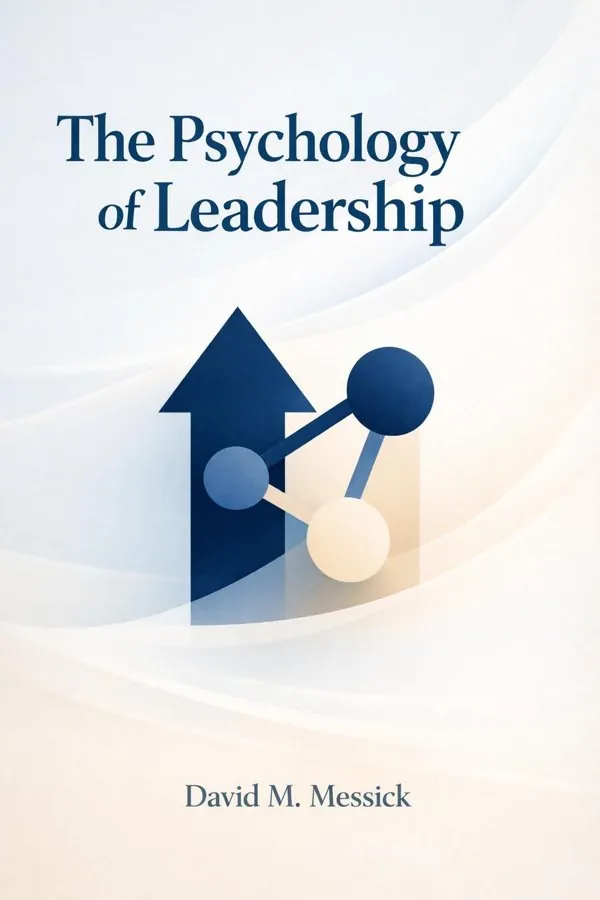
The Psychology of Leadership: Summary & Key Insights
 10 min10 chaptersAudio available
What Is The Psychology of Leadership About?
The Psychology of Leadership by David M. Messick is a leadership book spanning 10 pages. This book explores the psychological foundations of leadership, examining how leaders influence followers, make decisions, and shape organizational culture. It integrates research from social psychology, cognitive science, and organizational behavior to explain the mental processes underlying effective leadership and ethical decision-making.
This FizzRead summary covers all 10 key chapters of The Psychology of Leadership in approximately 10 minutes, distilling the most important ideas, arguments, and takeaways from David M. Messick's work. Also available as an audio summary and Key Quotes Podcast.
The Psychology of Leadership
This book explores the psychological foundations of leadership, examining how leaders influence followers, make decisions, and shape organizational culture. It integrates research from social psychology, cognitive science, and organizational behavior to explain the mental processes underlying effective leadership and ethical decision-making.
Who Should Read The Psychology of Leadership?
This book is perfect for anyone interested in leadership and looking to gain actionable insights in a short read. Whether you're a student, professional, or lifelong learner, the key ideas from The Psychology of Leadership by David M. Messick will help you think differently.
- ✓Readers who enjoy leadership and want practical takeaways
- ✓Professionals looking to apply new ideas to their work and life
- ✓Anyone who wants the core insights of The Psychology of Leadership in just 10 minutes
Want the full summary?
Get instant access to this book summary and 100K+ more with Fizz Moment.
Get Free SummaryAvailable on App Store • Free to download
Key Chapters
Early leadership theories imagined the leader as a figure marked by distinct innate traits — a person destined to command, with qualities separating them from ordinary followers. But as social psychology advanced, we began to recognize that leadership cannot be explained merely by personality profiles. Instead, it is a dynamic process that unfolds between people in context.
In developing this idea, I draw attention to the shift from static trait models to process-oriented frameworks. Where once we measured charisma and intelligence, we now study perception, cognition, and interaction. Leadership emerges from relationships — it is co-created by leaders and followers rather than imposed from above. This change marks a fundamental redefinition: a leader is no longer identified solely by who they are, but by how they engage, interpret, and act.
Through this process lens, traits become just one part of a broader tapestry involving social cognition, situational awareness, and moral reasoning. In organizational settings, leaders shape norms not by commands but by signals, expectations, and the psychological atmosphere they create. Their behavior triggers interpretive responses, and these responses stabilize into shared beliefs about what is appropriate, fair, and worthy of commitment.
From this perspective, the very act of leadership is a social experiment — one that depends on collective meaning-making. When followers choose to endorse a leader, they are responding to cues of competence and morality, not only to hierarchical authority. Understanding this shift equips us to see leadership as a living process, grounded in human psychology rather than personality mystique.
Leadership, at its core, is a cognitive enterprise. Every decision — whether strategic or moral — arises from how a leader interprets the world. I have spent much of my career studying these interpretations and the biases that distort them. Leaders, like all human beings, are vulnerable to cognitive shortcuts: they overvalue their own perspectives, underestimate uncertainty, and project confidence even when evidence is thin.
In this section, I explore the mental mechanics of judgment. When a leader faces complex organizational dilemmas, they construct mental models to simplify ambiguity. These models are indispensable, yet they carry inherent risks. Confirmation bias, attribution errors, and the illusion of control can lead even experienced leaders into flawed decisions. The psychology of leadership becomes a study of how these biases interact with power — because authority magnifies the consequences of cognitive error.
Beyond mistakes, cognition also empowers leadership through insight. A perceptive leader recognizes patterns in chaotic circumstances, synthesizes disparate inputs, and generates meaning that others can act upon. The ability to see connections across domains embodies cognitive complexity, a hallmark of advanced leadership. It is not about thinking faster, but about thinking deeper — appreciating multiple perspectives and integrating them ethically.
Effective leadership demands metacognition: the awareness of one’s own thinking. By questioning assumptions and examining how values silently shape interpretation, leaders cultivate judgment that is not merely efficient but morally sound. This intersection of cognition and ethics lies at the heart of psychological leadership — the discipline of self-reflective decision-making that transforms command into guidance.
+ 8 more chapters — available in the FizzRead app
All Chapters in The Psychology of Leadership
About the Author
David M. Messick was a social psychologist known for his research on ethics, fairness, and leadership. He served as a professor at Northwestern University and contributed significantly to the study of decision-making and moral psychology in organizational contexts.
Get This Summary in Your Preferred Format
Read or listen to the The Psychology of Leadership summary by David M. Messick anytime, anywhere. FizzRead offers multiple formats so you can learn on your terms — all free.
Available formats: App · Audio · PDF · EPUB — All included free with FizzRead
Download The Psychology of Leadership PDF and EPUB Summary
Key Quotes from The Psychology of Leadership
“Early leadership theories imagined the leader as a figure marked by distinct innate traits — a person destined to command, with qualities separating them from ordinary followers.”
“Leadership, at its core, is a cognitive enterprise.”
Frequently Asked Questions about The Psychology of Leadership
The Psychology of Leadership by David M. Messick is a leadership book that explores key ideas across 10 chapters. This book explores the psychological foundations of leadership, examining how leaders influence followers, make decisions, and shape organizational culture. It integrates research from social psychology, cognitive science, and organizational behavior to explain the mental processes underlying effective leadership and ethical decision-making.
You Might Also Like

Extreme Ownership
Jocko Willink
10 min
Dare to Lead
Brene Brown
10 min
Leaders Eat Last
Simon Sinek
10 min
The 21 Irrefutable Laws of Leadership
John Maxwell
10 min
Start With Why
Simon Sinek
10 min
How to Lead When You're Not in Charge
Clay Scroggins
10 minBrowse by Category
Ready to read The Psychology of Leadership?
Get the full summary and 100K+ more books with Fizz Moment.