
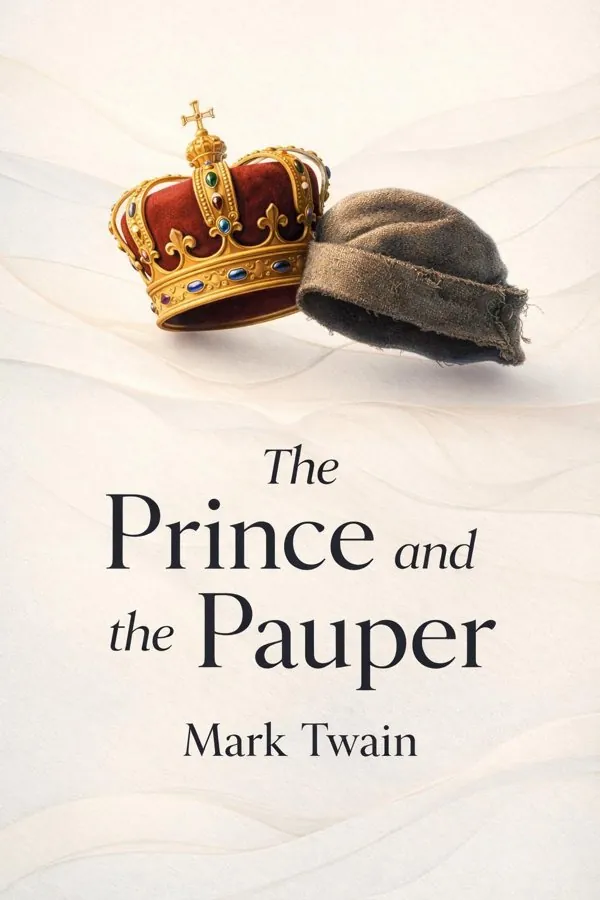
The Prince and the Pauper: Summary & Key Insights
by Mark Twain
 10 min8 chaptersAudio available
Key Takeaways from The Prince and the Pauper
A child’s destiny often appears to be written long before he can speak, and Twain builds his novel around that uncomfortable truth.
Sometimes one accidental moment exposes truths that years of routine conceal.
Power looks glamorous from a distance, but up close it is often burden, scrutiny, and responsibility.
People rarely understand injustice until it reaches their own skin.
One of Twain’s most unsettling claims is that justice often serves rank before it serves truth.
What Is The Prince and the Pauper About?
The Prince and the Pauper by Mark Twain is a classics book spanning 4 pages. What determines a person’s worth: birth, clothing, title, or character? In The Prince and the Pauper, Mark Twain turns that question into a vivid historical adventure set in sixteenth-century England. The novel follows two boys who look exactly alike but live at opposite ends of society: Tom Canty, a neglected child from London’s slums, and Edward Tudor, heir to the English throne. When they exchange clothes in a moment of curiosity, the world immediately mistakes each boy for the other, forcing them to live lives they never chose. What begins as a clever plot device becomes a sharp examination of power, poverty, justice, and human dignity. Through Tom’s uneasy rise into privilege and Edward’s brutal descent into hardship, Twain exposes how social systems reward appearance and status more than truth and merit. Yet the story is never merely grim; it is lively, humane, and filled with suspense, irony, and moral insight. Twain brings to the novel the same satirical intelligence and deep sympathy that made him one of literature’s great observers of society. The Prince and the Pauper endures because its central question still matters: how differently would we judge people if we truly understood their circumstances?
This FizzRead summary covers all 8 key chapters of The Prince and the Pauper in approximately 10 minutes, distilling the most important ideas, arguments, and takeaways from Mark Twain's work. Also available as an audio summary and Key Quotes Podcast.
The Prince and the Pauper
What determines a person’s worth: birth, clothing, title, or character? In The Prince and the Pauper, Mark Twain turns that question into a vivid historical adventure set in sixteenth-century England. The novel follows two boys who look exactly alike but live at opposite ends of society: Tom Canty, a neglected child from London’s slums, and Edward Tudor, heir to the English throne. When they exchange clothes in a moment of curiosity, the world immediately mistakes each boy for the other, forcing them to live lives they never chose.
What begins as a clever plot device becomes a sharp examination of power, poverty, justice, and human dignity. Through Tom’s uneasy rise into privilege and Edward’s brutal descent into hardship, Twain exposes how social systems reward appearance and status more than truth and merit. Yet the story is never merely grim; it is lively, humane, and filled with suspense, irony, and moral insight.
Twain brings to the novel the same satirical intelligence and deep sympathy that made him one of literature’s great observers of society. The Prince and the Pauper endures because its central question still matters: how differently would we judge people if we truly understood their circumstances?
Who Should Read The Prince and the Pauper?
This book is perfect for anyone interested in classics and looking to gain actionable insights in a short read. Whether you're a student, professional, or lifelong learner, the key ideas from The Prince and the Pauper by Mark Twain will help you think differently.
- ✓Readers who enjoy classics and want practical takeaways
- ✓Professionals looking to apply new ideas to their work and life
- ✓Anyone who wants the core insights of The Prince and the Pauper in just 10 minutes
Want the full summary?
Get instant access to this book summary and 100K+ more with Fizz Moment.
Get Free SummaryAvailable on App Store • Free to download
Key Chapters
A child’s destiny often appears to be written long before he can speak, and Twain builds his novel around that uncomfortable truth. Tom Canty is born into hunger, dirt, and fear in Offal Court, where beatings are common and hope is scarce. His family lives in crushing poverty, and his daily reality is shaped by deprivation rather than possibility. Yet Tom possesses imagination, gentleness, and curiosity. He dreams of princes, ceremonies, and a world governed by grace instead of violence. Across the city, Edward Tudor grows up surrounded by luxury, servants, and ceremony. He has everything Tom lacks—protection, education, status, and power—but he also lives inside rigid rules that dictate his every move.
Twain’s opening contrast does more than set the scene. It challenges the assumption that social position reflects moral worth. Tom is not low because he is lesser, and Edward is not elevated because he is better. They are simply born into different systems. That distinction is the novel’s moral engine. By making the boys physically identical, Twain strips away superficial differences and forces readers to confront how much of social judgment depends on costume, accent, and environment.
This idea remains strikingly relevant. In modern life, people are still sorted by zip code, schooling, family wealth, job title, and appearance. We often confuse advantage with virtue and hardship with failure. The novel invites us to question those reflexes. When evaluating others, ask: how much of what I admire or dismiss is really the result of circumstance? Actionable takeaway: practice separating character from status by looking for effort, kindness, and integrity rather than outward signs of success.
Sometimes one accidental moment exposes truths that years of routine conceal. When Tom wanders near the royal palace and is roughly handled by a guard, Prince Edward intervenes and invites him inside. The two boys, astonished by their identical appearance, compare their lives with fascination. In playful curiosity, they exchange clothes. But before they can reverse the experiment, Edward rushes out to confront the guard and is mistaken for a commoner, while Tom—dressed as the prince—is trapped inside the palace and treated as royalty.
The brilliance of this turning point lies in its simplicity. Nothing essential about either boy changes except what he is wearing, yet everyone around them immediately responds as though their identities have truly been transformed. Twain uses this switch to satirize a society that mistakes symbols for substance. The palace trusts garments, etiquette, and setting more than truth. The streets do the same. Edward protests that he is the prince, but stripped of visible status, his words sound absurd. Tom insists he is poor, but surrounded by courtiers, his protests are interpreted as illness or eccentricity.
This is one of Twain’s sharpest observations: institutions often defend appearances because they are easier to manage than reality. Modern readers can see parallels in professional titles, social media images, luxury branding, and credentials that are taken as proof of value before a person’s actual qualities are known.
The switch also forces empathy through experience. Neither boy merely hears about the other’s world; each must endure it. That is what gives the novel its lasting power. Actionable takeaway: whenever possible, test assumptions by seeking firsthand perspective—listen deeply, enter unfamiliar environments, and remember how easily appearances can mislead.
Power looks glamorous from a distance, but up close it is often burden, scrutiny, and responsibility. Once Tom is taken for the prince, he is overwhelmed by the machinery of court life. He is dressed, instructed, watched, and interpreted at every moment. His confusion is mistaken for royal oddness, and his lack of knowledge becomes a political concern. Yet over time, Tom begins to adapt. He learns court customs, responds to officials, and gradually discovers that authority can influence real lives.
This section of the novel is important because Twain does not portray Tom simply as an impostor enjoying luxury. Tom is frightened, isolated, and painfully aware that he does not belong. Still, his life in poverty has given him something many nobles lack: familiarity with suffering. Because he has known hunger, beating, and injustice, he responds to legal cruelty and social indifference with instinctive compassion. When he hears cases or witnesses harsh punishments, his judgments tend to be more merciful than those of people raised in privilege. In this way, Twain suggests that experience of hardship can deepen moral imagination.
Tom’s time in power illustrates a timeless leadership principle: decisions are better when guided by empathy rather than abstraction. Leaders who have only known comfort may speak about discipline, order, or efficiency while overlooking the human cost of their policies. Those who have suffered are often more alert to consequences.
For readers today, Tom’s arc offers a practical lesson in stewardship. If you find yourself in a position of influence—at work, at home, or in your community—remember that authority is not proof of superiority. It is an opportunity to relieve burdens and correct unfairness. Actionable takeaway: use any power you hold to make systems more humane, especially for people whose struggles are easiest to ignore.
People rarely understand injustice until it reaches their own skin. Cast out of the palace in rags, Edward expects his rank alone to restore order. Instead, he is mocked, beaten, ignored, and dragged through the brutal realities of Tudor England. He encounters hunger, imprisonment, corruption, and the arbitrary cruelty of law. The boy who was born to rule discovers that suffering is not an exception in his kingdom—it is a daily condition for many of his subjects.
This transformation is central to the novel’s moral architecture. Edward begins with genuine kindness, but his compassion is still abstract. He pities the poor because he has heard of them. Once mistaken for a pauper, he experiences the terrifying gap between legal ideals and lived reality. He sees how quickly authorities abuse those without protection. He learns how witnesses lie, mobs judge, and systems punish the weak. These encounters mature him. By the time he returns to power, he is not merely a prince who means well; he is someone who has endured the consequences of bad governance.
Twain’s insight is politically and personally powerful. Policies designed from a distance often fail because they ignore lived experience. The same applies in ordinary relationships. It is easy to prescribe discipline, patience, or gratitude to others when you have not faced their obstacles. Hardship, while painful, can become a school of perception.
In modern terms, Edward’s journey reminds us to seek understanding beyond theory. Leaders should spend time with frontline workers, citizens, students, patients, or customers instead of relying solely on reports. Parents, managers, and teachers should listen before judging. Actionable takeaway: before making decisions about others, learn what their reality actually feels like—not in principle, but in practice.
One of Twain’s most unsettling claims is that justice often serves rank before it serves truth. Throughout Edward’s time among the poor, he discovers a legal system that appears orderly from above but feels arbitrary and vicious from below. Innocent people are threatened, absurd punishments are imposed, and accusations carry more weight than facts when the accused lacks standing. The novel repeatedly shows that law, in practice, can become an instrument of humiliation rather than fairness.
Edward’s outrage is not just personal. As he moves through prisons, courtrooms, and hostile streets, he comes to see how institutions that should protect people can instead magnify their vulnerability. A prince’s words are treated as law within the palace, but the same words spoken by a ragged boy are dismissed as madness. This dramatic irony reinforces Twain’s critique: truth is often judged not by evidence but by who is speaking. The system does not ask, “What is right?” first. It asks, “What is your station?”
That insight extends far beyond Tudor England. In modern societies, access to good lawyers, education, reputation, or financial resources still shapes outcomes. Some people are believed quickly; others must fight to prove even obvious truths. Twain encourages readers to recognize these distortions rather than accept official procedures as automatically just.
The practical application is clear. Fairness requires more than rules. It requires vigilance about who benefits from those rules and who is silenced by them. In workplaces, schools, and communities, the confident and well-connected are often heard first. Actionable takeaway: when judging a situation, deliberately give extra attention to voices with less power, and ask whether process is protecting justice or merely protecting status.
Twain’s most memorable device is also his deepest philosophical challenge: if changing clothes changes how the world treats you, how stable is identity in social life? Tom remains Tom in the palace, and Edward remains Edward in the streets, yet each is redefined by others the moment appearances shift. The novel demonstrates how society constructs identity from external signals—dress, speech, setting, and expectation—rather than from inward truth.
This does not mean identity is unreal. On the contrary, Twain shows how painful it is when a person’s true self is denied. Edward knows who he is, but no one believes him. Tom knows he is not the prince, but his surroundings force him to perform a role. The emotional strain both boys experience reveals the human need to be recognized accurately. To be unseen, misnamed, or disbelieved is not a minor inconvenience; it is a form of dispossession.
The idea has strong contemporary relevance. People are constantly categorized by profession, class, age, race, accent, or online persona. Once a label is attached, others often interpret every action through it. A junior employee may be underestimated, a wealthy person presumed competent, a struggling student dismissed as lazy. Yet labels reveal little about depth, potential, or pain.
Twain urges readers to hold social identities more lightly and moral identities more seriously. The question is not, “What role does this person occupy?” but “Who are they, and how are they being treated?” This shift can transform daily interactions. Actionable takeaway: resist reducing people to visible roles; ask better questions, listen longer, and leave room for identities that cannot be read from the surface.
Empathy begins in imagination, but it becomes durable through contact with reality. Tom, before entering the palace, imagines princely life with wonder. Edward, before losing his status, imagines poverty only dimly. Both boys possess some capacity for kindness, yet each understands the other’s world mainly through stories. The switch forces imagination to become experience, and that transformation changes them more than any lecture could.
Twain seems to suggest that moral growth requires crossing boundaries. Tom becomes a better ruler-in-training because he has lived among the poor. Edward becomes a wiser future king because he has suffered like one of his subjects. Neither learns compassion by remaining safely within his original circle. They learn by being exposed to discomfort, uncertainty, and dependence.
This lesson applies widely. Reading literature, hearing personal stories, traveling, volunteering, and working with people from different backgrounds can all stretch moral imagination. But the key is not exposure for its own sake. It is humble attention. Many people encounter difference without being changed because they remain defensive or superior. The boys change because they are vulnerable inside unfamiliar systems.
For modern readers, the novel argues against insulated living. If all your relationships are with people of similar income, education, politics, or culture, your understanding of society will be partial and often distorted. Compassion is not just a feeling; it is an informed response shaped by real encounters.
Actionable takeaway: intentionally place yourself in settings that broaden your understanding—read outside your experience, listen to those unlike you, and let unfamiliar realities challenge your assumptions before you form conclusions.
The resolution of The Prince and the Pauper is satisfying not simply because the right boy regains the throne, but because the restoration is morally earned. Edward eventually proves his identity and is restored to his rightful position as king. Yet he returns changed. He has seen the kingdom from below and carries into power a sharper awareness of suffering. Tom, meanwhile, is not punished as a villain. He is recognized for his decency, his restraint, and the humane instincts he displayed while occupying borrowed authority.
Twain avoids a simplistic ending in which social order is merely reset and all lessons disappear. Instead, he emphasizes that legitimacy matters, but so does moral transformation. Edward should be king because he truly is king, yet that fact alone is not enough. What gives the ending its ethical force is that he has acquired humility. He understands that privilege without insight is dangerous. Tom, though returned to his ordinary station, is honored because truth has room for gratitude as well as correction.
This balance is one of the novel’s finest contributions. Justice is not revenge. It is the restoration of what is right, accompanied by recognition of what has been learned. In families, organizations, and communities, mistakes and misunderstandings are inevitable. The best outcomes do more than assign proper roles; they also preserve dignity and incorporate new wisdom.
Readers can apply this by handling conflict with both honesty and generosity. Correct errors clearly, but do not ignore good intentions or growth. Actionable takeaway: when order must be restored, aim not only to put things back in place, but to ensure everyone involved leaves wiser, humbler, and more humane.
All Chapters in The Prince and the Pauper
About the Author
Mark Twain, born Samuel Langhorne Clemens in 1835, was an American novelist, essayist, humorist, and lecturer whose work helped define modern American literature. Raised in Missouri along the Mississippi River, he drew deeply from regional speech, social observation, and personal experience. Before becoming a full-time writer, he worked as a printer, journalist, and riverboat pilot, experiences that later shaped his fiction. Twain became famous for blending wit, adventure, and satire in books such as The Adventures of Tom Sawyer, Adventures of Huckleberry Finn, A Connecticut Yankee in King Arthur’s Court, and The Prince and the Pauper. His writing often challenged hypocrisy, injustice, and social pretension while remaining vivid and entertaining. Twain died in 1910, but his voice remains one of the most recognizable and influential in world literature.
Get This Summary in Your Preferred Format
Read or listen to the The Prince and the Pauper summary by Mark Twain anytime, anywhere. FizzRead offers multiple formats so you can learn on your terms — all free.
Available formats: App · Audio · PDF · EPUB — All included free with FizzRead
Download The Prince and the Pauper PDF and EPUB Summary
Key Quotes from The Prince and the Pauper
“A child’s destiny often appears to be written long before he can speak, and Twain builds his novel around that uncomfortable truth.”
“Sometimes one accidental moment exposes truths that years of routine conceal.”
“Power looks glamorous from a distance, but up close it is often burden, scrutiny, and responsibility.”
“People rarely understand injustice until it reaches their own skin.”
“One of Twain’s most unsettling claims is that justice often serves rank before it serves truth.”
Frequently Asked Questions about The Prince and the Pauper
The Prince and the Pauper by Mark Twain is a classics book that explores key ideas across 8 chapters. What determines a person’s worth: birth, clothing, title, or character? In The Prince and the Pauper, Mark Twain turns that question into a vivid historical adventure set in sixteenth-century England. The novel follows two boys who look exactly alike but live at opposite ends of society: Tom Canty, a neglected child from London’s slums, and Edward Tudor, heir to the English throne. When they exchange clothes in a moment of curiosity, the world immediately mistakes each boy for the other, forcing them to live lives they never chose. What begins as a clever plot device becomes a sharp examination of power, poverty, justice, and human dignity. Through Tom’s uneasy rise into privilege and Edward’s brutal descent into hardship, Twain exposes how social systems reward appearance and status more than truth and merit. Yet the story is never merely grim; it is lively, humane, and filled with suspense, irony, and moral insight. Twain brings to the novel the same satirical intelligence and deep sympathy that made him one of literature’s great observers of society. The Prince and the Pauper endures because its central question still matters: how differently would we judge people if we truly understood their circumstances?
More by Mark Twain

You Might Also Like





Browse by Category
Ready to read The Prince and the Pauper?
Get the full summary and 100K+ more books with Fizz Moment.