
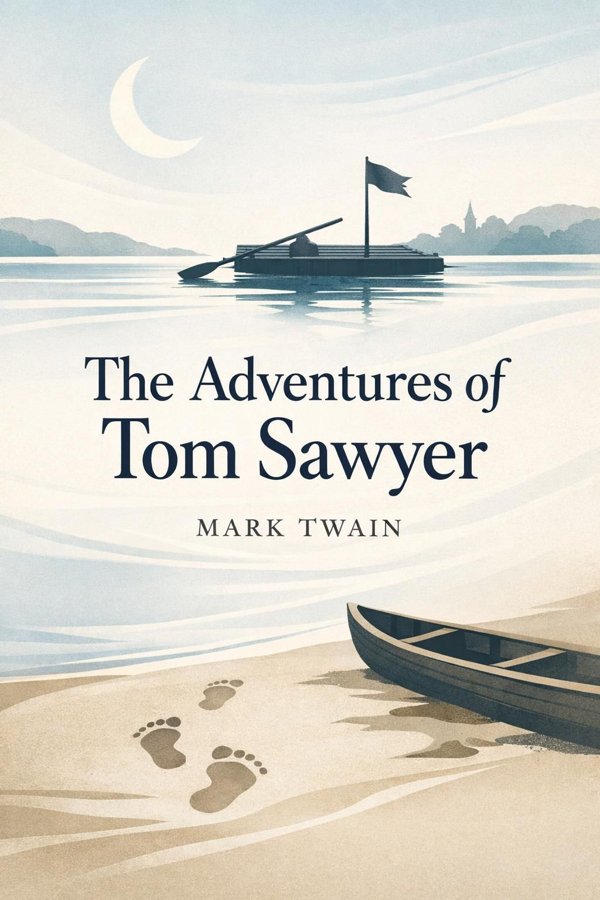
The Adventures of Tom Sawyer: Summary & Key Insights
by Mark Twain
 10 min10 chaptersAudio available
Key Takeaways from The Adventures of Tom Sawyer
Childhood often begins as a conflict between energy and structure, and Tom Sawyer lives inside that conflict from the first pages.
Friendship becomes powerful when it gives shape to desires we cannot yet name, and Huck Finn does exactly that for Tom.
Nothing seems less exciting than painting a fence, yet Twain turns that chore into one of literature’s greatest lessons in human psychology.
Early love is often less about knowing another person than about discovering a new version of oneself, and Tom’s romance with Becky Thatcher captures that perfectly.
A child’s world changes forever the first time adventure collides with real evil.
What Is The Adventures of Tom Sawyer About?
The Adventures of Tom Sawyer by Mark Twain is a classics book spanning 10 pages. First published in 1876, The Adventures of Tom Sawyer is one of the defining novels of American literature. Set in the fictional river town of St. Petersburg, Missouri, it follows the restless, imaginative Tom Sawyer as he navigates school, church, friendship, first love, fear, guilt, and adventure. On the surface, it is a lively story of pranks, treasure hunts, and boyhood escapades. Beneath that surface, however, Mark Twain captures something universal: the tension between freedom and responsibility, the way children test the rules of the adult world, and the slow, uneasy birth of conscience. What makes the novel endure is Twain’s rare ability to combine humor with moral depth. He writes with affection for childhood, but without sentimentality. Tom can be selfish, vain, brave, generous, manipulative, and deeply human—often all in the same chapter. Twain, drawing on his own upbringing along the Mississippi River, gives the story authenticity, sharp social observation, and a voice that feels vividly alive. The result is not just a charming adventure tale, but a portrait of youth that still feels fresh, funny, and true.
This FizzRead summary covers all 10 key chapters of The Adventures of Tom Sawyer in approximately 10 minutes, distilling the most important ideas, arguments, and takeaways from Mark Twain's work. Also available as an audio summary and Key Quotes Podcast.
The Adventures of Tom Sawyer
First published in 1876, The Adventures of Tom Sawyer is one of the defining novels of American literature. Set in the fictional river town of St. Petersburg, Missouri, it follows the restless, imaginative Tom Sawyer as he navigates school, church, friendship, first love, fear, guilt, and adventure. On the surface, it is a lively story of pranks, treasure hunts, and boyhood escapades. Beneath that surface, however, Mark Twain captures something universal: the tension between freedom and responsibility, the way children test the rules of the adult world, and the slow, uneasy birth of conscience.
What makes the novel endure is Twain’s rare ability to combine humor with moral depth. He writes with affection for childhood, but without sentimentality. Tom can be selfish, vain, brave, generous, manipulative, and deeply human—often all in the same chapter. Twain, drawing on his own upbringing along the Mississippi River, gives the story authenticity, sharp social observation, and a voice that feels vividly alive. The result is not just a charming adventure tale, but a portrait of youth that still feels fresh, funny, and true.
Who Should Read The Adventures of Tom Sawyer?
This book is perfect for anyone interested in classics and looking to gain actionable insights in a short read. Whether you're a student, professional, or lifelong learner, the key ideas from The Adventures of Tom Sawyer by Mark Twain will help you think differently.
- ✓Readers who enjoy classics and want practical takeaways
- ✓Professionals looking to apply new ideas to their work and life
- ✓Anyone who wants the core insights of The Adventures of Tom Sawyer in just 10 minutes
Want the full summary?
Get instant access to this book summary and 100K+ more with Fizz Moment.
Get Free SummaryAvailable on App Store • Free to download
Key Chapters
Childhood often begins as a conflict between energy and structure, and Tom Sawyer lives inside that conflict from the first pages. In Aunt Polly’s home, he faces chores, school, Bible lessons, and the expectations of respectable society. Yet Tom instinctively resists every attempt to make life orderly. He slips away from responsibilities, invents excuses, and turns discipline into a game. Aunt Polly, meanwhile, is far more than a scolding guardian. She represents the adult world’s mixture of duty, love, frustration, and forgiveness. She wants Tom to become decent, but she also understands, however imperfectly, that his wildness is part of who he is.
Twain uses their relationship to show that moral formation rarely happens through simple obedience. Tom does not grow because rules are imposed on him; he grows through testing limits and discovering consequences. That pattern remains recognizable in modern life. Children, students, and even adults often resist what feels forced upon them, not always because they reject the value behind it, but because they want ownership over their choices. A child who avoids homework, an employee who drags through a task, or a teenager who challenges a household rule may all be expressing the same desire for autonomy.
The genius of Twain’s portrayal is that he neither idealizes rebellion nor condemns it outright. Tom’s mischief is entertaining, but it also exposes the need for guidance. Aunt Polly’s discipline is necessary, but it works best when softened by compassion. Their dynamic suggests that growth happens when authority is firm enough to create boundaries and humane enough to allow for imperfection.
Actionable takeaway: When dealing with resistance—your own or someone else’s—look beneath the behavior and ask what need for freedom, dignity, or recognition is driving it.
Friendship becomes powerful when it gives shape to desires we cannot yet name, and Huck Finn does exactly that for Tom. Huck is everything respectable society distrusts: unwashed, unschooled, loosely supervised, and the son of the town drunkard. To adults, he is a warning. To Tom, he is a vision of liberty. Huck can sleep where he wants, roam when he pleases, and avoid the rituals of school, church, and social performance. In him, Tom sees not merely a companion for adventure but an alternative way of life.
Twain makes this friendship central because it reveals a lasting truth: people are often drawn to those who embody what they themselves are denied. Tom, constrained by household expectations, admires Huck’s independence. Huck, excluded by respectable society, benefits from Tom’s imagination, loyalty, and social confidence. Their bond crosses class and respectability, suggesting that genuine friendship often ignores the boundaries communities try to enforce.
This idea has practical force beyond the novel. Many meaningful relationships form between people with contrasting strengths, backgrounds, or statuses. The disciplined student may learn spontaneity from a creative friend. A risk-taker may learn steadiness from someone more grounded. In workplaces, communities, and families, mutual respect across difference can create growth that sameness cannot.
At the same time, Twain does not present freedom as simple ease. Huck’s liberty comes with insecurity, exposure, and social neglect. The novel therefore asks a subtle question: what kind of freedom is worth wanting? The best freedom is not mere escape from rules, but room to live honestly without losing human connection.
Actionable takeaway: Value friendships that challenge your assumptions and widen your sense of what a good life can look like.
Nothing seems less exciting than painting a fence, yet Twain turns that chore into one of literature’s greatest lessons in human psychology. Ordered to whitewash Aunt Polly’s fence on a Saturday, Tom initially sees the task as punishment. But when other boys appear, he transforms the situation by pretending the work is a rare privilege. He behaves as if painting the fence requires taste, skill, and luck. Soon the boys beg to participate, and Tom not only avoids the labor but profits from it.
The scene is funny because it is true. People tend to want what appears exclusive, meaningful, or voluntarily chosen. Tom succeeds not by forcing anyone, but by altering perception. The task remains the same; only its social meaning changes. Twain shows how value is often manufactured through framing, scarcity, and status. This insight applies everywhere: marketing campaigns create desire by implying select access; leaders motivate teams by connecting tasks to purpose; even children are more likely to engage when they feel agency rather than coercion.
Yet the episode also carries a moral edge. Tom’s brilliance borders on manipulation. He understands vanity and desire well enough to exploit them. Twain admires the ingenuity while quietly inviting readers to ask whether persuasion serves truth or self-interest. In modern terms, the same skills can be used ethically or cynically. A teacher might make learning inviting; a salesperson might create false urgency; a manager might inspire or manipulate.
What matters is not only whether persuasion works, but what it is working toward. Tom’s fence trick reveals an enduring principle: human motivation is shaped less by raw obligation than by meaning, perception, and the illusion of choice.
Actionable takeaway: When you want engagement—from yourself or others—reframe the task around meaning, ownership, and value rather than mere duty.
Early love is often less about knowing another person than about discovering a new version of oneself, and Tom’s romance with Becky Thatcher captures that perfectly. When Becky arrives, Tom’s imagination ignites. He performs, boasts, sulks, and dreams with all the intensity that childhood can bring to feeling. Their courtship is innocent yet dramatic, full of vows, jealousy, wounded pride, and reconciliation. Twain treats these emotions with humor, but not with contempt. He understands that to children, such feelings are not trivial rehearsals for adult life; they are real experiences of longing, vulnerability, and self-consciousness.
Tom’s attraction to Becky reveals how identity is shaped by being seen. He wants to impress her, to appear brave and special, to become the hero of his own story. In this sense, first love is tied to performance. We often discover our vanity, insecurity, and desire for approval through attachment. Modern readers can recognize the same pattern in school crushes, social media self-presentation, or the urge to become more interesting in someone else’s eyes.
But the Becky episodes also teach emotional responsibility. Tom’s flirtations and Becky’s jealousy show how easily pride can create hurt. Their misunderstandings are small, yet the moral lesson is large: affection requires honesty, not theater alone. The novel suggests that maturing in love means moving from self-display toward care for another person’s feelings.
Twain’s portrayal is memorable because it captures the comedy of young romance while respecting its seriousness. It reminds us that emotional growth often begins in awkwardness, not wisdom.
Actionable takeaway: In relationships, notice where you are performing for approval instead of communicating honestly, and choose sincerity over drama.
A child’s world changes forever the first time adventure collides with real evil. That change occurs when Tom and Huck witness a murder in the graveyard. What begins as a nighttime thrill—a secret excursion to test superstitions—turns into terror when Injun Joe kills Dr. Robinson and frames Muff Potter. In that instant, the novel shifts from playful mischief to moral danger. Tom is no longer merely a boy dodging chores; he is a witness carrying truth that could save an innocent man and endanger himself.
Twain uses this episode to show how conscience is born under pressure. Tom knows what happened, but fear seals his silence. He and Huck swear secrecy, and the burden of that oath begins to torment him. This is psychologically acute. People often imagine morality as clarity followed by action, yet in reality moral choice is entangled with fear, loyalty, self-protection, and uncertainty. Children and adults alike may remain silent in the face of wrongdoing because the cost of speaking feels too high.
The graveyard scene also exposes the fragility of justice in a community shaped by rumor and appearances. Muff Potter is weak, disreputable, and easy to accuse. Injun Joe is dangerous and manipulative. Twain suggests that truth does not automatically prevail; it depends on someone’s courage.
In practical life, this insight matters in schools, workplaces, and communities. Bullying, fraud, abuse, and misconduct often continue because bystanders are afraid. Moral growth requires more than good feelings; it requires the willingness to face risk for the sake of truth.
Actionable takeaway: When you witness wrongdoing, do not assume someone else will act—prepare yourself to tell the truth through the safest responsible channel available.
Whenever ordinary life feels confining, the fantasy of disappearing becomes strangely attractive. Tom, Huck, and Joe Harper act on that fantasy when they run away to Jackson’s Island, imagining themselves as pirates free from rules, chores, and adult oversight. At first, the island delivers exactly what they crave: open air, campfires, swimming, storytelling, and the intoxicating sense that they belong only to themselves. Twain captures the deep appeal of escape, especially for the young. Freedom here feels physical, immediate, and complete.
Yet the island episodes quickly reveal the limits of fantasy. The boys enjoy liberty, but they also begin to feel loneliness, guilt, and homesickness. They discover that being absent has consequences. While they are playing at death and independence, the town believes them drowned. Their adventure, once exhilarating, acquires emotional weight. Twain’s point is subtle but profound: escape can expose what everyday life was quietly giving us all along—belonging, care, and identity.
This remains relevant in modern forms. People dream of quitting jobs without a plan, abandoning obligations, or disconnecting entirely from family and community. Sometimes distance is necessary, but the desire to flee can hide a deeper question: are we seeking true renewal, or merely relief from discomfort? The boys learn that freedom without relationship can become emptiness.
The island therefore stands as both wish fulfillment and correction. It honors the need for space, adventure, and independence while showing that a meaningful life cannot be built on escape alone. Real maturity involves balancing self-direction with ties to others.
Actionable takeaway: Before making an escape decision, ask whether you need permanent withdrawal or simply a healthier way to restore freedom within your existing life.
Sometimes people understand their value only when they imagine life without themselves, and Tom’s dramatic return at his own funeral captures that insight with unforgettable force. After the town presumes the boys dead, grief spreads through families and community. Tom secretly observes the sorrow before choosing the perfect theatrical moment to reappear in church alongside Huck and Joe. The scene satisfies his vanity, certainly, but it also reveals something deeper. Tom learns that he is loved not merely as a source of trouble, but as a presence whose absence wounds others.
Twain handles this with both irony and tenderness. Tom’s instinct is performative—he stages his return for maximum effect—but beneath the performance lies a genuine awakening. For all his rebellion, he does not truly want to be forgotten. He wants freedom and admiration, but he also wants attachment. This is one of the novel’s central psychological truths: even the most independence-loving spirit still longs to matter to others.
In contemporary life, this dynamic appears whenever people seek attention through withdrawal, silence, or dramatic gestures. A teenager may test whether anyone notices. An employee may disengage to see if they are valued. A friend may retreat hoping to be pursued. While such behavior can be immature, it often points to a legitimate human need for recognition and belonging.
Tom’s experience suggests that healthy belonging becomes possible when recognition is sought more directly and less theatrically. To know that we matter, we do not need to vanish and return; we need relationships in which care is expressed openly. The funeral scene is comic, but its emotional core is serious.
Actionable takeaway: Do not wait for absence to prove your importance—build relationships where appreciation and affection are spoken while people are present.
Courage is most meaningful when it costs something, and Tom proves his growth when he testifies on behalf of Muff Potter. For much of the novel, Tom carries the terrible knowledge of the graveyard murder in silence. That silence is understandable; Injun Joe is dangerous, and fear is not imaginary. But as Muff Potter’s trial advances, Tom can no longer evade the moral weight of his knowledge. He finally speaks, exposing the truth and interrupting an injustice that the whole town was prepared to accept.
This moment matters because it transforms Tom from a clever actor into a moral agent. Earlier, he used imagination to avoid work, impress Becky, and orchestrate adventures. Here, imagination gives way to conscience. He does not act because he is fearless; he acts despite fear. Twain therefore offers a mature view of bravery. Real courage is not the absence of dread but the decision that another person’s need matters more than one’s own comfort.
The scene has broad practical relevance. Whistleblowers, witnesses, students reporting harassment, and employees confronting unethical practices all face versions of Tom’s dilemma. Speaking up can bring retaliation, social isolation, or danger. Yet silence often allows harm to harden into normality. Twain reminds us that justice depends on ordinary individuals who decide not to look away.
Tom’s testimony does not solve everything. Injun Joe escapes, and the threat remains. This too is realistic. Doing the right thing does not guarantee immediate safety or closure. But it does mark a turning point in character. Tom becomes larger than his own appetite for adventure.
Actionable takeaway: Define in advance what values you will not betray, so that when fear arrives, your conscience already has a clear direction.
Growing up often means entering the dark without certainty that a way out exists, and McDougal’s Cave gives that experience physical form. What begins as a picnic and excursion turns perilous when Tom and Becky become lost underground. In the cave, the world of play suddenly becomes a test of endurance, leadership, and emotional steadiness. The darkness, maze-like passages, fading hope, and isolation force Tom to become something he has only pretended to be before: truly responsible.
Twain uses the cave as more than an adventure setting. It is a symbolic landscape of confusion and maturation. In ordinary life, adults often navigate by clear routines and familiar expectations. In crisis, those supports disappear. Tom can no longer rely on charm or theatricality. Becky depends on him, and he must manage fear, preserve hope, ration resources, and search intelligently for escape. His courage here is practical rather than performative.
The cave also deepens the novel’s treatment of love and responsibility. Tom’s care for Becky is no longer about showing off. It becomes patient, protective, and sacrificial. This marks one of his clearest steps toward maturity. In modern terms, many people discover their real character not in success but in moments of stress: illness in the family, financial uncertainty, professional crisis, or emotional hardship. Under pressure, pretense thins out.
When Tom finally finds a way out, the escape feels earned because he has changed within the ordeal. The cave teaches that fear can shrink us, but it can also organize us around what matters most. Adversity does not automatically improve character, yet it can reveal and refine it.
Actionable takeaway: In difficult situations, focus first on the next wise step—calm, care, and problem-solving often matter more than dramatic confidence.
Adventure stories often end with treasure, but Twain uses treasure to ask what remains after innocence has been tested. The discovery of gold and the death of Injun Joe bring outward closure to the novel’s dangers. The villain who haunted the story is gone, the hidden wealth is found, and Tom and Huck stand on the edge of transformed social status. Yet the deeper resolution is not financial. The boys have passed through fear, guilt, fantasy, and moral trial. They are not adults, but they are no longer untouched by the world.
Injun Joe’s role in this ending is especially important. He represents menace, revenge, and the hidden violence beneath the town’s ordinary life. His death seals one chapter of terror, but Twain avoids easy triumph. The novel does not suggest that evil has been fully explained or defeated forever. Rather, it shows that childhood eventually encounters realities that cannot be turned into games.
The treasure, by contrast, symbolizes possibility. For Tom, it confirms the adventurous narratives he longs to inhabit. For Huck, it threatens to pull him toward respectability and the social order he distrusts. Their different responses highlight one of the novel’s most interesting tensions: success often brings new forms of constraint. What the world calls improvement may feel like confinement to someone who values independence.
This final movement gives the novel its bittersweet quality. The story ends in excitement, but also in transition. Childhood has not vanished, yet it has been altered by experience. That is why the book continues to resonate: it understands that growing up means carrying wonder forward without remaining naive.
Actionable takeaway: As you gain success or security, ask not only what you have acquired, but what kind of person your new circumstances are shaping you to become.
All Chapters in The Adventures of Tom Sawyer
About the Author
Mark Twain, born Samuel Langhorne Clemens in 1835, was an American novelist, humorist, essayist, and lecturer widely regarded as one of the central voices in American literature. Raised in Missouri along the Mississippi River, he drew deeply from the landscapes, dialects, and social life of the American South and West. Before becoming a full-time writer, he worked as a printer, riverboat pilot, and journalist—experiences that enriched his storytelling with realism and wit. Twain became famous for works such as The Adventures of Tom Sawyer, Adventures of Huckleberry Finn, and The Prince and the Pauper. His writing combines humor, sharp social criticism, and memorable vernacular speech. He died in 1910, but his influence on literature and culture remains profound.
Get This Summary in Your Preferred Format
Read or listen to the The Adventures of Tom Sawyer summary by Mark Twain anytime, anywhere. FizzRead offers multiple formats so you can learn on your terms — all free.
Available formats: App · Audio · PDF · EPUB — All included free with FizzRead
Download The Adventures of Tom Sawyer PDF and EPUB Summary
Key Quotes from The Adventures of Tom Sawyer
“Childhood often begins as a conflict between energy and structure, and Tom Sawyer lives inside that conflict from the first pages.”
“Friendship becomes powerful when it gives shape to desires we cannot yet name, and Huck Finn does exactly that for Tom.”
“Nothing seems less exciting than painting a fence, yet Twain turns that chore into one of literature’s greatest lessons in human psychology.”
“Early love is often less about knowing another person than about discovering a new version of oneself, and Tom’s romance with Becky Thatcher captures that perfectly.”
“A child’s world changes forever the first time adventure collides with real evil.”
Frequently Asked Questions about The Adventures of Tom Sawyer
The Adventures of Tom Sawyer by Mark Twain is a classics book that explores key ideas across 10 chapters. First published in 1876, The Adventures of Tom Sawyer is one of the defining novels of American literature. Set in the fictional river town of St. Petersburg, Missouri, it follows the restless, imaginative Tom Sawyer as he navigates school, church, friendship, first love, fear, guilt, and adventure. On the surface, it is a lively story of pranks, treasure hunts, and boyhood escapades. Beneath that surface, however, Mark Twain captures something universal: the tension between freedom and responsibility, the way children test the rules of the adult world, and the slow, uneasy birth of conscience. What makes the novel endure is Twain’s rare ability to combine humor with moral depth. He writes with affection for childhood, but without sentimentality. Tom can be selfish, vain, brave, generous, manipulative, and deeply human—often all in the same chapter. Twain, drawing on his own upbringing along the Mississippi River, gives the story authenticity, sharp social observation, and a voice that feels vividly alive. The result is not just a charming adventure tale, but a portrait of youth that still feels fresh, funny, and true.
More by Mark Twain


You Might Also Like






Browse by Category
Ready to read The Adventures of Tom Sawyer?
Get the full summary and 100K+ more books with Fizz Moment.