
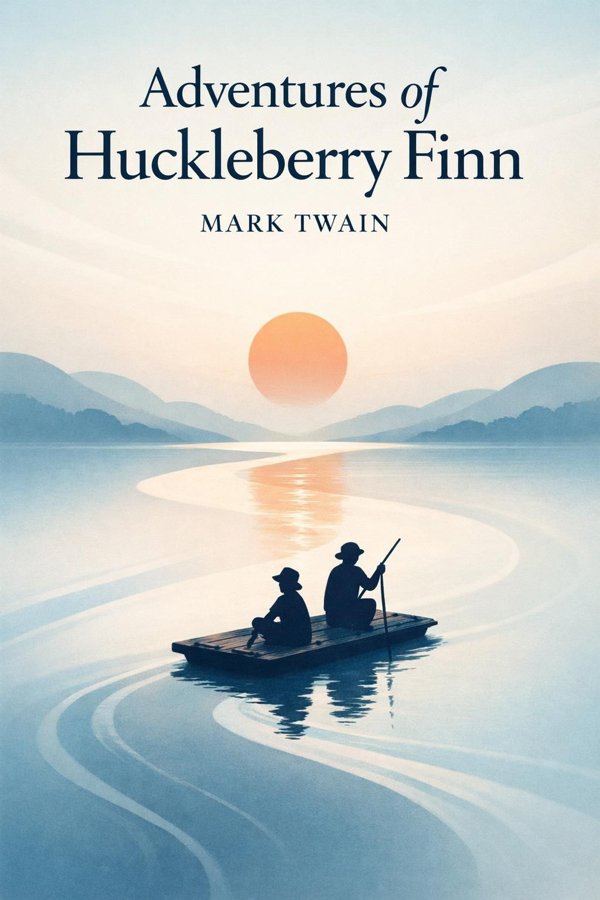
Adventures of Huckleberry Finn: Summary & Key Insights
by Mark Twain
 10 min9 chaptersAudio available
Key Takeaways from Adventures of Huckleberry Finn
One of the novel’s first great questions is this: what if so-called civilization is not always civilizing?
Freedom often begins in loneliness, but it becomes meaningful through relationship.
Sometimes a setting is not just a backdrop but the central symbol of a story’s moral world.
A society can train people to feel guilty for doing what is right.
The people who speak most confidently about virtue are not always the most virtuous.
What Is Adventures of Huckleberry Finn About?
Adventures of Huckleberry Finn by Mark Twain is a classics book spanning 4 pages. Adventures of Huckleberry Finn is far more than a boyhood adventure story. Published in 1884, Mark Twain’s novel follows young Huck Finn as he flees his violent father and drifts down the Mississippi River with Jim, an enslaved man escaping bondage. On the surface, it is a tale of rafts, small towns, scams, feuds, and narrow escapes. Beneath that lively plot, however, lies one of the sharpest moral critiques in American literature. Through Huck’s plainspoken voice, Twain examines freedom, race, conscience, friendship, and the gap between what society teaches and what is actually right. Huck has been shaped by a world full of religious talk, social rules, and legal injustices, yet his lived experience with Jim forces him to question everything he has been taught. That tension gives the novel its enduring power. Twain wrote with rare authority about the Mississippi River and the culture of the American South, combining humor, satire, and realism in a way that transformed fiction. The result is a classic that remains deeply relevant wherever people must choose between public approval and private morality.
This FizzRead summary covers all 9 key chapters of Adventures of Huckleberry Finn in approximately 10 minutes, distilling the most important ideas, arguments, and takeaways from Mark Twain's work. Also available as an audio summary and Key Quotes Podcast.
Adventures of Huckleberry Finn
Adventures of Huckleberry Finn is far more than a boyhood adventure story. Published in 1884, Mark Twain’s novel follows young Huck Finn as he flees his violent father and drifts down the Mississippi River with Jim, an enslaved man escaping bondage. On the surface, it is a tale of rafts, small towns, scams, feuds, and narrow escapes. Beneath that lively plot, however, lies one of the sharpest moral critiques in American literature. Through Huck’s plainspoken voice, Twain examines freedom, race, conscience, friendship, and the gap between what society teaches and what is actually right. Huck has been shaped by a world full of religious talk, social rules, and legal injustices, yet his lived experience with Jim forces him to question everything he has been taught. That tension gives the novel its enduring power. Twain wrote with rare authority about the Mississippi River and the culture of the American South, combining humor, satire, and realism in a way that transformed fiction. The result is a classic that remains deeply relevant wherever people must choose between public approval and private morality.
Who Should Read Adventures of Huckleberry Finn?
This book is perfect for anyone interested in classics and looking to gain actionable insights in a short read. Whether you're a student, professional, or lifelong learner, the key ideas from Adventures of Huckleberry Finn by Mark Twain will help you think differently.
- ✓Readers who enjoy classics and want practical takeaways
- ✓Professionals looking to apply new ideas to their work and life
- ✓Anyone who wants the core insights of Adventures of Huckleberry Finn in just 10 minutes
Want the full summary?
Get instant access to this book summary and 100K+ more with Fizz Moment.
Get Free SummaryAvailable on App Store • Free to download
Key Chapters
One of the novel’s first great questions is this: what if so-called civilization is not always civilizing? At the beginning of Adventures of Huckleberry Finn, Huck is taken in by the Widow Douglas and Miss Watson, who want to make him respectable. They dress him properly, educate him, and try to teach him religion and manners. Yet Huck experiences these efforts less as kindness than as confinement. He feels trapped by stiff clothing, rigid schedules, and a moral code that seems disconnected from real life. Twain immediately sets up a tension between the demands of society and Huck’s instinctive love of freedom.
That tension becomes darker with the return of Pap, Huck’s drunken and abusive father. Pap is uncivilized in the most obvious way: violent, racist, lazy, and cruel. But Twain’s point is not that society is good and Pap is bad. Rather, he shows that both can be oppressive in different forms. The Widow tries to shape Huck into a proper boy without understanding him; Pap claims paternal authority while treating Huck as property. Huck is squeezed between respectability and brutality, and neither offers real freedom.
This opening matters because it frames Huck’s escape as more than a physical act. He is not simply running away from Pap; he is fleeing every structure that tries to own him. In modern terms, the novel asks us to examine institutions that claim to improve people while denying their humanity or agency. Schools, families, workplaces, and communities can all confuse obedience with virtue.
A practical way to apply this idea is to question whether a rule actually serves human well-being or merely enforces conformity. When you feel pressure to behave a certain way, ask: Is this helping me grow, or just making me easier to control? Actionable takeaway: distinguish between guidance that nurtures your character and authority that merely demands submission.
Freedom often begins in loneliness, but it becomes meaningful through relationship. When Huck escapes to Jackson’s Island, he first enjoys the relief of being away from both Pap and polite society. The island offers silence, nature, and the thrilling sense that no one can command him. Yet Huck’s solitude soon changes when he discovers Jim there. Jim has run away after learning that Miss Watson may sell him farther down the river, separating him from everything he knows. This meeting transforms the novel from a survival tale into a moral journey.
At first, Huck sees Jim through the assumptions of his time. He has been taught to think of an enslaved man as property, not as an equal companion. But the island begins to undo those ideas. Huck and Jim share food, stories, danger, and practical tasks. They depend on each other. In that shared life, Jim ceases to be an abstract category and becomes a person with fears, hopes, humor, dignity, and intelligence. Twain uses this change not through speeches but through experience. Huck learns not because someone lectures him, but because he lives alongside Jim.
This is one of the book’s most powerful lessons: prejudice often survives at a distance and weakens in genuine contact. It is easier to accept cruel systems when the people harmed by them remain invisible. The moment we know someone personally, inherited stereotypes begin to break apart.
In everyday life, this applies to all kinds of divisions—race, class, nationality, religion, age, or profession. Real understanding grows when we move beyond labels and enter shared human situations. Listen longer. Work alongside people unlike yourself. Let experience challenge secondhand beliefs.
Actionable takeaway: if you want to overcome a stereotype, replace assumption with relationship—spend real time with the person behind the category.
Sometimes a setting is not just a backdrop but the central symbol of a story’s moral world. In Adventures of Huckleberry Finn, the Mississippi River represents movement, possibility, and temporary liberation. On land, Huck and Jim encounter rules, violence, fraud, feuds, slavery, and the endless performance of social respectability. On the raft, they experience rare moments of peace. The river becomes a floating space outside ordinary hierarchy, where a poor white boy and an enslaved Black man can speak more honestly than they can anywhere else.
Twain repeatedly contrasts the calm rhythm of the river with the chaos of shore life. The raft is simple, but it allows mutual dependence and quiet reflection. Land promises order but delivers corruption. This contrast does not mean the river is perfectly safe; storms, fog, and separation constantly threaten Huck and Jim. But even those dangers feel natural, while the dangers on shore are often created by human greed and cruelty.
The river also symbolizes moral transition. Huck is literally traveling through space, but he is also drifting away from the values he has inherited. Each mile carries him further from fixed beliefs and closer to his own independent conscience. That is why the river remains one of the most memorable images in American literature: it captures the feeling of becoming someone new before the world can force you back into an old role.
In modern life, most people do not have a river raft, but they still need reflective spaces where social pressure loosens its grip. This might be a walk, a commute without distractions, time in nature, journaling, or any environment where performance gives way to thought.
Actionable takeaway: create your own “river” regularly—a space apart from noise and expectation where you can hear what you truly think and value.
A society can train people to feel guilty for doing what is right. That paradox lies at the heart of Huck’s inner conflict. Throughout the novel, Huck believes that helping Jim escape is morally wrong because the society around him has taught him that enslaved people are property and that returning Jim would be the honest, lawful act. Huck is not naturally cruel; he is morally confused by the world that raised him. Twain’s brilliance lies in showing that conscience is not always a pure inner voice. Sometimes conscience simply repeats social conditioning.
This becomes clear when Huck struggles over whether to turn Jim in. He feels affection and loyalty toward Jim, yet he also feels shame for helping him. That emotional conflict reveals how deeply unjust systems embed themselves in ordinary thought. Huck is forced to choose between the rules he has inherited and the human reality he has witnessed. His experience with Jim gradually teaches him that kindness, loyalty, and shared suffering matter more than legal or religious approval.
This idea remains strikingly relevant. People often assume that if a norm is widespread, it must be moral. But history shows the opposite: entire societies have accepted injustice while calling it order. Conscience must therefore be examined, not merely obeyed. We should ask where our moral reflexes come from and whom they serve.
In practical terms, think about moments when workplace culture, family expectation, or peer pressure encourages silence about something unfair. You may feel disloyal for challenging it, even when you know someone is being harmed. That discomfort does not prove you are wrong; it may prove that the surrounding culture is.
Actionable takeaway: when guilt and compassion conflict, pause and investigate whether your guilt comes from true ethics or from inherited social pressure.
The people who speak most confidently about virtue are not always the most virtuous. Twain fills Adventures of Huckleberry Finn with communities that prize manners, religion, and social status while tolerating profound cruelty and foolishness. This is where the novel’s satire becomes especially sharp. Huck repeatedly encounters adults who consider themselves civilized, yet their behavior exposes vanity, superstition, greed, dishonesty, and moral blindness.
The Grangerford-Shepherdson feud is a perfect example. Both families are well-dressed, churchgoing, and proud of their breeding, but they carry on a senseless cycle of violence that no one can even fully explain. The contrast is devastating: people sit in church listening to sermons on brotherly love while keeping their rifles close at hand. Twain suggests that social polish can coexist with brutality, and that public respectability often hides private absurdity.
The Duke and the King deepen this critique. Their scams succeed not only because they are clever, but because people want to be fooled. Vanity, gullibility, and social insecurity make communities vulnerable to deception. Twain laughs at this weakness, but his humor has a serious edge. He is showing how easily performance can replace truth.
This satire applies well beyond the nineteenth century. Modern societies also reward image, rhetoric, and symbolic gestures while avoiding difficult moral reckonings. Institutions can celebrate values they do not practice. Individuals can speak the language of justice, family, or faith while acting from self-interest.
A useful habit is to judge people and systems less by what they claim and more by what they consistently do. Ask whether stated principles appear in actual treatment of the vulnerable.
Actionable takeaway: whenever an individual or institution presents itself as righteous, look past appearances and evaluate the gap between its ideals and its conduct.
Much of the novel’s comedy comes from deception, but the laughter often leaves a bitter aftertaste. The Duke and the King, two con men Huck and Jim encounter on the river, are theatrical frauds who survive by improvising identities and exploiting the weaknesses of others. They pretend to be nobility, revival preachers, actors, and heirs. Their schemes are ridiculous, yet they keep working because people are eager to believe convenient stories.
Twain uses these episodes to show that fraud is not limited to criminals. Everyday society is full of performance. Respectable citizens posture as honorable, religious, educated, or compassionate while ignoring injustice around them. The con men are exaggerated versions of a broader cultural habit: saying whatever secures advantage. In this sense, the Duke and the King are not just comic villains; they are mirrors held up to the communities they trick.
Huck’s response to them is important. He is not morally pure, but he increasingly recognizes the harm of manipulation. His disgust with their cruelty, especially in the Wilks episode, marks another step in his development. He begins to act not just for self-preservation but to protect others from exploitation.
The lesson is highly practical. Modern life also rewards strategic self-presentation. People curate personas online, in business, and in public life. That does not make all self-presentation dishonest, but it does mean we must learn to recognize when performance becomes manipulation.
A good test is to ask who benefits from a given narrative and who is being pressured not to question it. Whether in media, marketing, politics, or personal relationships, deception often succeeds by appealing to vanity, urgency, or trust.
Actionable takeaway: train yourself to pause before accepting a dramatic claim or polished persona—ask for evidence, watch for consistency, and notice who profits from your belief.
Real moral growth often arrives in a moment when a person chooses relationship over ideology. Huck’s most famous breakthrough comes when he decides not to betray Jim, even though he believes this decision may condemn him spiritually. After wrestling with whether to send a letter revealing Jim’s whereabouts, Huck remembers Jim’s loyalty and companionship. He then tears up the letter and declares, in essence, that he will accept damnation rather than abandon his friend. It is one of the defining moments in American fiction.
What makes this scene so powerful is that Huck does not suddenly become an enlightened reformer. He still lacks the language to critique slavery in political terms. His transformation is more intimate and therefore more convincing. He chooses based on love, gratitude, and recognition of shared humanity. Twain suggests that moral truth sometimes emerges before intellectual certainty. Huck acts rightly before he can fully explain why.
This matters because many people wait to do the right thing until they feel fully informed, perfectly consistent, or socially supported. But decisive ethical action often begins with something simpler: refusing to harm a person whose humanity has become undeniable to you. Huck’s decision is imperfect, emotional, and morally courageous.
In everyday life, moral breakthroughs may look smaller but follow the same pattern. You speak up for a colleague others are scapegoating. You refuse to laugh at a demeaning joke. You protect someone vulnerable even when your group disapproves. You may still feel conflicted, but action creates clarity.
Actionable takeaway: when you recognize a human being is being wronged, do not wait for perfect certainty or social permission—take the concrete step that protects them.
The final section of the novel is often unsettling because it forces us to confront how easily suffering can be turned into entertainment. At the Phelps farm, Jim is already near freedom, but Tom Sawyer reenters the story and turns Jim’s escape into an elaborate game. Tom invents absurd complications, unnecessary risks, and theatrical gestures because he wants an adventure that matches the romantic stories he admires. Huck, who has grown morally over the course of the journey, largely follows Tom’s lead.
This ending reveals several hard truths. First, imagination without empathy can become cruelty. Tom treats Jim as a prop in his fantasy, forgetting that Jim is a real person whose liberty and safety are at stake. Second, social habits are difficult to outgrow. Huck has changed, but he is still susceptible to Tom’s confidence and the prestige of old patterns. Third, systems of domination often survive because those with power can afford to play games with other people’s lives.
Jim’s dignity in these scenes is especially important. He endures foolishness and danger, yet he also shows moral greatness, particularly in his concern for others. Twain thereby restores depth to the character most at risk of being marginalized by the farce.
Readers continue to debate this ending, and that debate is valuable. It reminds us that even great works can contain tensions and discomforts that demand interpretation. The final chapters challenge us not to confuse excitement with justice.
In practical terms, this applies whenever leaders, experts, or confident personalities complicate simple moral issues to preserve their own sense of importance. If someone’s clever plan increases risk for those already vulnerable, skepticism is warranted.
Actionable takeaway: never let style, charisma, or theatrics distract you from the basic question—does this course of action actually help the person whose freedom or well-being is on the line?
All Chapters in Adventures of Huckleberry Finn
About the Author
Mark Twain, born Samuel Langhorne Clemens in 1835, was one of America’s most influential writers and public speakers. Raised near the Mississippi River in Missouri, he drew heavily on his early experiences of river towns, regional speech, and frontier life. Before becoming famous as an author, he worked as a printer, journalist, and riverboat pilot, occupations that shaped both his realism and humor. Twain gained international recognition for works such as The Adventures of Tom Sawyer, Adventures of Huckleberry Finn, and A Connecticut Yankee in King Arthur’s Court. His writing is celebrated for its wit, vivid storytelling, and sharp criticism of social hypocrisy, racism, and human folly. He died in 1910, but his voice remains central to American literature.
Get This Summary in Your Preferred Format
Read or listen to the Adventures of Huckleberry Finn summary by Mark Twain anytime, anywhere. FizzRead offers multiple formats so you can learn on your terms — all free.
Available formats: App · Audio · PDF · EPUB — All included free with FizzRead
Download Adventures of Huckleberry Finn PDF and EPUB Summary
Key Quotes from Adventures of Huckleberry Finn
“One of the novel’s first great questions is this: what if so-called civilization is not always civilizing?”
“Freedom often begins in loneliness, but it becomes meaningful through relationship.”
“Sometimes a setting is not just a backdrop but the central symbol of a story’s moral world.”
“A society can train people to feel guilty for doing what is right.”
“The people who speak most confidently about virtue are not always the most virtuous.”
Frequently Asked Questions about Adventures of Huckleberry Finn
Adventures of Huckleberry Finn by Mark Twain is a classics book that explores key ideas across 9 chapters. Adventures of Huckleberry Finn is far more than a boyhood adventure story. Published in 1884, Mark Twain’s novel follows young Huck Finn as he flees his violent father and drifts down the Mississippi River with Jim, an enslaved man escaping bondage. On the surface, it is a tale of rafts, small towns, scams, feuds, and narrow escapes. Beneath that lively plot, however, lies one of the sharpest moral critiques in American literature. Through Huck’s plainspoken voice, Twain examines freedom, race, conscience, friendship, and the gap between what society teaches and what is actually right. Huck has been shaped by a world full of religious talk, social rules, and legal injustices, yet his lived experience with Jim forces him to question everything he has been taught. That tension gives the novel its enduring power. Twain wrote with rare authority about the Mississippi River and the culture of the American South, combining humor, satire, and realism in a way that transformed fiction. The result is a classic that remains deeply relevant wherever people must choose between public approval and private morality.
More by Mark Twain
You Might Also Like





Browse by Category
Ready to read Adventures of Huckleberry Finn?
Get the full summary and 100K+ more books with Fizz Moment.