
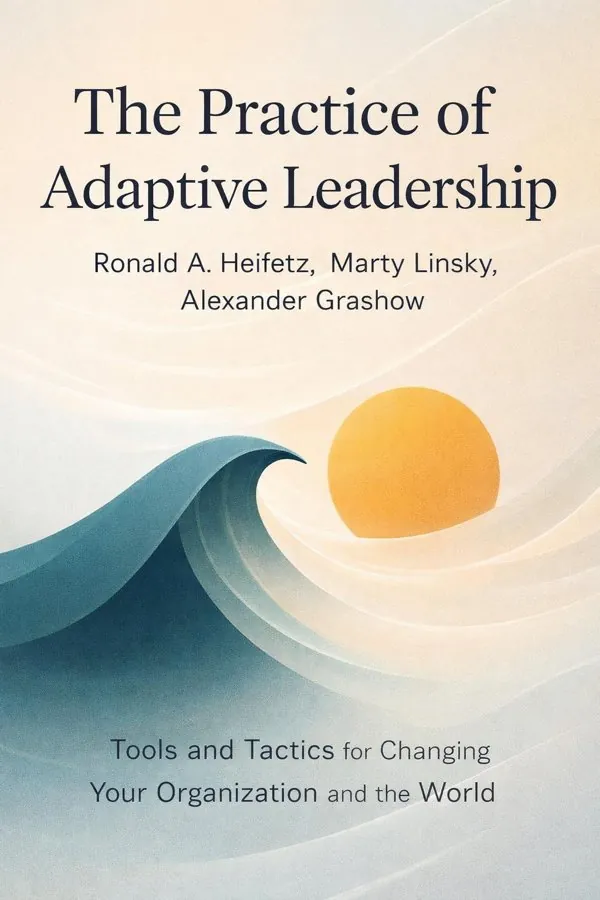
The Practice of Adaptive Leadership: Tools and Tactics for Changing Your Organization and the World: Summary & Key Insights
by Ronald A. Heifetz, Marty Linsky, Alexander Grashow
 10 min6 chaptersAudio available
What Is The Practice of Adaptive Leadership: Tools and Tactics for Changing Your Organization and the World About?
The Practice of Adaptive Leadership: Tools and Tactics for Changing Your Organization and the World by Ronald A. Heifetz, Marty Linsky, Alexander Grashow is a leadership book spanning 6 pages. The Practice of Adaptive Leadership is a practical guide for leaders who seek to navigate complex challenges and drive meaningful change. Building on the foundational ideas of adaptive leadership, the authors provide actionable tools, frameworks, and case studies to help individuals and organizations adapt to shifting environments, mobilize people, and sustain progress in the face of uncertainty.
This FizzRead summary covers all 6 key chapters of The Practice of Adaptive Leadership: Tools and Tactics for Changing Your Organization and the World in approximately 10 minutes, distilling the most important ideas, arguments, and takeaways from Ronald A. Heifetz, Marty Linsky, Alexander Grashow's work. Also available as an audio summary and Key Quotes Podcast.
The Practice of Adaptive Leadership: Tools and Tactics for Changing Your Organization and the World
The Practice of Adaptive Leadership is a practical guide for leaders who seek to navigate complex challenges and drive meaningful change. Building on the foundational ideas of adaptive leadership, the authors provide actionable tools, frameworks, and case studies to help individuals and organizations adapt to shifting environments, mobilize people, and sustain progress in the face of uncertainty.
Who Should Read The Practice of Adaptive Leadership: Tools and Tactics for Changing Your Organization and the World?
This book is perfect for anyone interested in leadership and looking to gain actionable insights in a short read. Whether you're a student, professional, or lifelong learner, the key ideas from The Practice of Adaptive Leadership: Tools and Tactics for Changing Your Organization and the World by Ronald A. Heifetz, Marty Linsky, Alexander Grashow will help you think differently.
- ✓Readers who enjoy leadership and want practical takeaways
- ✓Professionals looking to apply new ideas to their work and life
- ✓Anyone who wants the core insights of The Practice of Adaptive Leadership: Tools and Tactics for Changing Your Organization and the World in just 10 minutes
Want the full summary?
Get instant access to this book summary and 100K+ more with Fizz Moment.
Get Free SummaryAvailable on App Store • Free to download
Key Chapters
One of the most liberating insights for any leader is realizing that not all problems are the same. Some can be solved with knowledge and procedures—what we call technical challenges. Others demand transformation of hearts, minds, and habits—the adaptive kind. The tragedy of most organizational breakdowns is that leaders misdiagnose one for the other. When you treat an adaptive problem as technical, you might deliver temporary relief but no lasting progress.
Imagine you are trying to improve hospital safety. A technical challenge would be installing a new checklist or digital monitoring system; the adaptive challenge, however, involves changing the culture of denial, hierarchy, and fear of blame. Adaptive challenges require shifting the collective mindset. They expose gaps between values and behavior.
As a leader, your role is not to fix these adaptive problems for people but to mobilize them to address reality together. You must make space for them to feel losses associated with change, to learn new competencies, and to renegotiate loyalties. Adaptive leadership asks you to guide people through competing commitments. It’s why this form of leadership is often painful—it demands that people leave behind what has worked before.
Distinguishing clearly between the two types of challenges helps you resist the seduction of authority. When followers cry out for immediate answers, the technical mindset tempts you to comply. But adaptive leadership reminds you that giving quick solutions may rob people of their opportunity to learn, mature, and take responsibility. The heart of the practice lies in recognizing that adaptive challenges are not problems to be solved but processes to be lived.
Before you can intervene meaningfully, you must understand the organization as a living system. Every system has hidden loyalties, sacred values, unmet expectations, and informal rules that govern behavior. These forces often matter more than official charts and policies.
Diagnosing the system means observing how authority is exercised, how decisions are really made, and what people depend on for stability. Ask yourself: who benefits from the status quo? Who feels threatened by change? Which value conflicts remain unspoken? We call this taking a ‘balcony view.’ From there, you can perceive patterns that those on the dance floor—caught in daily pressures—cannot.
But diagnosis also demands empathy. People resist not because they dislike progress; they resist protecting what they love. Understanding that principle keeps your analysis humane. Instead of labeling resistance as obstruction, you begin to see it as self-preservation. Your job is to engage it constructively by connecting adaptation to the values people care most about.
We encourage leaders to identify sources of authority, informal influencers, factions, and unacknowledged losses. Often, hidden alliances and histories shape current tensions. By naming these dynamics aloud, you bring sunlight into organizational shadows, opening space for honest learning and movement. Adaptive leadership is systemic sensemaking—it ensures that any intervention targets the real, underlying challenge rather than its visible symptoms.
+ 4 more chapters — available in the FizzRead app
All Chapters in The Practice of Adaptive Leadership: Tools and Tactics for Changing Your Organization and the World
About the Authors
Ronald A. Heifetz is a co-founder of the Center for Public Leadership at Harvard Kennedy School and a leading authority on adaptive leadership. Marty Linsky is a faculty member at Harvard Kennedy School and co-founder of Cambridge Leadership Associates. Alexander Grashow is a leadership consultant and co-author specializing in organizational transformation.
Get This Summary in Your Preferred Format
Read or listen to the The Practice of Adaptive Leadership: Tools and Tactics for Changing Your Organization and the World summary by Ronald A. Heifetz, Marty Linsky, Alexander Grashow anytime, anywhere. FizzRead offers multiple formats so you can learn on your terms — all free.
Available formats: App · Audio · PDF · EPUB — All included free with FizzRead
Download The Practice of Adaptive Leadership: Tools and Tactics for Changing Your Organization and the World PDF and EPUB Summary
Key Quotes from The Practice of Adaptive Leadership: Tools and Tactics for Changing Your Organization and the World
“One of the most liberating insights for any leader is realizing that not all problems are the same.”
“Before you can intervene meaningfully, you must understand the organization as a living system.”
Frequently Asked Questions about The Practice of Adaptive Leadership: Tools and Tactics for Changing Your Organization and the World
The Practice of Adaptive Leadership: Tools and Tactics for Changing Your Organization and the World by Ronald A. Heifetz, Marty Linsky, Alexander Grashow is a leadership book that explores key ideas across 6 chapters. The Practice of Adaptive Leadership is a practical guide for leaders who seek to navigate complex challenges and drive meaningful change. Building on the foundational ideas of adaptive leadership, the authors provide actionable tools, frameworks, and case studies to help individuals and organizations adapt to shifting environments, mobilize people, and sustain progress in the face of uncertainty.
You Might Also Like

Extreme Ownership
Jocko Willink
10 min
Dare to Lead
Brene Brown
10 min
Leaders Eat Last
Simon Sinek
10 min
The 21 Irrefutable Laws of Leadership
John Maxwell
10 min
Start With Why
Simon Sinek
10 min
How to Lead When You're Not in Charge
Clay Scroggins
10 minBrowse by Category
Ready to read The Practice of Adaptive Leadership: Tools and Tactics for Changing Your Organization and the World?
Get the full summary and 100K+ more books with Fizz Moment.