
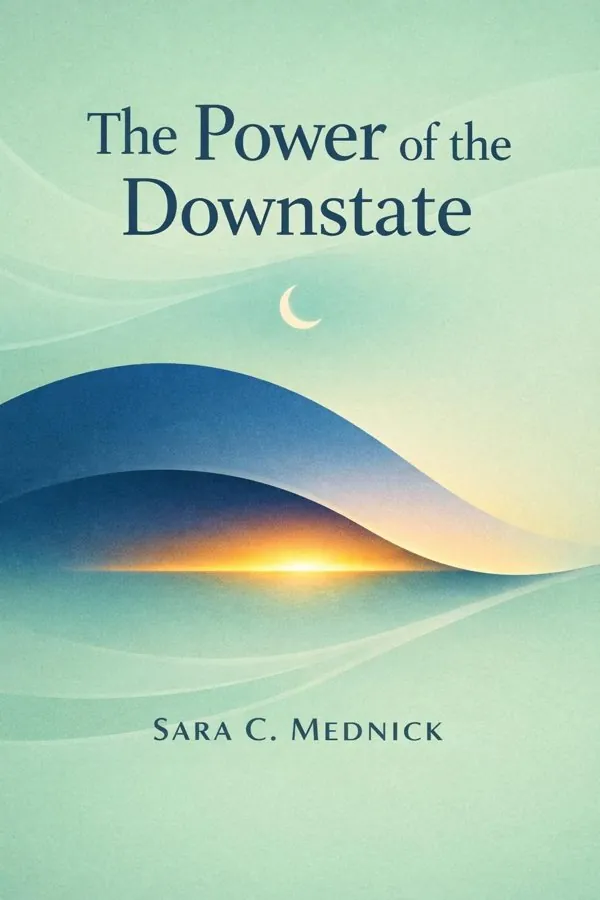
The Power of the Downstate: Recharge Your Life Using Your Body’s Own Restorative Systems: Summary & Key Insights
 10 min4 chaptersAudio available
What Is The Power of the Downstate: Recharge Your Life Using Your Body’s Own Restorative Systems About?
The Power of the Downstate: Recharge Your Life Using Your Body’s Own Restorative Systems by Sara C. Mednick is a neuroscience book spanning 4 pages. In this book, cognitive neuroscientist Sara C. Mednick explores the concept of the 'Downstate'—the body’s natural period of rest and repair that occurs during sleep, relaxation, and other restorative activities. Drawing on neuroscience and circadian biology, Mednick explains how modern lifestyles disrupt these natural rhythms and offers practical strategies to restore balance, improve energy, and enhance overall well-being.
This FizzRead summary covers all 4 key chapters of The Power of the Downstate: Recharge Your Life Using Your Body’s Own Restorative Systems in approximately 10 minutes, distilling the most important ideas, arguments, and takeaways from Sara C. Mednick's work. Also available as an audio summary and Key Quotes Podcast.
The Power of the Downstate: Recharge Your Life Using Your Body’s Own Restorative Systems
In this book, cognitive neuroscientist Sara C. Mednick explores the concept of the 'Downstate'—the body’s natural period of rest and repair that occurs during sleep, relaxation, and other restorative activities. Drawing on neuroscience and circadian biology, Mednick explains how modern lifestyles disrupt these natural rhythms and offers practical strategies to restore balance, improve energy, and enhance overall well-being.
Who Should Read The Power of the Downstate: Recharge Your Life Using Your Body’s Own Restorative Systems?
This book is perfect for anyone interested in neuroscience and looking to gain actionable insights in a short read. Whether you're a student, professional, or lifelong learner, the key ideas from The Power of the Downstate: Recharge Your Life Using Your Body’s Own Restorative Systems by Sara C. Mednick will help you think differently.
- ✓Readers who enjoy neuroscience and want practical takeaways
- ✓Professionals looking to apply new ideas to their work and life
- ✓Anyone who wants the core insights of The Power of the Downstate: Recharge Your Life Using Your Body’s Own Restorative Systems in just 10 minutes
Want the full summary?
Get instant access to this book summary and 100K+ more with Fizz Moment.
Get Free SummaryAvailable on App Store • Free to download
Key Chapters
The Downstate is the biological period where your body repairs itself. It appears most vividly during sleep but also thrives in waking moments of calm, rhythmic breathing, and enjoyment. At its core, the Downstate is governed by the parasympathetic nervous system—the calm counterpart to the fight-or-flight Upstate. During this phase, cortisol levels drop, heart rate decreases, and tissues receive oxygen and nutrients for healing. In this book, I explain that our bodies evolved with rhythmic oscillations—daily waves between spending and saving energy. The Downstate replenishes cellular resources, fine-tunes metabolism, and restores the hormonal balance disrupted by prolonged stress.
Consider how restorative systems work together: sleep consolidates memory and clears metabolic waste from the brain via the glymphatic system; relaxation activates vagal tone, stabilizing emotion and immune function; and circadian synchronization ensures these processes occur when the body expects them. From a neuroscientist’s perspective, each Downstate event is a microcosm of recovery—neurons reestablish homeostasis, organs repair oxidative damage, and emotions reset. When we consistently activate these systems, we cultivate physiological harmony—the key predictor of health and performance.
The tragedy of our time is that most people live in chronic Upstate overstimulation. Blue-light screens, caffeine, and social stress extend wakefulness beyond natural bounds, preventing the body from descending into restorative cycles. Through my research, I have seen that when Downstate deprivation becomes habitual, cognitive sharpness declines and emotional regulation falters. Fatigue becomes normal; anxiety feels inevitable. But they aren’t inevitable—they’re symptoms of imbalance.
Recognizing this rhythm allows you to reshape your life. The Downstate is not about withdrawal but about engagement with renewal. By choosing when to rest, by allowing intervals of stillness and genuine sleep, you synchronize your internal systems. This alignment yields more sustainable energy than any stimulant could provide, and it builds resilience against both physical illness and emotional exhaustion.
Within your brain, rest is a vivid state of activity. During sleep, the hippocampus and neocortex replay patterns from the day, encoding memories and reorganizing knowledge. Meanwhile, glial cells flush waste products and inflammatory molecules that accumulate during wakefulness. These are not passive processes—they are the body’s nightly maintenance work. Yet, what makes the Downstate imperative today is how relentlessly our technologies disrupt these rhythms.
In modern life, artificial light delays melatonin release—the hormone signaling your brain that it’s time to power down. The constant ping of notifications triggers the stress response even during supposed downtime. This leaves the autonomic nervous system locked in a sympathetic, Upstate mode. When that happens, sleep architecture deteriorates—your deep slow-wave sleep shortens, REM stages fragment, and the next day’s mood circuitry fails to recalibrate. You awaken unrefreshed, your cognition dulls, and you chase stimulation to compensate.
In my laboratory studies, participants who follow natural light exposure and wind-down routines show marked differences: their parasympathetic activity resumes dominance sooner, their heart rate variability improves, and their deep sleep restores hormonal balance. This isn’t just theoretical science—it’s lived experience proving that synchronization matters. The circadian rhythm orchestrates not only sleep but also metabolism, immune response, and emotional framing. When we disrupt it through late-night work or irregular meals, we unhinge the central clock that governs every peripheral system in the body.
But there’s hope. Our biology remains adaptable. We can retrain the Downstate by honoring cues our body already understands: darkness for sleep onset, warmth and relaxation for parasympathetic activation, and social connection for hormonal balance. The neuroscience of rest teaches that recovery comes from coherence—when brain regions vibrate in harmonized frequency bands, cognitive renewal follows. We don’t need to retreat from technology entirely; we need to use it consciously, creating boundaries that restore the balance evolution gifted us.
+ 2 more chapters — available in the FizzRead app
All Chapters in The Power of the Downstate: Recharge Your Life Using Your Body’s Own Restorative Systems
About the Author
Sara C. Mednick, Ph.D., is a cognitive neuroscientist and professor of psychology at the University of California, Irvine. Her research focuses on sleep, memory, and the relationship between rest and cognitive performance. She is also the author of 'Take a Nap! Change Your Life.'
Get This Summary in Your Preferred Format
Read or listen to the The Power of the Downstate: Recharge Your Life Using Your Body’s Own Restorative Systems summary by Sara C. Mednick anytime, anywhere. FizzRead offers multiple formats so you can learn on your terms — all free.
Available formats: App · Audio · PDF · EPUB — All included free with FizzRead
Download The Power of the Downstate: Recharge Your Life Using Your Body’s Own Restorative Systems PDF and EPUB Summary
Key Quotes from The Power of the Downstate: Recharge Your Life Using Your Body’s Own Restorative Systems
“The Downstate is the biological period where your body repairs itself.”
“Within your brain, rest is a vivid state of activity.”
Frequently Asked Questions about The Power of the Downstate: Recharge Your Life Using Your Body’s Own Restorative Systems
The Power of the Downstate: Recharge Your Life Using Your Body’s Own Restorative Systems by Sara C. Mednick is a neuroscience book that explores key ideas across 4 chapters. In this book, cognitive neuroscientist Sara C. Mednick explores the concept of the 'Downstate'—the body’s natural period of rest and repair that occurs during sleep, relaxation, and other restorative activities. Drawing on neuroscience and circadian biology, Mednick explains how modern lifestyles disrupt these natural rhythms and offers practical strategies to restore balance, improve energy, and enhance overall well-being.
You Might Also Like
Anxious
Joseph LeDoux
10 min
Hallucinations
Oliver Sacks
10 min
The Biological Mind: How Brain, Body, and Environment Collaborate to Make Us Who We Are
Alan Jasanoff
10 min
The Feeling of Life Itself: Why Consciousness Is Widespread but Can't Be Computed
Christof Koch
10 min
The No-Nonsense Meditation Book
Steven Laureys
10 min
A General Theory of Love
Thomas Lewis, Fari Amini, Richard Lannon
10 minBrowse by Category
Ready to read The Power of the Downstate: Recharge Your Life Using Your Body’s Own Restorative Systems?
Get the full summary and 100K+ more books with Fizz Moment.