
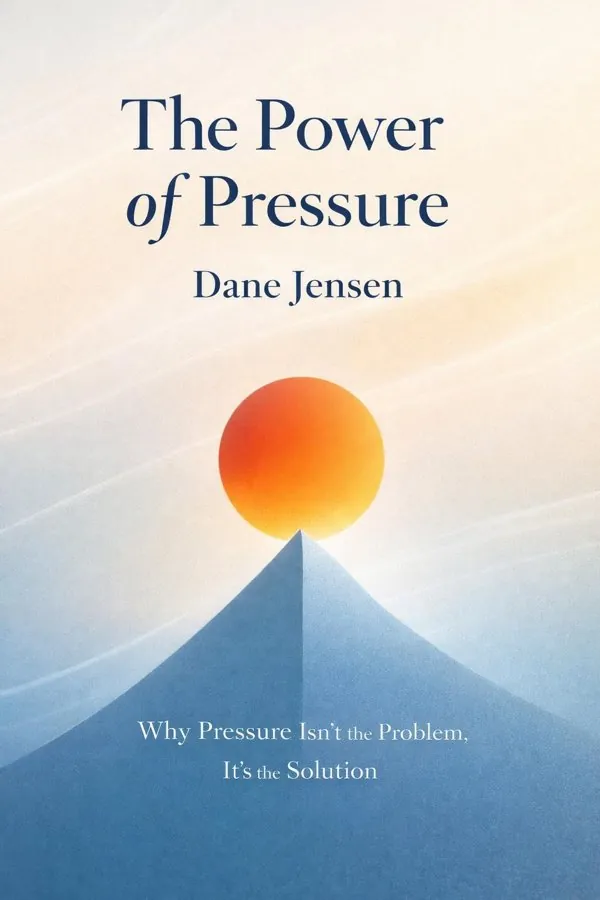
The Power of Pressure: Why Pressure Isn't the Problem, It's the Solution: Summary & Key Insights
by Dane Jensen
 10 min10 chaptersAudio available
Key Takeaways from The Power of Pressure: Why Pressure Isn't the Problem, It's the Solution
One of the book’s most useful insights is that pressure is not just another word for stress.
Pressure rarely comes out of nowhere.
A critical insight in the book is that pressure is universal, but people’s responses to it are highly individual.
Pressure grows when our field of vision narrows too far.
Many people try to beat pressure by becoming mentally tougher in the moment.
What Is The Power of Pressure: Why Pressure Isn't the Problem, It's the Solution About?
The Power of Pressure: Why Pressure Isn't the Problem, It's the Solution by Dane Jensen is a leadership book spanning 10 pages. Pressure is usually treated like a threat to avoid, manage, or survive. In The Power of Pressure, Dane Jensen turns that assumption upside down. His central claim is both surprising and deeply practical: pressure itself is not what ruins performance. More often, pressure is the condition that reveals what matters, sharpens focus, and creates the possibility of excellence. The real challenge is learning how to work with pressure instead of fighting against it. Jensen draws from psychology, leadership coaching, performance science, and years of advising executives, athletes, and high-stakes teams. He shows that pressure is not random. It follows patterns, stems from identifiable sources, and affects people in predictable ways. That means it can be understood, prepared for, and used intentionally. For leaders, professionals, entrepreneurs, and anyone facing important moments, this book offers a more useful framework than generic stress-management advice. Rather than promising a pressure-free life, Jensen teaches readers how to expand their capacity, steady themselves in critical moments, recover more intelligently, and help others perform when stakes are high. It is a book about resilience, but even more, it is a book about rising to occasions that truly matter.
This FizzRead summary covers all 10 key chapters of The Power of Pressure: Why Pressure Isn't the Problem, It's the Solution in approximately 10 minutes, distilling the most important ideas, arguments, and takeaways from Dane Jensen's work. Also available as an audio summary and Key Quotes Podcast.
The Power of Pressure: Why Pressure Isn't the Problem, It's the Solution
Pressure is usually treated like a threat to avoid, manage, or survive. In The Power of Pressure, Dane Jensen turns that assumption upside down. His central claim is both surprising and deeply practical: pressure itself is not what ruins performance. More often, pressure is the condition that reveals what matters, sharpens focus, and creates the possibility of excellence. The real challenge is learning how to work with pressure instead of fighting against it.
Jensen draws from psychology, leadership coaching, performance science, and years of advising executives, athletes, and high-stakes teams. He shows that pressure is not random. It follows patterns, stems from identifiable sources, and affects people in predictable ways. That means it can be understood, prepared for, and used intentionally.
For leaders, professionals, entrepreneurs, and anyone facing important moments, this book offers a more useful framework than generic stress-management advice. Rather than promising a pressure-free life, Jensen teaches readers how to expand their capacity, steady themselves in critical moments, recover more intelligently, and help others perform when stakes are high. It is a book about resilience, but even more, it is a book about rising to occasions that truly matter.
Who Should Read The Power of Pressure: Why Pressure Isn't the Problem, It's the Solution?
This book is perfect for anyone interested in leadership and looking to gain actionable insights in a short read. Whether you're a student, professional, or lifelong learner, the key ideas from The Power of Pressure: Why Pressure Isn't the Problem, It's the Solution by Dane Jensen will help you think differently.
- ✓Readers who enjoy leadership and want practical takeaways
- ✓Professionals looking to apply new ideas to their work and life
- ✓Anyone who wants the core insights of The Power of Pressure: Why Pressure Isn't the Problem, It's the Solution in just 10 minutes
Want the full summary?
Get instant access to this book summary and 100K+ more with Fizz Moment.
Get Free SummaryAvailable on App Store • Free to download
Key Chapters
One of the book’s most useful insights is that pressure is not just another word for stress. Many people blend together stress, anxiety, urgency, and performance nerves, then try to solve them all the same way. Jensen argues that this confusion matters, because if you misdiagnose the experience, you choose the wrong response. Stress is the body’s general response to demand. Anxiety is often anticipation of threat. Pressure, by contrast, is the psychological weight we feel when something important is at stake and our performance seems consequential.
That distinction explains why pressure often appears in moments that are meaningful rather than merely busy. A difficult investor pitch, a crucial board presentation, a championship game, or a high-stakes conversation with a direct report can all create pressure even if they are brief. What makes them intense is not just workload, but importance. Pressure is tied to consequence.
This reframing is powerful because it removes some of the shame people feel when pressure rises. Feeling pressure does not mean you are weak or unprepared. It often means you care, the stakes are real, and your actions matter. In fact, many peak moments in life come wrapped in pressure.
A practical application is to stop saying, “I’m stressed,” and ask instead, “What kind of pressure am I under right now?” That question leads to better action. Are the stakes high? Is the outcome uncertain? Is the volume overwhelming? Naming the true source helps you respond with precision rather than panic.
Actionable takeaway: The next time you feel overwhelmed before an important moment, define whether you are facing stress, anxiety, or pressure. Clear language creates clearer choices.
Pressure rarely comes out of nowhere. Jensen explains that most high-pressure experiences are built from three ingredients: significance, uncertainty, and volume. Significance is how much the outcome matters to you. Uncertainty is how little control or predictability you feel. Volume is the sheer amount coming at you at once. When these three forces combine, pressure spikes.
This framework helps explain why two people can face the same event and experience it differently. A routine presentation may create little pressure for a veteran executive but enormous pressure for a new manager whose credibility feels on the line. Likewise, a familiar crisis may be manageable if the path forward is clear, but deeply pressurizing when key facts are missing and decisions must be made quickly.
The model is also practical because it lets you intervene at the right point. If significance is driving pressure, you may need perspective and values-based grounding. If uncertainty is the issue, you may need better preparation, scenario planning, or a narrower focus on controllables. If volume is overwhelming you, simplification, delegation, or pacing becomes crucial.
Leaders can use this lens with teams as well. When employees seem rattled, don’t assume they lack resilience. Ask what is making the moment hard. Is the decision especially important? Are goals unclear? Is too much happening at once? Once identified, pressure becomes more manageable.
Actionable takeaway: In any high-stakes situation, rate significance, uncertainty, and volume from 1 to 10. Then target the highest score first instead of trying to solve everything at once.
A critical insight in the book is that pressure is universal, but people’s responses to it are highly individual. Some become hyper-focused and decisive. Others overthink, rush, freeze, people-please, or lose perspective. Jensen encourages readers to study their own pressure pattern rather than assuming a generic formula will work. Self-awareness is not a luxury under pressure; it is a performance skill.
This means looking at what happens in your body, thinking, emotions, and behavior when stakes rise. Do your shoulders tighten? Does your breathing become shallow? Do you speak too quickly, become defensive, or obsess over what could go wrong? These signals often emerge before performance visibly deteriorates, which means they can serve as early warning indicators.
Understanding your pattern also reveals the strengths hidden inside your default reaction. The person who becomes perfectionistic may care deeply about quality. The one who takes over may be trying to create control amid uncertainty. The issue is not that these impulses are evil. The issue is that under pressure they often become overextended.
In leadership settings, this self-knowledge improves relationships. A leader who knows they become abrupt under pressure can put guardrails around communication before tension escalates. A founder who tends to catastrophize can ask a trusted colleague to reality-check their conclusions during critical moments.
Actionable takeaway: Create a personal pressure profile. Write down your physical, mental, emotional, and behavioral signs of pressure, then identify one recurring habit you need to interrupt before your next important challenge.
Pressure grows when our field of vision narrows too far. Jensen shows that one of the most effective responses is not to pretend the stakes do not matter, but to regain perspective so the moment stops consuming your entire identity. This is not about minimizing responsibility. It is about seeing the event in its proper proportion.
Under pressure, people often fuse outcome with self-worth. A failed negotiation becomes proof of incompetence. A difficult conversation feels like a referendum on leadership. A missed target starts to look like a permanent verdict. Perspective breaks that fusion. It reminds you that this moment matters, but it is not all that you are.
Jensen’s approach is especially helpful because it avoids empty reassurance. Instead of saying, “Relax, it’s no big deal,” he encourages more grounded reframing. You can ask: What is actually being decided here? What remains true regardless of this outcome? What can I control today? What would I tell a colleague in the same situation? These questions widen the lens without erasing the importance of the task.
This matters for teams too. Leaders set the emotional scale of pressure. If they dramatize every setback, people lose clarity. If they acknowledge seriousness while reinforcing direction, capability, and learning, they create steadier performance.
Actionable takeaway: Before a high-pressure event, write two sentences: why this moment matters and why it does not define you. Read them immediately before you perform.
Many people try to beat pressure by becoming mentally tougher in the moment. Jensen argues that while in-the-moment skills matter, performance under pressure depends heavily on capacity built beforehand. Pressure becomes destructive when demands exceed the resources available to meet them. Those resources include sleep, emotional regulation, physical energy, preparation, support, time, and cognitive bandwidth.
This idea is liberating because it shifts attention away from personality and toward system design. You do not need to be naturally calm to handle pressure better. You may need a better recovery rhythm, clearer priorities, stronger routines, or fewer unnecessary commitments. Capacity is trainable.
Think of a leader managing a major transformation while also dealing with constant operational issues. If they are chronically sleep-deprived, context-switching all day, and making every decision themselves, pressure will hit harder. The solution is not merely to “be resilient.” It is to build structure: delegate, block thinking time, reduce decision clutter, and protect renewal.
Jensen’s point also applies to organizations. Teams often fail under pressure not because they lack talent, but because the system consumes capacity faster than it replenishes it. Overloaded calendars, unclear priorities, and nonstop urgency create fragility.
Actionable takeaway: Identify one capacity drain and one capacity builder in your life. Remove or reduce the drain this week, and schedule the builder as a non-negotiable part of your performance routine.
Preparation does more than improve skill; it reduces uncertainty, one of pressure’s core drivers. Jensen emphasizes that good preparation is not about endlessly rehearsing in a comfort zone. It is about training in ways that resemble the conditions under which performance will actually be tested. The best preparation narrows the gap between practice and reality.
This means preparing for variability, not just ideal execution. A sales leader should not only memorize the pitch, but also rehearse objections. A manager anticipating a hard conversation should prepare for defensiveness, silence, or emotion. A public speaker should practice recovering from losing a slide, forgetting a point, or being interrupted. When pressure rises, flexibility often matters more than polish.
Preparation also builds confidence through evidence. Real confidence is not motivational self-talk detached from reality. It is the memory of having done difficult things before, having rehearsed challenges, and having a plan when the unexpected appears. This kind of confidence is quiet, durable, and useful.
Leaders can institutionalize this by running pre-mortems, simulations, and scenario drills. Teams that practice under realistic conditions are less rattled when the stakes are real. They do not become fearless; they become familiar with challenge.
Actionable takeaway: Before your next important event, prepare in three layers: ideal execution, likely obstacles, and recovery moves if things go wrong. Pressure decreases when you know how to respond beyond Plan A.
When the pressure is on, complexity becomes the enemy. Jensen highlights that in critical moments, people rarely rise to the level of their intentions; they fall to the level of their habits and anchors. That is why in-the-moment performance depends less on elaborate mental strategies and more on a few reliable cues that stabilize attention.
These anchors can be physical, mental, or behavioral. A slow exhale can settle the nervous system. A single phrase such as “one thing at a time” can interrupt spiraling thought. A process cue like “listen first” or “plant your feet” can keep you connected to execution instead of outcome. The point is not to eliminate pressure sensations. The point is to stop being dragged around by them.
This is especially important because pressure often hijacks attention. We start imagining consequences, reading other people’s reactions, or jumping ahead to what failure would mean. Anchors bring focus back to the next useful action. An athlete returns to mechanics. A surgeon returns to the procedure. A leader returns to the question that needs answering now.
Teams benefit from shared anchors too. In a crisis, short phrases that encode priorities can restore coordination: “stabilize first,” “facts before opinions,” or “serve the customer in front of us.”
Actionable takeaway: Choose one breathing anchor, one phrase, and one process cue for high-pressure situations. Practice them in low-stakes moments so they are available automatically when stakes rise.
One of the most overlooked truths in the book is that pressure management does not end when the event is over. Recovery is not a reward for performance; it is part of performance itself. Without recovery, pressure accumulates, learning gets distorted, and even success can become unsustainable.
Jensen encourages readers to resist two unhelpful post-pressure habits. The first is immediate self-criticism, replaying every flaw before the nervous system has settled. The second is total avoidance, where people distract themselves and never extract lessons from the experience. Better recovery includes both decompression and reflection.
Decompression may involve sleep, movement, conversation, quiet, or any ritual that helps the body exit high alert. Reflection then asks more useful questions than “Did I win or lose?” You might ask: What worked under pressure? Where did I drift? What surprised me? What should I repeat, and what should I redesign? This turns pressure into a teacher instead of just a test.
For leaders, recovery also has a cultural dimension. Teams that move from one crisis to the next without pause may look productive, but they are often eroding judgment and morale. Debriefs, time boundaries, and acknowledgement of effort help preserve long-term capability.
Actionable takeaway: After your next high-pressure event, use a two-step ritual: first recover physically and emotionally, then spend ten minutes capturing three lessons before moving on.
Pressure is never only individual in organizations. Leaders create, amplify, absorb, and interpret pressure for everyone around them. Jensen shows that effective leadership under pressure is not just about staying calm personally. It is about helping a group distinguish what matters, reducing unhelpful uncertainty, and preventing volume from turning into chaos.
This starts with clarity. Under pressure, people need to know what the real priorities are, what decisions are fixed, what remains uncertain, and what success looks like now. Ambiguity is costly when stakes are high. Leaders who overcommunicate priorities reduce friction and wasted effort.
It also involves emotional steadiness. Team members watch leaders for cues about how worried they should be. Calm does not mean false optimism or detachment. It means communicating seriousness without infecting others with panic. A steady leader can say, “This is difficult, the stakes are real, here is what we know, and here is our next move.” That combination builds trust.
Finally, leaders shape pressure through structure. They can sequence work, allocate resources, remove low-value demands, and create rhythms of review and recovery. In this sense, leading under pressure is operational as much as emotional.
Actionable takeaway: In your next high-pressure team situation, communicate four things explicitly: what matters most, what is uncertain, what each person owns, and when the team will regroup to assess progress.
The book’s deeper message is that lasting confidence is earned through repeated contact with pressure, not escape from it. Jensen argues that people grow when they encounter meaningful pressure, prepare for it, perform within it, recover from it, and then do it again. This cycle builds adaptability and self-trust.
That is why avoiding pressure often backfires. The more we organize life around never feeling uncomfortable, the more fragile we become when stakes inevitably rise. By contrast, gradually taking on meaningful challenges expands our tolerance and competence. Pressure becomes less alien and more workable.
This principle applies across leadership. A new manager gains confidence by having difficult conversations, not by reading endlessly about them. An executive becomes stronger by making visible decisions with incomplete information. A team grows by handling real deadlines, customer complaints, and strategic uncertainty with support and reflection.
Importantly, Jensen does not glorify burnout or relentless strain. Growth comes from cycles of challenge and recovery, not permanent overload. The goal is not to live at maximum pressure, but to become more capable when pressure appears.
Actionable takeaway: Choose one meaningful pressure challenge just beyond your comfort zone this month. Prepare for it deliberately, reflect afterward, and use the experience to expand your definition of what you can handle.
All Chapters in The Power of Pressure: Why Pressure Isn't the Problem, It's the Solution
About the Author
Dane Jensen is a leadership strategist, speaker, and performance expert focused on helping people and organizations excel under pressure. He is the CEO of Third Factor, a consultancy that works with executives, teams, and companies around the world on leadership, execution, resilience, and high performance. Jensen has spent years studying how pressure affects behavior and results, drawing insights from psychology, coaching, and real-world experience with leaders, athletes, and demanding professional environments. In addition to his consulting work, he has taught at institutions including Queen’s University and the University of North Carolina. His writing and speaking are known for combining rigorous thinking with practical application. In The Power of Pressure, Jensen distills his core ideas into a clear framework for understanding pressure and using it as a catalyst for better performance and growth.
Get This Summary in Your Preferred Format
Read or listen to the The Power of Pressure: Why Pressure Isn't the Problem, It's the Solution summary by Dane Jensen anytime, anywhere. FizzRead offers multiple formats so you can learn on your terms — all free.
Available formats: App · Audio · PDF · EPUB — All included free with FizzRead
Download The Power of Pressure: Why Pressure Isn't the Problem, It's the Solution PDF and EPUB Summary
Key Quotes from The Power of Pressure: Why Pressure Isn't the Problem, It's the Solution
“One of the book’s most useful insights is that pressure is not just another word for stress.”
“Jensen explains that most high-pressure experiences are built from three ingredients: significance, uncertainty, and volume.”
“A critical insight in the book is that pressure is universal, but people’s responses to it are highly individual.”
“Pressure grows when our field of vision narrows too far.”
“Many people try to beat pressure by becoming mentally tougher in the moment.”
Frequently Asked Questions about The Power of Pressure: Why Pressure Isn't the Problem, It's the Solution
The Power of Pressure: Why Pressure Isn't the Problem, It's the Solution by Dane Jensen is a leadership book that explores key ideas across 10 chapters. Pressure is usually treated like a threat to avoid, manage, or survive. In The Power of Pressure, Dane Jensen turns that assumption upside down. His central claim is both surprising and deeply practical: pressure itself is not what ruins performance. More often, pressure is the condition that reveals what matters, sharpens focus, and creates the possibility of excellence. The real challenge is learning how to work with pressure instead of fighting against it. Jensen draws from psychology, leadership coaching, performance science, and years of advising executives, athletes, and high-stakes teams. He shows that pressure is not random. It follows patterns, stems from identifiable sources, and affects people in predictable ways. That means it can be understood, prepared for, and used intentionally. For leaders, professionals, entrepreneurs, and anyone facing important moments, this book offers a more useful framework than generic stress-management advice. Rather than promising a pressure-free life, Jensen teaches readers how to expand their capacity, steady themselves in critical moments, recover more intelligently, and help others perform when stakes are high. It is a book about resilience, but even more, it is a book about rising to occasions that truly matter.
You Might Also Like

Extreme Ownership
Jocko Willink
10 min
Dare to Lead
Brene Brown
10 min
Leaders Eat Last
Simon Sinek
10 min
The 21 Irrefutable Laws of Leadership
John Maxwell
10 min
Start With Why
Simon Sinek
10 min
How to Lead When You're Not in Charge
Clay Scroggins
10 minBrowse by Category
Ready to read The Power of Pressure: Why Pressure Isn't the Problem, It's the Solution?
Get the full summary and 100K+ more books with Fizz Moment.