
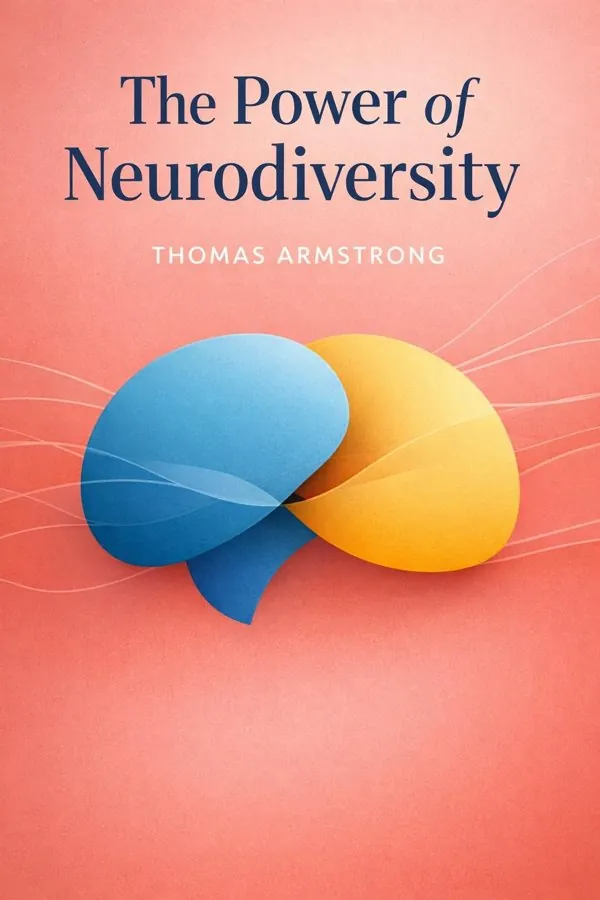
The Power of Neurodiversity: Unleashing the Advantages of Your Differently Wired Brain: Summary & Key Insights
 10 min4 chaptersAudio available
What Is The Power of Neurodiversity: Unleashing the Advantages of Your Differently Wired Brain About?
The Power of Neurodiversity: Unleashing the Advantages of Your Differently Wired Brain by Thomas Armstrong is a neuroscience book spanning 4 pages. In this groundbreaking work, Thomas Armstrong explores the concept of neurodiversity—the idea that conditions such as ADHD, autism, dyslexia, and other cognitive differences are not simply disorders but natural variations of the human brain. Drawing on research from neuroscience, psychology, and education, Armstrong argues that these differences can offer unique strengths and perspectives. The book provides strategies for individuals, educators, and employers to recognize and harness the potential of neurodiverse minds.
This FizzRead summary covers all 4 key chapters of The Power of Neurodiversity: Unleashing the Advantages of Your Differently Wired Brain in approximately 10 minutes, distilling the most important ideas, arguments, and takeaways from Thomas Armstrong's work. Also available as an audio summary and Key Quotes Podcast.
The Power of Neurodiversity: Unleashing the Advantages of Your Differently Wired Brain
In this groundbreaking work, Thomas Armstrong explores the concept of neurodiversity—the idea that conditions such as ADHD, autism, dyslexia, and other cognitive differences are not simply disorders but natural variations of the human brain. Drawing on research from neuroscience, psychology, and education, Armstrong argues that these differences can offer unique strengths and perspectives. The book provides strategies for individuals, educators, and employers to recognize and harness the potential of neurodiverse minds.
Who Should Read The Power of Neurodiversity: Unleashing the Advantages of Your Differently Wired Brain?
This book is perfect for anyone interested in neuroscience and looking to gain actionable insights in a short read. Whether you're a student, professional, or lifelong learner, the key ideas from The Power of Neurodiversity: Unleashing the Advantages of Your Differently Wired Brain by Thomas Armstrong will help you think differently.
- ✓Readers who enjoy neuroscience and want practical takeaways
- ✓Professionals looking to apply new ideas to their work and life
- ✓Anyone who wants the core insights of The Power of Neurodiversity: Unleashing the Advantages of Your Differently Wired Brain in just 10 minutes
Want the full summary?
Get instant access to this book summary and 100K+ more with Fizz Moment.
Get Free SummaryAvailable on App Store • Free to download
Key Chapters
For most of modern history, neurological differences were viewed strictly through the lens of medicine and disorder. Autism, bipolar disorder, dyslexia, and ADHD were framed as clinical pathologies to be cured or corrected. In this section, I trace how this viewpoint developed, showing that our cultural definitions of 'mental illness' are deeply entangled with social values. The early psychiatric traditions of the twentieth century taught society to equate deviation with dysfunction. But science—and lived experience—now reveal a more complex truth.
The idea of neurodiversity arose as a challenge to this deficit-based paradigm, first emerging from the autism rights movement in the late 1990s. Activists and scientists began to say, 'We are not broken; we are different.' Over time, this view expanded to encompass a broad spectrum of human neurological diversity. When we understand the brain as an adaptive organ shaped by millions of years of evolution, it becomes clear that variation is not only normal but essential. The diversity of cognitive styles is part of the species’ survival strategy.
I urge readers to consider the history of dyslexia, for instance. For decades, educational systems punished students for struggling to read, never realizing that many dyslexic individuals possess exceptional spatial or visual thinking abilities that make them natural engineers, architects, or artists. Similarly, traits associated with ADHD—restlessness, high energy, divergent thinking—often mirror the skills of entrepreneurs and innovators. What was once called a disorder may well be a different operating system.
Understanding this shift frees us from shame. It lets educators and parents reframe behavior not as pathology but as difference. When historical bias gives way to scientific insight, we begin to celebrate the full range of human neurology, recognizing the value of each mind within its ecological niche.
The heart of neurodiversity lies in viewing the brain as a dynamic ecosystem of cognitive variation. Each human brain is composed of a unique combination of strengths and challenges, just as ecosystems contain diverse organisms that together sustain balance. In my book, I explain that rather than judging minds against a single standard of intelligence or functionality, we must study them as expressions of evolutionary diversity.
Neuroscience now affirms that multiple cognitive architectures can lead to success. Variation in dopamine regulation, sensory processing, and attentional networks—traditionally associated with disorders—may produce distinctive advantages under certain conditions. Evolution did not design one 'optimal' brain but many styles suited for different tasks, environments, and historical moments.
From this perspective, neurodiversity becomes a framework for empowerment. Instead of asking, 'How can we fix this person’s deficits?' we ask, 'How can this individual’s brain flourish in the right environment?' This ecological thinking transforms how we understand education, mental health, and work. It emphasizes that optimal outcomes emerge when we match individual profiles to supportive surroundings.
I discuss how adaptive traits in autism may relate to heightened perception and detailed thinking; how dyslexic brains, which specialize in holistic visual processing, excel in complex pattern recognition; and how the drive and rapid ideation of ADHD reflect neural systems tuned for exploration. These traits evolved for reasons—and they continue to serve vital functions.
By embracing the neurodiversity paradigm, we reclaim agency. Being differently wired means possessing a brain fitted for unique modes of experience and creation. Once society recognizes this, what was once marginalized becomes a source of innovation, empathy, and cultural growth.
+ 2 more chapters — available in the FizzRead app
All Chapters in The Power of Neurodiversity: Unleashing the Advantages of Your Differently Wired Brain
About the Author
Thomas Armstrong, Ph.D., is an American educator, psychologist, and author known for his work on multiple intelligences, learning differences, and human potential. He has written numerous books on education and neurodiversity and has lectured internationally on how to support diverse learners.
Get This Summary in Your Preferred Format
Read or listen to the The Power of Neurodiversity: Unleashing the Advantages of Your Differently Wired Brain summary by Thomas Armstrong anytime, anywhere. FizzRead offers multiple formats so you can learn on your terms — all free.
Available formats: App · Audio · PDF · EPUB — All included free with FizzRead
Download The Power of Neurodiversity: Unleashing the Advantages of Your Differently Wired Brain PDF and EPUB Summary
Key Quotes from The Power of Neurodiversity: Unleashing the Advantages of Your Differently Wired Brain
“For most of modern history, neurological differences were viewed strictly through the lens of medicine and disorder.”
“The heart of neurodiversity lies in viewing the brain as a dynamic ecosystem of cognitive variation.”
Frequently Asked Questions about The Power of Neurodiversity: Unleashing the Advantages of Your Differently Wired Brain
The Power of Neurodiversity: Unleashing the Advantages of Your Differently Wired Brain by Thomas Armstrong is a neuroscience book that explores key ideas across 4 chapters. In this groundbreaking work, Thomas Armstrong explores the concept of neurodiversity—the idea that conditions such as ADHD, autism, dyslexia, and other cognitive differences are not simply disorders but natural variations of the human brain. Drawing on research from neuroscience, psychology, and education, Armstrong argues that these differences can offer unique strengths and perspectives. The book provides strategies for individuals, educators, and employers to recognize and harness the potential of neurodiverse minds.
You Might Also Like
Anxious
Joseph LeDoux
10 min
Hallucinations
Oliver Sacks
10 min
The Biological Mind: How Brain, Body, and Environment Collaborate to Make Us Who We Are
Alan Jasanoff
10 min
The Feeling of Life Itself: Why Consciousness Is Widespread but Can't Be Computed
Christof Koch
10 min
The No-Nonsense Meditation Book
Steven Laureys
10 min
A General Theory of Love
Thomas Lewis, Fari Amini, Richard Lannon
10 minBrowse by Category
Ready to read The Power of Neurodiversity: Unleashing the Advantages of Your Differently Wired Brain?
Get the full summary and 100K+ more books with Fizz Moment.