
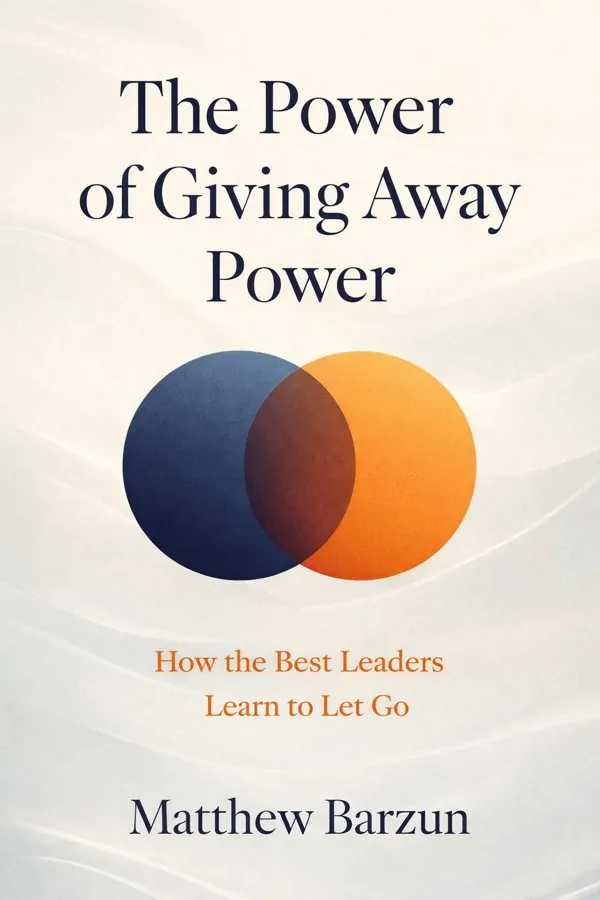
The Power of Giving Away Power: How the Best Leaders Learn to Let Go: Summary & Key Insights
 10 min6 chaptersAudio available
What Is The Power of Giving Away Power: How the Best Leaders Learn to Let Go About?
The Power of Giving Away Power: How the Best Leaders Learn to Let Go by Matthew Barzun is a leadership book spanning 6 pages. In this thought-provoking book, Matthew Barzun challenges traditional notions of leadership and power. Drawing from his experiences as a U.S. ambassador and business leader, he argues that true influence comes not from control but from empowering others. Through stories and insights, Barzun explores how leaders can create networks of trust and collaboration, fostering environments where everyone contributes to shared success.
This FizzRead summary covers all 6 key chapters of The Power of Giving Away Power: How the Best Leaders Learn to Let Go in approximately 10 minutes, distilling the most important ideas, arguments, and takeaways from Matthew Barzun's work. Also available as an audio summary and Key Quotes Podcast.
The Power of Giving Away Power: How the Best Leaders Learn to Let Go
In this thought-provoking book, Matthew Barzun challenges traditional notions of leadership and power. Drawing from his experiences as a U.S. ambassador and business leader, he argues that true influence comes not from control but from empowering others. Through stories and insights, Barzun explores how leaders can create networks of trust and collaboration, fostering environments where everyone contributes to shared success.
Who Should Read The Power of Giving Away Power: How the Best Leaders Learn to Let Go?
This book is perfect for anyone interested in leadership and looking to gain actionable insights in a short read. Whether you're a student, professional, or lifelong learner, the key ideas from The Power of Giving Away Power: How the Best Leaders Learn to Let Go by Matthew Barzun will help you think differently.
- ✓Readers who enjoy leadership and want practical takeaways
- ✓Professionals looking to apply new ideas to their work and life
- ✓Anyone who wants the core insights of The Power of Giving Away Power: How the Best Leaders Learn to Let Go in just 10 minutes
Want the full summary?
Get instant access to this book summary and 100K+ more with Fizz Moment.
Get Free SummaryAvailable on App Store • Free to download
Key Chapters
To help visualize the difference between traditional and generative power, I introduce two simple images: two cones. The first cone points upward, with a single peak at the top and a wide base at the bottom. This is how most of us depict an organization, a government, or even a family structure. Its orientation mirrors our inherited assumptions—that authority moves downward, that clarity and order depend on those at the top making decisions for everyone below.
But flip that cone on its side, and something remarkable happens. The second cone’s base becomes an opening, and its shape now suggests movement beyond itself. Instead of compression from above, it radiates outward. This is the generative model of power: instead of control narrowing toward a single point, it widens toward collective possibility. It's a shift from hierarchy to network, from containment to connection.
When I served as an ambassador, I saw how each cone influences behavior. In embassy culture, when the traditional cone prevailed, creativity stalled. People looked upward for permission, fearing mistakes. But when we intentionally invited everyone—from senior diplomats to local staff—to contribute insights, the dynamic reversed. The side-ways cone became a metaphor we could all work with: power expanding outward, fueled by conversation, trust, and curiosity. The image helped us unlearn our instinct to climb upward and instead start building outward.
The lesson of the two cones is not theoretical—it’s experiential. Once you start seeing your organization through the lens of the second cone, you notice how often people’s talents remain untapped because direction flows only one way. True leadership, then, is not about being the person at the peak but about being the one who changes the shape of power itself.
For generations, we’ve trusted control as the surest way to achieve results. Yet control carries hidden costs. At first, it feels efficient—decisions are centralized, roles are clear, and responsibility is unambiguous. But over time, control breeds dependency. People stop thinking for themselves, waiting instead for authority to direct their next move. What looks like order soon calcifies into stagnation.
I’ve seen this in diplomacy and business alike. In hierarchical systems, information struggles to flow upward. Those at the top rarely receive unfiltered feedback because subordinates fear repercussions or believe their input doesn’t matter. Creative energy dissipates because there’s no space for it to take root. Control cultures, by nature, prize predictability over discovery. But leadership in the twenty-first century demands flexibility, adaptability, and shared intelligence—qualities stifled by rigid command structures.
Control also undermines motivation. When people are micromanaged, they may comply, but they rarely commit. Purpose gets replaced by performance metrics; curiosity by compliance. Over time, this condition of control creates burnout both for leaders, who shoulder unrealistically solitary responsibility, and for team members, who feel unseen.
The antidote to this malaise is not anarchy but trust. Relinquishing control doesn’t mean relinquishing accountability; it means redefining accountability as a shared enterprise. Generative leadership is not about knowing every answer but about creating the environment where the right questions can surface from anyone. I learned that once you stop trying to be the sole architect, you discover far greater collective intelligence than you imagined possible.
+ 4 more chapters — available in the FizzRead app
All Chapters in The Power of Giving Away Power: How the Best Leaders Learn to Let Go
About the Author
Matthew Barzun is an American businessman, diplomat, and author. He served as U.S. Ambassador to Sweden and later to the United Kingdom under President Barack Obama. Known for his collaborative leadership style, Barzun has also held executive roles in technology and media companies. 'The Power of Giving Away Power' is his first book, reflecting his philosophy of distributed leadership and collective empowerment.
Get This Summary in Your Preferred Format
Read or listen to the The Power of Giving Away Power: How the Best Leaders Learn to Let Go summary by Matthew Barzun anytime, anywhere. FizzRead offers multiple formats so you can learn on your terms — all free.
Available formats: App · Audio · PDF · EPUB — All included free with FizzRead
Download The Power of Giving Away Power: How the Best Leaders Learn to Let Go PDF and EPUB Summary
Key Quotes from The Power of Giving Away Power: How the Best Leaders Learn to Let Go
“To help visualize the difference between traditional and generative power, I introduce two simple images: two cones.”
“For generations, we’ve trusted control as the surest way to achieve results.”
Frequently Asked Questions about The Power of Giving Away Power: How the Best Leaders Learn to Let Go
The Power of Giving Away Power: How the Best Leaders Learn to Let Go by Matthew Barzun is a leadership book that explores key ideas across 6 chapters. In this thought-provoking book, Matthew Barzun challenges traditional notions of leadership and power. Drawing from his experiences as a U.S. ambassador and business leader, he argues that true influence comes not from control but from empowering others. Through stories and insights, Barzun explores how leaders can create networks of trust and collaboration, fostering environments where everyone contributes to shared success.
You Might Also Like

Extreme Ownership
Jocko Willink
10 min
Dare to Lead
Brene Brown
10 min
Leaders Eat Last
Simon Sinek
10 min
The 21 Irrefutable Laws of Leadership
John Maxwell
10 min
Start With Why
Simon Sinek
10 min
How to Lead When You're Not in Charge
Clay Scroggins
10 minBrowse by Category
Ready to read The Power of Giving Away Power: How the Best Leaders Learn to Let Go?
Get the full summary and 100K+ more books with Fizz Moment.