
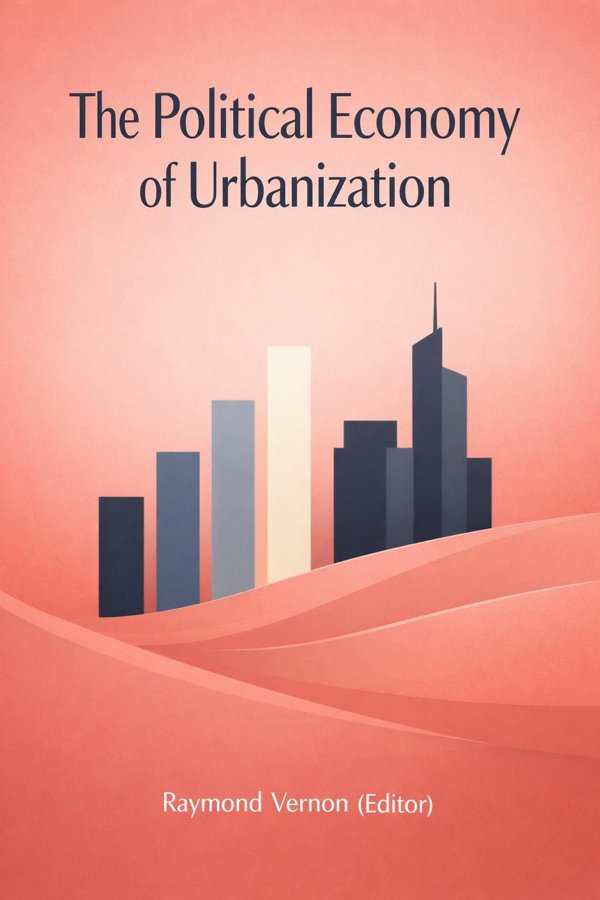
The Political Economy of Urbanization: Summary & Key Insights
 10 min12 chaptersAudio available
What Is The Political Economy of Urbanization About?
The Political Economy of Urbanization by Raymond Vernon (Editor) is a economics book spanning 12 pages. This edited volume explores the complex interrelations between economic development and urban growth, analyzing how industrialization, migration, and policy decisions shape urbanization processes. Contributors examine case studies from both developed and developing nations, offering comparative insights into the political and economic forces driving urban change.
This FizzRead summary covers all 12 key chapters of The Political Economy of Urbanization in approximately 10 minutes, distilling the most important ideas, arguments, and takeaways from Raymond Vernon (Editor)'s work. Also available as an audio summary and Key Quotes Podcast.
The Political Economy of Urbanization
This edited volume explores the complex interrelations between economic development and urban growth, analyzing how industrialization, migration, and policy decisions shape urbanization processes. Contributors examine case studies from both developed and developing nations, offering comparative insights into the political and economic forces driving urban change.
Who Should Read The Political Economy of Urbanization?
This book is perfect for anyone interested in economics and looking to gain actionable insights in a short read. Whether you're a student, professional, or lifelong learner, the key ideas from The Political Economy of Urbanization by Raymond Vernon (Editor) will help you think differently.
- ✓Readers who enjoy economics and want practical takeaways
- ✓Professionals looking to apply new ideas to their work and life
- ✓Anyone who wants the core insights of The Political Economy of Urbanization in just 10 minutes
Want the full summary?
Get instant access to this book summary and 100K+ more with Fizz Moment.
Get Free SummaryAvailable on App Store • Free to download
Key Chapters
At the heart of our inquiry lies the question: what do we mean by urbanization in economic and political terms? In this volume, we define it not merely as the numerical increase in the urban population, but as a structural transformation driven by the reallocation of labor, capital, and institutions. Economic theory tells us that industrialization draws workers toward centers of production. Yet this movement is not purely spontaneous. It is conditioned by roads built or neglected, by tax incentives offered or withheld, by the capacity of governments to plan and to restrain. We position urbanization, therefore, within a framework that binds together industrial expansion, labor migration, and capital accumulation.
This conceptual approach forces us to reconsider the role of the state. Market forces alone cannot explain why some nations channel urban growth into balanced regional development while others witness the unmanageable sprawl of primate cities. Policy interventions — whether through investment in infrastructure, regulation of land use, or housing subsidies — shape the rhythm of urban transition. The contributors argue that understanding these linkages is essential if we are to move beyond simplistic models that equate urban growth with progress.
In economic terms, the city functions as both a concentration of production and a locus of consumption. Politically, it represents a site of contestation where competing interests struggle over resource allocation. Urbanization, then, becomes the theater in which the broader drama of development is staged. To analyze this, we must merge the economist’s macro lens with the political scientist’s institutional scrutiny. This conceptual synthesis forms the backbone of the book and sets the stage for examining historical patterns and contemporary dilemmas alike.
The story of urbanization begins with industrialization. In the industrialized nations of Europe and North America, urban growth emerged organically from technological transformation and market expansion. Early factory systems demanded a steady supply of labor, drawing peasants from rural villages into towns that soon swelled into cities. But this process, as we emphasize, was not simply an economic inevitability. It was guided by policy — sometimes deliberate, sometimes reactive — responding to pressures of sanitation, housing, and social unrest.
During the nineteenth century, Britain’s experience epitomized the tensions of unplanned growth, while continental Europe demonstrated more intentional urban design as municipal institutions evolved. The American experience added a different dimension: immigration and the frontier economy combined to create urban centers that thrived on both industrial capital and the politics of municipal patronage. Each case illustrates how economic forces generate opportunities, but political institutions determine whether those opportunities become sustainable urban systems or chaotic concentrations of poverty.
By revisiting this history, we remind ourselves that today’s urban crises in developing regions are not wholly novel. They echo earlier struggles to manage transition. The key difference is that earlier industrial urbanizations occurred over generations, while contemporary ones unfold in decades, leaving far less room for adaptation. Understanding how earlier societies balanced growth and governance thus provides invaluable perspective for those now navigating similar transformations under compressed timelines.
+ 10 more chapters — available in the FizzRead app
All Chapters in The Political Economy of Urbanization
About the Author
Raymond Vernon (1913–1999) was an American economist and professor at Harvard University, known for his work on international business, multinational corporations, and economic development. He served as a senior official in the U.S. government and authored influential works on globalization and industrial policy.
Get This Summary in Your Preferred Format
Read or listen to the The Political Economy of Urbanization summary by Raymond Vernon (Editor) anytime, anywhere. FizzRead offers multiple formats so you can learn on your terms — all free.
Available formats: App · Audio · PDF · EPUB — All included free with FizzRead
Download The Political Economy of Urbanization PDF and EPUB Summary
Key Quotes from The Political Economy of Urbanization
“At the heart of our inquiry lies the question: what do we mean by urbanization in economic and political terms?”
“The story of urbanization begins with industrialization.”
Frequently Asked Questions about The Political Economy of Urbanization
The Political Economy of Urbanization by Raymond Vernon (Editor) is a economics book that explores key ideas across 12 chapters. This edited volume explores the complex interrelations between economic development and urban growth, analyzing how industrialization, migration, and policy decisions shape urbanization processes. Contributors examine case studies from both developed and developing nations, offering comparative insights into the political and economic forces driving urban change.
You Might Also Like
Business Adventures
John Brooks
10 min
Nudge
Richard H. Thaler, Cass R. Sunstein
10 min
The Hitchhiker"s Guide to the Galaxy
Douglas Adams
10 minThe Muqaddimah
Ibn Khaldun
10 minThe Outsiders
William N. Thorndike
10 min
A Little History of Economics
Niall Kishtainy
10 minBrowse by Category
Ready to read The Political Economy of Urbanization?
Get the full summary and 100K+ more books with Fizz Moment.