
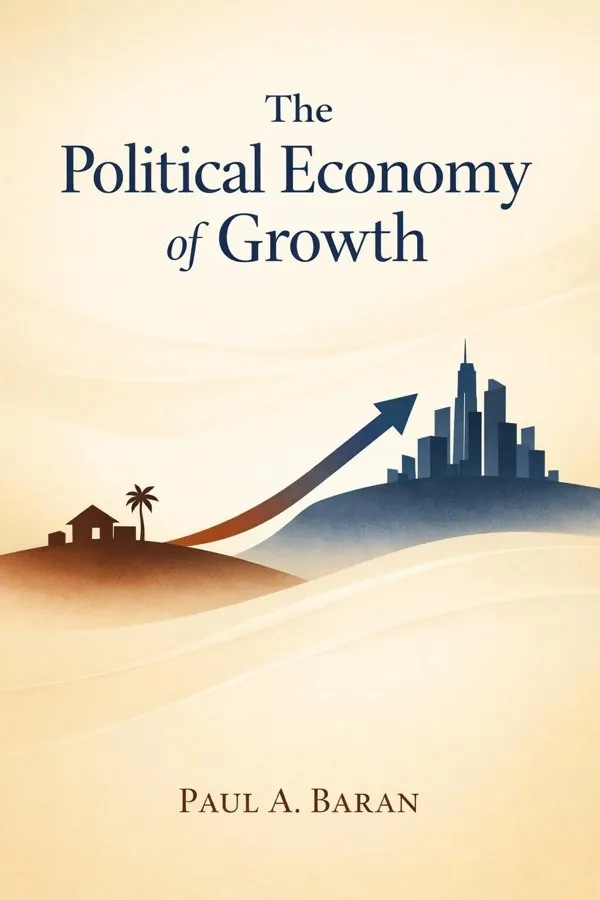
The Political Economy of Growth: Summary & Key Insights
 10 min8 chaptersAudio available
What Is The Political Economy of Growth About?
The Political Economy of Growth by Paul A. Baran is a economics book spanning 8 pages. In this influential work, Paul A. Baran examines the structural causes of economic underdevelopment in the global South, arguing that the capitalist system inherently produces inequality between advanced and backward economies. He explores how surplus is generated and appropriated, and how the political and social institutions of underdeveloped countries are shaped by their dependence on advanced capitalist nations. The book became a cornerstone of Marxist development theory and dependency analysis.
This FizzRead summary covers all 8 key chapters of The Political Economy of Growth in approximately 10 minutes, distilling the most important ideas, arguments, and takeaways from Paul A. Baran's work. Also available as an audio summary and Key Quotes Podcast.
The Political Economy of Growth
In this influential work, Paul A. Baran examines the structural causes of economic underdevelopment in the global South, arguing that the capitalist system inherently produces inequality between advanced and backward economies. He explores how surplus is generated and appropriated, and how the political and social institutions of underdeveloped countries are shaped by their dependence on advanced capitalist nations. The book became a cornerstone of Marxist development theory and dependency analysis.
Who Should Read The Political Economy of Growth?
This book is perfect for anyone interested in economics and looking to gain actionable insights in a short read. Whether you're a student, professional, or lifelong learner, the key ideas from The Political Economy of Growth by Paul A. Baran will help you think differently.
- ✓Readers who enjoy economics and want practical takeaways
- ✓Professionals looking to apply new ideas to their work and life
- ✓Anyone who wants the core insights of The Political Economy of Growth in just 10 minutes
Want the full summary?
Get instant access to this book summary and 100K+ more with Fizz Moment.
Get Free SummaryAvailable on App Store • Free to download
Key Chapters
To understand the predicament of underdeveloped nations, I begin by tracing the historical formation of capitalism itself. Modern capitalist economies did not emerge uniformly across the globe; they arose from specific historical conditions within Europe, where technical progress, commercial expansion, and social transformation coincided. The Industrial Revolution created new forms of production and exchange, giving rise to powerful capitalist classes whose wealth depended on extracting surplus from labor. Yet this wealth accumulation was never confined to national borders—it required a global sphere of exploitation.
From the early days of colonialism, the expansion of European capitalism generated a world system divided into ‘advanced’ and ‘backward’ regions. Colonies supplied raw materials and served as markets for manufactured goods, while metropolitan economies accumulated surpluses that fueled further industrialization. This division, once established, entrenched itself through centuries of trade patterns, property relations, and institutional formations.
In this historical context, the backwardness of certain nations cannot be seen as accidental or transitional. It was deliberately structured into the global order. Even after the dissolution of formal colonial empires, the economic dependency of former colonies persisted through the mechanisms of international finance, trade agreements, and monopoly control of technology. Underdeveloped nations inherited social and political arrangements designed not for their growth but for the perpetuation of external exploitation. Their elites, often shaped by colonial privilege, became intermediaries in maintaining these relations.
Thus, when I speak of underdevelopment, I refer not to a lack of development, but to a form of *dependent development*—a situation where domestic progress is constrained and distorted by the needs of dominant capitalist centers. History reveals that the wealth of advanced nations and the poverty of backward ones are two sides of the same coin. One produces the other. It is within this dialectical framework that we must study growth, not as the accumulation of capital in abstract, but as a social process governed by power and surplus appropriation.
The central analytical concept I introduce is that of **economic surplus**. Every society, regardless of its mode of production, produces more than is strictly necessary to sustain its labor and reproduce its material conditions. This surplus—whether in the form of goods, services, or monetary value—is the basis of progress. But its potential remains abstract until it is harnessed productively.
In a developed capitalist economy, surplus manifests as profits that can be reinvested for technological improvement and industrial expansion. However, the capitalist’s motivation for reinvestment is not social welfare but private gain. The actual utilization of surplus thus depends on the balance between productive and unproductive consumption, between reinvestment and waste. I distinguish between **potential surplus**, which could be used for development if society were organized rationally, and **actual surplus**, which is realized within existing institutional constraints.
Underdeveloped economies often display a paradox: despite widespread poverty, they possess significant potential surplus. Resources are misallocated in the service of luxury consumption, inefficient bureaucracy, and capital flight. Wealth generated domestically fails to translate into meaningful investment in industry, education, or infrastructure. Consequently, the economic surplus becomes a measure not only of a nation’s output but of its social priorities.
In capitalist society, surplus is governed by the laws of distribution among property-owning classes. The portion of surplus that is reinvested productively depends on the structure of power within the economy—whether monopolies dominate markets, whether foreign interests control finance, and whether the state serves industrial development or elite privilege. Only in a planned society, where surplus allocation follows social objectives rather than private profit, can it achieve its full developmental potential. Thus, the problem of underdevelopment is not the absence of surplus but the misdirection of its use.
+ 6 more chapters — available in the FizzRead app
All Chapters in The Political Economy of Growth
About the Author
Paul Alexander Baran (1909–1964) was a Polish-American Marxist economist and a leading member of the Stanford School of political economy. He is best known for his contributions to the theory of economic surplus and his collaboration with Paul M. Sweezy on 'Monopoly Capital'.
Get This Summary in Your Preferred Format
Read or listen to the The Political Economy of Growth summary by Paul A. Baran anytime, anywhere. FizzRead offers multiple formats so you can learn on your terms — all free.
Available formats: App · Audio · PDF · EPUB — All included free with FizzRead
Download The Political Economy of Growth PDF and EPUB Summary
Key Quotes from The Political Economy of Growth
“To understand the predicament of underdeveloped nations, I begin by tracing the historical formation of capitalism itself.”
“The central analytical concept I introduce is that of **economic surplus**.”
Frequently Asked Questions about The Political Economy of Growth
The Political Economy of Growth by Paul A. Baran is a economics book that explores key ideas across 8 chapters. In this influential work, Paul A. Baran examines the structural causes of economic underdevelopment in the global South, arguing that the capitalist system inherently produces inequality between advanced and backward economies. He explores how surplus is generated and appropriated, and how the political and social institutions of underdeveloped countries are shaped by their dependence on advanced capitalist nations. The book became a cornerstone of Marxist development theory and dependency analysis.
You Might Also Like

Business Adventures
John Brooks
10 min
Nudge
Richard H. Thaler, Cass R. Sunstein
10 min
The Hitchhiker"s Guide to the Galaxy
Douglas Adams
10 minThe Muqaddimah
Ibn Khaldun
10 minThe Outsiders
William N. Thorndike
10 min
A Little History of Economics
Niall Kishtainy
10 minBrowse by Category
Ready to read The Political Economy of Growth?
Get the full summary and 100K+ more books with Fizz Moment.