
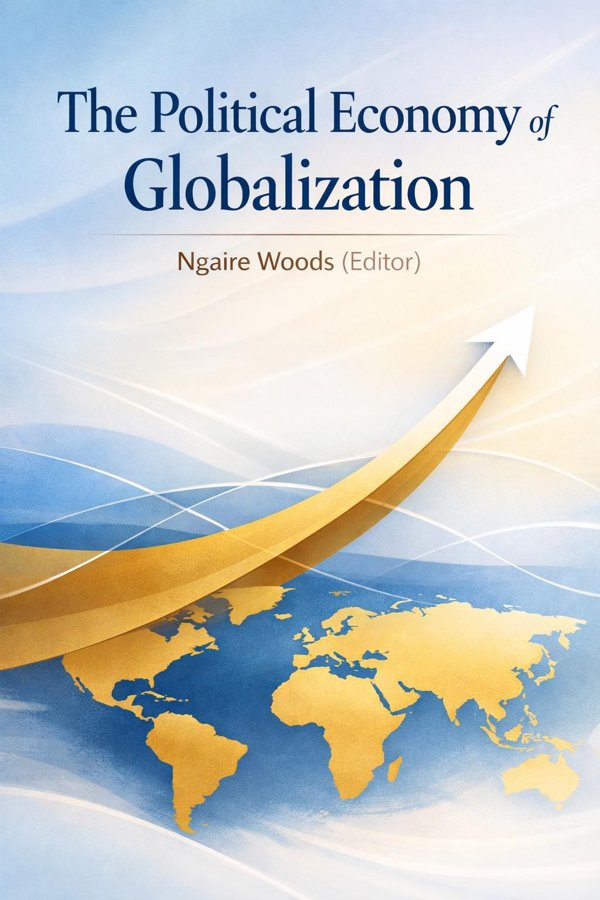
The Political Economy of Globalization: Summary & Key Insights
 10 min10 chaptersAudio available
What Is The Political Economy of Globalization About?
The Political Economy of Globalization by Ngaire Woods (Editor) is a economics book spanning 10 pages. This scholarly volume explores the complex interactions between global economic integration and national political systems. It examines how globalization affects state sovereignty, economic policy, and inequality, featuring contributions from leading economists and political scientists. The essays analyze trade liberalization, financial flows, and the governance of global institutions such as the IMF and World Bank.
This FizzRead summary covers all 10 key chapters of The Political Economy of Globalization in approximately 10 minutes, distilling the most important ideas, arguments, and takeaways from Ngaire Woods (Editor)'s work. Also available as an audio summary and Key Quotes Podcast.
The Political Economy of Globalization
This scholarly volume explores the complex interactions between global economic integration and national political systems. It examines how globalization affects state sovereignty, economic policy, and inequality, featuring contributions from leading economists and political scientists. The essays analyze trade liberalization, financial flows, and the governance of global institutions such as the IMF and World Bank.
Who Should Read The Political Economy of Globalization?
This book is perfect for anyone interested in economics and looking to gain actionable insights in a short read. Whether you're a student, professional, or lifelong learner, the key ideas from The Political Economy of Globalization by Ngaire Woods (Editor) will help you think differently.
- ✓Readers who enjoy economics and want practical takeaways
- ✓Professionals looking to apply new ideas to their work and life
- ✓Anyone who wants the core insights of The Political Economy of Globalization in just 10 minutes
Want the full summary?
Get instant access to this book summary and 100K+ more with Fizz Moment.
Get Free SummaryAvailable on App Store • Free to download
Key Chapters
In beginning our shared journey, I invite readers to define globalization not as an ideology but as an empirical process of interdependence that erodes certain barriers while constructing new forms of regulation. The authors in this section confront a central tension: globalization appears to weaken states’ capacity, yet in practice it transforms rather than eliminates state sovereignty.
Several theoretical traditions shape this debate. Economic liberalism interprets globalization as the natural outgrowth of market expansion, where the removal of trade and capital barriers allows efficiency to drive prosperity. This vision, however, often assumes that global markets operate autonomously from politics. In contrast, the political economy tradition insists that market outcomes are politically embedded—they are the product of policy choices and institutional arrangements. Interdependence theory adds a further twist. It suggests that as states become economically intertwined, they must develop new forms of cooperation, leading to shared vulnerabilities that transcend national borders.
The contributors explore these frameworks to reveal that sovereignty itself is evolving rather than collapsing. A state’s autonomy is constrained by its participation in a global system, but its power may also be reconfigured toward negotiation and coordination. Understanding globalization in these terms allows us to grasp its complexity: it is both a process of integration and a field of contestation. By grounding theory in politics, we can see globalization as neither a destiny nor a disaster, but as a terrain of political struggle over rules, norms, and benefits.
As trade and finance transcend national boundaries, countries find themselves balancing between global efficiency and domestic stability. In this section, the contributors dissect how liberalization reshapes national economic policies. Trade openness forces governments to reconsider taxation, labor standards, and welfare spending. Financial liberalization, particularly since the 1980s, means that capital can flee quickly from one jurisdiction to another, disciplining governments through the threat of exit.
But globalization does not affect all economies equally. Developed nations often manage liberalization through institutional buffers—robust financial regulation, coherent industrial policy, and social safety nets. Developing nations, by contrast, face the challenge of attracting investment while retaining sovereign policy space. The mechanism of conditionality, imposed by international institutions, frequently reduces that space further.
What emerges is an intricate picture of dependency and adaptation. National economies are not mere victims of globalization; they are also architects of it. Some nations, such as the East Asian ‘tigers,’ have demonstrated that proactive policy can harness global markets for domestic development. Others have found themselves constrained by debt and exposure to volatile capital flows. This interplay underlines the book’s key message: globalization transforms governance by redefining the feasible set of national policies.
+ 8 more chapters — available in the FizzRead app
All Chapters in The Political Economy of Globalization
About the Author
Ngaire Woods is a British political economist and the founding dean of the Blavatnik School of Government at the University of Oxford. Her research focuses on global economic governance, international institutions, and the role of developing countries in the global economy.
Get This Summary in Your Preferred Format
Read or listen to the The Political Economy of Globalization summary by Ngaire Woods (Editor) anytime, anywhere. FizzRead offers multiple formats so you can learn on your terms — all free.
Available formats: App · Audio · PDF · EPUB — All included free with FizzRead
Download The Political Economy of Globalization PDF and EPUB Summary
Key Quotes from The Political Economy of Globalization
“The authors in this section confront a central tension: globalization appears to weaken states’ capacity, yet in practice it transforms rather than eliminates state sovereignty.”
“As trade and finance transcend national boundaries, countries find themselves balancing between global efficiency and domestic stability.”
Frequently Asked Questions about The Political Economy of Globalization
The Political Economy of Globalization by Ngaire Woods (Editor) is a economics book that explores key ideas across 10 chapters. This scholarly volume explores the complex interactions between global economic integration and national political systems. It examines how globalization affects state sovereignty, economic policy, and inequality, featuring contributions from leading economists and political scientists. The essays analyze trade liberalization, financial flows, and the governance of global institutions such as the IMF and World Bank.
You Might Also Like

Business Adventures
John Brooks
10 min
Nudge
Richard H. Thaler, Cass R. Sunstein
10 min
The Hitchhiker"s Guide to the Galaxy
Douglas Adams
10 minThe Muqaddimah
Ibn Khaldun
10 minThe Outsiders
William N. Thorndike
10 min
A Little History of Economics
Niall Kishtainy
10 minBrowse by Category
Ready to read The Political Economy of Globalization?
Get the full summary and 100K+ more books with Fizz Moment.