
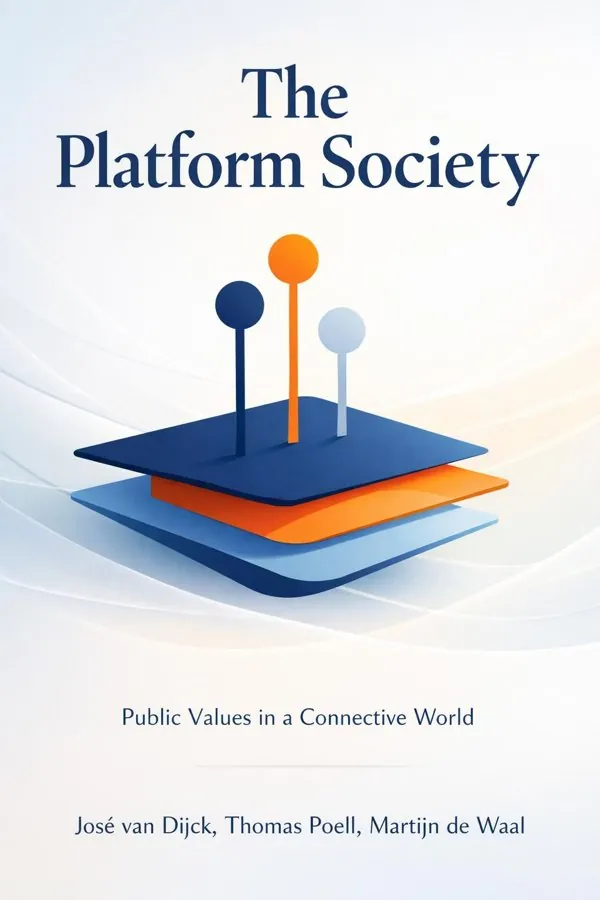
The Platform Society: Public Values in a Connective World: Summary & Key Insights
by José van Dijck, Thomas Poell, Martijn de Waal
 10 min8 chaptersAudio available
What Is The Platform Society: Public Values in a Connective World About?
The Platform Society: Public Values in a Connective World by José van Dijck, Thomas Poell, Martijn de Waal is a digital_culture book spanning 8 pages. The Platform Society explores how digital platforms such as Google, Facebook, and Uber have become the new infrastructures of public life. The authors analyze how these platforms shape communication, knowledge, and civic engagement, and how they challenge traditional institutions in media, education, and urban life. They argue for the need to safeguard public values like equality, privacy, and democracy in a world increasingly governed by private digital intermediaries.
This FizzRead summary covers all 8 key chapters of The Platform Society: Public Values in a Connective World in approximately 10 minutes, distilling the most important ideas, arguments, and takeaways from José van Dijck, Thomas Poell, Martijn de Waal's work. Also available as an audio summary and Key Quotes Podcast.
The Platform Society: Public Values in a Connective World
The Platform Society explores how digital platforms such as Google, Facebook, and Uber have become the new infrastructures of public life. The authors analyze how these platforms shape communication, knowledge, and civic engagement, and how they challenge traditional institutions in media, education, and urban life. They argue for the need to safeguard public values like equality, privacy, and democracy in a world increasingly governed by private digital intermediaries.
Who Should Read The Platform Society: Public Values in a Connective World?
This book is perfect for anyone interested in digital_culture and looking to gain actionable insights in a short read. Whether you're a student, professional, or lifelong learner, the key ideas from The Platform Society: Public Values in a Connective World by José van Dijck, Thomas Poell, Martijn de Waal will help you think differently.
- ✓Readers who enjoy digital_culture and want practical takeaways
- ✓Professionals looking to apply new ideas to their work and life
- ✓Anyone who wants the core insights of The Platform Society: Public Values in a Connective World in just 10 minutes
Want the full summary?
Get instant access to this book summary and 100K+ more with Fizz Moment.
Get Free SummaryAvailable on App Store • Free to download
Key Chapters
The digital age began with the utopian vision of an open network. Early internet culture celebrated decentralization, collaboration, and the empowerment of users. Discussion forums, blogs, and independent websites formed a diverse ecology of voices. However, as connectivity expanded, companies discovered that the value of the network resided in scale — in their ability to capture and organize data across millions of users. Thus began the transformation from an open web to a platform-based ecosystem.
Platforms are not mere participants within digital networks; they are the gatekeepers and architects of interaction. They build infrastructures that mediate communication and economic exchange, relying on network effects that favor monopolistic dominance. Over time, a small number of corporations consolidated control: Google came to organize information, Facebook social relations, Amazon consumption, and Uber mobility. Together, they form what we call the connective infrastructure of contemporary society.
This concentration of power has profound consequences. While platforms claim to empower individuals by providing access and participation, they embed users into systems that collect and monetize behavioral data. The connective promise — linking people, knowledge, and resources — thus becomes inseparable from the commodification of public life. What was once a community of peers is now an economy of data transactions. The history of this shift is essential, for it shows how economic models and technological designs shape not only our online interactions but our democratic institutions.
To grasp how platforms govern society, we identify three fundamental processes: datafication, commodification, and selection. Datafication means transforming every aspect of human behavior into quantifiable data points. Every like, search, click, or ride becomes a trace that platforms capture and organize. These traces are not collected for mere utility; they feed predictive systems that anticipate and influence future actions.
Commodification follows naturally: once user activity is datafied, it can be turned into economic value. Advertising ecosystems, app marketplaces, and the gig economy rely on converting participation into profit. The key resource of the platform society is therefore not content or labor alone, but the data generated by continuous engagement. In this logic, users are both producers and products — they co-create the system that commodifies their everyday lives.
Selection refers to the algorithmic filtering of information, goods, or people. Platforms do not present reality as it is; they curate it according to opaque metrics of relevance and popularity. These selection mechanisms determine what news we see, which driver we meet, which course we take, or how our city is governed. They script behaviors and redefine social hierarchies based on computational calculation, not deliberative choice.
Together, these mechanisms constitute the infrastructure of governance in the platform society. Understanding them is the first step toward reclaiming the ability to align technology with collective values rather than private extraction.
+ 6 more chapters — available in the FizzRead app
All Chapters in The Platform Society: Public Values in a Connective World
About the Authors
José van Dijck is a professor of media studies at Utrecht University. Thomas Poell is a professor of data, culture, and institutions at the University of Amsterdam. Martijn de Waal is a professor of media studies at the Amsterdam University of Applied Sciences. Together, they research the societal impact of digital platforms and the governance of online public spaces.
Get This Summary in Your Preferred Format
Read or listen to the The Platform Society: Public Values in a Connective World summary by José van Dijck, Thomas Poell, Martijn de Waal anytime, anywhere. FizzRead offers multiple formats so you can learn on your terms — all free.
Available formats: App · Audio · PDF · EPUB — All included free with FizzRead
Download The Platform Society: Public Values in a Connective World PDF and EPUB Summary
Key Quotes from The Platform Society: Public Values in a Connective World
“The digital age began with the utopian vision of an open network.”
“To grasp how platforms govern society, we identify three fundamental processes: datafication, commodification, and selection.”
Frequently Asked Questions about The Platform Society: Public Values in a Connective World
The Platform Society: Public Values in a Connective World by José van Dijck, Thomas Poell, Martijn de Waal is a digital_culture book that explores key ideas across 8 chapters. The Platform Society explores how digital platforms such as Google, Facebook, and Uber have become the new infrastructures of public life. The authors analyze how these platforms shape communication, knowledge, and civic engagement, and how they challenge traditional institutions in media, education, and urban life. They argue for the need to safeguard public values like equality, privacy, and democracy in a world increasingly governed by private digital intermediaries.
You Might Also Like

An Ugly Truth: Inside Facebook’s Battle for Domination
Sheera Frenkel, Cecilia Kang
10 min
Cyber Citizens
Ian Goodfellow
10 min
Digital Minimalism: Choosing a Focused Life in a Noisy World
Cal Newport
10 min
E‑Books & Beyond
Various Authors
10 min
The Future of Media
Various Authors
10 min
This Is Why We Can't Have Nice Things
Whitney Phillips
10 minBrowse by Category
Ready to read The Platform Society: Public Values in a Connective World?
Get the full summary and 100K+ more books with Fizz Moment.