
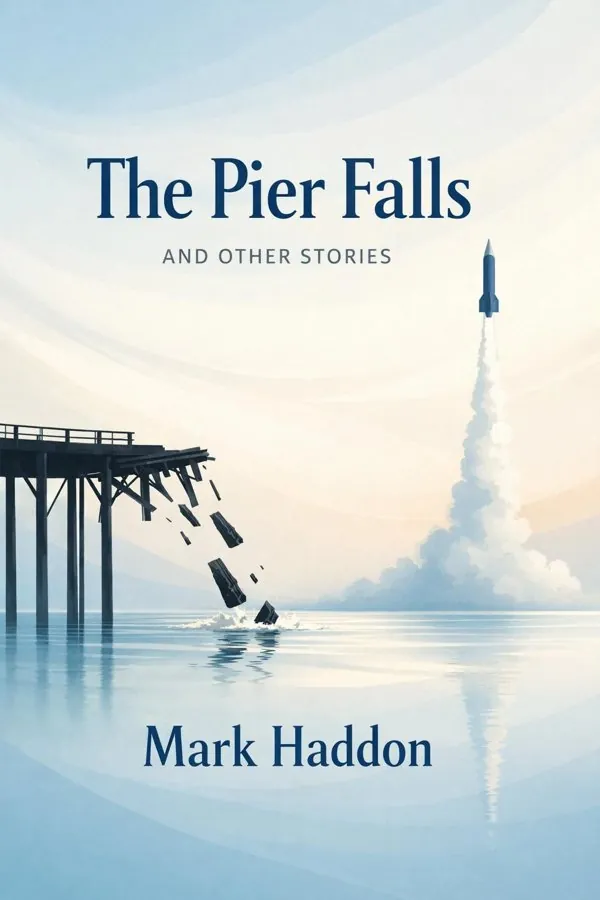
The Pier Falls: And Other Stories: Summary & Key Insights
by Mark Haddon
 10 min8 chapters
Key Takeaways from The Pier Falls: And Other Stories
One of the most unsettling truths in Haddon's collection is that disaster rarely announces itself politely.
A striking insight running through this collection is that intimacy does not guarantee understanding.
Few writers depict panic as sharply as Mark Haddon does in this collection.
Although many of the stories begin in recognizable reality, Haddon often introduces elements of myth, fantasy, fable, or speculative fiction.
A painful but important thread in The Pier Falls: And Other Stories is the exposure of children to adult confusion, negligence, vanity, fear, and unresolved damage.
What Is The Pier Falls: And Other Stories About?
The Pier Falls: And Other Stories by Mark Haddon is a bestsellers book. The Pier Falls: And Other Stories is a dark, brilliant, and unexpectedly moving collection that shows Mark Haddon at his most imaginative and unsettling. Best known for The Curious Incident of the Dog in the Night-Time, Haddon turns here to short fiction, offering nine stories that range from domestic realism to myth, apocalypse, fable, and psychological drama. These are not comfortable tales. They are stories about accidents, isolation, desire, parenting, violence, memory, and the strange instability beneath ordinary life. Again and again, Haddon places familiar people in situations where routine collapses and deeper truths emerge. What makes this collection matter is its range and precision. Haddon writes with sharp observation, emotional intelligence, and a willingness to move between the intimate and the catastrophic. One story may begin with a family outing and end in horror; another may use fantasy or speculative elements to expose very human fears. Throughout, he asks what happens when control disappears, when people misread one another, or when love fails to protect us. The result is a collection that feels intellectually rich and emotionally piercing, rewarding readers who appreciate literary fiction that is bold, varied, and impossible to forget.
This FizzRead summary covers all 8 key chapters of The Pier Falls: And Other Stories in approximately 10 minutes, distilling the most important ideas, arguments, and takeaways from Mark Haddon's work.
The Pier Falls: And Other Stories
The Pier Falls: And Other Stories is a dark, brilliant, and unexpectedly moving collection that shows Mark Haddon at his most imaginative and unsettling. Best known for The Curious Incident of the Dog in the Night-Time, Haddon turns here to short fiction, offering nine stories that range from domestic realism to myth, apocalypse, fable, and psychological drama. These are not comfortable tales. They are stories about accidents, isolation, desire, parenting, violence, memory, and the strange instability beneath ordinary life. Again and again, Haddon places familiar people in situations where routine collapses and deeper truths emerge.
What makes this collection matter is its range and precision. Haddon writes with sharp observation, emotional intelligence, and a willingness to move between the intimate and the catastrophic. One story may begin with a family outing and end in horror; another may use fantasy or speculative elements to expose very human fears. Throughout, he asks what happens when control disappears, when people misread one another, or when love fails to protect us. The result is a collection that feels intellectually rich and emotionally piercing, rewarding readers who appreciate literary fiction that is bold, varied, and impossible to forget.
Who Should Read The Pier Falls: And Other Stories?
This book is perfect for anyone interested in bestsellers and looking to gain actionable insights in a short read. Whether you're a student, professional, or lifelong learner, the key ideas from The Pier Falls: And Other Stories by Mark Haddon will help you think differently.
- ✓Readers who enjoy bestsellers and want practical takeaways
- ✓Professionals looking to apply new ideas to their work and life
- ✓Anyone who wants the core insights of The Pier Falls: And Other Stories in just 10 minutes
Want the full summary?
Get instant access to this book summary and 100K+ more with Fizz Moment.
Get Free SummaryAvailable on App Store • Free to download
Key Chapters
One of the most unsettling truths in Haddon's collection is that disaster rarely announces itself politely. A normal day, a casual outing, a recognizable social scene, or a familiar relationship can tip into chaos in an instant. The title story captures this idea with devastating force, showing how a public space associated with leisure and nostalgia can suddenly become the site of mass panic and irreversible loss. Haddon is interested not only in catastrophe itself, but in how quickly the ordinary proves fragile.
This is what gives the stories their emotional power. They begin from situations readers understand: family dynamics, travel, romantic tension, parenting, work, memory. Then something shifts. A misjudgment, a random event, a hidden impulse, or a structural weakness tears through the surface of everyday life. In Haddon's world, safety is often revealed as a temporary illusion. That does not make the stories nihilistic. Instead, it makes them honest about how vulnerable people really are.
In practical terms, this theme invites readers to think differently about control. We often behave as if good planning guarantees good outcomes, but Haddon reminds us that life is full of variables we cannot master. That insight can deepen empathy. When others make mistakes under pressure or struggle after sudden loss, their reactions may reflect human limits rather than moral failure.
A useful application is to pay more attention to the relationships and routines you take for granted. The stories suggest that stability is precious precisely because it is not permanent. Small acts of care, preparation, and presence matter more than we think.
Actionable takeaway: Treat ordinary moments as meaningful, and build resilience by valuing people and routines before crisis forces you to.
A striking insight running through this collection is that intimacy does not guarantee understanding. Parents misunderstand children, partners misread each other, friends project motives, and strangers become screens for private fears. Haddon repeatedly exposes the gap between what people believe about one another and what is actually true. His characters often live beside each other physically while remaining emotionally or psychologically obscured.
This idea is central to the tension in many of the stories. Conflict does not always come from obvious villains or dramatic betrayals. Sometimes it comes from ordinary blindness: assumptions left unchallenged, feelings left unspoken, histories left unexamined. Haddon is exceptionally good at showing how people narrate each other into simple roles, only to discover that no one is as stable or legible as they seemed. A parent may believe they are protecting a child while really expressing control. A spouse may interpret silence as indifference when it hides fear or shame. Even self-knowledge proves incomplete.
That emotional ambiguity makes the collection feel true to life. In real relationships, people are rarely fully knowable. We infer, guess, react, and improvise. Haddon dramatizes the risks of this process, but he also suggests its poignancy. The fact that we can never completely possess another person's inner life is part of what makes connection difficult and valuable.
Readers can apply this theme by becoming more curious and less certain in their own relationships. Instead of rushing to interpret someone else's behavior, ask what unseen pressures, griefs, or assumptions may be shaping it. Listening becomes more important than conclusion.
Actionable takeaway: Replace quick judgments with thoughtful questions, and approach close relationships with humility about how much you do not yet know.
Few writers depict panic as sharply as Mark Haddon does in this collection. His stories show that fear is not just an emotion; it is a force that rearranges perception, decision-making, morality, and memory. In moments of danger, people may become selfish, brave, confused, tender, irrational, or unexpectedly practical. Haddon refuses sentimental certainty about how human beings behave under stress. Instead, he presents fear as a revealing test.
This matters because many stories about crisis divide people too neatly into heroes and failures. Haddon is more interested in complexity. A person may act generously in one second and cruelly in the next. Someone confident in calm conditions may become useless in emergency, while a seemingly passive person may become decisive. Under pressure, social scripts fall away. What remains is often uncomfortable, but it is deeply human.
The stories also suggest that fear does not end when danger ends. Its aftereffects linger in guilt, trauma, obsessive recollection, and changed relationships. People replay choices, wonder what they should have done, and reinterpret the past through the lens of catastrophe. Haddon understands that the moral drama of fear continues long after the event itself.
In everyday life, most readers will not face the kinds of extreme crises some of these stories depict. But the principle still applies in smaller forms: workplace conflict, family emergencies, medical news, financial pressure, social humiliation. Stress reveals habits of mind. Do you freeze, blame, deny, or focus? Do you protect the vulnerable or your own image?
You can use this insight to prepare yourself before crisis comes. Develop calm routines, practice clear communication, and reflect honestly on your behavior under pressure rather than imagining an idealized version of yourself.
Actionable takeaway: Notice how you respond to smaller stresses now, and strengthen the habits you would want to rely on in a real emergency.
Although many of the stories begin in recognizable reality, Haddon often introduces elements of myth, fantasy, fable, or speculative fiction. This is not decorative strangeness. It is a deliberate way of seeing human experience from new angles. By stretching reality, Haddon reveals emotional truths that straightforward realism might leave hidden. The strange, in his hands, becomes a diagnostic tool.
A mythical or surreal premise allows him to dramatize loneliness, desire, guilt, power, and estrangement with unusual clarity. When the normal rules are altered, readers can see the underlying psychological logic more vividly. Fantasy here does not offer escapism. It sharpens perception. It strips away social habit and puts fundamental human drives on display.
This blending of modes is one reason the collection feels so rich. Haddon is not confined to a single literary register. He can move from domestic detail to nightmare, from satirical observation to almost allegorical force. That variety reflects the complexity of life itself. Some experiences feel documentary; others feel dreamlike, absurd, or mythic. By shifting style, he honors those different textures of reality.
Readers can take a practical lesson from this technique. Sometimes indirect approaches reveal more than literal description. In conversation, education, therapy, or personal reflection, metaphor can unlock insight where plain explanation fails. A person may understand their situation better through an image, story, or imagined scenario than through abstract analysis alone.
So when a problem feels resistant to straightforward thinking, try another frame. Describe it as a storm, a maze, a machine, or a myth. That change in perspective may show patterns you were missing.
Actionable takeaway: Use metaphor and imaginative reframing to understand difficult emotions or situations that ordinary language cannot fully capture.
A painful but important thread in The Pier Falls: And Other Stories is the exposure of children to adult confusion, negligence, vanity, fear, and unresolved damage. Haddon does not romanticize childhood as innocent sanctuary. Instead, he shows how children live inside systems shaped by adults who are often distracted, self-involved, overwhelmed, or simply wrong. The result is not always dramatic abuse; often it is something subtler but still consequential: misattunement, misjudgment, instability, or emotional absence.
This theme gives the collection much of its moral urgency. When adults fail, children absorb the effects without having the language or power to interpret them. A parent may think they are acting reasonably while transmitting anxiety or causing harm. A family may appear functional from outside while privately producing fear or confusion. Haddon captures how children observe more than adults realize, and how their vulnerability makes ordinary adult errors carry greater weight.
At the same time, the stories avoid simple blame. Adults in Haddon's fiction are often limited, frightened, or trapped in pressures they do not know how to handle. That complexity matters. The collection is not interested in easy condemnation but in the chain reaction by which private dysfunction becomes shared damage.
The practical application is clear for readers who are parents, teachers, caregivers, or simply influential adults. Children need more than provision and instruction. They need emotional steadiness, honest attention, and self-awareness from the adults around them. Even when life is chaotic, how adults handle chaos becomes part of a child's inner world.
A useful habit is to ask not only, "What am I trying to do?" but also, "How might this feel to the child experiencing it?" That shift in perspective can transform communication and care.
Actionable takeaway: Practice self-awareness around children, because the emotional atmosphere adults create often shapes them as much as words or rules do.
Another challenging idea in Haddon's collection is that violence does not always come from grand hatred or dramatic evil. Sometimes it is random, structural, accidental, bureaucratic, or emotionally detached. That impersonality makes it more frightening, not less. A collapse, a neglectful system, a reckless impulse, or a failure to act can injure just as decisively as deliberate cruelty. Haddon understands that harm is often embedded in ordinary conditions rather than isolated in monstrous individuals.
This perspective expands the reader's moral field of vision. If we imagine violence only as direct attack, we miss the forms it takes through indifference, poor design, social hierarchy, and institutional distance. In Haddon's stories, people can become casualties of systems, environments, and collective failures. Even when no one intended a specific outcome, real suffering follows. That does not erase responsibility. It complicates it.
The significance of this theme extends beyond fiction. In public life, many harms emerge through normalization: unsafe infrastructure, neglected mental health, careless leadership, dehumanizing language, or social practices that render some people invisible. The collection encourages readers to think beyond private morality and consider wider patterns that produce damage.
On a personal level, this insight can sharpen ethical attention. Harm is not only what we choose aggressively; it is also what we permit passively. Ignoring a hazard, dismissing someone's distress, or assuming "someone else will deal with it" can be consequential.
One practical response is to become more alert to preventable vulnerabilities in your environment, whether at home, work, school, or community. Ask what weak point everyone has accepted simply because it is familiar.
Actionable takeaway: Look for forms of harm created by neglect or systems, and take responsibility for addressing preventable risks before they become irreversible.
Haddon's stories are often bleak, but they are rarely humorless. One of his distinctive strengths is the ability to place wit, irony, or absurd observation alongside grief, dread, and violence. This tonal combination is not a contradiction. It reflects lived experience. Even in terrible circumstances, people notice ridiculous details, think petty thoughts, misunderstand each other, or cling to dry humor as a way of staying psychologically intact.
The effect of this balance is powerful. Humor prevents the stories from becoming heavy-handed or melodramatic. It creates texture, surprise, and emotional range. More importantly, it deepens rather than weakens the darkness. A funny line in the middle of an unsettling scene can make the scene feel more real, because people do not stop being contradictory simply because something serious is happening.
This tonal complexity also reveals Haddon's intelligence as a writer. He trusts readers to tolerate mixed feelings. A moment can be funny and tragic, absurd and painful, intimate and alienating. The collection asks us to abandon simple emotional categories and accept that human life is often compositionally messy.
There is a practical lesson here for readers navigating difficulty. Humor, used well, is not denial. It can be a tool for perspective, connection, and endurance. In families, teams, and friendships, the ability to notice absurdity without dismissing pain can make hard situations more bearable. The key is tone: humor should not silence suffering, but it can coexist with honesty about it.
In your own life, try allowing room for emotional complexity instead of forcing every experience into either "serious" or "light." That flexibility can reduce shame and increase resilience.
Actionable takeaway: Use humor carefully as a form of perspective and connection, while still fully acknowledging the seriousness of what you or others are facing.
A final key idea of this collection lies in its form. The Pier Falls: And Other Stories demonstrates how short fiction can create immense psychological, thematic, and emotional depth without the length of a novel. Haddon uses compression with remarkable skill. In relatively few pages, he establishes voice, conflict, atmosphere, and moral complexity, often leaving readers with the sense of having encountered an entire world.
This matters because short stories are sometimes undervalued as minor or transitional forms, treated as exercises rather than major artistic achievements. Haddon proves the opposite. The brevity of the stories intensifies their force. There is little padding, little explanatory comfort, and often no neat closure. Readers are required to infer, participate, and sit with ambiguity. That active reading experience can be especially rewarding.
The collection also benefits from variety. Because the stories differ in genre, setting, and mood, the book becomes a conversation among forms of human experience rather than a single linear argument. One story illuminates another by contrast. A realistic domestic piece may sharpen the impact of a speculative one; a mythic scenario may echo an ordinary emotional pattern elsewhere in the book.
For readers, the practical application is twofold. First, do not underestimate what a short work can achieve. A story read in one sitting can challenge assumptions as strongly as a long novel. Second, short fiction is ideal for reflective reading habits. You can finish a story, pause, and ask what lingers: an image, a question, a discomfort, a line of dialogue.
Actionable takeaway: Read short stories slowly and reflectively, giving each one space to resonate, because compression often carries more meaning than it first appears to contain.
All Chapters in The Pier Falls: And Other Stories
About the Author
Mark Haddon is a British author whose work spans novels, short stories, poetry, screenwriting, and children's literature. He gained international fame with The Curious Incident of the Dog in the Night-Time, a bestselling novel celebrated for its distinctive voice and insight into perception and communication. Born in Northampton, England, Haddon studied English and later worked with people with autism, an experience that informed some of his writing, though he has consistently resisted simplistic labels around his work. His career includes books for both adults and younger readers, as well as writing for television and radio. Haddon is widely admired for his stylistic versatility, dark humor, and psychological acuity. The Pier Falls: And Other Stories highlights his ability to compress complex human experience into powerful, memorable short fiction.
Get This Summary in Your Preferred Format
Read or listen to the The Pier Falls: And Other Stories summary by Mark Haddon anytime, anywhere. FizzRead offers multiple formats so you can learn on your terms — all free.
Available formats: App · Audio · PDF · EPUB — All included free with FizzRead
Download The Pier Falls: And Other Stories PDF and EPUB Summary
Key Quotes from The Pier Falls: And Other Stories
“One of the most unsettling truths in Haddon's collection is that disaster rarely announces itself politely.”
“A striking insight running through this collection is that intimacy does not guarantee understanding.”
“Few writers depict panic as sharply as Mark Haddon does in this collection.”
“Although many of the stories begin in recognizable reality, Haddon often introduces elements of myth, fantasy, fable, or speculative fiction.”
“A painful but important thread in The Pier Falls: And Other Stories is the exposure of children to adult confusion, negligence, vanity, fear, and unresolved damage.”
Frequently Asked Questions about The Pier Falls: And Other Stories
The Pier Falls: And Other Stories by Mark Haddon is a bestsellers book that explores key ideas across 8 chapters. The Pier Falls: And Other Stories is a dark, brilliant, and unexpectedly moving collection that shows Mark Haddon at his most imaginative and unsettling. Best known for The Curious Incident of the Dog in the Night-Time, Haddon turns here to short fiction, offering nine stories that range from domestic realism to myth, apocalypse, fable, and psychological drama. These are not comfortable tales. They are stories about accidents, isolation, desire, parenting, violence, memory, and the strange instability beneath ordinary life. Again and again, Haddon places familiar people in situations where routine collapses and deeper truths emerge. What makes this collection matter is its range and precision. Haddon writes with sharp observation, emotional intelligence, and a willingness to move between the intimate and the catastrophic. One story may begin with a family outing and end in horror; another may use fantasy or speculative elements to expose very human fears. Throughout, he asks what happens when control disappears, when people misread one another, or when love fails to protect us. The result is a collection that feels intellectually rich and emotionally piercing, rewarding readers who appreciate literary fiction that is bold, varied, and impossible to forget.
More by Mark Haddon
You Might Also Like
The Godfather
Mario Puzo
10 min
The Handmaid's Tale
Margaret Atwood
10 min
The Hunger Games
Suzanne Collins
10 min
The Nightingale
Kristin Hannah
10 min
The Seven Husbands of Evelyn Hugo
Taylor Jenkins Reid
10 min
Backwater Justice
Fern Michaels
10 minBrowse by Category
Ready to read The Pier Falls: And Other Stories?
Get the full summary and 100K+ more books with Fizz Moment.