
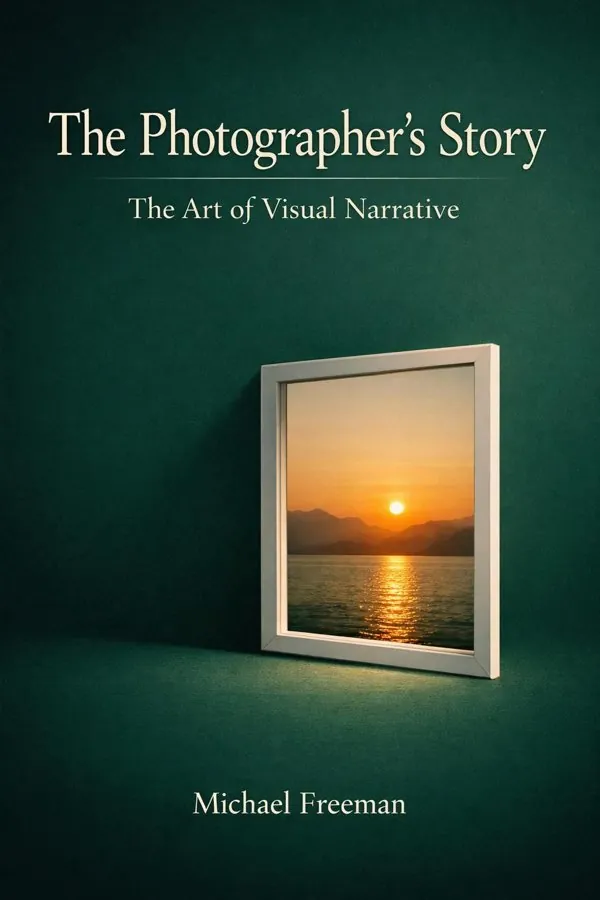
The Photographer's Story: The Art of Visual Narrative: Summary & Key Insights
 10 min8 chaptersAudio available
What Is The Photographer's Story: The Art of Visual Narrative About?
The Photographer's Story: The Art of Visual Narrative by Michael Freeman is a photography book spanning 8 pages. In this book, Michael Freeman explores the art of visual storytelling through photography. He guides readers on how to construct compelling photo narratives, drawing from his extensive experience as a professional photographer and photojournalist. The book delves into composition, sequencing, and the emotional impact of images, offering practical insights for both aspiring and seasoned photographers.
This FizzRead summary covers all 8 key chapters of The Photographer's Story: The Art of Visual Narrative in approximately 10 minutes, distilling the most important ideas, arguments, and takeaways from Michael Freeman's work. Also available as an audio summary and Key Quotes Podcast.
The Photographer's Story: The Art of Visual Narrative
In this book, Michael Freeman explores the art of visual storytelling through photography. He guides readers on how to construct compelling photo narratives, drawing from his extensive experience as a professional photographer and photojournalist. The book delves into composition, sequencing, and the emotional impact of images, offering practical insights for both aspiring and seasoned photographers.
Who Should Read The Photographer's Story: The Art of Visual Narrative?
This book is perfect for anyone interested in photography and looking to gain actionable insights in a short read. Whether you're a student, professional, or lifelong learner, the key ideas from The Photographer's Story: The Art of Visual Narrative by Michael Freeman will help you think differently.
- ✓Readers who enjoy photography and want practical takeaways
- ✓Professionals looking to apply new ideas to their work and life
- ✓Anyone who wants the core insights of The Photographer's Story: The Art of Visual Narrative in just 10 minutes
Want the full summary?
Get instant access to this book summary and 100K+ more with Fizz Moment.
Get Free SummaryAvailable on App Store • Free to download
Key Chapters
When we speak of narrative, we often think of words — novels, essays, or journalism. Yet storytelling principles are universal, reaching far beyond language. In photography, the tools are visual: framing, light, gesture, rhythm, and sequence. The photograph becomes the equivalent of a sentence, while a series of photographs becomes a paragraph or a chapter.
As in writing, the photographer considers plot, character, and setting. In visual terms, these become moment, subject, and environment. A narrative photograph suggests a before and after; it invites the viewer to imagine what has led to this point and what might follow. That imaginative engagement is the essence of storytelling. Without it, photographs risk becoming static descriptions rather than evocative experiences.
This translation from language to image involves adapting structural devices such as tension and release, climax, and resolution. Photographers can express these through contrasts of scale, the interplay of light and shadow, or a rhythm created by movement and stillness. The viewer reads visual cues in much the same way a reader interprets a sentence.
My approach has always been analytical yet intuitive. I often begin with a feeling — curiosity, irony, compassion — and then build the frame around that emotional core. In places as diverse as Burmese temples or Moroccan souks, I’ve discovered that story arises naturally when we are attentive to relationships: between people, between people and places, and between the photographer and the scene. Composition, then, is not merely design but choreography of meaning. The visual weight of each element determines how the eye travels across the frame, and in that journey lies the story.
Photographers often wrestle with a paradox: we want to be both invisible observers and active narrators. To tell a story visually, one must see beyond surface appearances and understand the human pulse beneath them. That requires empathy. The photographer must connect emotionally to the subject while maintaining clarity of intent.
As a photojournalist, I’ve worked in situations where observation and judgment intertwine — from documenting rituals in Asia to interpreting urban life. Each encounter taught me that objectivity can never be absolute; framing is an act of editing reality. A storyteller acknowledges that. The question is not whether to intervene, but how to interpret truth responsibly.
To be a storyteller is to take on a point of view. Every choice — lens, distance, angle, moment — carries meaning. The camera’s perspective becomes your voice, suggesting intimacy, distance, grandeur, or vulnerability. The more aware you are of that voice, the more authentically your narrative emerges.
At the same time, photography rewards patience. Observation means waiting for gestures to align, for light to become expressive, for the unexpected to unfold. Great stories depend on timing as much as structure. In moments of stillness, the photographer anticipates the scene’s rhythm, learning to see potential stories even before they happen. Over time, this cultivated awareness transforms ordinary observation into storytelling instinct.
+ 6 more chapters — available in the FizzRead app
All Chapters in The Photographer's Story: The Art of Visual Narrative
About the Author
Michael Freeman is a British photographer and author known for his expertise in photographic composition and visual design. He has written numerous books on photography and has worked extensively for publications such as Smithsonian Magazine, focusing on travel, architecture, and culture.
Get This Summary in Your Preferred Format
Read or listen to the The Photographer's Story: The Art of Visual Narrative summary by Michael Freeman anytime, anywhere. FizzRead offers multiple formats so you can learn on your terms — all free.
Available formats: App · Audio · PDF · EPUB — All included free with FizzRead
Download The Photographer's Story: The Art of Visual Narrative PDF and EPUB Summary
Key Quotes from The Photographer's Story: The Art of Visual Narrative
“When we speak of narrative, we often think of words — novels, essays, or journalism.”
“Photographers often wrestle with a paradox: we want to be both invisible observers and active narrators.”
Frequently Asked Questions about The Photographer's Story: The Art of Visual Narrative
The Photographer's Story: The Art of Visual Narrative by Michael Freeman is a photography book that explores key ideas across 8 chapters. In this book, Michael Freeman explores the art of visual storytelling through photography. He guides readers on how to construct compelling photo narratives, drawing from his extensive experience as a professional photographer and photojournalist. The book delves into composition, sequencing, and the emotional impact of images, offering practical insights for both aspiring and seasoned photographers.
More by Michael Freeman
You Might Also Like

An American In Provence
Jamie Beck
10 min
Camera Lucida: Reflections on Photography
Roland Barthes
10 min
Girl on Girl: Art and Photography in the Age of the Female Gaze
Charlotte Jansen
10 min
Mastering Composition: The Definitive Guide for Photographers
Richard Garvey-Williams
10 min
On Photography
Susan Sontag
10 min
Photography Q&A: Real Questions. Real Answers.
Zack Arias
10 minBrowse by Category
Ready to read The Photographer's Story: The Art of Visual Narrative?
Get the full summary and 100K+ more books with Fizz Moment.