
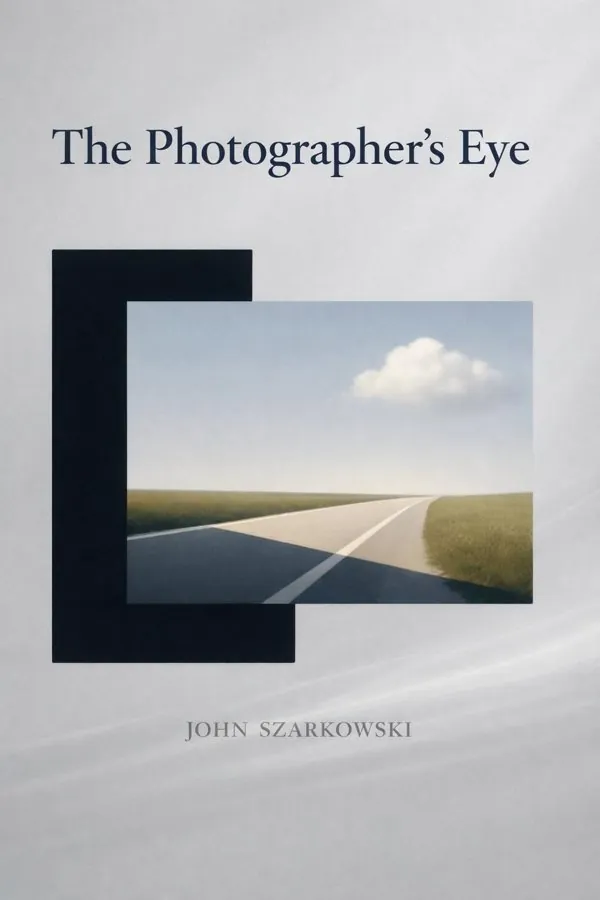
The Photographer’s Eye: Summary & Key Insights
 10 min7 chaptersAudio available
What Is The Photographer’s Eye About?
The Photographer’s Eye by John Szarkowski is a photography book spanning 7 pages. The Photographer’s Eye, originally published in 1966 by The Museum of Modern Art, explores the fundamental visual principles of photography. Drawing from the museum’s landmark 1964 exhibition, Szarkowski identifies key elements—such as the frame, vantage point, and time—that define photographic vision. The book presents works by masters like Atget, Cartier-Bresson, and Evans, offering a concise and influential study of the medium’s visual language.
This FizzRead summary covers all 7 key chapters of The Photographer’s Eye in approximately 10 minutes, distilling the most important ideas, arguments, and takeaways from John Szarkowski's work. Also available as an audio summary and Key Quotes Podcast.
The Photographer’s Eye
The Photographer’s Eye, originally published in 1966 by The Museum of Modern Art, explores the fundamental visual principles of photography. Drawing from the museum’s landmark 1964 exhibition, Szarkowski identifies key elements—such as the frame, vantage point, and time—that define photographic vision. The book presents works by masters like Atget, Cartier-Bresson, and Evans, offering a concise and influential study of the medium’s visual language.
Who Should Read The Photographer’s Eye?
This book is perfect for anyone interested in photography and looking to gain actionable insights in a short read. Whether you're a student, professional, or lifelong learner, the key ideas from The Photographer’s Eye by John Szarkowski will help you think differently.
- ✓Readers who enjoy photography and want practical takeaways
- ✓Professionals looking to apply new ideas to their work and life
- ✓Anyone who wants the core insights of The Photographer’s Eye in just 10 minutes
Want the full summary?
Get instant access to this book summary and 100K+ more with Fizz Moment.
Get Free SummaryAvailable on App Store • Free to download
Key Chapters
Each photograph begins with a fact, a tangible subject before the lens. Unlike painting, where imagination may construct entire worlds, photography starts with what is in front of the camera. We are obliged to begin with The Thing Itself. This truth gives photography both its authority and its limitation.
I have often said that a photograph is a record of the real world, yet not reality itself. The world grants the image its credibility, but the photographer must find within that world a new order. The photograph resembles its subject so closely that we may be deceived into thinking it is identical, yet the magic of photography lies precisely in this transformation of fact into form. When Walker Evans pointed his camera toward a decaying wall or Atget toward a deserted shopfront, they were not copying reality but interpreting it—the strength of their vision lay in how they made the familiar seem newly visible.
Photography thus stands as both a testimony and a translation. The thing photographed provides the raw material, but the eye that selects, frames, and captures defines what the picture becomes. The thing itself is the anchor, and yet, paradoxically, it is also where imagination begins.
The camera, by its nature, isolates. It crops from the flow of existence a fragment, a sliver of the larger whole. This ability to extract detail gives photography an intellectual precision unmatched by any other art. As our eyes wander, our attention darting from one impression to another, the camera freezes a particular configuration of light and form. It says: look here—this is part of the truth.
In embracing the detail, photography became the art of recognition rather than invention. From the earliest daguerreotypes to modern reportage, the camera’s revelation of seemingly trivial details has shaped how we understand the world. What once seemed insignificant now becomes symbolic. Consider Cartier-Bresson’s Paris streets or Dorothea Lange’s portrait of a weathered hand—each detail carries weight, serving as an emblem of human experience.
This selective vision is perhaps photography’s essential gift and challenge. The photographer must ask continually: what fragment contains the essence of the whole? What portion of the visible can bear the burden of meaning? The most eloquent photographs persuade us that the smallest details—a glint of light on glass, a discarded sign, a passing silhouette—sum up entire worlds.
+ 5 more chapters — available in the FizzRead app
All Chapters in The Photographer’s Eye
About the Author
John Szarkowski (1925–2007) was an American photographer, curator, and critic. As Director of Photography at The Museum of Modern Art in New York from 1962 to 1991, he profoundly shaped the understanding of photography as an art form. His writings and exhibitions helped establish photography’s place within modern visual culture.
Get This Summary in Your Preferred Format
Read or listen to the The Photographer’s Eye summary by John Szarkowski anytime, anywhere. FizzRead offers multiple formats so you can learn on your terms — all free.
Available formats: App · Audio · PDF · EPUB — All included free with FizzRead
Download The Photographer’s Eye PDF and EPUB Summary
Key Quotes from The Photographer’s Eye
“Each photograph begins with a fact, a tangible subject before the lens.”
“It crops from the flow of existence a fragment, a sliver of the larger whole.”
Frequently Asked Questions about The Photographer’s Eye
The Photographer’s Eye by John Szarkowski is a photography book that explores key ideas across 7 chapters. The Photographer’s Eye, originally published in 1966 by The Museum of Modern Art, explores the fundamental visual principles of photography. Drawing from the museum’s landmark 1964 exhibition, Szarkowski identifies key elements—such as the frame, vantage point, and time—that define photographic vision. The book presents works by masters like Atget, Cartier-Bresson, and Evans, offering a concise and influential study of the medium’s visual language.
You Might Also Like
An American In Provence
Jamie Beck
10 min
Camera Lucida: Reflections on Photography
Roland Barthes
10 min
Girl on Girl: Art and Photography in the Age of the Female Gaze
Charlotte Jansen
10 min
Mastering Composition: The Definitive Guide for Photographers
Richard Garvey-Williams
10 min
On Photography
Susan Sontag
10 min
Photography Q&A: Real Questions. Real Answers.
Zack Arias
10 minBrowse by Category
Ready to read The Photographer’s Eye?
Get the full summary and 100K+ more books with Fizz Moment.