
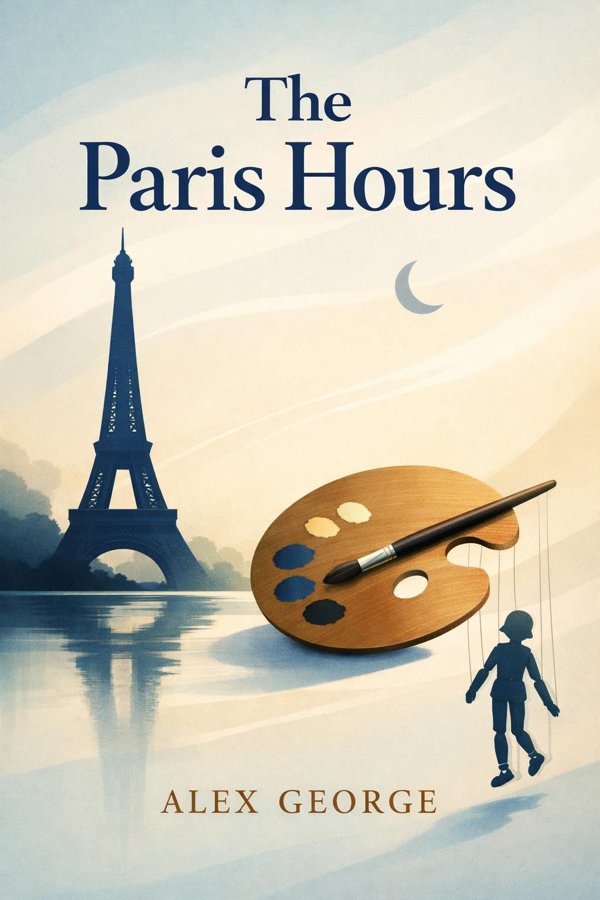
The Paris Hours: Summary & Key Insights
by Alex George
 10 min9 chaptersAudio available
Key Takeaways from The Paris Hours
A city can look healed long before its people feel whole.
To be unnoticed is painful; to be remembered incorrectly can be just as haunting.
Sometimes survival is not enough; a person also needs a way to return to themselves.
People often reveal their deepest truths through masks rather than direct confession.
A single day can contain the moral pressure of an entire life.
What Is The Paris Hours About?
The Paris Hours by Alex George is a bestsellers book spanning 5 pages. Set across a single day in Paris in 1927, The Paris Hours by Alex George is a beautifully constructed historical novel about people living quietly at the edge of reinvention. A painter, a puppeteer, a journalist, and a former housekeeper move through the city carrying grief, hope, guilt, and unfinished stories. Their lives seem separate at first, yet Paris itself gradually draws them together, revealing how private wounds can echo across strangers’ lives. What makes the novel so compelling is its balance of intimacy and sweep: it captures the glamour of literary salons, cafés, and boulevards while never losing sight of the emotional scars left by World War I. At its heart, this is a book about memory, art, loss, and the possibility of redemption. Alex George, known for lyrical historical fiction and a gift for warm, humane storytelling, brings both atmosphere and emotional intelligence to the novel. The result is a richly textured portrait of a city—and of ordinary people whose hidden inner lives prove quietly extraordinary.
This FizzRead summary covers all 9 key chapters of The Paris Hours in approximately 10 minutes, distilling the most important ideas, arguments, and takeaways from Alex George's work. Also available as an audio summary and Key Quotes Podcast.
The Paris Hours
Set across a single day in Paris in 1927, The Paris Hours by Alex George is a beautifully constructed historical novel about people living quietly at the edge of reinvention. A painter, a puppeteer, a journalist, and a former housekeeper move through the city carrying grief, hope, guilt, and unfinished stories. Their lives seem separate at first, yet Paris itself gradually draws them together, revealing how private wounds can echo across strangers’ lives. What makes the novel so compelling is its balance of intimacy and sweep: it captures the glamour of literary salons, cafés, and boulevards while never losing sight of the emotional scars left by World War I. At its heart, this is a book about memory, art, loss, and the possibility of redemption. Alex George, known for lyrical historical fiction and a gift for warm, humane storytelling, brings both atmosphere and emotional intelligence to the novel. The result is a richly textured portrait of a city—and of ordinary people whose hidden inner lives prove quietly extraordinary.
Who Should Read The Paris Hours?
This book is perfect for anyone interested in bestsellers and looking to gain actionable insights in a short read. Whether you're a student, professional, or lifelong learner, the key ideas from The Paris Hours by Alex George will help you think differently.
- ✓Readers who enjoy bestsellers and want practical takeaways
- ✓Professionals looking to apply new ideas to their work and life
- ✓Anyone who wants the core insights of The Paris Hours in just 10 minutes
Want the full summary?
Get instant access to this book summary and 100K+ more with Fizz Moment.
Get Free SummaryAvailable on App Store • Free to download
Key Chapters
A city can look healed long before its people feel whole. One of the most striking ideas in The Paris Hours is the contrast between Paris’s dazzling public life and the private pain still lodged in its streets, apartments, and hearts. In 1927, the war is over, cafés are lively, artists are working, and the city seems once again to be the cultural capital of Europe. Yet beneath that brightness sits exhaustion, mourning, and a fragile uncertainty about what the future means after mass loss.
Alex George uses Paris not merely as a setting but as an emotional landscape. The boulevards, bridges, bookshops, and crowded rooms hold memory as powerfully as the characters do. The city becomes a paradox: full of movement yet heavy with stillness, full of beauty yet shaped by absence. This matters because it shows how recovery works in real life. People often return to routines before they are emotionally ready. Societies celebrate progress while individuals are still trying to understand what they have survived.
This idea has practical resonance beyond the novel. Modern readers can recognize similar tensions in any place recovering from collective crisis. Work resumes, art returns, conversation restarts, but grief remains active under the surface. The novel reminds us to look beyond appearances—whether in cities, communities, or the people we know. Someone who looks composed may still be carrying an invisible war.
As you read, pay attention to the gap between what Paris displays and what its inhabitants suppress. Actionable takeaway: when assessing recovery—your own or others’—look beneath surface normalcy and make room for the emotions that public optimism often hides.
To be unnoticed is painful; to be remembered incorrectly can be just as haunting. Camille’s storyline explores the uneasy relationship between anonymity and permanence. Once the housekeeper to Marcel Proust, she lives close to one of literature’s great minds and to a man obsessed with memory, time, and the preservation of experience. Her search for a lost notebook is not just a plot device. It reflects a deeper human hunger: the desire to know that one’s life has mattered and will not vanish without trace.
Camille is not famous, wealthy, or socially powerful. That is precisely why her story feels so moving. She represents the many people history barely records—the workers, caretakers, companions, and witnesses whose lives support culture but rarely enter the official narrative. Through her, George asks who gets remembered and who gets erased. The notebook symbolizes more than paper. It stands for voice, testimony, and the fragile evidence of a life honestly lived.
In practical terms, Camille’s journey invites readers to think about their own relationship with memory. We often assume legacy belongs to public achievement, but the novel suggests otherwise. A life can matter through care, loyalty, endurance, and truth. Preserving stories—through journals, conversations, photographs, letters, or family history—becomes an act of dignity.
Camille also teaches that searching for the past is rarely about nostalgia alone. It can be a necessary step toward self-understanding. She is not simply retrieving an object; she is reclaiming meaning.
Actionable takeaway: record one story from your life or your family’s history that might otherwise disappear, because remembrance is one of the simplest ways to honor ordinary significance.
Sometimes survival is not enough; a person also needs a way to return to themselves. Guillaume, the painter, embodies this idea through his struggle to make art after profound disruption. In The Paris Hours, painting is not treated as decorative talent or social ambition. It is presented as a form of resurrection—an attempt to rebuild identity when trauma, disappointment, or time has left a person feeling diminished.
Guillaume’s artistic life reveals an important truth: creativity is often less about inspiration than about courage. To make art is to risk exposure. It means placing one’s inner life into visible form and accepting that it may be misunderstood, ignored, or judged. For someone carrying wounds, that vulnerability can feel nearly impossible. Yet George shows that art can transform pain not by erasing it, but by giving it shape. What cannot be spoken directly may still be painted, staged, written, or sung.
This idea has broad application. Not everyone is a professional artist, but almost everyone needs some means of expression. Journaling, music, sketching, cooking, gardening, or building something with one’s hands can serve a similar function. The point is not excellence; it is honest engagement. Creative practice can help people process grief, reclaim agency, and reconnect with beauty after hardship.
Guillaume’s arc also challenges the assumption that healing must look efficient or practical. Art may not solve external problems, but it can restore inner coherence. It reminds us that making something can be a declaration that life still contains possibility.
Actionable takeaway: choose one creative habit—even a small one—and practice it consistently for a week, not to produce a masterpiece, but to reconnect with your own interior life.
People often reveal their deepest truths through masks rather than direct confession. Souren, the puppeteer, demonstrates how performance can become one of the most honest forms of communication. On the surface, puppetry might seem whimsical or marginal compared with painting, literature, or journalism. But in The Paris Hours, it carries emotional and philosophical weight. Through crafted figures and staged stories, Souren reaches feelings that ordinary speech cannot safely express.
This is one of the novel’s most subtle insights: artifice can uncover authenticity. A puppet is not alive, yet it allows living people to project fear, tenderness, humor, guilt, and longing into visible form. The distance created by performance makes difficult truths bearable. We do this in everyday life too. We talk more freely while discussing a film, a song, or a fictional character because indirect language feels safer than naked exposure.
Souren’s work also highlights the importance of audience. Healing is not only about expression; it also depends on being witnessed. A performance becomes meaningful because someone receives it. In this way, George suggests that connection is collaborative. We need both the courage to show ourselves and the generosity to attend to others.
Practically, this idea applies to parenting, teaching, therapy, and friendship. Storytelling tools—metaphor, role-play, fiction, art—can help people articulate emotions they cannot yet name. Children often do this naturally through play, but adults benefit from it too.
Souren reminds us that what looks small or old-fashioned may hold profound power. Actionable takeaway: when direct conversation feels impossible, try expressing a difficult feeling through a story, image, or symbolic object and share it with someone you trust.
A single day can contain the moral pressure of an entire life. Jean-Paul’s storyline introduces conflict, urgency, and the idea that ordinary decisions are rarely simple when they are shaped by fear, regret, or responsibility. He is not portrayed as a tidy hero or villain. Instead, Alex George gives him the burden of human complexity: the knowledge that choices made in one moment can ripple through many others.
What makes this thread compelling is how it links private conflict with the novel’s larger pattern of interwoven destinies. Jean-Paul moves through Paris believing, as many people do, that his struggle is uniquely his own. But the city keeps proving otherwise. Individual actions intersect. Secrets travel. One person’s attempt to protect themselves may wound another, while one act of courage may open a path to grace for several people at once.
This reflects real life more accurately than stories that divide people into the innocent and the guilty. Most moral dilemmas arise in gray areas—between loyalty and honesty, self-preservation and sacrifice, love and duty. Jean-Paul’s tension reminds readers that being human means acting without complete certainty and then living with the consequences.
The practical lesson is to treat choices with humility. We cannot control every outcome, but we can pause long enough to ask better questions: What fear is driving me? Who else might be affected? What would integrity require here? The novel does not promise that good choices always lead to easy results, only that evasion deepens damage.
Actionable takeaway: before making a difficult decision, write down the likely impact on yourself and on at least two other people; clarity often emerges when consequences are made concrete.
What we remember is never neutral; it becomes the architecture of who we think we are. Throughout The Paris Hours, memory is not treated as a passive archive but as an active force shaping identity, desire, and behavior. Characters do not simply carry the past; they interpret it, revise it, flee it, and sometimes build their lives around it. The result is a novel deeply interested in how remembrance can both preserve and distort the self.
This theme resonates strongly because memory is selective. We emphasize certain scenes, blur others, and often attach meaning retrospectively. A kindness can become a lifeline in recollection; a loss can become a defining myth. In Camille’s connection to Proust, in the war’s lingering shadow, and in each character’s private history, George explores the tension between what happened and what continues to live emotionally.
That insight has practical importance. Many people assume they are trapped by their past, when in fact they are trapped by a single interpretation of it. The novel does not preach easy reinvention, nor does it deny the reality of pain. Instead, it implies that healing may begin when memory is approached with curiosity rather than submission. What if a past event contains more than one truth? What if remembrance can be honoring without being imprisoning?
This applies in daily life through reflection, therapy, conversation, or writing. Revisiting formative memories can reveal hidden assumptions about worth, guilt, or belonging.
Actionable takeaway: identify one memory that strongly shapes how you see yourself and ask what alternative, equally truthful interpretation might exist; a shift in meaning can create room for change.
The most radical kindness in fiction is to take ordinary lives seriously. One of the achievements of The Paris Hours is its refusal to reserve depth for the famous, glamorous, or obviously powerful. Although literary figures and artistic circles hover at the edges of the novel, its emotional center belongs to people who might normally pass unnoticed: a housekeeper, a puppeteer, a struggling painter, a working journalist. George insists that their hopes and wounds deserve the same narrative dignity history often grants only to celebrated names.
This matters because readers are trained by both culture and media to equate significance with visibility. Yet most human life happens outside the spotlight. The novel invites us to see routine labor, modest ambition, and quiet endurance as worthy of close attention. That shift in perspective can be deeply affirming. It tells readers that they do not need an extraordinary résumé for their emotional lives to matter.
There is a practical ethical lesson here too. If every stranger carries a complex inner world, then impatience, dismissal, and casual judgment become harder to justify. The waiter, neighbor, cleaner, or clerk standing before us may be living through grief, yearning, artistic aspiration, or moral conflict as intense as anything in grand literature.
The book’s tenderness toward ordinary people is part of what makes it memorable. It restores proportion to our understanding of human value. Achievement matters, but attention matters too.
Actionable takeaway: practice looking at one person you normally overlook and imagine the hidden pressures, memories, and desires they may carry; empathy often begins with disciplined attention.
People are rarely saved by grand theories; they are more often changed by encounters that break isolation. Beneath its elegant structure and historical atmosphere, The Paris Hours is a novel about redemption through connection. Each central character is enclosed in some form of solitude—by grief, secrecy, disappointment, or fear. Paris surrounds them with crowds, but crowds are not the same as intimacy. The movement of the story gradually reveals that healing becomes possible when people risk being known.
Importantly, George does not present redemption as moral perfection or complete closure. His characters are not simply cleansed of the past. Instead, they edge toward honesty, mercy, and renewed participation in life. That is a more believable and useful vision of change. Redemption here is relational. It arises when someone tells the truth, listens without cruelty, offers forgiveness, or chooses courage over concealment.
This idea has immediate application. Many struggles worsen in secrecy. Shame thrives where there is no witness, and grief hardens when it is carried alone. The novel suggests that while solitude can be necessary for reflection, prolonged isolation distorts perspective. We often need another person to help us bear what we cannot solve.
Connection also requires timing and trust. Not every confession is wise, and not every listener is safe. But the book encourages movement toward openness rather than permanent retreat. Even small acts—a candid conversation, an apology, a shared memory—can alter the emotional direction of a life.
Actionable takeaway: identify one burden you have been carrying alone and share a truthful version of it with a trustworthy person; connection may not erase pain, but it can make redemption imaginable.
All Chapters in The Paris Hours
About the Author
Alex George is a British-born novelist, lawyer, and bookseller who lives in the United States. He is known for writing thoughtful, lyrical fiction that combines strong characterization with a vivid sense of time and place. His novels include A Good American, Setting Free the Kites, and The Paris Hours, and his work often explores memory, identity, family, and the hidden emotional lives of ordinary people. Beyond his writing, George has also been active in the literary community as a bookseller and advocate for independent bookstores and reading culture. His fiction is widely appreciated for its warmth, humane insight, and elegant prose. In The Paris Hours, he brings those strengths to a richly atmospheric portrait of postwar Paris and the intertwined destinies of four memorable characters.
Get This Summary in Your Preferred Format
Read or listen to the The Paris Hours summary by Alex George anytime, anywhere. FizzRead offers multiple formats so you can learn on your terms — all free.
Available formats: App · Audio · PDF · EPUB — All included free with FizzRead
Download The Paris Hours PDF and EPUB Summary
Key Quotes from The Paris Hours
“A city can look healed long before its people feel whole.”
“To be unnoticed is painful; to be remembered incorrectly can be just as haunting.”
“Sometimes survival is not enough; a person also needs a way to return to themselves.”
“People often reveal their deepest truths through masks rather than direct confession.”
“A single day can contain the moral pressure of an entire life.”
Frequently Asked Questions about The Paris Hours
The Paris Hours by Alex George is a bestsellers book that explores key ideas across 9 chapters. Set across a single day in Paris in 1927, The Paris Hours by Alex George is a beautifully constructed historical novel about people living quietly at the edge of reinvention. A painter, a puppeteer, a journalist, and a former housekeeper move through the city carrying grief, hope, guilt, and unfinished stories. Their lives seem separate at first, yet Paris itself gradually draws them together, revealing how private wounds can echo across strangers’ lives. What makes the novel so compelling is its balance of intimacy and sweep: it captures the glamour of literary salons, cafés, and boulevards while never losing sight of the emotional scars left by World War I. At its heart, this is a book about memory, art, loss, and the possibility of redemption. Alex George, known for lyrical historical fiction and a gift for warm, humane storytelling, brings both atmosphere and emotional intelligence to the novel. The result is a richly textured portrait of a city—and of ordinary people whose hidden inner lives prove quietly extraordinary.
You Might Also Like
The Godfather
Mario Puzo
10 min
The Handmaid's Tale
Margaret Atwood
10 min
The Hunger Games
Suzanne Collins
10 min
The Nightingale
Kristin Hannah
10 min
The Seven Husbands of Evelyn Hugo
Taylor Jenkins Reid
10 min
Backwater Justice
Fern Michaels
10 minBrowse by Category
Ready to read The Paris Hours?
Get the full summary and 100K+ more books with Fizz Moment.