
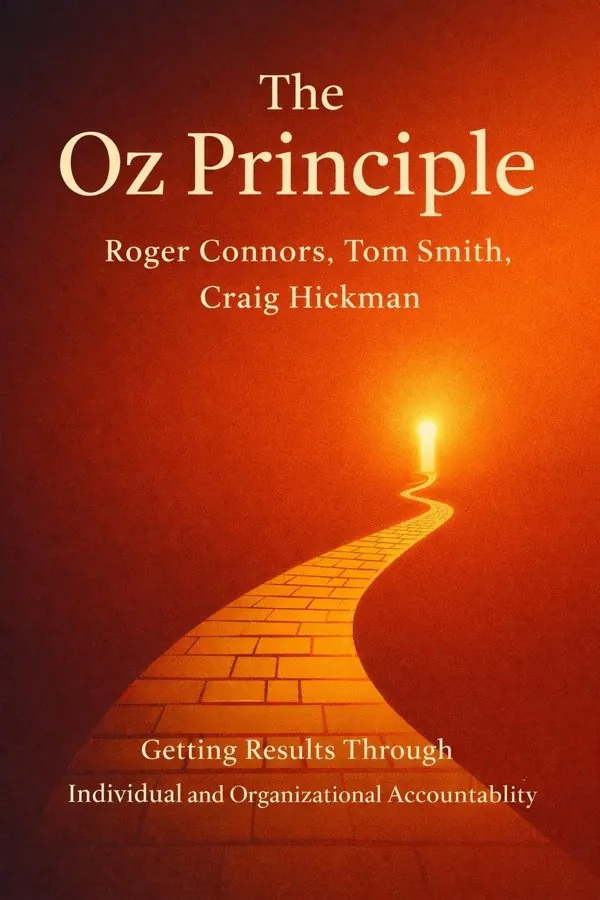
The Oz Principle: Getting Results Through Individual and Organizational Accountability: Summary & Key Insights
by Roger Connors, Tom Smith, Craig Hickman
 10 min3 chaptersAudio available
What Is The Oz Principle: Getting Results Through Individual and Organizational Accountability About?
The Oz Principle: Getting Results Through Individual and Organizational Accountability by Roger Connors, Tom Smith, Craig Hickman is a leadership book spanning 3 pages. The Oz Principle explores the concept of accountability as the key to achieving results in both personal and organizational contexts. Drawing on the metaphor of 'The Wizard of Oz,' the authors illustrate how individuals and teams can move from a victim mindset to one of ownership, empowerment, and proactive problem-solving. The book provides practical frameworks and tools to foster a culture of accountability that drives performance and success.
This FizzRead summary covers all 3 key chapters of The Oz Principle: Getting Results Through Individual and Organizational Accountability in approximately 10 minutes, distilling the most important ideas, arguments, and takeaways from Roger Connors, Tom Smith, Craig Hickman's work. Also available as an audio summary and Key Quotes Podcast.
The Oz Principle: Getting Results Through Individual and Organizational Accountability
The Oz Principle explores the concept of accountability as the key to achieving results in both personal and organizational contexts. Drawing on the metaphor of 'The Wizard of Oz,' the authors illustrate how individuals and teams can move from a victim mindset to one of ownership, empowerment, and proactive problem-solving. The book provides practical frameworks and tools to foster a culture of accountability that drives performance and success.
Who Should Read The Oz Principle: Getting Results Through Individual and Organizational Accountability?
This book is perfect for anyone interested in leadership and looking to gain actionable insights in a short read. Whether you're a student, professional, or lifelong learner, the key ideas from The Oz Principle: Getting Results Through Individual and Organizational Accountability by Roger Connors, Tom Smith, Craig Hickman will help you think differently.
- ✓Readers who enjoy leadership and want practical takeaways
- ✓Professionals looking to apply new ideas to their work and life
- ✓Anyone who wants the core insights of The Oz Principle: Getting Results Through Individual and Organizational Accountability in just 10 minutes
Want the full summary?
Get instant access to this book summary and 100K+ more with Fizz Moment.
Get Free SummaryAvailable on App Store • Free to download
Key Chapters
In every troubled organization we’ve encountered, there exists a storyline that unfolds almost predictably—it’s the story of the Victim Cycle. It begins innocently enough: targets aren’t met, communication falters, resources shrink, or market conditions shift. People start asking, “Who’s to blame?” or “Why is this happening to us?” Before long, the narrative of victimization gains strength. People focus on circumstances instead of solutions and spend more time explaining why results didn’t occur than figuring out how to make them happen.
This is what we call living Below the Line—a state where accountability is absent and people react to problems by denying, blaming, or rationalizing. Below the Line thinking feels comforting because it shields us from discomfort. Yet it is deceptive. Victim thinking robs individuals and organizations of the power to change. The essence of the Victim Cycle is energy misdirection: every ounce of attention goes toward justification instead of creation.
We’ve heard countless variations of this story in boardrooms and break rooms alike: “We can’t succeed because management doesn’t support us.” “If only corporate would understand our challenges.” “The clients are too demanding.” Over time, such language creates an invisible ceiling on performance. When people see themselves as powerless, they stop seeking solutions. The irony is that in trying to avoid responsibility, we also forfeit influence.
Escaping the Victim Cycle demands one critical insight: accountability begins with self-awareness. The first step out of the Below the Line mindset is to notice how often we default to excuses or external explanations. The moment we acknowledge this pattern, we gain a foothold to rise above it. In essence, accountability rewires the story. Instead of responding with “Who caused this?” the accountable question becomes “What can I do?”
Working with hundreds of organizations, we observed that high-performance cultures are built not by eradicating obstacles but by reframing them. The difference between thriving and stagnating environments is not the number of problems they face—it is the speed and courage with which they move Above the Line to confront them. Being Above the Line means owning reality, no matter how uncomfortable. It means seeing yourself as the agent of change rather than its subject. Such a shift may feel small, but it creates profound momentum.
To rise Above the Line consistently, we developed a simple but powerful framework: the four steps to accountability—See It, Own It, Solve It, and Do It. These steps are not linear commands but rather interdependent mindsets that together define what it means to take full ownership of results.
See It is about recognizing reality for what it is. Accountability starts with awareness: seeing the truth, however inconvenient, and acknowledging the factors—both external and internal—that have led to the current situation. We discovered that individuals who See It clearly never get stuck in illusion or denial. They listen generously, invite feedback, and seek multiple perspectives. Seeing is more than observing; it is understanding without distortion. Only when we are brutally honest with reality can we begin to craft genuine solutions.
Own It follows naturally. Once you have seen things as they are, the next move is to accept your role in them. Ownership is not self-blame—it is self-empowerment. To Own It means to say, “Regardless of how we got here, what can I do to move forward?” This shift transforms passivity into initiative. When organizations instill this belief collectively, projects stop languishing in endless justification meetings and start moving with purpose. Every person feels the weight—and the potential—of their contribution.
Solve It embodies creativity in action. Accountability does not end at recognition; it manifests in solution-making. Those who Solve It go beyond complaining about constraints. They innovate within them. We’ve seen frontline employees propose process improvements that saved millions, simply because they refused to stop at identifying problems. Solving It energizes the workplace with possibility and fosters collaboration rooted in shared responsibility.
Finally, Do It represents execution—the vital test of accountability. All the insight and ownership in the world mean little without follow-through. The most accountable organizations are relentless in ensuring commitments turn into results. Doing It requires courage, discipline, and integrity. It is the point where intent meets evidence.
When individuals and teams move through these four steps consistently, accountability becomes habitual. It ceases to be enforced and becomes self-driven. In that environment, results stop being accidental—they become expectable. The four steps, then, are not a program or a slogan; they are the DNA of sustained performance.
+ 1 more chapters — available in the FizzRead app
All Chapters in The Oz Principle: Getting Results Through Individual and Organizational Accountability
About the Authors
Roger Connors, Tom Smith, and Craig Hickman are recognized experts in organizational culture and leadership development. They co-founded Partners In Leadership, a consulting firm specializing in accountability and culture change. Their work has influenced numerous Fortune 500 companies and is widely cited in the field of management and leadership.
Get This Summary in Your Preferred Format
Read or listen to the The Oz Principle: Getting Results Through Individual and Organizational Accountability summary by Roger Connors, Tom Smith, Craig Hickman anytime, anywhere. FizzRead offers multiple formats so you can learn on your terms — all free.
Available formats: App · Audio · PDF · EPUB — All included free with FizzRead
Download The Oz Principle: Getting Results Through Individual and Organizational Accountability PDF and EPUB Summary
Key Quotes from The Oz Principle: Getting Results Through Individual and Organizational Accountability
“In every troubled organization we’ve encountered, there exists a storyline that unfolds almost predictably—it’s the story of the Victim Cycle.”
“To rise Above the Line consistently, we developed a simple but powerful framework: the four steps to accountability—See It, Own It, Solve It, and Do It.”
Frequently Asked Questions about The Oz Principle: Getting Results Through Individual and Organizational Accountability
The Oz Principle: Getting Results Through Individual and Organizational Accountability by Roger Connors, Tom Smith, Craig Hickman is a leadership book that explores key ideas across 3 chapters. The Oz Principle explores the concept of accountability as the key to achieving results in both personal and organizational contexts. Drawing on the metaphor of 'The Wizard of Oz,' the authors illustrate how individuals and teams can move from a victim mindset to one of ownership, empowerment, and proactive problem-solving. The book provides practical frameworks and tools to foster a culture of accountability that drives performance and success.
More by Roger Connors, Tom Smith, Craig Hickman
You Might Also Like
Extreme Ownership
Jocko Willink
10 min
Dare to Lead
Brene Brown
10 min
Leaders Eat Last
Simon Sinek
10 min
The 21 Irrefutable Laws of Leadership
John Maxwell
10 min
Start With Why
Simon Sinek
10 min
How to Lead When You're Not in Charge
Clay Scroggins
10 minBrowse by Category
Ready to read The Oz Principle: Getting Results Through Individual and Organizational Accountability?
Get the full summary and 100K+ more books with Fizz Moment.