
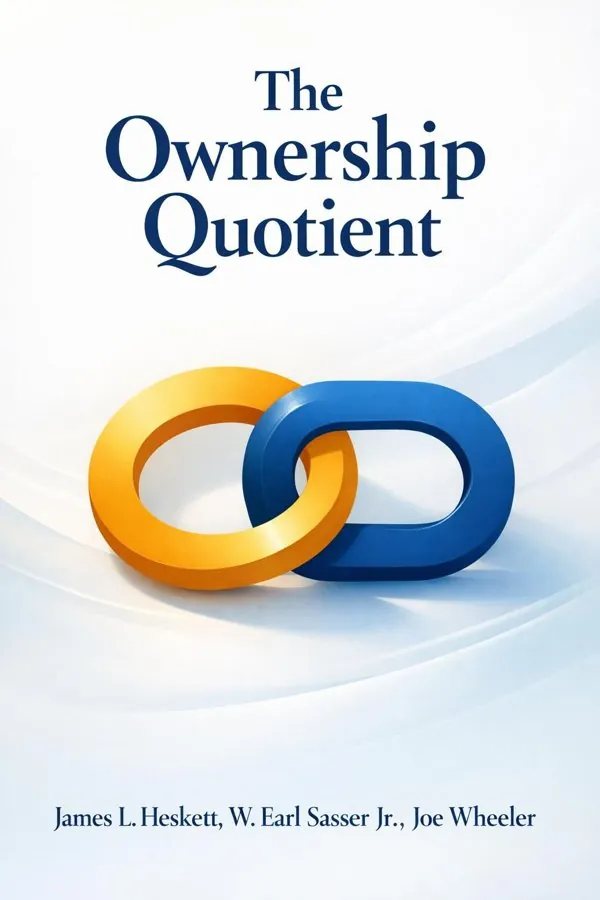
The Ownership Quotient: Putting the Service Profit Chain to Work for Unbeatable Competitive Advantage: Summary & Key Insights
by James L. Heskett, W. Earl Sasser Jr., Joe Wheeler
 10 min9 chaptersAudio available
What Is The Ownership Quotient: Putting the Service Profit Chain to Work for Unbeatable Competitive Advantage About?
The Ownership Quotient: Putting the Service Profit Chain to Work for Unbeatable Competitive Advantage by James L. Heskett, W. Earl Sasser Jr., Joe Wheeler is a leadership book spanning 9 pages. The book explores how companies can achieve sustainable competitive advantage by fostering a sense of ownership among employees and customers. Building on the Service Profit Chain framework, the authors demonstrate how organizations that create emotional connections with both employees and customers can drive superior performance, loyalty, and profitability. Through case studies and research insights, the book provides a roadmap for leaders to build cultures of engagement and accountability.
This FizzRead summary covers all 9 key chapters of The Ownership Quotient: Putting the Service Profit Chain to Work for Unbeatable Competitive Advantage in approximately 10 minutes, distilling the most important ideas, arguments, and takeaways from James L. Heskett, W. Earl Sasser Jr., Joe Wheeler's work. Also available as an audio summary and Key Quotes Podcast.
The Ownership Quotient: Putting the Service Profit Chain to Work for Unbeatable Competitive Advantage
The book explores how companies can achieve sustainable competitive advantage by fostering a sense of ownership among employees and customers. Building on the Service Profit Chain framework, the authors demonstrate how organizations that create emotional connections with both employees and customers can drive superior performance, loyalty, and profitability. Through case studies and research insights, the book provides a roadmap for leaders to build cultures of engagement and accountability.
Who Should Read The Ownership Quotient: Putting the Service Profit Chain to Work for Unbeatable Competitive Advantage?
This book is perfect for anyone interested in leadership and looking to gain actionable insights in a short read. Whether you're a student, professional, or lifelong learner, the key ideas from The Ownership Quotient: Putting the Service Profit Chain to Work for Unbeatable Competitive Advantage by James L. Heskett, W. Earl Sasser Jr., Joe Wheeler will help you think differently.
- ✓Readers who enjoy leadership and want practical takeaways
- ✓Professionals looking to apply new ideas to their work and life
- ✓Anyone who wants the core insights of The Ownership Quotient: Putting the Service Profit Chain to Work for Unbeatable Competitive Advantage in just 10 minutes
Want the full summary?
Get instant access to this book summary and 100K+ more with Fizz Moment.
Get Free SummaryAvailable on App Store • Free to download
Key Chapters
We coined the term Ownership Quotient to describe the degree to which employees and customers feel emotionally connected to the success of the organization. It is not simply about having loyal employees or satisfied customers, but about nurturing genuine commitment — a sense of belonging that motivates both groups to act as stewards of the brand.
The Service Profit Chain emphasized the causal link between employee satisfaction, customer loyalty, and profitability. However, as our research matured, we noticed that satisfaction alone could not sustain outstanding performance. Some employees were content yet passive; some customers were satisfied yet indifferent. The difference lay in ownership. When individuals see themselves as part of something larger, they invest discretionary effort and creativity into its success.
This quotient can be observed and measured through behavioral indicators. Employees with high ownership take initiative beyond their formal roles. Customers with strong ownership advocate for the company, defend it, and participate in its improvement. By introducing the Ownership Quotient, we sought to give managers a new way of diagnosing and developing these emotional bonds.
But ownership must be authentic. It begins with transparency — making sure everyone understands how the organization operates and what success looks like. It grows through involvement — inviting individuals to shape outcomes and decisions. And it endures through recognition — celebrating collective achievement rather than only individual performance. The moment employees and customers perceive fairness, trust, and purpose, ownership takes root. When they do not, disengagement spreads like corrosion.
Thus, the Ownership Quotient offers leaders a way to translate emotional engagement into measurable business performance. It is not a slogan but a management system grounded in research and proven in practice.
When employees are emotionally engaged, service quality transforms from mechanical execution into genuine experience. Engagement goes beyond motivation; it connects personal identity with organizational purpose. In our studies, emotionally engaged employees consistently delivered service that delighted customers even under pressure, because their behavior arose from conviction, not compliance.
Consider Ritz-Carlton, whose staff are empowered to make decisions that protect the guest experience. Each employee receives discretion to spend money solving a customer problem before seeking managerial approval. This trust signals that management values judgment, not just efficiency. The result is not chaos but commitment — employees treat guests as if they were welcoming them into their own home.
This emotional investment radiates outward. Customers perceive authenticity immediately. They interact not with brands but with human beings who care. Emotional engagement drives the subtle but crucial behaviors — tone of voice, anticipation of needs, empathy — that cannot be mandated by procedure. When engagement thrives, these interactions accumulate into loyalty.
Yet engagement cannot be forced through slogans or incentives. It grows in cultures where leadership listens actively, removes operational barriers, and provides meaning. We found that employees who understand the link between their performance and customer impact show measurable improvements in quality metrics. Their emotional connection translates directly into financial returns because customers respond with repeat business and advocacy.
If you, as a leader, wish to cultivate this engagement, start by examining whether people in your organization know why their work matters. Purpose is the foundation of emotional connection. Recognize the stories of impact that inspire pride, and you will begin to see service delivery shift from routine to remarkable.
+ 7 more chapters — available in the FizzRead app
All Chapters in The Ownership Quotient: Putting the Service Profit Chain to Work for Unbeatable Competitive Advantage
About the Authors
James L. Heskett is a professor emeritus at Harvard Business School known for his work on service management and organizational performance. W. Earl Sasser Jr. is a Baker Foundation Professor at Harvard Business School and a pioneer in service operations management. Joe Wheeler is an executive director at The Service Profit Chain Institute and a consultant specializing in customer experience and leadership development.
Get This Summary in Your Preferred Format
Read or listen to the The Ownership Quotient: Putting the Service Profit Chain to Work for Unbeatable Competitive Advantage summary by James L. Heskett, W. Earl Sasser Jr., Joe Wheeler anytime, anywhere. FizzRead offers multiple formats so you can learn on your terms — all free.
Available formats: App · Audio · PDF · EPUB — All included free with FizzRead
Download The Ownership Quotient: Putting the Service Profit Chain to Work for Unbeatable Competitive Advantage PDF and EPUB Summary
Key Quotes from The Ownership Quotient: Putting the Service Profit Chain to Work for Unbeatable Competitive Advantage
“We coined the term Ownership Quotient to describe the degree to which employees and customers feel emotionally connected to the success of the organization.”
“When employees are emotionally engaged, service quality transforms from mechanical execution into genuine experience.”
Frequently Asked Questions about The Ownership Quotient: Putting the Service Profit Chain to Work for Unbeatable Competitive Advantage
The Ownership Quotient: Putting the Service Profit Chain to Work for Unbeatable Competitive Advantage by James L. Heskett, W. Earl Sasser Jr., Joe Wheeler is a leadership book that explores key ideas across 9 chapters. The book explores how companies can achieve sustainable competitive advantage by fostering a sense of ownership among employees and customers. Building on the Service Profit Chain framework, the authors demonstrate how organizations that create emotional connections with both employees and customers can drive superior performance, loyalty, and profitability. Through case studies and research insights, the book provides a roadmap for leaders to build cultures of engagement and accountability.
You Might Also Like

Extreme Ownership
Jocko Willink
10 min
Dare to Lead
Brene Brown
10 min
Leaders Eat Last
Simon Sinek
10 min
The 21 Irrefutable Laws of Leadership
John Maxwell
10 min
Start With Why
Simon Sinek
10 min
How to Lead When You're Not in Charge
Clay Scroggins
10 minBrowse by Category
Ready to read The Ownership Quotient: Putting the Service Profit Chain to Work for Unbeatable Competitive Advantage?
Get the full summary and 100K+ more books with Fizz Moment.