
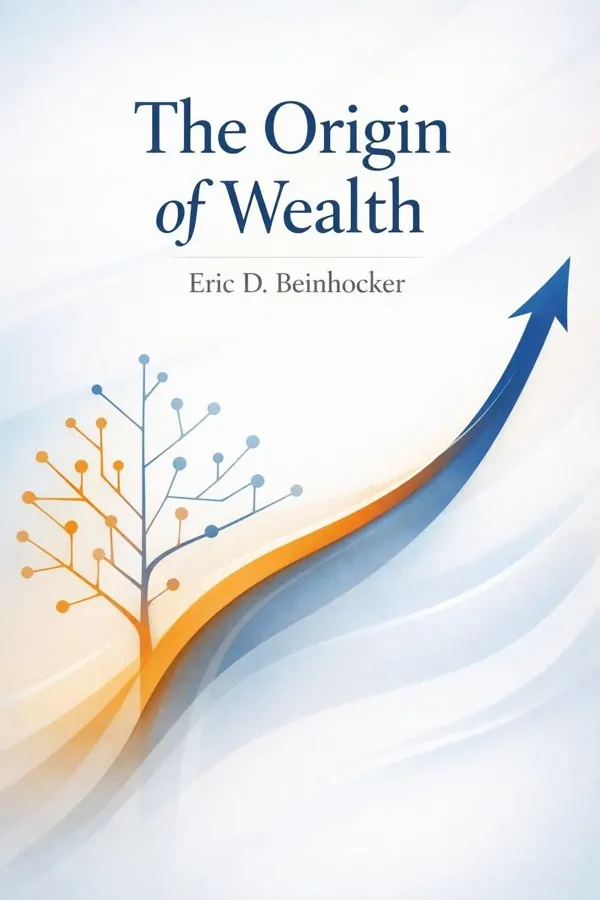
The Origin of Wealth: Evolution, Complexity, and the Radical Remaking of Economics: Summary & Key Insights
 10 min7 chaptersAudio available
What Is The Origin of Wealth: Evolution, Complexity, and the Radical Remaking of Economics About?
The Origin of Wealth: Evolution, Complexity, and the Radical Remaking of Economics by Eric D. Beinhocker is a economics book spanning 7 pages. In this groundbreaking work, Eric D. Beinhocker explores how wealth emerges through evolutionary processes in the economy. Drawing on insights from complexity science, evolutionary biology, and behavioral economics, he argues that traditional economic theories fail to explain how innovation and growth truly occur. The book presents a new framework for understanding economic systems as dynamic, adaptive, and ever-evolving networks of agents and ideas.
This FizzRead summary covers all 7 key chapters of The Origin of Wealth: Evolution, Complexity, and the Radical Remaking of Economics in approximately 10 minutes, distilling the most important ideas, arguments, and takeaways from Eric D. Beinhocker's work. Also available as an audio summary and Key Quotes Podcast.
The Origin of Wealth: Evolution, Complexity, and the Radical Remaking of Economics
In this groundbreaking work, Eric D. Beinhocker explores how wealth emerges through evolutionary processes in the economy. Drawing on insights from complexity science, evolutionary biology, and behavioral economics, he argues that traditional economic theories fail to explain how innovation and growth truly occur. The book presents a new framework for understanding economic systems as dynamic, adaptive, and ever-evolving networks of agents and ideas.
Who Should Read The Origin of Wealth: Evolution, Complexity, and the Radical Remaking of Economics?
This book is perfect for anyone interested in economics and looking to gain actionable insights in a short read. Whether you're a student, professional, or lifelong learner, the key ideas from The Origin of Wealth: Evolution, Complexity, and the Radical Remaking of Economics by Eric D. Beinhocker will help you think differently.
- ✓Readers who enjoy economics and want practical takeaways
- ✓Professionals looking to apply new ideas to their work and life
- ✓Anyone who wants the core insights of The Origin of Wealth: Evolution, Complexity, and the Radical Remaking of Economics in just 10 minutes
Want the full summary?
Get instant access to this book summary and 100K+ more with Fizz Moment.
Get Free SummaryAvailable on App Store • Free to download
Key Chapters
Wealth, in its most fundamental sense, is not about money—it is about the creation of order that has fitness, or usefulness, in the world. To see wealth as 'fit order' is to see it as structured patterns of knowledge embodied in technologies, organizations, and institutions that enable human beings to solve problems and meet needs more effectively than before.
Historically, economics has tended to treat wealth as something to be measured in monetary terms—GDP, income, or stock valuations. But such measures are surface reflections of a deeper, more dynamic process. What truly matters is the underlying knowledge that allows societies to transform energy and matter into forms that generate value. Consider a simple product like a smartphone: its value lies not in the physical materials but in the layered design intelligence—software, algorithms, user interfaces—that make it useful. That design is a product of accumulated knowledge, trial, and error across generations of innovation.
When we define wealth in this evolutionary and informational way, many economic puzzles dissolve. Wealth creation becomes a continuous process of adaptation to changing environments. It is less about accumulating static stocks of capital and more about nurturing ecosystems that continuously produce new 'fit orders'—new ways of arranging matter, energy, and information to better serve human goals. Thus, the origin of wealth lies in our species’ remarkable capacity to learn, experiment, and evolve culturally and technologically.
If wealth is the accumulation of fit order, then evolution is its engine. Just as in biological systems, economic evolution unfolds through differentiation, selection, and amplification. New ideas, products, or institutions emerge through the creative recombination of existing elements. Some of these variants prove more 'fit'—they succeed in solving problems or satisfying human desires better than others. These successful patterns are selected and amplified through market processes, organizational growth, and social imitation.
This evolutionary framework replaces the outdated notion of equilibrium with one of continuous change. Economies are not static systems seeking balance; they are dynamic processes exploring a vast landscape of possibilities. Like nature, they operate far from equilibrium, driven by feedback loops, nonlinear interactions, and history-dependent paths. In this evolving universe, success depends not on achieving a perfect state but on the capacity to adapt.
The key insight is that evolution produces complexity without a designer. The decentralized interactions of millions of human agents—each experimenting, learning, and imitating—generate emergent patterns of order that no single mind could foresee. This is how businesses evolve industries, how technologies advance, and how societies reinvent themselves.
+ 5 more chapters — available in the FizzRead app
All Chapters in The Origin of Wealth: Evolution, Complexity, and the Radical Remaking of Economics
About the Author
Eric D. Beinhocker is an American economist and executive director of the Institute for New Economic Thinking at the Oxford Martin School, University of Oxford. He previously worked at McKinsey & Company and has written extensively on complexity economics and the evolution of wealth.
Get This Summary in Your Preferred Format
Read or listen to the The Origin of Wealth: Evolution, Complexity, and the Radical Remaking of Economics summary by Eric D. Beinhocker anytime, anywhere. FizzRead offers multiple formats so you can learn on your terms — all free.
Available formats: App · Audio · PDF · EPUB — All included free with FizzRead
Download The Origin of Wealth: Evolution, Complexity, and the Radical Remaking of Economics PDF and EPUB Summary
Key Quotes from The Origin of Wealth: Evolution, Complexity, and the Radical Remaking of Economics
“Wealth, in its most fundamental sense, is not about money—it is about the creation of order that has fitness, or usefulness, in the world.”
“If wealth is the accumulation of fit order, then evolution is its engine.”
Frequently Asked Questions about The Origin of Wealth: Evolution, Complexity, and the Radical Remaking of Economics
The Origin of Wealth: Evolution, Complexity, and the Radical Remaking of Economics by Eric D. Beinhocker is a economics book that explores key ideas across 7 chapters. In this groundbreaking work, Eric D. Beinhocker explores how wealth emerges through evolutionary processes in the economy. Drawing on insights from complexity science, evolutionary biology, and behavioral economics, he argues that traditional economic theories fail to explain how innovation and growth truly occur. The book presents a new framework for understanding economic systems as dynamic, adaptive, and ever-evolving networks of agents and ideas.
You Might Also Like

Business Adventures
John Brooks
10 min
Nudge
Richard H. Thaler, Cass R. Sunstein
10 min
The Hitchhiker"s Guide to the Galaxy
Douglas Adams
10 minThe Muqaddimah
Ibn Khaldun
10 minThe Outsiders
William N. Thorndike
10 min
A Little History of Economics
Niall Kishtainy
10 minBrowse by Category
Ready to read The Origin of Wealth: Evolution, Complexity, and the Radical Remaking of Economics?
Get the full summary and 100K+ more books with Fizz Moment.