
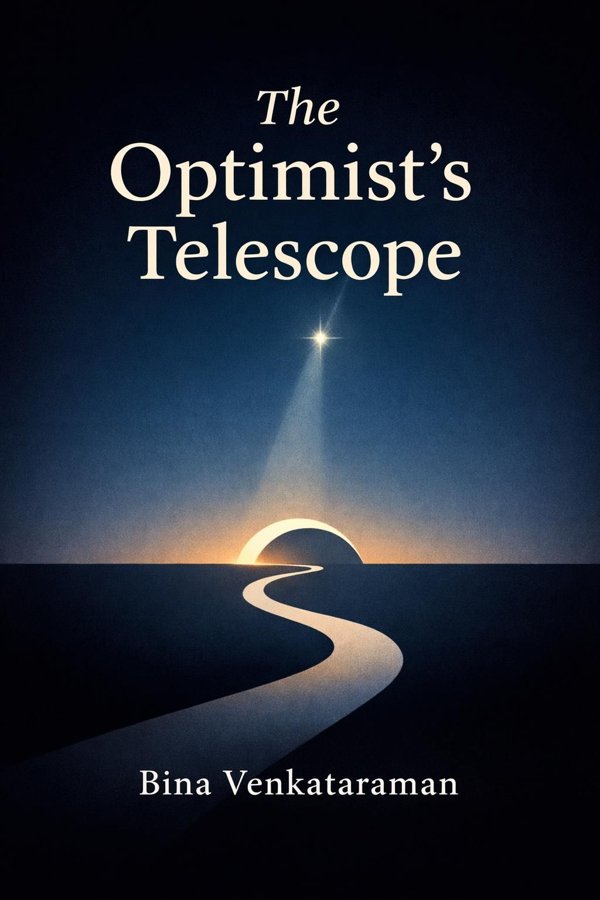
The Optimist's Telescope: Thinking Ahead in a Reckless Age: Summary & Key Insights
 10 min9 chaptersAudio available
What Is The Optimist's Telescope: Thinking Ahead in a Reckless Age About?
The Optimist's Telescope: Thinking Ahead in a Reckless Age by Bina Venkataraman is a mindset book spanning 9 pages. In this thought-provoking book, Bina Venkataraman explores how individuals and societies can make wiser decisions for the future in an age dominated by short-term thinking. Drawing on insights from science, economics, and history, she offers practical strategies to cultivate foresight and resilience, helping readers to act today with the future in mind.
This FizzRead summary covers all 9 key chapters of The Optimist's Telescope: Thinking Ahead in a Reckless Age in approximately 10 minutes, distilling the most important ideas, arguments, and takeaways from Bina Venkataraman's work. Also available as an audio summary and Key Quotes Podcast.
The Optimist's Telescope: Thinking Ahead in a Reckless Age
In this thought-provoking book, Bina Venkataraman explores how individuals and societies can make wiser decisions for the future in an age dominated by short-term thinking. Drawing on insights from science, economics, and history, she offers practical strategies to cultivate foresight and resilience, helping readers to act today with the future in mind.
Who Should Read The Optimist's Telescope: Thinking Ahead in a Reckless Age?
This book is perfect for anyone interested in mindset and looking to gain actionable insights in a short read. Whether you're a student, professional, or lifelong learner, the key ideas from The Optimist's Telescope: Thinking Ahead in a Reckless Age by Bina Venkataraman will help you think differently.
- ✓Readers who enjoy mindset and want practical takeaways
- ✓Professionals looking to apply new ideas to their work and life
- ✓Anyone who wants the core insights of The Optimist's Telescope: Thinking Ahead in a Reckless Age in just 10 minutes
Want the full summary?
Get instant access to this book summary and 100K+ more with Fizz Moment.
Get Free SummaryAvailable on App Store • Free to download
Key Chapters
At the root of our difficulty with foresight is an ancient quirk of the human mind. Psychologists call it 'present bias'—the tendency to favor immediate rewards over future gains, even when the long-term outcome is clearly better. In laboratories, it appears when subjects choose one cookie now over two later; in society, it manifests in citizens who vote for tax cuts while demanding better schools and infrastructure. This bias is not a moral failing; it is evolution’s way of ensuring survival in unpredictable environments. But the world we inhabit today—globalized, data-saturated, and intertwined—magnifies the cost of this bias exponentially.
In this chapter, I draw from behavioral science and experiments showing how our brains discount the future with astonishing speed. Studies reveal that when we imagine the future self, our brains often treat that self as a stranger. It’s no wonder we underinvest in retirement savings or health care; we simply don’t identify with the person who will bear the consequences. Culturally, too, our narratives celebrate near-term success: the quarterly earnings report, the breaking news cycle, the instant viral hit. As a result, we’ve built systems—from corporate incentives to political reelection cycles—that reward expediency over endurance.
But present bias is not destiny. Some societies and individuals have learned to overcome it by cultivating rituals and structures that keep the long view visible. I describe how Indigenous communities maintained ecological harmony through storytelling and seasonal ceremonies that encoded long-term memory into daily life. In Japan, the practice of 'future design' invites citizens to deliberate on policy as if they were residents of the year 2060, aligning decisions with imagined futures rather than current convenience. Through such practices, we begin to weaken the tyranny of the present. Foresight, like physical strength, grows with training—it thrives in communities that make the future tangible and familiar.
Our capacity for foresight depends on our grasp of history. When I interviewed scientists and policymakers, I was struck by how often they turned to historical analogies to navigate uncertainty. The eradication of smallpox, the environmental regulation victories of the 20th century, the reforestation movements—all arose because some people learned from previous crises where foresight had failed.
In this part, I invite readers to reexamine moments when humanity succeeded or stumbled in thinking ahead. We revisit, for instance, the Dust Bowl of the 1930s—caused by aggressive short-term cultivation that stripped the plains of resilience. Yet, out of that devastation, conservation efforts emerged that reshaped American agriculture. Likewise, the Montreal Protocol, which protected the ozone layer, stands out as a triumph of global foresight: nations agreed to limit harmful chemicals before catastrophe was irreversible. These stories remind us that humanity can pivot when we learn to read warning signs not as inevitabilities but as calls to stewardship.
By bringing history closer, we realize foresight is less about prediction than about pattern recognition. Those who can see continuity between past, present, and potential futures act not from fear, but from understanding. The telescope, in this sense, is also a rearview mirror—it lets us focus ahead by remembering where we’ve been.
+ 7 more chapters — available in the FizzRead app
All Chapters in The Optimist's Telescope: Thinking Ahead in a Reckless Age
About the Author
Bina Venkataraman is an American writer, journalist, and policy expert. A former journalist for The Boston Globe and The New York Times, she served as a senior advisor for climate change innovation in the Obama White House. She is currently the editorial page editor of The Boston Globe and a lecturer at MIT.
Get This Summary in Your Preferred Format
Read or listen to the The Optimist's Telescope: Thinking Ahead in a Reckless Age summary by Bina Venkataraman anytime, anywhere. FizzRead offers multiple formats so you can learn on your terms — all free.
Available formats: App · Audio · PDF · EPUB — All included free with FizzRead
Download The Optimist's Telescope: Thinking Ahead in a Reckless Age PDF and EPUB Summary
Key Quotes from The Optimist's Telescope: Thinking Ahead in a Reckless Age
“At the root of our difficulty with foresight is an ancient quirk of the human mind.”
“Our capacity for foresight depends on our grasp of history.”
Frequently Asked Questions about The Optimist's Telescope: Thinking Ahead in a Reckless Age
The Optimist's Telescope: Thinking Ahead in a Reckless Age by Bina Venkataraman is a mindset book that explores key ideas across 9 chapters. In this thought-provoking book, Bina Venkataraman explores how individuals and societies can make wiser decisions for the future in an age dominated by short-term thinking. Drawing on insights from science, economics, and history, she offers practical strategies to cultivate foresight and resilience, helping readers to act today with the future in mind.
You Might Also Like


Browse by Category
Ready to read The Optimist's Telescope: Thinking Ahead in a Reckless Age?
Get the full summary and 100K+ more books with Fizz Moment.