
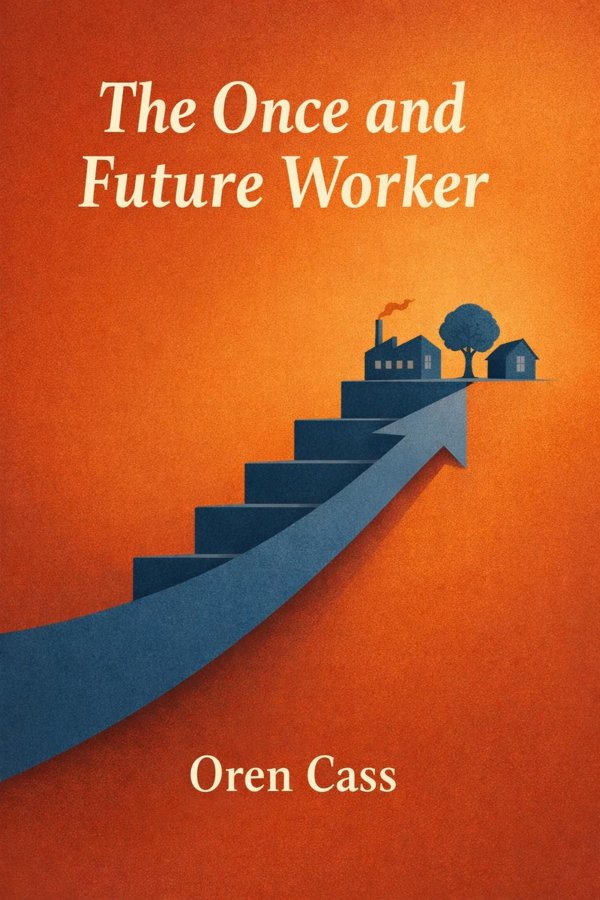
The Once and Future Worker: A Vision for the Renewal of Work in America: Summary & Key Insights
by Oren Cass
 10 min10 chaptersAudio available
Key Takeaways from The Once and Future Worker: A Vision for the Renewal of Work in America
A society can become richer on paper while growing weaker in practice.
The most important thing about work may be what it does to people, not just what it pays them.
Cheaper products are not the same as a stronger society.
A great education system does more than send the most ambitious students to college.
Free trade is not automatically good if it hollows out the nation’s capacity to employ its people well.
What Is The Once and Future Worker: A Vision for the Renewal of Work in America About?
The Once and Future Worker: A Vision for the Renewal of Work in America by Oren Cass is a economics book spanning 12 pages. What if America’s economic problem is not that people consume too little, but that too many people cannot find work that supports a family, builds dignity, and anchors a community? In The Once and Future Worker, Oren Cass argues that modern economic policy has drifted away from a basic truth: a healthy society depends on meaningful work. For decades, leaders across the political spectrum have judged success through GDP growth, cheaper consumer goods, and rising aggregate wealth. Cass contends that this framework misses what matters most in everyday life—whether people can contribute productively, form stable families, and participate in strong local institutions. Blending economic analysis with social criticism, Cass challenges the assumption that low prices and high consumption are enough to define prosperity. He calls instead for a worker-centered economy, one that values labor market health over abstract efficiency and treats employment as a social good, not merely a cost. Drawing on his experience as a public policy expert and founder of American Compass, Cass offers a provocative, policy-driven vision for renewing work in America through reforms in education, trade, welfare, and labor institutions.
This FizzRead summary covers all 10 key chapters of The Once and Future Worker: A Vision for the Renewal of Work in America in approximately 10 minutes, distilling the most important ideas, arguments, and takeaways from Oren Cass's work. Also available as an audio summary and Key Quotes Podcast.
The Once and Future Worker: A Vision for the Renewal of Work in America
What if America’s economic problem is not that people consume too little, but that too many people cannot find work that supports a family, builds dignity, and anchors a community? In The Once and Future Worker, Oren Cass argues that modern economic policy has drifted away from a basic truth: a healthy society depends on meaningful work. For decades, leaders across the political spectrum have judged success through GDP growth, cheaper consumer goods, and rising aggregate wealth. Cass contends that this framework misses what matters most in everyday life—whether people can contribute productively, form stable families, and participate in strong local institutions.
Blending economic analysis with social criticism, Cass challenges the assumption that low prices and high consumption are enough to define prosperity. He calls instead for a worker-centered economy, one that values labor market health over abstract efficiency and treats employment as a social good, not merely a cost. Drawing on his experience as a public policy expert and founder of American Compass, Cass offers a provocative, policy-driven vision for renewing work in America through reforms in education, trade, welfare, and labor institutions.
Who Should Read The Once and Future Worker: A Vision for the Renewal of Work in America?
This book is perfect for anyone interested in economics and looking to gain actionable insights in a short read. Whether you're a student, professional, or lifelong learner, the key ideas from The Once and Future Worker: A Vision for the Renewal of Work in America by Oren Cass will help you think differently.
- ✓Readers who enjoy economics and want practical takeaways
- ✓Professionals looking to apply new ideas to their work and life
- ✓Anyone who wants the core insights of The Once and Future Worker: A Vision for the Renewal of Work in America in just 10 minutes
Want the full summary?
Get instant access to this book summary and 100K+ more with Fizz Moment.
Get Free SummaryAvailable on App Store • Free to download
Key Chapters
A society can become richer on paper while growing weaker in practice. That is the historical puzzle Oren Cass places at the center of this book. In the decades after World War II, the United States built an economy in which rising productivity, strong industrial employment, and family formation often moved together. Work did not simply provide income; it organized daily life, gave workers social standing, and helped communities remain stable. Over time, however, policy priorities shifted. Economists and policymakers increasingly defined success in terms of maximizing consumption, expanding global efficiency, and increasing GDP, even if those gains were unevenly distributed or socially disruptive.
Cass argues that this postwar evolution did not happen all at once. It emerged through many decisions in trade, education, welfare, and labor policy. Manufacturing decline, offshoring, weakened unions, and the growth of a credential-based professional economy all changed what kinds of jobs were available and who could access them. Communities that once depended on productive work often found themselves replaced by transfer payments, low-wage service work, or labor force withdrawal. The official numbers could still look healthy, but local realities told another story.
A useful example is the difference between national economic growth and regional collapse. A city may gain access to cheaper imported products while losing the factories that sustained local households. The result is not just fewer jobs, but weaker civic life, delayed marriage, and less optimism for the next generation.
Actionable takeaway: When judging economic change, ask not only whether it lowers prices or raises output, but whether it expands access to stable, productive work that can support families and communities.
The most important thing about work may be what it does to people, not just what it pays them. Cass insists that labor should not be understood as merely one input in a market transaction. Work shapes identity, discipline, social responsibility, and belonging. A job can give a person structure, connect effort to reward, and create pride in contributing to something larger than oneself. In that sense, work is not only an economic activity but a moral and cultural institution.
This idea challenges the dominant view that a society can compensate for lost work with cheap goods, tax credits, or public benefits. Cass does not deny that income matters. Rather, he argues that income alone cannot replace the formative role of participation in productive life. A worker-centered economy therefore asks a different question from a consumption-centered one. Instead of asking, “How can we maximize material abundance?” it asks, “How can we ensure that more citizens are able to build decent lives through work?”
Consider the contrast between two households with similar income. One relies on unstable part-time jobs and public assistance; the other on steady employment with clear responsibilities and room for advancement. Even if annual income appears similar, the social and psychological realities are profoundly different. Stability, self-respect, and long-term planning are easier when work is dependable and meaningful.
Cass’s point also applies to policy design. Wage subsidies, vocational pathways, apprenticeship systems, and labor standards can be judged by whether they strengthen productive participation rather than simply increasing disposable income.
Actionable takeaway: Evaluate your own definition of prosperity. Include not only what people can buy, but whether they have reliable opportunities to contribute, grow, and support others through work.
Cheaper products are not the same as a stronger society. One of Cass’s sharpest critiques is aimed at the consumption-centered model that has dominated modern economic thinking. In this model, policy is considered successful if consumers get lower prices, more choices, and greater purchasing power. The assumption is that if households can buy more for less, welfare has improved. Cass argues that this framework is too narrow because it treats people primarily as consumers rather than as workers, parents, neighbors, and citizens.
The problem is that consumer gains can coexist with labor market losses. A family may benefit from inexpensive imported goods at the same time that its community loses the industries that provided stable employment. Nationally, economists might count the savings at the checkout counter while understating the social costs of wage stagnation, labor force decline, addiction, family breakdown, and regional despair. A policy can be efficient in market terms but destructive in human terms.
This does not mean Cass rejects markets or abundance. His argument is about hierarchy: consumption should serve the health of society, not define it. Economic policy should care whether workers can negotiate fair wages, whether communities retain productive capacity, and whether family-supporting employment remains widely available.
A practical application is how we discuss retail savings from trade deals or automation. Instead of celebrating lower prices alone, a fuller analysis would ask who lost bargaining power, what happened to local job ladders, and whether displaced workers found comparable roles. These are not side issues; for Cass, they are the main event.
Actionable takeaway: The next time an economic policy is praised for lowering costs, ask the companion question: what did it do to the availability, quality, and dignity of work?
A great education system does more than send the most ambitious students to college. Cass argues that America’s education culture has become too narrowly organized around a single ideal: the bachelor’s degree as the default route to success. In practice, this model leaves many young people underserved. It treats non-college pathways as second-rate, even though the economy needs technicians, skilled tradespeople, machine operators, health support workers, and many others whose jobs can be stable, valuable, and respected.
Cass’s concern is not anti-college. It is anti-monoculture. When policymakers push “college for all,” they often ignore differences in aptitude, interests, and labor market realities. Students may accumulate debt, fail to complete degrees, or graduate into jobs unrelated to their studies. Meanwhile, employers struggle to fill practical roles requiring technical competence rather than academic credentials. The result is a mismatch between education and work.
He points to alternatives such as apprenticeships, vocational education, employer partnerships, and career-focused high school tracks. Countries with strong technical training systems often integrate school and work more effectively, helping young adults move into productive employment without forcing everyone through the same pipeline. In the United States, community colleges, industry certifications, and earn-and-learn models could play a much larger role.
For families and local leaders, this means redefining success. A welder, radiology technician, electrician, or advanced manufacturing specialist should not be seen as settling for less. These can be pathways to solid income, mastery, and family stability.
Actionable takeaway: Support education policies and personal choices that align training with real labor market opportunities, and treat vocational and technical pathways as dignified first-choice options, not backup plans.
Free trade is not automatically good if it hollows out the nation’s capacity to employ its people well. Cass challenges the conventional wisdom that trade liberalization should be pursued whenever it increases efficiency or lowers consumer prices. He argues that trade policy must be evaluated in light of its impact on domestic production, strategic resilience, and the quality of work available to citizens.
For many economists, imports that reduce costs are a clear win, and workers displaced by global competition can in theory move into better jobs elsewhere. Cass responds that this theory often failed in reality. Adjustment was slow, painful, and geographically concentrated. Workers did not seamlessly relocate or retrain. Entire towns built around manufacturing lost their economic core. The damage spread beyond wages to local institutions, tax bases, marriage rates, and public confidence.
Cass does not call for blanket isolationism. Rather, he advocates a more balanced approach that recognizes domestic production as a public good. Tariffs, industrial policy, procurement rules, and strategic trade measures may at times be justified if they preserve critical industries and support broad-based employment. This is especially relevant in sectors tied to national security, supply chain resilience, or regional economic health.
A practical example is semiconductor production or essential medical supply chains. Relying entirely on global markets may appear efficient until disruption reveals the hidden costs of dependency. Similarly, encouraging domestic manufacturing can create job ladders for workers without elite credentials.
Actionable takeaway: Think of trade policy not only as a tool for maximizing cheap imports, but as a strategic choice about what kind of productive capacity and employment base a nation wants to preserve.
Markets do not simply discover wages and conditions; institutions help determine them. Cass emphasizes that labor markets are not natural phenomena operating in a vacuum. Rules, norms, bargaining structures, immigration policy, and corporate governance all influence how gains are distributed between capital and labor. If policymakers care about workers, they cannot assume that growth alone will naturally translate into good jobs.
One reason for worker vulnerability, in Cass’s view, is the weakening of institutions that once gave employees more leverage and security. Union decline, fissured workplaces, the rise of contracting arrangements, and relentless pressure for short-term shareholder returns have often reduced worker power. At the same time, labor regulation has not adapted well to modern employment forms. The result is an economy where many firms optimize flexibility and cost minimization while workers bear more instability.
Cass’s worker-centered approach therefore includes rebuilding labor market institutions. This could mean sectoral bargaining, stronger support for worker organization, wage standards, or policies that discourage exploitative employment models. It could also involve rethinking immigration in sectors where labor oversupply suppresses wages or weakens incentives for firms to invest in training and productivity.
At the company level, the concept translates into management choices as well. Firms can choose to invest in retention, skill development, and internal promotion rather than relying on high turnover and precarious scheduling. Public policy can reward such behavior through procurement, tax preferences, or labor-linked standards.
Actionable takeaway: Do not treat wages and job quality as the inevitable output of impersonal markets. Support institutions and policies that strengthen worker bargaining power, encourage long-term investment in employees, and raise the floor for decent work.
When work weakens, families often weaken with it. Cass repeatedly ties labor market health to broader social outcomes, especially marriage, childrearing, and community stability. His argument is not that economics explains everything, but that the ability to contribute materially remains central to adult responsibility and family formation. Stable work helps people plan, commit, and build. Persistent job insecurity does the opposite.
This connection is especially visible in places where male labor force participation has fallen sharply. As access to family-supporting jobs declines, marriage rates often fall, nonmarital births rise, and social fragmentation increases. Cass is careful not to romanticize the past, but he insists that productive roles matter. A society cannot assume strong families will survive indefinitely if work becomes unstable, low-status, or unavailable for large portions of the population.
The implications are broader than household budgets. Schools, churches, civic groups, and neighborhoods all depend on adults who feel rooted and invested. Someone with predictable hours, career direction, and a sense of obligation is more likely to coach a youth team, care for elderly relatives, or participate in local institutions. Work creates habits of responsibility that spill over into community life.
A practical example is the difference between an area dominated by stable skilled employment and one dominated by churn in low-wage service jobs. In the former, workers can budget, save, and imagine a future. In the latter, instability makes long-term commitments harder.
Actionable takeaway: When thinking about family policy, do not focus only on benefits and services. Also ask whether the labor market offers enough stable, respectable work to make long-term commitment and caregiving realistically attainable.
A compassionate safety net can become counterproductive if it stops caring about whether people work. Cass criticizes both the left and the right for often discussing welfare in incomplete ways. One side may emphasize reducing poverty through transfers; the other may focus on shrinking government spending. Cass’s worker-centered lens asks a different question: does social policy strengthen the norm and feasibility of productive participation?
He does not argue against public support for families in hardship. In fact, he acknowledges that many households need assistance. His concern is that benefit systems often prioritize income supplementation without enough regard for how program design affects work incentives, family structure, and social expectations. If benefits phase out sharply as earnings rise, or if support is detached from any pathway into stable employment, policy may relieve immediate pain while reinforcing long-term dependency or detachment from the labor market.
Cass favors reforms that make work pay and support caregiving without treating nonwork as the default answer. Wage subsidies, child benefits connected to family formation, and local employment initiatives can be more constructive than systems that merely transfer cash while accepting labor market dysfunction as permanent. He also urges policymakers to address the underlying absence of good jobs rather than using welfare as a substitute for economic renewal.
For example, expanding benefits in a deindustrialized town may help residents survive, but if no effort is made to rebuild productive capacity, the community remains fragile. Social insurance should cushion shocks while encouraging reattachment and responsibility.
Actionable takeaway: Judge welfare policy by two standards at once: whether it protects vulnerable households today, and whether it reinforces a realistic path toward stable work, family responsibility, and long-term independence.
If policymakers obsess over the wrong statistics, they will build the wrong economy. Cass argues that conventional economic measurement hides crucial realities. GDP can rise when financial activity expands, when imports get cheaper, or when affluent regions surge ahead, even as millions of workers face stagnating wages, declining participation, and social breakdown. Aggregate output is useful, but it is not a complete account of national well-being.
Cass calls for a shift in policy goals and the metrics used to evaluate success. Rather than asking only how fast the economy is growing, leaders should ask whether wages can support families, whether prime-age adults are working, whether communities retain productive industries, and whether gains are broadly distributed across regions and classes. Measures of labor force participation, median wages, household formation, and job quality may reveal more about the health of a society than headline GDP alone.
This matters because measurement shapes public priorities. If the central benchmark is consumer welfare, then automation, offshoring, and labor substitution may seem unambiguously positive. If the benchmark includes worker flourishing, then the same policies require a more careful assessment. Data should help expose social trade-offs, not conceal them.
A practical application is local and state economic development. Instead of celebrating any investment that increases taxable activity, officials can evaluate whether new projects create career ladders, retain local talent, and support family life. The same logic applies to corporate reporting and national policy scorekeeping.
Actionable takeaway: Expand the definition of economic success. Look beyond GDP and low prices to metrics that track whether people can find stable, productive, family-supporting work where they live.
America’s work crisis will not be solved by nostalgia or by market fatalism. Cass closes with a broad agenda for renewal that combines economic, political, and cultural reform. His central claim is that society must relearn how to govern markets toward social ends. The goal is not to freeze the economy in place or resist every technological shift, but to shape institutions so that innovation supports workers rather than displacing them without recourse.
This agenda spans multiple domains. In education, it means elevating vocational pathways and connecting schools more directly to employers. In trade, it means protecting strategic industries and rebuilding domestic productive capacity. In labor markets, it means creating institutions that raise wages and bargaining power. In welfare, it means designing support systems that reinforce work and family life. And culturally, it means restoring respect for productive labor across the class spectrum.
Cass also points to the political challenge. Elites often benefit from the current model, whether through cheaper services, investment returns, or professional insulation from labor market disruption. Worker-centered reform therefore requires leadership willing to contest comfortable assumptions. It asks conservatives to move beyond simplistic faith in deregulated markets and progressives to move beyond transfer-based remedies detached from employment.
At ground level, renewal can begin with local coalitions: businesses investing in apprenticeships, schools partnering with industry, mayors prioritizing productive development, and civic organizations treating work as a social priority.
Actionable takeaway: Replace resignation with institution-building. Whether in policy, business, education, or community leadership, look for concrete ways to strengthen productive work as the foundation of economic and social renewal.
All Chapters in The Once and Future Worker: A Vision for the Renewal of Work in America
About the Author
Oren Cass is an American public policy expert, writer, and leading voice in debates about work, wages, and the future of the U.S. economy. He is the founder and chief economist of American Compass, a think tank focused on developing a worker-centered conservative economic agenda. Before launching American Compass, Cass was a senior fellow at the Manhattan Institute, where he wrote widely on labor markets, social policy, and industrial strategy. He also served as domestic policy director for Mitt Romney’s 2012 presidential campaign. Known for challenging market orthodoxies on the right, Cass argues that economic policy should prioritize strong families, productive employment, and national resilience over abstract measures like consumer welfare alone. His work has influenced conversations across politics, business, and policy circles.
Get This Summary in Your Preferred Format
Read or listen to the The Once and Future Worker: A Vision for the Renewal of Work in America summary by Oren Cass anytime, anywhere. FizzRead offers multiple formats so you can learn on your terms — all free.
Available formats: App · Audio · PDF · EPUB — All included free with FizzRead
Download The Once and Future Worker: A Vision for the Renewal of Work in America PDF and EPUB Summary
Key Quotes from The Once and Future Worker: A Vision for the Renewal of Work in America
“A society can become richer on paper while growing weaker in practice.”
“The most important thing about work may be what it does to people, not just what it pays them.”
“Cheaper products are not the same as a stronger society.”
“A great education system does more than send the most ambitious students to college.”
“Free trade is not automatically good if it hollows out the nation’s capacity to employ its people well.”
Frequently Asked Questions about The Once and Future Worker: A Vision for the Renewal of Work in America
The Once and Future Worker: A Vision for the Renewal of Work in America by Oren Cass is a economics book that explores key ideas across 10 chapters. What if America’s economic problem is not that people consume too little, but that too many people cannot find work that supports a family, builds dignity, and anchors a community? In The Once and Future Worker, Oren Cass argues that modern economic policy has drifted away from a basic truth: a healthy society depends on meaningful work. For decades, leaders across the political spectrum have judged success through GDP growth, cheaper consumer goods, and rising aggregate wealth. Cass contends that this framework misses what matters most in everyday life—whether people can contribute productively, form stable families, and participate in strong local institutions. Blending economic analysis with social criticism, Cass challenges the assumption that low prices and high consumption are enough to define prosperity. He calls instead for a worker-centered economy, one that values labor market health over abstract efficiency and treats employment as a social good, not merely a cost. Drawing on his experience as a public policy expert and founder of American Compass, Cass offers a provocative, policy-driven vision for renewing work in America through reforms in education, trade, welfare, and labor institutions.
You Might Also Like
Business Adventures
John Brooks
10 min
Nudge
Richard H. Thaler, Cass R. Sunstein
10 min
The Hitchhiker"s Guide to the Galaxy
Douglas Adams
10 minThe Muqaddimah
Ibn Khaldun
10 minThe Outsiders
William N. Thorndike
10 min
A Little History of Economics
Niall Kishtainy
10 minBrowse by Category
Ready to read The Once and Future Worker: A Vision for the Renewal of Work in America?
Get the full summary and 100K+ more books with Fizz Moment.