
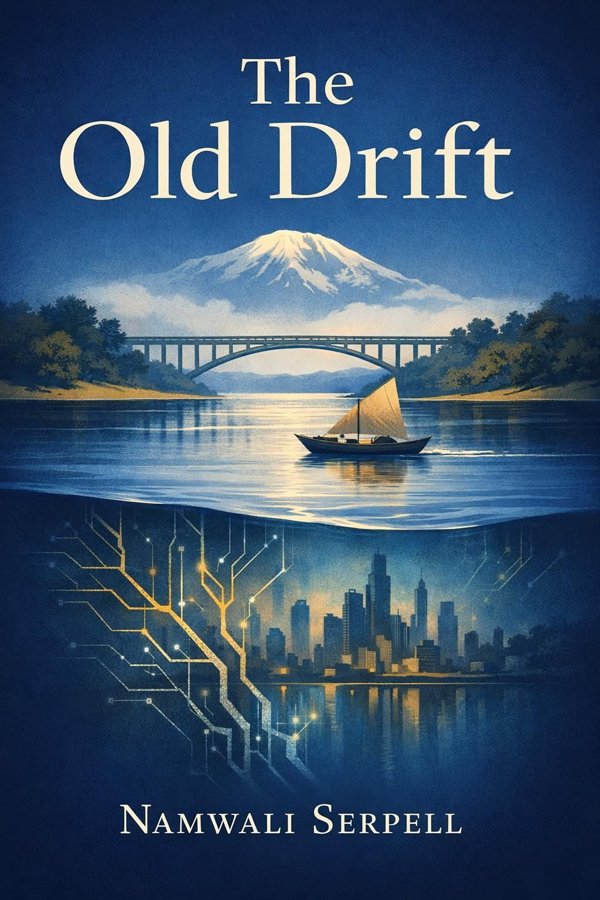
The Old Drift: Summary & Key Insights
 10 min9 chaptersAudio available
Key Takeaways from The Old Drift
History often begins not with noble purpose, but with confusion, vanity, and unintended consequences.
A body can become an archive when history refuses to write certain lives down.
The end of empire does not end the people shaped by it.
Families survive history not only through adaptation, but through stories that make survival bearable.
Political liberation is transformative, but it does not magically erase the structures that came before.
What Is The Old Drift About?
The Old Drift by Namwali Serpell is a bestsellers book spanning 8 pages. What if a nation’s history could be told not as a straight line, but as a swarm of voices, accidents, inheritances, and inventions? The Old Drift by Namwali Serpell is a sweeping, genre-defying novel that follows three interwoven families in Zambia across more than a century, from colonial incursion to political independence and into a speculative technological future. Blending historical fiction, family saga, satire, romance, magical realism, and science fiction, Serpell turns private lives into a lens on national transformation. The novel begins at the Old Drift settlement near the Zambezi River, where a minor colonial mishap quietly sets in motion generations of entanglement among African, European, and Indian descendants. From there, it explores illness, migration, desire, revolution, memory, and innovation with unusual formal daring and emotional depth. The book matters because it refuses simplified narratives about Africa, modernity, or empire; instead, it shows how history lives on in bodies, relationships, infrastructure, and imagination. Serpell, a celebrated Zambian writer and literary scholar, brings both intellectual authority and stylistic brilliance to a novel that is as ambitious as it is humane.
This FizzRead summary covers all 9 key chapters of The Old Drift in approximately 10 minutes, distilling the most important ideas, arguments, and takeaways from Namwali Serpell's work. Also available as an audio summary and Key Quotes Podcast.
The Old Drift
What if a nation’s history could be told not as a straight line, but as a swarm of voices, accidents, inheritances, and inventions? The Old Drift by Namwali Serpell is a sweeping, genre-defying novel that follows three interwoven families in Zambia across more than a century, from colonial incursion to political independence and into a speculative technological future. Blending historical fiction, family saga, satire, romance, magical realism, and science fiction, Serpell turns private lives into a lens on national transformation. The novel begins at the Old Drift settlement near the Zambezi River, where a minor colonial mishap quietly sets in motion generations of entanglement among African, European, and Indian descendants. From there, it explores illness, migration, desire, revolution, memory, and innovation with unusual formal daring and emotional depth. The book matters because it refuses simplified narratives about Africa, modernity, or empire; instead, it shows how history lives on in bodies, relationships, infrastructure, and imagination. Serpell, a celebrated Zambian writer and literary scholar, brings both intellectual authority and stylistic brilliance to a novel that is as ambitious as it is humane.
Who Should Read The Old Drift?
This book is perfect for anyone interested in bestsellers and looking to gain actionable insights in a short read. Whether you're a student, professional, or lifelong learner, the key ideas from The Old Drift by Namwali Serpell will help you think differently.
- ✓Readers who enjoy bestsellers and want practical takeaways
- ✓Professionals looking to apply new ideas to their work and life
- ✓Anyone who wants the core insights of The Old Drift in just 10 minutes
Want the full summary?
Get instant access to this book summary and 100K+ more with Fizz Moment.
Get Free SummaryAvailable on App Store • Free to download
Key Chapters
History often begins not with noble purpose, but with confusion, vanity, and unintended consequences. The Old Drift opens with Percy M. Clark, an Englishman whose arrival in colonial Zambia carries all the absurdity and arrogance of empire. He is not a heroic conqueror so much as a flawed, often ridiculous participant in a larger system of domination. Yet that is precisely Serpell’s point: empires are built not only by grand strategy, but by ordinary people who assume they have the right to enter, name, photograph, classify, and possess other worlds.
Percy’s presence at the Old Drift settlement near the Zambezi River establishes the novel’s foundational encounter between colonial fantasy and local reality. He embodies the intrusive gaze of empire, especially through photography, which in the novel becomes a symbol of control, framing, and distortion. What he sees is filtered through his assumptions; what he fails to understand becomes just as important as what he records. The colonial beginning is therefore not a stable point of origin but a mistake-ridden collision whose consequences ripple outward through bloodlines, institutions, and myths.
Serpell uses Percy to show that historical violence is often wrapped in eccentricity, curiosity, and self-justification. Readers can apply this insight beyond the novel by asking how present systems of power also hide behind seemingly harmless habits like documentation, tourism, development, or innovation. Who gets to observe, define, and archive others? Whose version becomes official?
Actionable takeaway: When examining any historical or contemporary system, look beyond heroic narratives and ask what assumptions, accidents, and unequal power relations made it possible.
A body can become an archive when history refuses to write certain lives down. Sibilla’s story shifts the novel away from the colonial outsider’s gaze and into a deeply intimate African experience shaped by illness, vulnerability, and endurance. Her body is not merely a private site of pain; it becomes a place where broader social forces register themselves. Through Sibilla, Serpell shows that colonial history is not only enacted through borders and policies, but also through medicine, sexuality, superstition, and the unequal meanings assigned to women’s suffering.
Sibilla’s illness marks her as fragile and mysterious, but Serpell refuses to reduce her to victimhood. Instead, Sibilla becomes a foundational figure in the African family line, one whose experiences reverberate through descendants. Her relationship to motherhood, intimacy, and memory creates a counter-history to official records. If Percy’s camera represents one kind of historical capture, Sibilla’s body represents another: history lived, endured, and passed on through emotion, blood, and silence.
This part of the novel also demonstrates how private pain becomes collective inheritance. Families often carry unresolved trauma through habits, fears, stories, and absences, even when no one names the original wound. In real life, this can be seen in how communities pass down anxieties around authority, health, or belonging after periods of violence or displacement.
Serpell’s treatment of Sibilla invites readers to take seriously forms of knowledge that are often dismissed as feminine, bodily, or irrational. These are not marginal to history; they are central to it.
Actionable takeaway: Pay attention to what bodies, family stories, and silences reveal about history, especially when formal archives leave important lives out.
The end of empire does not end the people shaped by it. Through Agnes, Serpell explores the European lineage not at the moment of colonial confidence, but in the emotionally disorienting aftermath of war, migration, and diminishing certainty. Agnes belongs to a world where imperial identity no longer offers stable meaning, yet its assumptions still linger. Her life reveals that colonial systems damage not only the colonized, but also those who inherit distorted ideas of belonging, superiority, and home.
Agnes’s story is marked by displacement. She is caught between geographies and identities, unable to return to a pure origin because such an origin never really existed. Serpell treats this not as a sentimental tragedy, but as evidence that colonialism produces psychic instability alongside political domination. The colonizer’s descendants may lose status, certainty, or direction, but they do so from within structures they benefited from. This tension gives Agnes’s storyline moral and emotional complexity.
What makes this section especially powerful is how Serpell avoids caricature. Agnes is not simply a symbol of European decline; she is a person navigating loneliness, history, and the erosion of inherited narratives. In modern terms, her story can help readers think about what happens when long-dominant identities begin to confront their own fragility. Societies undergoing demographic, political, or cultural shifts often experience similar anxiety.
The practical value of Agnes’s arc lies in its insistence that reckoning requires more than nostalgia or guilt. It demands an honest examination of how identity was constructed in the first place and who paid the price for it.
Actionable takeaway: When inherited identities feel unstable, resist romanticizing the past and instead investigate the power structures that made that past seem secure.
Families survive history not only through adaptation, but through stories that make survival bearable. Matha anchors the Indian family line in The Old Drift, bringing with her a world of migration, commerce, spirituality, grief, and uncanny force. Through her, Serpell broadens the novel beyond a simple colonizer-colonized binary and reminds readers that Zambia’s history, like many national histories, is shaped by multiple diasporas whose roles are complex, ambiguous, and deeply human.
Matha’s storyline blends realism with something stranger. Her presence carries a charge of magic, but not in a decorative sense. The magical elements around her express how grief, devotion, memory, and intuition exceed rational explanation. Serpell uses this tonal flexibility to capture truths that a strictly realist mode might flatten. Migration is not just movement from one place to another; it also involves carrying invisible worlds of ancestors, rituals, fears, and desires into new terrain.
Matha also represents the burdens and possibilities of intermediary positions. Indian communities in colonial African settings often occupied uneven social locations, neither fully empowered like Europeans nor fully aligned with African majorities. The novel acknowledges this complexity without simplifying it into moral certainty. Matha’s family line becomes part of Zambia’s social fabric through commerce, kinship, and emotional attachment, while still retaining difference.
For readers today, this section offers a practical way to think about multicultural societies. Identity is rarely singular, and belonging often emerges through long negotiation rather than immediate acceptance. The stories people inherit may be as important as the documents they carry.
Actionable takeaway: In any community, look for the layered histories of migration and grief that shape people’s identities beyond official labels or stereotypes.
Political liberation is transformative, but it does not magically erase the structures that came before. As The Old Drift moves into the era of Zambian independence and its aftermath, Serpell shows the exhilaration of national possibility alongside the persistence of old hierarchies, frustrations, and contradictions. New flags, leaders, and institutions matter immensely, yet colonial logic can survive inside roads, bureaucracies, class divisions, and aspirations for modernity.
The descendants of the novel’s founding families inherit a country in motion. Their lives reflect urbanization, education, romance, political activism, and generational conflict. Independence opens real space for self-definition, but it also reveals how difficult it is to build a just society from inherited inequalities. This is one of the novel’s central strengths: it neither romanticizes the colonial period nor idealizes the postcolonial one. Instead, it portrays nationhood as a continuous, unfinished experiment.
Serpell’s insight is broadly useful. In many countries, moments of formal change, whether political transition, corporate restructuring, or institutional reform, are celebrated as fresh starts. But deep systems do not vanish overnight. A school can desegregate while keeping unequal assumptions. A company can rebrand while preserving exploitative culture. A nation can become independent while still relying on colonial infrastructure and imported models of progress.
By focusing on descendants rather than abstract history, the novel shows how these transitions are lived in everyday choices: whom one marries, where one works, what language one speaks, what future one imagines.
Actionable takeaway: Whenever a major transition is declared complete, ask which deeper habits, inequalities, and narratives may still be operating beneath the surface.
Sometimes the smallest creatures see the biggest truths. One of the most inventive features of The Old Drift is its mosquito chorus, a buzzing collective voice that observes, comments on, and reframes human events. At first this may seem whimsical, but the device is central to Serpell’s vision. The mosquitoes undermine human self-importance, reminding us that history is not only made by statesmen, soldiers, or inventors. It is also shaped by ecosystems, disease, chance, and nonhuman life.
The chorus adds irony, wit, and distance. Humans in the novel often act as though their plans are monumental, yet the mosquitoes expose how fragile and absurd those plans can be. Colonial ambition, romantic yearning, technological confidence, and political rhetoric all look different when seen from the perspective of tiny creatures thriving in the margins of human control. In Zambia’s history, where malaria and the environment have profoundly influenced settlement and survival, this narrative choice also carries material significance.
More broadly, the mosquito voice challenges narrow forms of storytelling. It suggests that no single perspective can contain reality, and that history is always richer, stranger, and less anthropocentric than official accounts admit. In practical terms, readers can apply this lesson by widening the frame through which they interpret events. Environmental factors, hidden labor, unintended side effects, and overlooked witnesses often shape outcomes more than public narratives acknowledge.
Serpell’s chorus is playful, but it is also humbling. It asks us to consider how little control people truly have, and how much they still pretend otherwise.
Actionable takeaway: When analyzing any major event, include the overlooked forces, environmental conditions, and marginal perspectives that conventional storytelling tends to ignore.
The future does not arrive clean; it carries the fingerprints of the past. In its later sections, The Old Drift shifts toward speculative fiction, imagining a near-future Zambia shaped by technological innovation, surveillance, biotechnology, and political unrest. This turn is not a departure from the novel’s historical concerns but their continuation. Serpell argues that modern tools often reactivate older fantasies of control, efficiency, and improvement, many of which are deeply entangled with colonial thinking.
The younger generations engage a Zambia transformed by digital systems and entrepreneurial ambition. Innovation promises empowerment, connection, and progress, yet it also introduces new forms of dependency, inequality, and bodily intrusion. In Serpell’s vision, technology is never neutral. It reflects the values of those who build it and the histories of the societies that adopt it. A device meant to liberate can become a mechanism of tracking. A scientific breakthrough can reproduce the same extractive mindset that once justified empire.
This idea is highly relevant today. Around the world, societies celebrate apps, data systems, drones, and biotech as signs of advancement. But who benefits? Who is monitored? Whose body becomes a testing ground? The novel encourages readers to see technology not as an inevitable force, but as a cultural and political choice.
By placing speculative elements in Zambia rather than in a conventional Western future, Serpell also expands the map of futurity. Africa is not outside modernity or merely reacting to it; it is generating complex futures of its own.
Actionable takeaway: Treat every new technology as a social design question by asking what history it carries, whose interests it serves, and what forms of control it may normalize.
What a family remembers can shape destiny, but so can what it distorts, suppresses, or forgets. Across generations, The Old Drift returns again and again to inheritance, not simply as property or bloodline, but as memory itself. Stories are passed down unevenly. Secrets harden into myths. Shame becomes silence. Love survives in fragments. Serpell shows that descendants do not receive the past intact; they receive it as a mix of fact, interpretation, rumor, and emotional residue.
This makes the novel especially powerful as a meditation on how people live with histories they did not choose. Characters inherit names, illnesses, fears, social positions, and unresolved relationships that shape their options long before they understand them. At the same time, inheritance is not destiny. The novel resists fatalism by showing that interpretation matters. To revisit the past is not merely to repeat it; it can also be to reframe it.
In everyday life, this insight applies to families, organizations, and nations alike. Many conflicts persist because inherited narratives go unquestioned. One sibling becomes “the responsible one,” another “the difficult one.” One nation remembers itself as benevolent while ignoring its violence. One institution celebrates tradition while burying exclusion. The stories endure because repetition gives them authority.
Serpell invites a more active relationship to memory. To remember well is not to preserve every tale unchanged, but to examine what each story protects and what it obscures. In this way, memory becomes both burden and tool.
Actionable takeaway: Identify one inherited story about your family, community, or institution and ask what it leaves out, who benefits from it, and whether it still deserves to guide the future.
History is often taught through wars, elections, and infrastructure, but novels remind us that nations are also built through attraction, jealousy, marriage, betrayal, and care. One of The Old Drift’s most affecting achievements is the way it ties intimate relationships to large-scale historical transformation. Serpell does not treat romance and family life as distractions from politics; she presents them as the very medium through which politics becomes personal.
Across the novel, relationships cross lines of race, class, culture, and generation. These bonds create new futures while also exposing old prejudices. Desire can challenge inherited boundaries, but it can also reproduce them. A marriage may symbolize modern hybridity while still containing inequality. A parent’s tenderness may coexist with damaging secrecy. A lover’s freedom may depend on another’s sacrifice. By holding these contradictions together, Serpell avoids sentimentalism and gives emotional life historical weight.
This perspective has practical value because people often imagine public systems and private feelings as separate spheres. Yet careers, migrations, political loyalties, and social identities are constantly shaped by whom people love, fear, envy, or mourn. Understanding a society requires understanding its households as much as its headlines.
Serpell’s multigenerational structure reinforces this point. One impulsive attachment can ripple through decades. One hidden affair can reshape lineage. One act of care can preserve a fragile future. History survives because people continue to bind themselves to one another, even amid violence and uncertainty.
Actionable takeaway: When trying to understand a larger social issue, examine the intimate relationships beneath it, because family patterns and emotional choices often reveal how public history actually endures.
All Chapters in The Old Drift
About the Author
Namwali Serpell is a Zambian novelist, essayist, and literary scholar born in Lusaka. She is widely recognized for her inventive style, intellectual range, and interest in the intersections of history, identity, form, and storytelling. Serpell first gained major attention through her essays and short fiction, winning honors such as the Caine Prize for African Writing and the Windham-Campbell Prize. In addition to her creative work, she has built a distinguished academic career as a professor of English and comparative literature. Her fiction often moves across genres and resists easy categorization, combining emotional depth with sharp critical insight. With The Old Drift, Serpell established herself as one of the most ambitious contemporary novelists, offering a bold reimagining of Zambia’s past, present, and future.
Get This Summary in Your Preferred Format
Read or listen to the The Old Drift summary by Namwali Serpell anytime, anywhere. FizzRead offers multiple formats so you can learn on your terms — all free.
Available formats: App · Audio · PDF · EPUB — All included free with FizzRead
Download The Old Drift PDF and EPUB Summary
Key Quotes from The Old Drift
“History often begins not with noble purpose, but with confusion, vanity, and unintended consequences.”
“A body can become an archive when history refuses to write certain lives down.”
“The end of empire does not end the people shaped by it.”
“Families survive history not only through adaptation, but through stories that make survival bearable.”
“Political liberation is transformative, but it does not magically erase the structures that came before.”
Frequently Asked Questions about The Old Drift
The Old Drift by Namwali Serpell is a bestsellers book that explores key ideas across 9 chapters. What if a nation’s history could be told not as a straight line, but as a swarm of voices, accidents, inheritances, and inventions? The Old Drift by Namwali Serpell is a sweeping, genre-defying novel that follows three interwoven families in Zambia across more than a century, from colonial incursion to political independence and into a speculative technological future. Blending historical fiction, family saga, satire, romance, magical realism, and science fiction, Serpell turns private lives into a lens on national transformation. The novel begins at the Old Drift settlement near the Zambezi River, where a minor colonial mishap quietly sets in motion generations of entanglement among African, European, and Indian descendants. From there, it explores illness, migration, desire, revolution, memory, and innovation with unusual formal daring and emotional depth. The book matters because it refuses simplified narratives about Africa, modernity, or empire; instead, it shows how history lives on in bodies, relationships, infrastructure, and imagination. Serpell, a celebrated Zambian writer and literary scholar, brings both intellectual authority and stylistic brilliance to a novel that is as ambitious as it is humane.
You Might Also Like

The Godfather
Mario Puzo
10 min
The Handmaid's Tale
Margaret Atwood
10 min
The Hunger Games
Suzanne Collins
10 min
The Nightingale
Kristin Hannah
10 min
The Seven Husbands of Evelyn Hugo
Taylor Jenkins Reid
10 min
Backwater Justice
Fern Michaels
10 minBrowse by Category
Ready to read The Old Drift?
Get the full summary and 100K+ more books with Fizz Moment.