
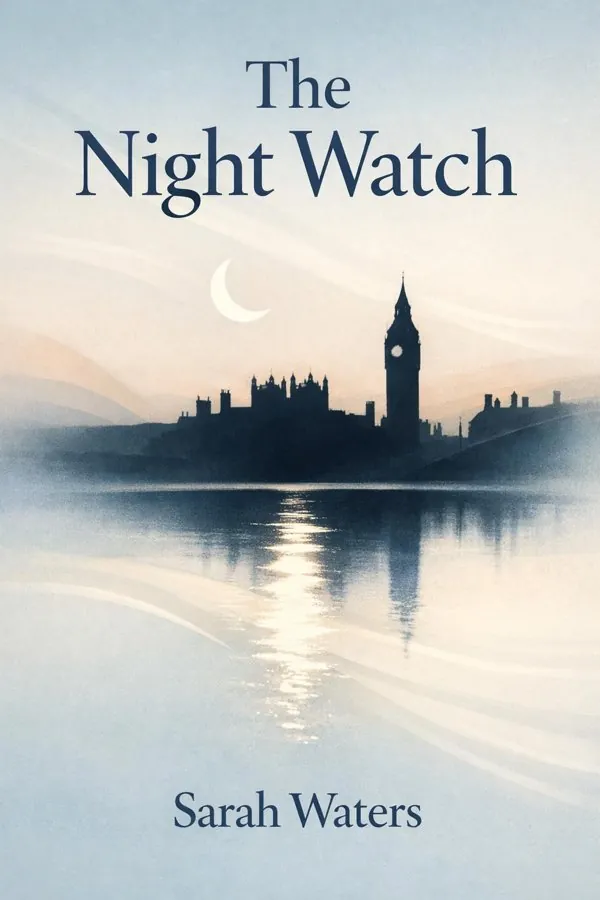
The Night Watch: Summary & Key Insights
by Sarah Waters
 10 min9 chaptersAudio available
Key Takeaways from The Night Watch
Peace does not always feel peaceful.
Danger can intensify intimacy in ways peace rarely does.
To understand a wound, you often have to return to the moment it first opened.
We judge people differently when we know the ending before the beginning.
History often remembers wars through battles and leaders while overlooking the intimate lives reshaped in their shadows.
What Is The Night Watch About?
The Night Watch by Sarah Waters is a classics book spanning 3 pages. What if the deepest truths about love and loss could only be understood by moving backward through time? Sarah Waters’s The Night Watch is a richly layered historical novel set in London during and after World War II, following the intertwined lives of Kay, Helen, Viv, and Duncan as they navigate desire, secrecy, betrayal, duty, and survival. Told in reverse chronological order, the novel begins in 1947, when the war has ended but its emotional wreckage remains, then travels back through 1944 and into 1941 to reveal how these damaged, searching lives became entangled. What makes The Night Watch so powerful is that it is not simply a war story. It is a novel about aftermath: how public events reorder private lives, how people reinvent themselves under pressure, and how love can be both sustaining and destructive. Waters, one of Britain’s most acclaimed historical novelists, brings extraordinary authority to this world through meticulous period detail, psychological precision, and her nuanced portrayal of queer lives too often erased from mainstream history. The result is a haunting, humane novel that turns the familiar wartime narrative inside out and asks what remains when the sirens stop.
This FizzRead summary covers all 9 key chapters of The Night Watch in approximately 10 minutes, distilling the most important ideas, arguments, and takeaways from Sarah Waters's work. Also available as an audio summary and Key Quotes Podcast.
The Night Watch
What if the deepest truths about love and loss could only be understood by moving backward through time? Sarah Waters’s The Night Watch is a richly layered historical novel set in London during and after World War II, following the intertwined lives of Kay, Helen, Viv, and Duncan as they navigate desire, secrecy, betrayal, duty, and survival. Told in reverse chronological order, the novel begins in 1947, when the war has ended but its emotional wreckage remains, then travels back through 1944 and into 1941 to reveal how these damaged, searching lives became entangled.
What makes The Night Watch so powerful is that it is not simply a war story. It is a novel about aftermath: how public events reorder private lives, how people reinvent themselves under pressure, and how love can be both sustaining and destructive. Waters, one of Britain’s most acclaimed historical novelists, brings extraordinary authority to this world through meticulous period detail, psychological precision, and her nuanced portrayal of queer lives too often erased from mainstream history. The result is a haunting, humane novel that turns the familiar wartime narrative inside out and asks what remains when the sirens stop.
Who Should Read The Night Watch?
This book is perfect for anyone interested in classics and looking to gain actionable insights in a short read. Whether you're a student, professional, or lifelong learner, the key ideas from The Night Watch by Sarah Waters will help you think differently.
- ✓Readers who enjoy classics and want practical takeaways
- ✓Professionals looking to apply new ideas to their work and life
- ✓Anyone who wants the core insights of The Night Watch in just 10 minutes
Want the full summary?
Get instant access to this book summary and 100K+ more with Fizz Moment.
Get Free SummaryAvailable on App Store • Free to download
Key Chapters
Peace does not always feel peaceful. In the opening section of The Night Watch, set in 1947, Sarah Waters presents London not as a city celebrating victory but as one living in emotional suspension. The war is over, yet its effects cling to streets, rooms, and bodies. Rationing continues, buildings remain damaged, and people who once had urgent wartime roles now struggle with stillness. This is especially true for Kay Langrish, who had meaning and momentum as an ambulance driver during the war but now drifts through civilian life feeling unneeded and unmoored.
Waters uses this drained atmosphere to show that historical crises do not end neatly when official peace arrives. Helen lives in a strained, evasive relationship, trapped by habits of concealment. Viv carries private burdens tied to love and compromise. Duncan, fragile and withdrawn, moves through life with the exhausted caution of someone who has survived but not recovered. By beginning here, Waters makes readers encounter consequences before causes. We see loneliness, distance, and emotional damage first, which gives every later revelation more force.
The section also offers a practical insight into how identity is shaped by circumstance. Many people discover that after intense periods of purpose—war, caregiving, crisis, career immersion—they can feel dislocated when ordinary life returns. Waters captures that unsettling transition with painful accuracy.
A useful way to apply this idea is to pay closer attention to aftermath in your own life. Instead of assuming that survival equals healing, ask what losses, habits, or emotional roles still linger after a difficult period has passed. The actionable takeaway: when a crisis ends, make space to examine who you have become in its wake rather than rushing to appear “back to normal.”
Danger can intensify intimacy in ways peace rarely does. In the 1944 section, Waters takes readers back to wartime London, where bombs, blackouts, and constant uncertainty create a world in which ordinary boundaries loosen. Here the city is not gray and depleted but charged, immediate, and unstable. Kay is at the height of her powers, driving ambulances through burning streets, rescuing the injured, and moving with competence and courage through catastrophe. Her wartime role gives her identity, usefulness, and a kind of freedom that peacetime society cannot easily accommodate.
This section shows how war accelerates relationships. Under pressure, people reveal themselves quickly; desire becomes urgent because tomorrow is not guaranteed. Helen and Viv are both shaped by this compressed emotional climate, though in very different ways. Choices that might once have unfolded slowly are made suddenly, often in secrecy, and with lasting consequences. Waters is especially interested in the paradox that war can be both destructive and liberating. For women, queer people, and those living outside respectable norms, wartime disruption can open spaces of movement and self-expression—even as it endangers them.
The London of air raids and emergency work also reveals a broader truth: people often discover hidden versions of themselves in periods of instability. A person who seems hesitant in ordinary life may become decisive in crisis. Another may pursue love recklessly because uncertainty makes honesty feel more urgent.
In practical terms, this section invites readers to think about how external pressure reshapes priorities. During difficult times, what matters tends to become startlingly clear. The actionable takeaway: notice which values emerge most strongly when life feels unstable, because they often reveal the truest map of who you are.
To understand a wound, you often have to return to the moment it first opened. In the novel’s final section, set in 1941, Waters reveals the origins of the relationships and injuries that have defined the later timeline. This backward movement is not a gimmick but the novel’s core emotional engine. By the time readers arrive here, they have already seen loneliness, betrayal, compromise, and regret. What 1941 offers is not innocence exactly, but possibility—the fragile point at which lives could still have gone differently.
This earlier wartime London is full of chance encounters, emerging attachments, and tentative self-inventions. Characters are still becoming themselves. Duncan’s vulnerability and inner conflict are easier to understand once we see the social pressures and emotional shocks surrounding him. Kay’s longing, intensity, and eventual heartbreak gain depth when we witness the hope and commitment from which they grow. Helen and Viv, too, are not yet fixed in the compromised forms we later know; they are people making choices under emotional and social constraints they do not fully grasp.
Waters demonstrates that beginnings are often ambiguous. The moments that shape a life do not always announce themselves as decisive. A meeting, a secret, a compromise, or a silence can gradually harden into fate. This is one reason the reverse structure is so effective: it reminds us that what looks inevitable in retrospect was once uncertain and contingent.
A practical application of this idea is to revisit the stories you tell about your own life. Events that now seem destined may have emerged from small, overlooked decisions. The actionable takeaway: when trying to understand a current conflict, trace it back patiently to its earliest beginnings—clarity often lies not in the climax, but in the first unnoticed turn.
We judge people differently when we know the ending before the beginning. One of The Night Watch’s most striking achievements is its reverse chronology, which transforms the act of reading into an exercise in humility. In a conventional narrative, readers meet characters in youth or hope, then watch them make mistakes and suffer consequences. Waters does the opposite. She introduces people in states of damage, pettiness, secrecy, or emotional fatigue, and only later reveals the pressures, desires, and wounds that brought them there.
This structure complicates easy moral conclusions. A character who seems cold in 1947 may appear deeply hurt when seen in 1944. Someone who looks weak or compromised may later be understood as trapped by class expectations, gender restrictions, fear, or grief. Waters does not excuse harmful actions, but she insists on context. The reader learns that behavior is rarely simple when viewed across time.
This technique has practical relevance beyond literature. In everyday life, we often encounter people at chapter seventeen and assume we know their whole story. We see the defensive colleague, the withdrawn friend, the bitter relative, or the unreliable partner, and treat the visible behavior as the full truth. Waters reminds us that most human conduct has a history.
The novel also suggests that memory itself works backward. We often begin with pain and only gradually recover its causes. By mirroring that process, The Night Watch feels psychologically authentic as well as formally inventive.
A useful application is to pause before assigning fixed labels to others—or to yourself. Ask what earlier fear, longing, or loss may lie beneath present behavior. The actionable takeaway: practice delayed judgment; understanding often grows when you seek the backstory before deciding the meaning.
A crisis can give people purpose, but purpose borrowed from crisis is often hard to keep. Throughout The Night Watch, Waters explores how wartime conditions created new forms of usefulness, freedom, and identity—especially for women—and how painfully those roles receded afterward. Kay’s trajectory embodies this tension most clearly. During the war, she is needed. She drives ambulances, acts decisively, and occupies public space with authority. In peacetime, that usefulness evaporates, and she becomes a figure of restlessness and grief.
This pattern extends beyond Kay. The war rearranges social expectations, allowing some characters to live more independently, work more visibly, or form relationships under altered conditions. But postwar society attempts to restore old norms, often without acknowledging how much people have changed. Waters suggests that one of the cruelties of historical transition is that institutions demand continuity even when individuals have been permanently transformed.
This idea resonates strongly in modern life. People who thrive in emergencies—caregivers, leaders, organizers, first responders, or simply those who become highly competent under pressure—may feel unexpected emptiness when the urgent moment passes. The same can happen after major projects, intense jobs, family crises, or periods of activism. What looked like burnout may actually be identity loss.
Waters’s insight is that recovery is not just about rest; it is about redefinition. People need new structures of meaning once the old emergency has ended. Without that, they may feel stranded between who they were and who they are expected to become.
The actionable takeaway: if a demanding period has ended, do not focus only on what you survived—identify what role gave you meaning during that time, and consciously build new forms of purpose to replace it.
Secrets rarely remain contained; they leak into tone, posture, routine, and trust. One of the novel’s central patterns is the way concealed truths shape every major relationship. Affairs, hidden desires, suppressed histories, and unspoken fears do not merely create plot twists in The Night Watch; they become the emotional weather in which the characters live. Waters shows that secrecy is exhausting not just because of what must be hidden, but because it forces people to divide themselves.
Helen’s life in particular reflects the burden of compartmentalization. Her choices are governed by what can and cannot be acknowledged, and this makes intimacy unstable. Viv’s compromises also reveal how private entanglements can lead to moral ambiguity and dependency. Duncan’s reserve is shaped by experiences too painful and socially dangerous to articulate freely. Even when characters are technically together, silence creates distance.
The novel avoids a simplistic lesson that all confession is liberating. In the world Waters depicts, openness can carry real social costs. That complexity gives the book its realism. Still, the emotional price of concealment remains high. Relationships built on partial truths become brittle; people begin managing perceptions rather than sharing lives.
This insight is highly practical. In families, partnerships, and workplaces, unresolved secrecy often appears indirectly: irritability, avoidance, over-control, emotional numbness, or recurring misunderstandings. The issue may not be dramatic deception so much as the inability to speak honestly about fear, desire, resentment, or shame.
The actionable takeaway: identify one important truth you are currently managing rather than addressing, and consider what safer, clearer form of honesty might reduce the strain before silence does more damage.
The most lasting effects of violence are often ordinary-looking. Rather than focusing only on dramatic wartime spectacle, The Night Watch pays close attention to trauma as something embedded in daily behavior: fatigue, watchfulness, emotional numbness, compulsive routines, difficulty trusting, and the inability to imagine a stable future. Waters’s characters do not always speak in explicit psychological language, but their bodies and habits reveal what they carry.
This is one reason the novel feels so modern despite its historical setting. It understands that trauma does not end when the event ends. Bombings, death, social shame, imprisonment, rejection, and fear continue to shape the nervous system long after the immediate danger has passed. Duncan’s fragility, Kay’s restless wandering, and the various forms of hesitation and self-protection shown by other characters all point to lives organized around surviving past pain.
Waters also emphasizes that trauma is relational. People adapt to injury in connection with others or in isolation from them. Support, misunderstanding, dependence, and betrayal all affect whether suffering softens or hardens. This makes the novel not just a portrait of damaged individuals, but of an entire postwar culture struggling to absorb what happened.
Readers can apply this insight by becoming more attentive to recurring patterns in themselves and others. If someone seems overly guarded, intensely self-reliant, or emotionally distant, it may reflect adaptation rather than personality alone. Compassion does not erase accountability, but it broadens understanding.
The actionable takeaway: when confronting a stubborn habit or emotional reaction, ask not only “What is wrong with me?” but “What might this response once have helped me survive?”
Not all great historical novels center on grand events; some reveal history most powerfully through kitchens, rented rooms, bus rides, and chance encounters. The Night Watch demonstrates that ordinary lives can carry enormous emotional and historical significance. Waters does not treat her characters as symbols standing in for wartime London; she gives them the full density of private people whose small decisions matter intensely. The result is a novel where a letter, a missed meeting, a domestic arrangement, or a hesitant conversation can feel as consequential as a public event.
This focus is part of the book’s larger argument about whose stories deserve seriousness. Ambulance work, clerical labor, caregiving, sexual secrecy, companionship, and survival on the social margins are all shown to be central to the truth of the era. Waters resists the idea that history belongs only to those in official power. Instead, she reveals how political upheaval enters intimate spaces and alters the texture of everyday life.
There is a practical lesson here about attention. Many people underestimate the significance of their own routines and relationships because they do not appear dramatic. Yet character is often formed in repeated, private acts: who we care for, what we hide, how we speak under strain, and what we do when no one is celebrating us.
The Night Watch invites readers to value emotional precision over spectacle. Its greatness lies in how carefully it observes the human cost of historical change and how respectfully it treats lives that might otherwise be dismissed as minor.
The actionable takeaway: look more closely at the ordinary scenes in your life, because the patterns within them often reveal your deepest loyalties, fears, and sources of meaning.
All Chapters in The Night Watch
About the Author
Sarah Waters is a British novelist renowned for her richly researched historical fiction and her groundbreaking portrayal of queer lives within the past. Born in 1966 in Neyland, Pembrokeshire, Wales, she studied English literature and later completed a PhD focused on lesbian and gay historical fiction. She rose to prominence with Tipping the Velvet and Affinity, and went on to earn major acclaim for novels including Fingersmith, The Night Watch, and The Little Stranger. Waters has been shortlisted for prestigious literary awards such as the Booker Prize and is widely praised for combining literary sophistication with vivid storytelling. Her work often explores gender, class, secrecy, desire, and social repression, bringing overlooked histories into the center of the novel with intelligence, empathy, and striking emotional power.
Get This Summary in Your Preferred Format
Read or listen to the The Night Watch summary by Sarah Waters anytime, anywhere. FizzRead offers multiple formats so you can learn on your terms — all free.
Available formats: App · Audio · PDF · EPUB — All included free with FizzRead
Download The Night Watch PDF and EPUB Summary
Key Quotes from The Night Watch
“In the opening section of The Night Watch, set in 1947, Sarah Waters presents London not as a city celebrating victory but as one living in emotional suspension.”
“Danger can intensify intimacy in ways peace rarely does.”
“To understand a wound, you often have to return to the moment it first opened.”
“We judge people differently when we know the ending before the beginning.”
“History often remembers wars through battles and leaders while overlooking the intimate lives reshaped in their shadows.”
Frequently Asked Questions about The Night Watch
The Night Watch by Sarah Waters is a classics book that explores key ideas across 9 chapters. What if the deepest truths about love and loss could only be understood by moving backward through time? Sarah Waters’s The Night Watch is a richly layered historical novel set in London during and after World War II, following the intertwined lives of Kay, Helen, Viv, and Duncan as they navigate desire, secrecy, betrayal, duty, and survival. Told in reverse chronological order, the novel begins in 1947, when the war has ended but its emotional wreckage remains, then travels back through 1944 and into 1941 to reveal how these damaged, searching lives became entangled. What makes The Night Watch so powerful is that it is not simply a war story. It is a novel about aftermath: how public events reorder private lives, how people reinvent themselves under pressure, and how love can be both sustaining and destructive. Waters, one of Britain’s most acclaimed historical novelists, brings extraordinary authority to this world through meticulous period detail, psychological precision, and her nuanced portrayal of queer lives too often erased from mainstream history. The result is a haunting, humane novel that turns the familiar wartime narrative inside out and asks what remains when the sirens stop.
More by Sarah Waters




You Might Also Like




Browse by Category
Ready to read The Night Watch?
Get the full summary and 100K+ more books with Fizz Moment.