
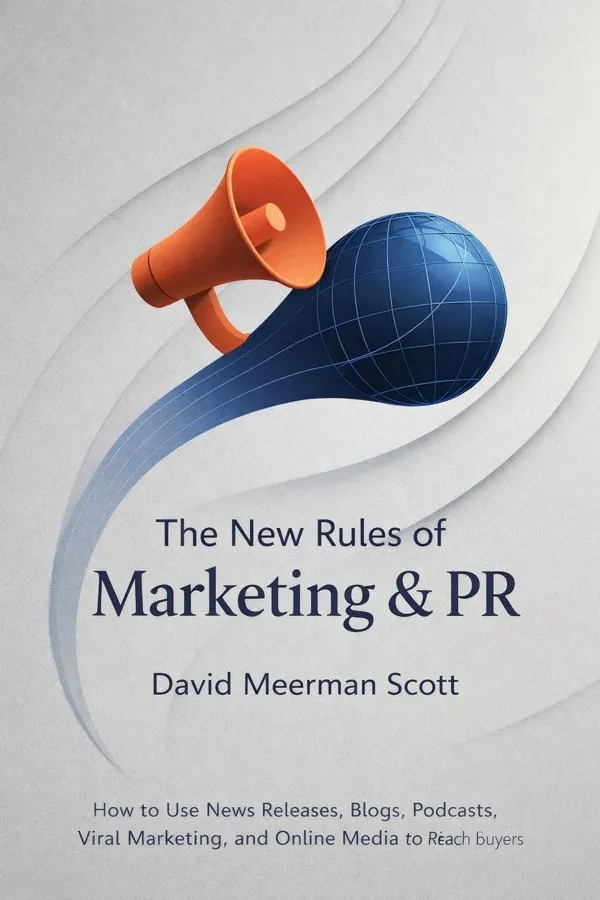
The New Rules of Marketing & PR: How to Use News Releases, Blogs, Podcasts, Viral Marketing, and Online Media to Reach Buyers Directly: Summary & Key Insights
 10 min10 chaptersAudio available
Key Takeaways from The New Rules of Marketing & PR: How to Use News Releases, Blogs, Podcasts, Viral Marketing, and Online Media to Reach Buyers Directly
A surprising truth sits at the center of modern marketing: many organizations still communicate as if the internet never happened.
The most effective sales pitch often does not sound like a sales pitch at all.
One of Scott’s most influential ideas is that the news release should no longer be written only for journalists.
If your marketing is meant for everyone, it rarely resonates with anyone.
People are far more likely to buy from organizations that have already helped them.
What Is The New Rules of Marketing & PR: How to Use News Releases, Blogs, Podcasts, Viral Marketing, and Online Media to Reach Buyers Directly About?
The New Rules of Marketing & PR: How to Use News Releases, Blogs, Podcasts, Viral Marketing, and Online Media to Reach Buyers Directly by David Meerman Scott is a marketing book spanning 13 pages. The New Rules of Marketing & PR is a practical guide to one of the biggest shifts in business communication: the move from gatekeeper-controlled media to direct, digital connection with buyers. In the old model, companies relied on advertising to interrupt audiences and public relations to persuade journalists. David Meerman Scott argues that the internet changed everything. Websites, blogs, social platforms, online video, podcasts, and search engines now allow organizations to publish useful content themselves and reach the right people at the right moment. What makes this book matter is its insistence that marketing and PR are no longer separate functions. Both are now driven by discoverable, shareable content that helps buyers solve problems, learn something, or make decisions. Scott does not present digital communication as a trend or a toolkit for tech companies alone. He shows that nonprofits, startups, global brands, consultants, and even public institutions can use these methods to build trust and spark action. As a marketing strategist and bestselling author known for his work on real-time engagement, Scott brings both authority and urgency. His message is simple: if you want attention today, earn it with valuable content instead of buying it with interruptions.
This FizzRead summary covers all 10 key chapters of The New Rules of Marketing & PR: How to Use News Releases, Blogs, Podcasts, Viral Marketing, and Online Media to Reach Buyers Directly in approximately 10 minutes, distilling the most important ideas, arguments, and takeaways from David Meerman Scott's work. Also available as an audio summary and Key Quotes Podcast.
The New Rules of Marketing & PR: How to Use News Releases, Blogs, Podcasts, Viral Marketing, and Online Media to Reach Buyers Directly
The New Rules of Marketing & PR is a practical guide to one of the biggest shifts in business communication: the move from gatekeeper-controlled media to direct, digital connection with buyers. In the old model, companies relied on advertising to interrupt audiences and public relations to persuade journalists. David Meerman Scott argues that the internet changed everything. Websites, blogs, social platforms, online video, podcasts, and search engines now allow organizations to publish useful content themselves and reach the right people at the right moment.
What makes this book matter is its insistence that marketing and PR are no longer separate functions. Both are now driven by discoverable, shareable content that helps buyers solve problems, learn something, or make decisions. Scott does not present digital communication as a trend or a toolkit for tech companies alone. He shows that nonprofits, startups, global brands, consultants, and even public institutions can use these methods to build trust and spark action.
As a marketing strategist and bestselling author known for his work on real-time engagement, Scott brings both authority and urgency. His message is simple: if you want attention today, earn it with valuable content instead of buying it with interruptions.
Who Should Read The New Rules of Marketing & PR: How to Use News Releases, Blogs, Podcasts, Viral Marketing, and Online Media to Reach Buyers Directly?
This book is perfect for anyone interested in marketing and looking to gain actionable insights in a short read. Whether you're a student, professional, or lifelong learner, the key ideas from The New Rules of Marketing & PR: How to Use News Releases, Blogs, Podcasts, Viral Marketing, and Online Media to Reach Buyers Directly by David Meerman Scott will help you think differently.
- ✓Readers who enjoy marketing and want practical takeaways
- ✓Professionals looking to apply new ideas to their work and life
- ✓Anyone who wants the core insights of The New Rules of Marketing & PR: How to Use News Releases, Blogs, Podcasts, Viral Marketing, and Online Media to Reach Buyers Directly in just 10 minutes
Want the full summary?
Get instant access to this book summary and 100K+ more with Fizz Moment.
Get Free SummaryAvailable on App Store • Free to download
Key Chapters
A surprising truth sits at the center of modern marketing: many organizations still communicate as if the internet never happened. For decades, marketing meant buying attention through ads, while public relations meant earning attention by convincing journalists to tell your story. In that world, a small number of gatekeepers decided what the public would see, hear, and read. David Meerman Scott argues that those rules were built for scarcity. Media space was limited, distribution was expensive, and audiences had little choice.
Digital channels destroyed that scarcity. A company can now publish a blog post, host a webinar, send an email series, launch a podcast, upload a video, or issue a web-friendly news release without waiting for approval from a newsroom. Buyers often begin their journey in a search engine, not with a salesperson or reporter. That means marketing and PR now work best when they help people discover useful information exactly when they need it.
Consider a software firm launching a new product. Under the old rules, it might buy trade magazine ads and hope for media coverage. Under the new rules, it would publish comparison guides, demo videos, customer stories, and problem-solving articles optimized for search. Prospects can then find the company directly while researching solutions.
Scott’s larger point is not simply that new tools exist. It is that power has shifted. Audiences choose what to consume, when to consume it, and whether to share it. Brands that cling to one-way promotion lose relevance to those that educate and engage.
Actionable takeaway: Audit your current marketing and PR efforts and ask one question of every activity: does this help buyers find and trust us directly, or are we still depending too heavily on interruption and gatekeepers?
The most effective sales pitch often does not sound like a sales pitch at all. Scott emphasizes that online content is not filler or decoration; it is the core way organizations earn attention, build credibility, and attract buyers. In the digital environment, content functions as a permanent, searchable representative of your brand. A useful article, a strong explainer video, or a practical podcast episode can introduce your expertise to thousands of people long before they speak with your team.
This changes how companies should think about publishing. Instead of producing generic promotional material, they should create content that matches real customer questions and concerns. A fitness brand might publish guides on training plans, nutrition myths, and injury prevention. A B2B cybersecurity firm might produce breach response checklists, compliance explainers, and webinars on emerging threats. In both cases, the content works because it solves problems first and promotes the brand second.
Scott also highlights that different content formats serve different buyer preferences. Blogs are excellent for search visibility and thought leadership. Podcasts build intimacy and loyalty. Videos can simplify complex topics quickly. Downloadable guides and white papers help capture leads from people who are actively evaluating solutions. The goal is not to be everywhere for the sake of visibility. The goal is to publish consistently where your buyers already look for answers.
Good content also compounds over time. Unlike a paid ad that disappears when the budget stops, a high-quality article or video can continue attracting visitors for months or years. That makes content a strategic asset, not a campaign accessory.
Actionable takeaway: Build a content plan around the top 20 questions your ideal customers ask before they buy, and answer each one through a format they already prefer to consume.
One of Scott’s most influential ideas is that the news release should no longer be written only for journalists. In the traditional model, a release existed mainly to persuade the press that a company announcement was worth covering. That led to stiff language, inflated claims, and little value for ordinary readers. Scott argues that on the web, a news release can become direct-to-buyer content that is searchable, shareable, and useful on its own.
This requires a complete mindset shift. A web news release should include plain language, customer relevance, keywords people actually search for, links to supporting resources, multimedia assets, and context that helps readers understand why the announcement matters. If a company launches a new service, the release should not merely state that executives are pleased. It should explain the problem the service solves, who it is for, how it works, and where to learn more.
Imagine a healthcare technology company introducing a remote monitoring tool. A traditional release might focus on awards, corporate growth, and executive quotes. A web-friendly release would also include use cases for clinics, implementation details, patient benefits, links to product demos, and terminology that doctors or administrators would search online. That makes the release valuable not just to media outlets, but to prospects, partners, analysts, and investors.
Scott’s insight matters because online publishing collapses the distance between announcement and audience. A release can now attract traffic from search, support social sharing, and lead visitors directly into the next step of the buying journey.
Actionable takeaway: Rewrite your next press release for your ideal customer first, using clear language, search-friendly terms, multimedia, and links that guide readers toward deeper engagement.
If your marketing is meant for everyone, it rarely resonates with anyone. Scott stresses the importance of buyer personas because relevance is the foundation of effective digital communication. A buyer persona is a detailed profile of a specific type of customer, including goals, frustrations, information habits, language, and buying triggers. Personas help marketers move beyond assumptions and speak to real human needs.
This is especially important online, where people expect content that feels timely and specific. A single product may appeal to multiple audiences for very different reasons. For example, accounting software might interest small-business owners seeking simplicity, finance managers needing advanced reporting, and accountants focused on compliance. Each group searches differently, asks different questions, and values different benefits. Without distinct personas, content becomes vague and forgettable.
Scott encourages organizations to research personas through customer interviews, sales conversations, support tickets, keyword behavior, and market observation. The aim is not to create fictional stereotypes but practical tools for decision-making. Once you understand your buyers deeply, you can tailor website messaging, blog topics, social posts, landing pages, and email sequences to their priorities.
Personas also improve internal alignment. Sales, product, and marketing teams can make better decisions when they share a common understanding of who they serve. A nonprofit, for instance, may need separate messaging for donors, volunteers, beneficiaries, and community partners. Persona thinking keeps those messages distinct and effective.
The broader lesson is that modern marketing succeeds through empathy. Technology helps distribute your message, but relevance determines whether anyone cares.
Actionable takeaway: Interview five recent customers and document their goals, objections, preferred channels, and search terms, then create or refine personas that guide every piece of content you publish.
People are far more likely to buy from organizations that have already helped them. Scott’s approach to marketing is rooted in generosity: create content that educates, clarifies, entertains, or solves a problem, and trust will follow. This is different from the old campaign mindset, where the goal was to push messages outward and repeat them loudly. In the new model, trust is earned through usefulness.
Valuable content often works best when it addresses specific stages of the buyer journey. Early-stage content might define a problem or explain common mistakes. Mid-stage content might compare options, answer objections, or offer frameworks for decision-making. Late-stage content could include case studies, implementation guides, pricing explainers, and detailed demos. Each piece moves the buyer closer to confidence.
For example, a home renovation company could publish articles on budgeting for kitchen remodels, timelines for permits, design trend tradeoffs, and checklists for hiring contractors. By the time a homeowner is ready to request a consultation, the company has already demonstrated expertise and reduced uncertainty. The same principle applies in B2B: a logistics firm that publishes practical guidance on shipping delays, customs compliance, and inventory risk becomes a trusted resource, not just a vendor.
Scott’s thinking also challenges organizations to abandon hollow jargon. Valuable content is concrete, readable, and rooted in audience needs. It should not exist merely to promote brand slogans or satisfy internal stakeholders.
The long-term impact is significant. Useful content improves search visibility, deepens engagement, strengthens brand authority, and shortens the path to purchase because buyers arrive already informed.
Actionable takeaway: Map your content to the full customer journey and make sure every stage includes materials that genuinely reduce confusion, answer questions, and help buyers make better decisions.
In a digital environment, timing can be as powerful as creativity. Scott is well known for championing real-time marketing: the practice of responding quickly to news, trends, events, and audience behavior with relevant content. The central idea is simple but demanding. Instead of waiting weeks or months for campaign approvals, organizations should be ready to publish timely material when attention is already concentrated around a topic.
Real-time marketing works because buyers live in the present. Their needs, searches, and conversations are shaped by what is happening now. A financial firm can comment on a regulatory change the day it is announced. A retailer can respond to seasonal demand shifts immediately. A cybersecurity company can publish guidance during a breaking breach story while prospects are urgently seeking information. In these moments, speed creates relevance, and relevance attracts attention.
But Scott also makes clear that real-time communication is not careless improvisation. It requires preparation: clear editorial principles, empowered teams, fast approval processes, and a strong understanding of audience interests. Without those foundations, brands either miss the opportunity or publish reactive content that feels forced.
This idea also applies to customer interaction. Monitoring social conversations, reviews, and search trends enables brands to answer questions promptly, adapt messaging, and enter discussions constructively. Real-time engagement demonstrates that a company is alert, responsive, and connected to its market.
The deeper lesson is that the internet rewards organizations that behave like publishers and participants, not slow-moving broadcasters. Attention is fluid, and opportunities are temporary.
Actionable takeaway: Set up a simple real-time response system with social monitoring, rapid internal approvals, and a small content team ready to create timely posts, articles, or videos when relevant moments arise.
A major contribution of Scott’s book is the argument that marketing and public relations should no longer operate as separate silos. In the traditional business structure, marketing handled advertising, brochures, and lead generation, while PR dealt with media relations and reputation. Online, that division becomes less useful because the same piece of content can serve multiple purposes at once: attract search traffic, shape brand perception, support sales, generate shares, and even earn media attention.
A well-crafted article, for example, can position a company as a thought leader, answer buyer questions, improve SEO, and give journalists a useful source to reference. A customer success story can support sales enablement while also reinforcing public credibility. A webinar can educate leads, create social content, and generate press interest if it addresses a timely issue. Scott shows that digital communication collapses the boundaries between these functions.
This integration leads to stronger strategy. Instead of separate teams producing disconnected messages, organizations can develop unified narratives rooted in audience needs. A product launch becomes more effective when press outreach, search content, landing pages, executive thought leadership, email campaigns, and social engagement all reinforce the same value proposition.
Scott also points to measurement as a force for alignment. When both marketing and PR are evaluated by business outcomes such as traffic, engagement, lead quality, and customer action, collaboration becomes easier. The debate shifts away from who owns the message and toward what helps the audience most.
For many organizations, this integrated model is not just efficient; it is necessary. Buyers do not experience your departments separately. They experience your brand as one continuous conversation.
Actionable takeaway: Bring marketing, PR, and sales stakeholders together to build one shared editorial calendar and one core message framework so every channel works toward the same buyer-focused goals.
Digital communication offers something traditional media rarely could: direct feedback. Scott encourages organizations to treat measurement as an engine for learning rather than a scoreboard for vanity. Page views, shares, downloads, media mentions, inbound links, email sign-ups, and conversions all reveal how audiences respond to content. The point is not to measure everything equally, but to identify which signals connect to business goals.
For example, a company trying to build awareness may focus on search visibility, referral traffic, and social engagement. A business trying to generate leads will care more about landing-page conversions, webinar registrations, demo requests, and email performance. A nonprofit might track volunteer sign-ups, donations, and petition participation. Scott’s approach is practical: metrics should clarify what content works, which personas are engaging, and where in the journey people lose momentum.
Yet implementation is not only technical. Scott repeatedly underscores ethics and authenticity. The internet rewards transparency over spin. Misleading headlines, manipulative tactics, and insincere participation may produce short-term attention, but they damage trust over time. Real authority comes from honesty, consistency, and a genuine commitment to serving the audience.
This is why case studies and roadmaps matter in the book. Scott wants readers to move from theory to practice responsibly. Teams should begin with clear buyer personas, publish valuable content, optimize discoverability, engage in real time, measure response, and improve continuously. The process is iterative, not one-and-done.
The organizations that win are not necessarily the loudest. They are the most useful, most responsive, and most credible.
Actionable takeaway: Choose three outcome-based metrics tied to your business goals, review them monthly, and pair every optimization decision with one ethical test: does this build long-term trust with the audience we want to serve?
All Chapters in The New Rules of Marketing & PR: How to Use News Releases, Blogs, Podcasts, Viral Marketing, and Online Media to Reach Buyers Directly
About the Author
David Meerman Scott is a marketing strategist, keynote speaker, and bestselling author best known for his work on digital communication, content marketing, and real-time engagement. Before becoming an author and consultant, he held executive roles in the information technology industry, where he developed firsthand insight into how markets respond to fast-moving information. He gained international recognition through The New Rules of Marketing & PR, a book that helped redefine how businesses think about online visibility, public relations, and direct audience connection. Scott has advised companies, nonprofits, startups, and global brands on using blogs, social media, news releases, and real-time content to build trust and drive growth. His work is valued for turning major shifts in media and buyer behavior into practical, accessible strategies.
Get This Summary in Your Preferred Format
Read or listen to the The New Rules of Marketing & PR: How to Use News Releases, Blogs, Podcasts, Viral Marketing, and Online Media to Reach Buyers Directly summary by David Meerman Scott anytime, anywhere. FizzRead offers multiple formats so you can learn on your terms — all free.
Available formats: App · Audio · PDF · EPUB — All included free with FizzRead
Download The New Rules of Marketing & PR: How to Use News Releases, Blogs, Podcasts, Viral Marketing, and Online Media to Reach Buyers Directly PDF and EPUB Summary
Key Quotes from The New Rules of Marketing & PR: How to Use News Releases, Blogs, Podcasts, Viral Marketing, and Online Media to Reach Buyers Directly
“A surprising truth sits at the center of modern marketing: many organizations still communicate as if the internet never happened.”
“The most effective sales pitch often does not sound like a sales pitch at all.”
“One of Scott’s most influential ideas is that the news release should no longer be written only for journalists.”
“If your marketing is meant for everyone, it rarely resonates with anyone.”
“People are far more likely to buy from organizations that have already helped them.”
Frequently Asked Questions about The New Rules of Marketing & PR: How to Use News Releases, Blogs, Podcasts, Viral Marketing, and Online Media to Reach Buyers Directly
The New Rules of Marketing & PR: How to Use News Releases, Blogs, Podcasts, Viral Marketing, and Online Media to Reach Buyers Directly by David Meerman Scott is a marketing book that explores key ideas across 10 chapters. The New Rules of Marketing & PR is a practical guide to one of the biggest shifts in business communication: the move from gatekeeper-controlled media to direct, digital connection with buyers. In the old model, companies relied on advertising to interrupt audiences and public relations to persuade journalists. David Meerman Scott argues that the internet changed everything. Websites, blogs, social platforms, online video, podcasts, and search engines now allow organizations to publish useful content themselves and reach the right people at the right moment. What makes this book matter is its insistence that marketing and PR are no longer separate functions. Both are now driven by discoverable, shareable content that helps buyers solve problems, learn something, or make decisions. Scott does not present digital communication as a trend or a toolkit for tech companies alone. He shows that nonprofits, startups, global brands, consultants, and even public institutions can use these methods to build trust and spark action. As a marketing strategist and bestselling author known for his work on real-time engagement, Scott brings both authority and urgency. His message is simple: if you want attention today, earn it with valuable content instead of buying it with interruptions.
More by David Meerman Scott
You Might Also Like

Captivology: The Science of Capturing People's Attention
Ben Parr
10 min
Marketing 5.0: Technology for Humanity
Philip Kotler, Hermawan Kartajaya, Iwan Setiawan
10 min
Marketing Strategy
Paul Fifield
10 min
UnMarketing: Stop Marketing. Start Engaging.
Scott Stratten
10 min
$100M Leads: How to Get Strangers to Want to Buy Your Stuff
Alex Hormozi
10 min
80/20 Sales and Marketing: The Definitive Guide to Working Less and Making More
Perry Marshall
10 minBrowse by Category
Ready to read The New Rules of Marketing & PR: How to Use News Releases, Blogs, Podcasts, Viral Marketing, and Online Media to Reach Buyers Directly?
Get the full summary and 100K+ more books with Fizz Moment.