
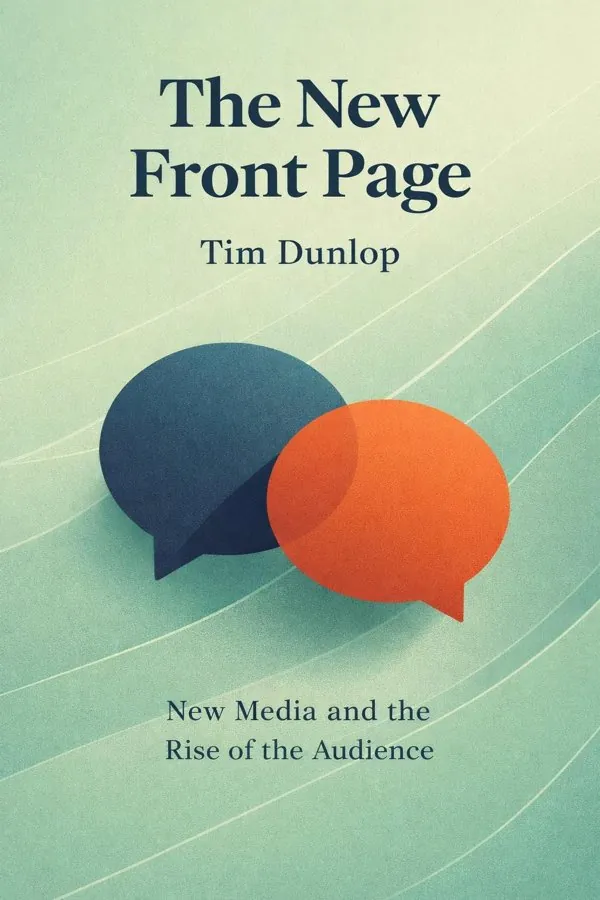
The New Front Page: New Media and the Rise of the Audience: Summary & Key Insights
by Tim Dunlop
 10 min9 chaptersAudio available
Key Takeaways from The New Front Page: New Media and the Rise of the Audience
One of the most radical ideas in digital media is that the audience is no longer merely watching from a distance.
The old power of journalism rested on scarcity: limited space, limited airtime, and limited access to publication.
When audiences participate in journalism, they do more than add comments beneath articles; they redefine what journalism is for.
In the old media order, trust often came from institutional status.
The metaphor of the front page once described a shared civic space.
What Is The New Front Page: New Media and the Rise of the Audience About?
The New Front Page: New Media and the Rise of the Audience by Tim Dunlop is a digital_culture book spanning 4 pages. The New Front Page: New Media and the Rise of the Audience examines one of the most important shifts in modern public life: the movement from a media world controlled by editors, broadcasters, and publishers to one increasingly shaped by users, networks, and platforms. Tim Dunlop argues that digital media has not simply changed how news is delivered; it has transformed who gets to speak, who gets heard, and how public conversation is formed. In place of the old front page, curated by a few powerful institutions, we now have a dynamic and contested information environment where audiences comment, share, remix, challenge, and sometimes even break the news themselves. This matters because journalism is deeply tied to democracy. If the public sphere changes, politics changes with it. Dunlop explores both the promise and the tension of this transformation: new opportunities for participation and accountability, but also fragmentation, mistrust, and economic strain. As an Australian writer and commentator on media, politics, and technology, Dunlop brings sharp analysis to a global issue. His book is essential for anyone trying to understand journalism’s future in the digital age.
This FizzRead summary covers all 9 key chapters of The New Front Page: New Media and the Rise of the Audience in approximately 10 minutes, distilling the most important ideas, arguments, and takeaways from Tim Dunlop's work. Also available as an audio summary and Key Quotes Podcast.
The New Front Page: New Media and the Rise of the Audience
The New Front Page: New Media and the Rise of the Audience examines one of the most important shifts in modern public life: the movement from a media world controlled by editors, broadcasters, and publishers to one increasingly shaped by users, networks, and platforms. Tim Dunlop argues that digital media has not simply changed how news is delivered; it has transformed who gets to speak, who gets heard, and how public conversation is formed. In place of the old front page, curated by a few powerful institutions, we now have a dynamic and contested information environment where audiences comment, share, remix, challenge, and sometimes even break the news themselves.
This matters because journalism is deeply tied to democracy. If the public sphere changes, politics changes with it. Dunlop explores both the promise and the tension of this transformation: new opportunities for participation and accountability, but also fragmentation, mistrust, and economic strain. As an Australian writer and commentator on media, politics, and technology, Dunlop brings sharp analysis to a global issue. His book is essential for anyone trying to understand journalism’s future in the digital age.
Who Should Read The New Front Page: New Media and the Rise of the Audience?
This book is perfect for anyone interested in digital_culture and looking to gain actionable insights in a short read. Whether you're a student, professional, or lifelong learner, the key ideas from The New Front Page: New Media and the Rise of the Audience by Tim Dunlop will help you think differently.
- ✓Readers who enjoy digital_culture and want practical takeaways
- ✓Professionals looking to apply new ideas to their work and life
- ✓Anyone who wants the core insights of The New Front Page: New Media and the Rise of the Audience in just 10 minutes
Want the full summary?
Get instant access to this book summary and 100K+ more with Fizz Moment.
Get Free SummaryAvailable on App Store • Free to download
Key Chapters
One of the most radical ideas in digital media is that the audience is no longer merely watching from a distance. For most of the twentieth century, journalism operated on a one-way model: news organizations produced, audiences consumed. The public might write letters to the editor or discuss the news privately, but they rarely influenced the story in real time. Dunlop shows that the internet shattered this arrangement. Through blogs, comment sections, social media platforms, discussion forums, and sharing tools, audiences gained the power to respond, critique, amplify, and even redirect the news agenda.
This shift matters because it changes the relationship between journalists and citizens. Audiences can now highlight overlooked issues, question official narratives, and bring local or marginalized perspectives into wider public view. A video recorded by a witness, a hashtag started by activists, or a thread unpacking a politician’s claim can shape public understanding before a newsroom has fully reacted. The public is no longer only the destination of journalism; it is increasingly part of the process.
That does not mean every audience contribution improves journalism. Online participation can be informed or reckless, generous or abusive. But Dunlop’s point is that the audience has become a structural force in media, not a passive afterthought. News organizations that still imagine readers as silent recipients risk misunderstanding the world they now serve.
A practical example is how breaking stories unfold on social media. Eyewitnesses post updates, experts add context, and readers flag inconsistencies long before the next day’s newspaper appears. The most effective journalists work with this reality rather than against it.
Actionable takeaway: Treat audiences as participants with insight, not just consumers to be managed. Whether you are a journalist, creator, or reader, engage critically and constructively in the conversation around news.
The old power of journalism rested on scarcity: limited space, limited airtime, and limited access to publication. In that world, editors acted as gatekeepers, deciding what counted as news and what remained invisible. Dunlop argues that digital media has weakened this role profoundly. Information now moves through search engines, social feeds, messaging apps, newsletters, blogs, and independent creators. The editor’s gate has not vanished entirely, but it is no longer the only entrance to public attention.
This collapse of gatekeeping has two major consequences. First, it democratizes publication. People no longer need institutional permission to circulate information, challenge dominant narratives, or organize public discussion. Second, it destabilizes authority. If many actors can publish at once, audiences must sort through competing claims, uneven quality, and conflicting interpretations. The old guarantee that “it’s in the paper, so it matters” no longer carries the same force.
Dunlop does not suggest that traditional gatekeeping was perfect. It often excluded minority voices, protected elite assumptions, and reinforced existing power structures. Yet he also recognizes that gatekeeping provided a form of verification and editorial judgment. The challenge of digital news is not simply that gatekeepers lost power, but that society must find new ways to build trust and signal reliability.
Consider how a political scandal now unfolds. A leaked document may first appear on a small blog, gain momentum on social media, attract fact-checkers and commentators, and only then be fully investigated by major outlets. The sequence of public attention is no longer centrally controlled.
Actionable takeaway: Don’t ask only who published a story. Ask how it was sourced, verified, and challenged. In a post-gatekeeping world, critical evaluation matters more than inherited authority.
When audiences participate in journalism, they do more than add comments beneath articles; they redefine what journalism is for. Dunlop argues that participatory media blurs the line between producer and consumer, turning news into a more collaborative, contested, and networked process. This can include citizen reporting, live community feedback, crowdsourced investigations, expert commentary from outside newsrooms, and readers contributing context or corrections.
The deeper point is that journalism is no longer only about delivering finished products. It is increasingly about facilitating public knowledge. A newsroom may publish an investigation, but the audience can extend its reach by sharing local evidence, surfacing witnesses, or identifying patterns the original reporters missed. Participation can make journalism more responsive and more accountable because the public is no longer locked out of the conversation.
At the same time, Dunlop highlights the economic problem built into this new environment. News organizations once funded journalism through advertising tied to their control over distribution. Digital platforms disrupted that model. Audiences now move fluidly across countless sites, and advertising revenue has followed scale and targeting rather than editorial labor. This means journalism is expected to be more open, interactive, and immediate while often operating with fewer resources.
A practical example is the rise of reader-supported journalism. Membership programs, donations, subscriptions, and crowdfunding all reflect an important shift: the audience is not just participating in content but in sustaining the institutions that produce it. News becomes a relationship, not just a commodity.
Actionable takeaway: Support the journalism you value, and if you produce news, create meaningful ways for audiences to contribute beyond clicks—through feedback, expertise, membership, and collaborative reporting.
In the old media order, trust often came from institutional status. A recognized masthead, a familiar anchor, or a respected editor signaled credibility before a story was even read. Dunlop argues that in digital media, this automatic trust has weakened. Audiences encounter journalism mixed with opinion, rumor, branded content, activism, and misinformation in the same scrolling environment. As a result, journalists can no longer rely on prestige alone. They must demonstrate reliability through transparency, responsiveness, and public engagement.
This change reshapes the journalist’s role in democracy. Instead of standing above the public as neutral gatekeepers of truth, journalists increasingly operate within a noisy and participatory information ecosystem. Their value lies not in exclusive authority but in disciplined methods: verification, context, fairness, explanation, and accountability. Trust is built when journalists show their work, acknowledge uncertainty, correct mistakes publicly, and engage criticism in good faith.
Dunlop’s argument is especially important in politically polarized environments, where suspicion of media institutions runs high. Defensive appeals to professional status often fail. What helps more is visible practice: linking to source documents, showing how facts were checked, explaining editorial choices, and distinguishing reporting from commentary. Trust becomes relational and ongoing rather than assumed and inherited.
For example, during a fast-moving public crisis, audiences may trust a reporter more if they clearly state what is confirmed, what remains uncertain, and where information originated. That form of honesty can be more credible than a polished but opaque voice of authority.
Actionable takeaway: If you work in media, replace “trust us” with “here’s how we know.” If you consume news, favor sources that are open about methods, corrections, and limitations.
The metaphor of the front page once described a shared civic space. Editors selected stories they believed mattered most, and that hierarchy shaped public attention. Dunlop shows that digital platforms have taken over much of this agenda-setting role. Today, many people do not visit a newspaper homepage first. They encounter news through Facebook posts, X threads, YouTube clips, TikTok videos, Google search results, or alerts pushed through apps. The “front page” is now personalized, algorithmic, and constantly changing.
This transformation has enormous implications. Platform design influences what people see, how long they engage, and which stories gain emotional or viral traction. News competes with entertainment, outrage, personal updates, and advertising in the same feed. Stories that are important for civic life may be crowded out by content that is simply more clickable or provocative. The public agenda becomes less collectively curated and more fragmented by user behavior and platform logic.
Dunlop’s insight is not that platforms are publishers in the old sense, but that they powerfully shape visibility. Their algorithms can amplify some voices, bury others, and reward formats suited to speed, novelty, and reaction. This changes how journalism is written, packaged, and distributed. Headlines become social hooks, visuals become essential, and speed can sometimes outrun depth.
A practical example is how a nuanced investigative article may receive less attention than a short, emotionally charged clip about the same issue. The platform environment encourages compression and immediacy, which can distort complex reporting.
Actionable takeaway: Build the habit of leaving the feed. Seek out full articles, direct sources, and trusted outlets rather than relying entirely on platform-curated snippets of the news.
News no longer travels in a straight line from newsroom to audience. Dunlop argues that it now moves through networks of friends, followers, influencers, experts, activists, and online communities. In this model, distribution is social. A story gains meaning not only from how it is reported, but from who shares it, how they frame it, and what community receives it. This is a major break from the mass media era, when a relatively small number of institutions pushed information outward to a broad public.
Networked news can be powerful because it allows stories to travel quickly and reach people through trusted social ties. A community group may elevate a local issue ignored by major outlets. Specialists may add expertise to a technical report. Social circulation can also create accountability by forcing institutions to respond to stories they might otherwise dismiss.
But networked distribution also creates new vulnerabilities. People often trust information because it comes from someone they know or identify with, not because it has been carefully verified. Communities can become echo chambers, reinforcing shared assumptions and rewarding content that confirms group identity. In such environments, false or misleading stories can spread rapidly because they feel socially meaningful.
An example is public health information. Accurate reporting can spread through doctors, teachers, and local organizations, helping communities understand policy changes. Yet misleading claims can also travel through the same pathways if trusted community figures repeat them.
Actionable takeaway: Notice not just what information says, but how it reached you. Before sharing, ask whether the story is credible on its own merits, not just persuasive within your network.
The dream of digital media was greater openness; the reality, Dunlop suggests, is more complicated. While the internet expands access to voices and information, it also fragments public attention. In the broadcast era, large audiences often encountered the same headlines at the same time. That shared exposure helped create a common public conversation, even if it was limited and imperfect. Digital media breaks that commonality into many smaller, overlapping publics.
Fragmentation has clear benefits. Communities once excluded from mainstream media can build their own spaces, tell their own stories, and organize around issues that traditional journalism neglected. Political minorities, diaspora groups, local activists, and specialist communities all gain visibility through digital tools. This pluralism can make democracy more representative.
Yet fragmentation also complicates democratic life. If people no longer share basic reference points, public debate becomes harder. Different groups may live in different informational worlds, each with its own authorities, priorities, and emotional triggers. Instead of arguing about what should be done, societies may first have to argue about what is happening at all.
Dunlop’s contribution is to show that this is not simply a technological issue but a civic one. Journalism in a fragmented environment must do more than publish facts. It must help connect publics, explain differences, and preserve enough common ground for democratic disagreement to remain possible.
A practical example is election coverage. Different communities may encounter entirely different narratives about the same candidates or issues, making consensus on basic facts difficult.
Actionable takeaway: Deliberately read across perspectives. To stay democratically informed, don’t rely on one community, one platform, or one ideological source.
At the heart of Dunlop’s book is a democratic argument: media change is not just about business models or gadgets, but about citizenship. The rise of the audience creates possibilities for a more participatory public sphere, where citizens are not merely informed by elites but involved in shaping public conversation. That can strengthen democracy by widening access, exposing institutional failures, and making journalism more accountable to the communities it serves.
But participation alone is not enough. A louder public sphere is not automatically a healthier one. If digital engagement rewards outrage, tribalism, and misinformation, then participation can corrode trust and collective decision-making. Dunlop’s analysis resists simple optimism. He sees real democratic promise in new media, but only if institutions, journalists, and citizens adapt responsibly.
That means building norms for constructive engagement, investing in quality reporting, supporting independent journalism, and improving public media literacy. It also means accepting that democracy is messier when more people can speak. The answer is not to retreat to the old gatekeeping model, but to create better systems for inclusion, verification, and dialogue.
A practical application is local journalism projects that invite residents to suggest story priorities, contribute knowledge, attend public forums, and help shape reporting agendas. Such models do not eliminate professional journalism; they deepen its civic relevance.
Actionable takeaway: Participate in the media environment as a citizen, not just a consumer. Support trustworthy journalism, share responsibly, contribute local knowledge, and help create the kind of public conversation democracy needs.
All Chapters in The New Front Page: New Media and the Rise of the Audience
About the Author
Tim Dunlop is an Australian writer, commentator, and public intellectual whose work focuses on the intersection of media, politics, technology, and democratic culture. He has written for major Australian publications and built a strong reputation as a thoughtful observer of how digital communication reshapes public life. Dunlop is particularly interested in the ways the internet, social media, and participatory platforms challenge traditional institutions, including journalism and political authority. His analysis often combines media criticism with broader reflections on citizenship and power in networked societies. In The New Front Page, he brings these interests together to explore how the rise of the audience has changed the meaning of news, the role of journalists, and the conditions of democratic debate in the digital era.
Get This Summary in Your Preferred Format
Read or listen to the The New Front Page: New Media and the Rise of the Audience summary by Tim Dunlop anytime, anywhere. FizzRead offers multiple formats so you can learn on your terms — all free.
Available formats: App · Audio · PDF · EPUB — All included free with FizzRead
Download The New Front Page: New Media and the Rise of the Audience PDF and EPUB Summary
Key Quotes from The New Front Page: New Media and the Rise of the Audience
“One of the most radical ideas in digital media is that the audience is no longer merely watching from a distance.”
“The old power of journalism rested on scarcity: limited space, limited airtime, and limited access to publication.”
“When audiences participate in journalism, they do more than add comments beneath articles; they redefine what journalism is for.”
“In the old media order, trust often came from institutional status.”
“The metaphor of the front page once described a shared civic space.”
Frequently Asked Questions about The New Front Page: New Media and the Rise of the Audience
The New Front Page: New Media and the Rise of the Audience by Tim Dunlop is a digital_culture book that explores key ideas across 9 chapters. The New Front Page: New Media and the Rise of the Audience examines one of the most important shifts in modern public life: the movement from a media world controlled by editors, broadcasters, and publishers to one increasingly shaped by users, networks, and platforms. Tim Dunlop argues that digital media has not simply changed how news is delivered; it has transformed who gets to speak, who gets heard, and how public conversation is formed. In place of the old front page, curated by a few powerful institutions, we now have a dynamic and contested information environment where audiences comment, share, remix, challenge, and sometimes even break the news themselves. This matters because journalism is deeply tied to democracy. If the public sphere changes, politics changes with it. Dunlop explores both the promise and the tension of this transformation: new opportunities for participation and accountability, but also fragmentation, mistrust, and economic strain. As an Australian writer and commentator on media, politics, and technology, Dunlop brings sharp analysis to a global issue. His book is essential for anyone trying to understand journalism’s future in the digital age.
You Might Also Like
An Ugly Truth: Inside Facebook’s Battle for Domination
Sheera Frenkel, Cecilia Kang
10 min
Cyber Citizens
Ian Goodfellow
10 min
Digital Minimalism: Choosing a Focused Life in a Noisy World
Cal Newport
10 min
E‑Books & Beyond
Various Authors
10 min
The Future of Media
Various Authors
10 min
This Is Why We Can't Have Nice Things
Whitney Phillips
10 minBrowse by Category
Ready to read The New Front Page: New Media and the Rise of the Audience?
Get the full summary and 100K+ more books with Fizz Moment.