
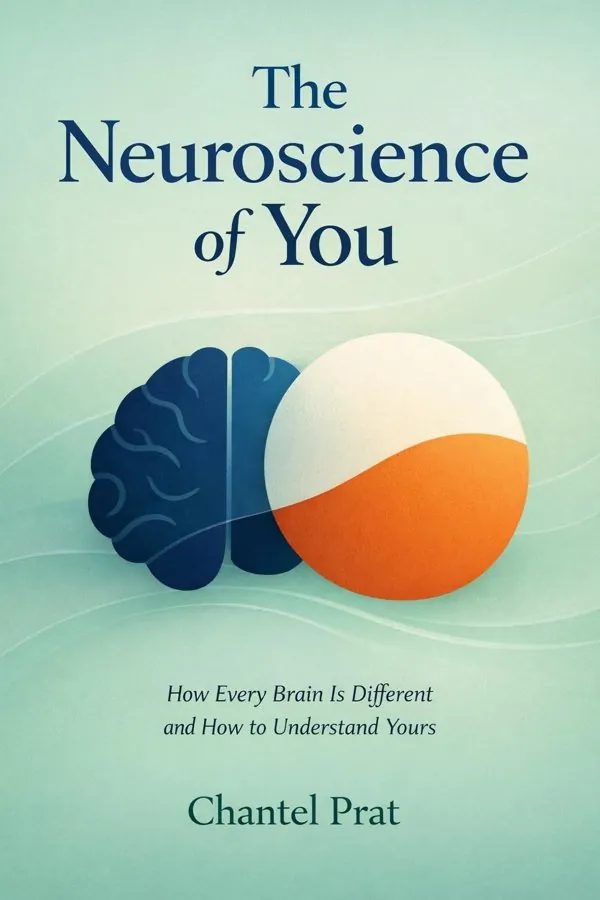
The Neuroscience of You: How Every Brain Is Different and How to Understand Yours: Summary & Key Insights
by Chantel Prat
 10 min11 chaptersAudio available
What Is The Neuroscience of You: How Every Brain Is Different and How to Understand Yours About?
The Neuroscience of You: How Every Brain Is Different and How to Understand Yours by Chantel Prat is a neuroscience book spanning 11 pages. This book explores how individual differences in brain structure and function shape personality, behavior, and cognition. Chantel Prat, a cognitive neuroscientist, explains complex neuroscience concepts in accessible language, showing how understanding your unique brain can improve self-awareness and relationships.
This FizzRead summary covers all 11 key chapters of The Neuroscience of You: How Every Brain Is Different and How to Understand Yours in approximately 10 minutes, distilling the most important ideas, arguments, and takeaways from Chantel Prat's work. Also available as an audio summary and Key Quotes Podcast.
The Neuroscience of You: How Every Brain Is Different and How to Understand Yours
This book explores how individual differences in brain structure and function shape personality, behavior, and cognition. Chantel Prat, a cognitive neuroscientist, explains complex neuroscience concepts in accessible language, showing how understanding your unique brain can improve self-awareness and relationships.
Who Should Read The Neuroscience of You: How Every Brain Is Different and How to Understand Yours?
This book is perfect for anyone interested in neuroscience and looking to gain actionable insights in a short read. Whether you're a student, professional, or lifelong learner, the key ideas from The Neuroscience of You: How Every Brain Is Different and How to Understand Yours by Chantel Prat will help you think differently.
- ✓Readers who enjoy neuroscience and want practical takeaways
- ✓Professionals looking to apply new ideas to their work and life
- ✓Anyone who wants the core insights of The Neuroscience of You: How Every Brain Is Different and How to Understand Yours in just 10 minutes
Want the full summary?
Get instant access to this book summary and 100K+ more with Fizz Moment.
Get Free SummaryAvailable on App Store • Free to download
Key Chapters
In this chapter, I begin with the foundations — the biological story that makes every brain different before we even take our first breath. Much of who we become begins in a swirl of genetic blueprints and early developmental chaos. The human brain develops from the same basic biological architecture, but each fold, each network, and each connection is subtly shaped by variations in our DNA and the environment in which we grow.
Think of your genome as a starting recipe. It dictates how your neurons will proliferate, where neurotransmitters might be more abundant, and how regions communicate. Yet genes don’t act in isolation — they respond to experience. Two individuals might share 99.9 percent of their genetic makeup, yet stress, nutrition, and even the mother’s mood during pregnancy can tune the way those genes are expressed in the developing brain. This gene-environment conversation continues throughout life, constantly shaping your neural reality.
Neural plasticity — the brain's capacity to rewire and adapt — ensures that even identical twins diverge over time. Every conversation you have, every book you read, every skill you try (and fail) to learn, etches microscopic changes into your neural architecture. The point is that the 'typical brain' is a myth. Every mind is a living map of experience, sculpted by biology but never imprisoned by it.
What this means for you is liberating: your abilities, habits, and quirks are neither hardwired nor arbitrary. They are the natural outcomes of how your biology interacts with your story. Understanding those building blocks empowers you to interpret your strengths and struggles not as moral qualities but as reflections of a unique, living system designed for adaptation.
We’ve all heard the clichés — the left-brained analytical thinker versus the right-brained creative dreamer. While popular culture oversimplifies this divide, neuroscience does reveal meaningful asymmetries that help explain different cognitive styles. In my research and teaching, I emphasize that lateralization — the specialization of brain hemispheres — is less about separation and more about coordination. Both sides are in constant dialogue, but they do tend to favor different jobs.
The left hemisphere usually manages structured language, sequential reasoning, and logical analysis, while the right hemisphere tends to process context, emotion, and holistic patterns. But these tendencies don’t make one hemisphere smarter or better. Rather, they create distinct entry points into understanding. Your left hemisphere might dissect the details of a problem, while your right interprets its broader meaning. Which hemisphere you rely on more determines the kind of thinker you are.
People vary widely in how balanced their hemispheric communication is. Some brains have stronger connectivity between hemispheres through the corpus callosum, making them fluid integrators of emotional and rational data. Others show more localized specialization, making them excellent in focused domains. Recognizing these patterns can demystify why some tasks — like following a recipe step-by-step or improvising during a debate — feel more natural to you than others. Your brain isn’t wrong; it’s specialized. As we move deeper into understanding these differences, the goal is always the same: to honor the particular dance your hemispheres perform, not to force them into someone else’s rhythm.
+ 9 more chapters — available in the FizzRead app
All Chapters in The Neuroscience of You: How Every Brain Is Different and How to Understand Yours
About the Author
Chantel Prat is a professor of psychology, neuroscience, and linguistics at the University of Washington. Her research focuses on the biological basis of individual differences in cognition and language processing.
Get This Summary in Your Preferred Format
Read or listen to the The Neuroscience of You: How Every Brain Is Different and How to Understand Yours summary by Chantel Prat anytime, anywhere. FizzRead offers multiple formats so you can learn on your terms — all free.
Available formats: App · Audio · PDF · EPUB — All included free with FizzRead
Download The Neuroscience of You: How Every Brain Is Different and How to Understand Yours PDF and EPUB Summary
Key Quotes from The Neuroscience of You: How Every Brain Is Different and How to Understand Yours
“In this chapter, I begin with the foundations — the biological story that makes every brain different before we even take our first breath.”
“We’ve all heard the clichés — the left-brained analytical thinker versus the right-brained creative dreamer.”
Frequently Asked Questions about The Neuroscience of You: How Every Brain Is Different and How to Understand Yours
The Neuroscience of You: How Every Brain Is Different and How to Understand Yours by Chantel Prat is a neuroscience book that explores key ideas across 11 chapters. This book explores how individual differences in brain structure and function shape personality, behavior, and cognition. Chantel Prat, a cognitive neuroscientist, explains complex neuroscience concepts in accessible language, showing how understanding your unique brain can improve self-awareness and relationships.
You Might Also Like
Anxious
Joseph LeDoux
10 min
Hallucinations
Oliver Sacks
10 min
The Biological Mind: How Brain, Body, and Environment Collaborate to Make Us Who We Are
Alan Jasanoff
10 min
The Feeling of Life Itself: Why Consciousness Is Widespread but Can't Be Computed
Christof Koch
10 min
The No-Nonsense Meditation Book
Steven Laureys
10 min
A General Theory of Love
Thomas Lewis, Fari Amini, Richard Lannon
10 minBrowse by Category
Ready to read The Neuroscience of You: How Every Brain Is Different and How to Understand Yours?
Get the full summary and 100K+ more books with Fizz Moment.