
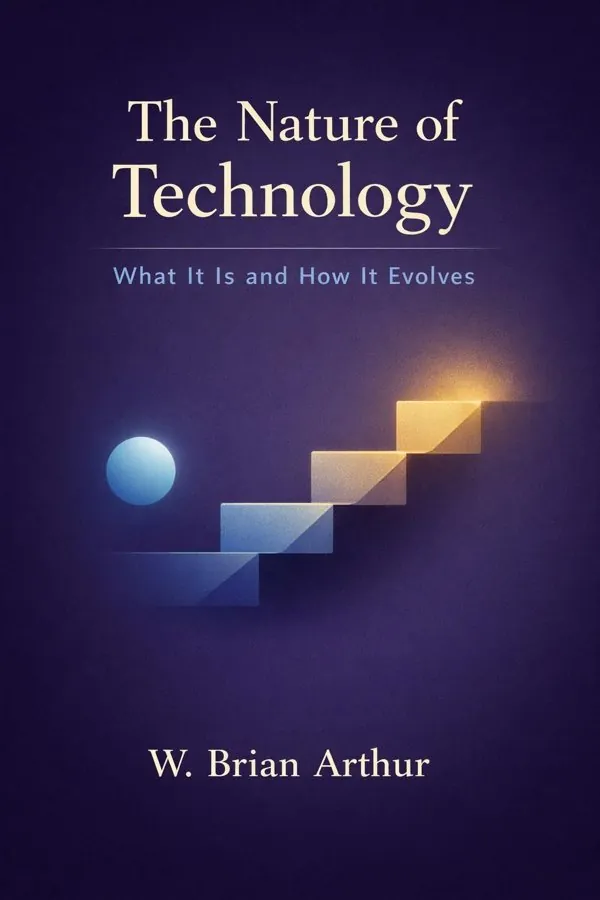
The Nature of Technology: What It Is and How It Evolves: Summary & Key Insights
 10 min10 chaptersAudio available
What Is The Nature of Technology: What It Is and How It Evolves About?
The Nature of Technology: What It Is and How It Evolves by W. Brian Arthur is a economics book spanning 10 pages. This book explores the fundamental nature of technology, arguing that technologies evolve through a process similar to biological evolution. W. Brian Arthur presents a comprehensive theory explaining how new technologies arise from the combination and reconfiguration of existing ones, and how this process drives economic and social change. The work bridges economics, engineering, and philosophy, offering insights into innovation and the dynamics of technological progress.
This FizzRead summary covers all 10 key chapters of The Nature of Technology: What It Is and How It Evolves in approximately 10 minutes, distilling the most important ideas, arguments, and takeaways from W. Brian Arthur's work. Also available as an audio summary and Key Quotes Podcast.
The Nature of Technology: What It Is and How It Evolves
This book explores the fundamental nature of technology, arguing that technologies evolve through a process similar to biological evolution. W. Brian Arthur presents a comprehensive theory explaining how new technologies arise from the combination and reconfiguration of existing ones, and how this process drives economic and social change. The work bridges economics, engineering, and philosophy, offering insights into innovation and the dynamics of technological progress.
Who Should Read The Nature of Technology: What It Is and How It Evolves?
This book is perfect for anyone interested in economics and looking to gain actionable insights in a short read. Whether you're a student, professional, or lifelong learner, the key ideas from The Nature of Technology: What It Is and How It Evolves by W. Brian Arthur will help you think differently.
- ✓Readers who enjoy economics and want practical takeaways
- ✓Professionals looking to apply new ideas to their work and life
- ✓Anyone who wants the core insights of The Nature of Technology: What It Is and How It Evolves in just 10 minutes
Want the full summary?
Get instant access to this book summary and 100K+ more with Fizz Moment.
Get Free SummaryAvailable on App Store • Free to download
Key Chapters
At the heart of my argument lies a simple but transformative redefinition. A technology, I propose, is a means to fulfill a human purpose through the orchestration of phenomena. Take the laser printer: it combines optical, electronic, and mechanical principles to convert digital images into ink on paper. Its essence is not found in its plastic casing or brand but in the way it coordinates the physical phenomena of light and motion to achieve an outcome.
Every technology can be decomposed into component technologies, each performing a sub-function and relying on underlying phenomena. This layered functionality distinguishes a technology from a mere tool. A hammer, as a tool, applies a single principle — mechanical force — toward a single action. A technology, by contrast, contains interlocking modules, each designed for precision purposes within a collective whole. Understanding technology, therefore, requires seeing it as an architecture of functions rather than a catalog of artifacts.
This view liberates us from the narrowness of technological determinism. It reminds us that what matters is not the physical form but the underlying arrangement of ideas and mechanisms. It also allows us to see how technologies can evolve: not by spontaneous invention or divine inspiration, but by the rearrangement and integration of existing functional components. Technologies, in essence, are repositories of orchestrated phenomena — accumulated achievements of human ingenuity built upon one another.
The central thesis of my book is that technology evolves through combination. Every new technology arises by linking existing ones into new architectures. This process, which I call combinatorial evolution, is analogous to how biology works, but in symbolic rather than genetic terms.
Biological evolution operates through mutation and recombination of genetic material. Technological evolution functions through the recombination of ideas, principles, and functional components. Consider the smartphone: it merges telephony, computing, photography, networking, and materials science. None of these originated within the smartphone itself; rather, they preexisted as separate domains that were combined into a coherent whole.
This process explains why innovation is cumulative and why technological progress accelerates over time. Each generation of technologies becomes the foundation for further creation, expanding the set of possible combinations. In any moment, the landscape of technology is not static but dynamic — composed of evolving components interacting within multiple domains. The key insight is that evolution in technology is not random: it follows discernible pathways dictated by functionality, available phenomena, and human purpose.
When we look at technological history through this lens, we realize that revolutions like the Industrial Revolution or the Digital Revolution were not singular miracles. They were waves of combinatorial synthesis, each unlocking new layers of possibility. The steam engine led to locomotive technology, which led to transportation networks, which enabled new forms of commerce. Likewise, computing merged with communication to yield the Internet, which itself catalyzed a cascade of subsequent innovations. Each layer breeds the next, forming a constantly self-reinforcing dynamic — the true evolutionary nature of technology.
+ 8 more chapters — available in the FizzRead app
All Chapters in The Nature of Technology: What It Is and How It Evolves
About the Author
W. Brian Arthur is an American economist and complexity scientist known for his pioneering work on the economics of technology and the theory of increasing returns. He is a founding member of the Santa Fe Institute and has contributed significantly to the study of complex systems and innovation.
Get This Summary in Your Preferred Format
Read or listen to the The Nature of Technology: What It Is and How It Evolves summary by W. Brian Arthur anytime, anywhere. FizzRead offers multiple formats so you can learn on your terms — all free.
Available formats: App · Audio · PDF · EPUB — All included free with FizzRead
Download The Nature of Technology: What It Is and How It Evolves PDF and EPUB Summary
Key Quotes from The Nature of Technology: What It Is and How It Evolves
“At the heart of my argument lies a simple but transformative redefinition.”
“The central thesis of my book is that technology evolves through combination.”
Frequently Asked Questions about The Nature of Technology: What It Is and How It Evolves
The Nature of Technology: What It Is and How It Evolves by W. Brian Arthur is a economics book that explores key ideas across 10 chapters. This book explores the fundamental nature of technology, arguing that technologies evolve through a process similar to biological evolution. W. Brian Arthur presents a comprehensive theory explaining how new technologies arise from the combination and reconfiguration of existing ones, and how this process drives economic and social change. The work bridges economics, engineering, and philosophy, offering insights into innovation and the dynamics of technological progress.
You Might Also Like

Business Adventures
John Brooks
10 min
Nudge
Richard H. Thaler, Cass R. Sunstein
10 min
The Hitchhiker"s Guide to the Galaxy
Douglas Adams
10 minThe Muqaddimah
Ibn Khaldun
10 minThe Outsiders
William N. Thorndike
10 min
A Little History of Economics
Niall Kishtainy
10 minBrowse by Category
Ready to read The Nature of Technology: What It Is and How It Evolves?
Get the full summary and 100K+ more books with Fizz Moment.