
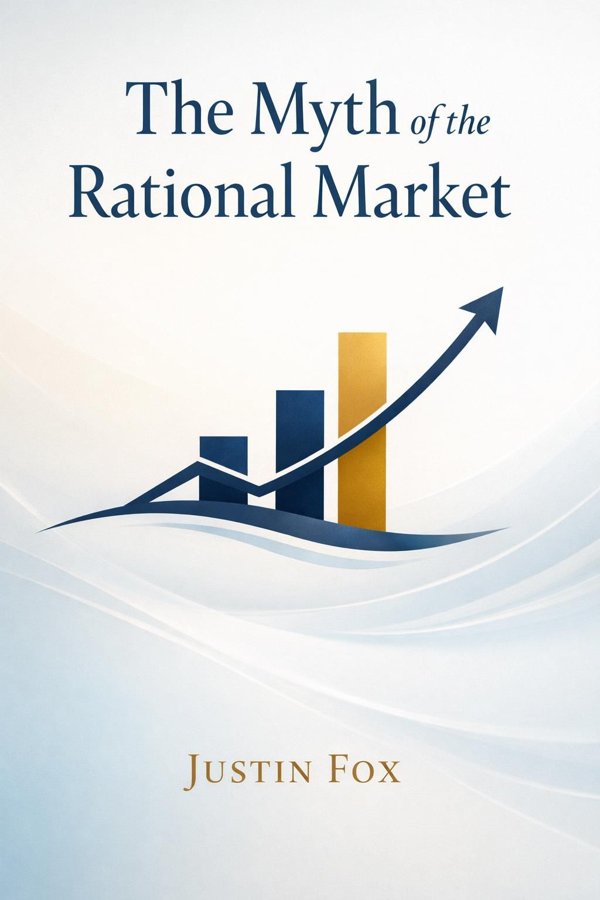
The Myth of the Rational Market: A History of Risk, Reward, and Delusion on Wall Street: Summary & Key Insights
by Justin Fox
 10 min6 chaptersAudio available
What Is The Myth of the Rational Market: A History of Risk, Reward, and Delusion on Wall Street About?
The Myth of the Rational Market: A History of Risk, Reward, and Delusion on Wall Street by Justin Fox is a economics book spanning 6 pages. The book traces the rise and fall of the efficient market hypothesis, exploring how economists and investors came to believe that markets are rational and self-correcting. Justin Fox examines the intellectual history behind modern financial theory, from early thinkers like Irving Fisher and John Maynard Keynes to the Chicago School economists, and how their ideas shaped Wall Street practices leading up to the 2008 financial crisis.
This FizzRead summary covers all 6 key chapters of The Myth of the Rational Market: A History of Risk, Reward, and Delusion on Wall Street in approximately 10 minutes, distilling the most important ideas, arguments, and takeaways from Justin Fox's work. Also available as an audio summary and Key Quotes Podcast.
The Myth of the Rational Market: A History of Risk, Reward, and Delusion on Wall Street
The book traces the rise and fall of the efficient market hypothesis, exploring how economists and investors came to believe that markets are rational and self-correcting. Justin Fox examines the intellectual history behind modern financial theory, from early thinkers like Irving Fisher and John Maynard Keynes to the Chicago School economists, and how their ideas shaped Wall Street practices leading up to the 2008 financial crisis.
Who Should Read The Myth of the Rational Market: A History of Risk, Reward, and Delusion on Wall Street?
This book is perfect for anyone interested in economics and looking to gain actionable insights in a short read. Whether you're a student, professional, or lifelong learner, the key ideas from The Myth of the Rational Market: A History of Risk, Reward, and Delusion on Wall Street by Justin Fox will help you think differently.
- ✓Readers who enjoy economics and want practical takeaways
- ✓Professionals looking to apply new ideas to their work and life
- ✓Anyone who wants the core insights of The Myth of the Rational Market: A History of Risk, Reward, and Delusion on Wall Street in just 10 minutes
Want the full summary?
Get instant access to this book summary and 100K+ more with Fizz Moment.
Get Free SummaryAvailable on App Store • Free to download
Key Chapters
In the early decades of the twentieth century, before formal financial theory took shape, pioneers like Irving Fisher and John Maynard Keynes wrestled with fundamental questions about rationality and speculation. Fisher, an optimist by temperament and intellect, believed that science could bring precision to economics. His attempts to measure expected returns and to link interest rates with inflation reflected a deep faith in reason. To Fisher, markets were systems that, though imperfect, tended toward equilibrium as participants acted rationally to maximize wealth. This belief in the market’s intelligence would later echo in the efficient market hypothesis. Yet Fisher’s personal story also reveals the limits of that optimism. Having invested heavily in the stock market before the crash of 1929, he lost his fortune and reputation. His tragedy symbolized the birth of skepticism—a reminder that markets could humble even the most rational minds.
Keynes, by contrast, distrusted the neatness of models. He saw markets as driven not just by calculation but by psychology—by waves of optimism and panic, by the unpredictable shifts of collective emotion. His notion of “animal spirits” introduced the idea that rational behavior was rarely pure; it was constantly infused with fear and hope. Keynes’s interventions during the Great Depression showed how markets could spiral into irrationality without guidance. Thus, while Fisher represented faith in market intelligence, Keynes stood for the realism of human behavior. Their intellectual tension—between rational equilibrium and emotional instability—would become the central drama of modern financial thought.
After the Second World War, economics entered a new era of formalization. The rise of computing power and data-driven analysis allowed economists to quantify uncertainty in ways never before possible. Figures such as Harry Markowitz and William Sharpe developed the mathematical foundations of portfolio theory, showing investors how diversification could minimize risk without compromising returns. This was rationality rendered into numbers—an equation of behavior that seemed to transcend psychology.
Within this intellectual context, Eugene Fama’s efficient market hypothesis (EMH) emerged as a cornerstone. Fama argued that market prices already incorporated all available information, meaning it was impossible to consistently outperform the market through stock picking or market timing. For many, this was liberating: it implied that markets were not just mechanisms of exchange but engines of truth. To believe in efficiency was to believe in the triumph of collective intelligence.
The appeal of this idea was profound, especially as it migrated from universities to investment firms. Portfolio managers began designing passive strategies based on market indexes, while financial theorists expanded their models of risk using statistical methodologies. The rational market became not just an academic concept but an operational paradigm—a way to justify the growing complexity of finance itself. Yet underlying this era of precision was a subtle deception: the belief that mathematical elegance equaled real-world accuracy. Even as models grew more sophisticated, their assumptions remained fragile—most dangerously, the assumption that investors behaved logically in the face of uncertainty.
+ 4 more chapters — available in the FizzRead app
All Chapters in The Myth of the Rational Market: A History of Risk, Reward, and Delusion on Wall Street
About the Author
Justin Fox is an American financial journalist and commentator. He has served as editorial director of the Harvard Business Review Group and was previously a columnist for Time magazine and a writer for Fortune. His work focuses on economics, finance, and the history of financial thought.
Get This Summary in Your Preferred Format
Read or listen to the The Myth of the Rational Market: A History of Risk, Reward, and Delusion on Wall Street summary by Justin Fox anytime, anywhere. FizzRead offers multiple formats so you can learn on your terms — all free.
Available formats: App · Audio · PDF · EPUB — All included free with FizzRead
Download The Myth of the Rational Market: A History of Risk, Reward, and Delusion on Wall Street PDF and EPUB Summary
Key Quotes from The Myth of the Rational Market: A History of Risk, Reward, and Delusion on Wall Street
“Fisher, an optimist by temperament and intellect, believed that science could bring precision to economics.”
“After the Second World War, economics entered a new era of formalization.”
Frequently Asked Questions about The Myth of the Rational Market: A History of Risk, Reward, and Delusion on Wall Street
The Myth of the Rational Market: A History of Risk, Reward, and Delusion on Wall Street by Justin Fox is a economics book that explores key ideas across 6 chapters. The book traces the rise and fall of the efficient market hypothesis, exploring how economists and investors came to believe that markets are rational and self-correcting. Justin Fox examines the intellectual history behind modern financial theory, from early thinkers like Irving Fisher and John Maynard Keynes to the Chicago School economists, and how their ideas shaped Wall Street practices leading up to the 2008 financial crisis.
You Might Also Like
Business Adventures
John Brooks
10 min
Nudge
Richard H. Thaler, Cass R. Sunstein
10 min
The Hitchhiker"s Guide to the Galaxy
Douglas Adams
10 minThe Muqaddimah
Ibn Khaldun
10 minThe Outsiders
William N. Thorndike
10 min
A Little History of Economics
Niall Kishtainy
10 minBrowse by Category
Ready to read The Myth of the Rational Market: A History of Risk, Reward, and Delusion on Wall Street?
Get the full summary and 100K+ more books with Fizz Moment.