
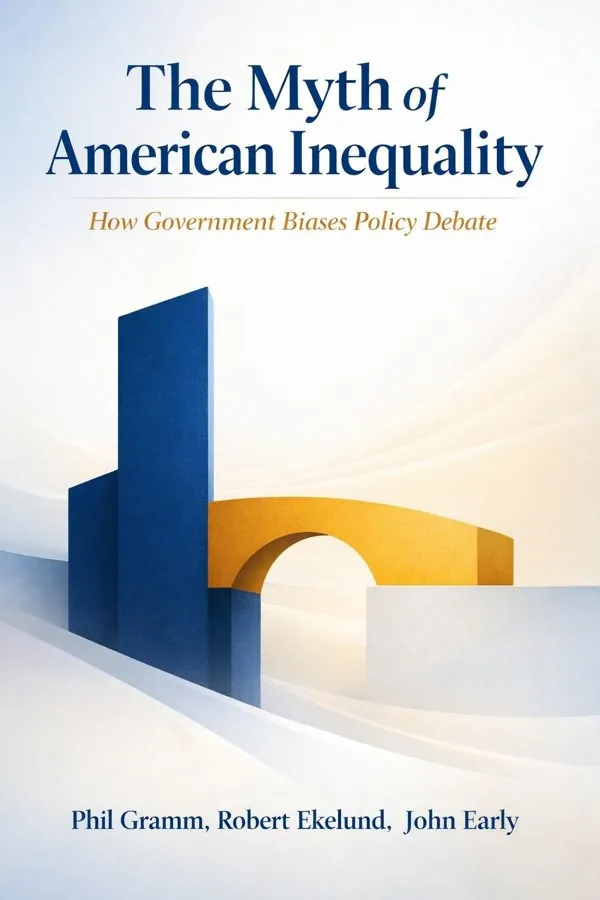
The Myth of American Inequality: How Government Biases Policy Debate: Summary & Key Insights
by Phil Gramm, Robert Ekelund, John Early
 10 min8 chaptersAudio available
What Is The Myth of American Inequality: How Government Biases Policy Debate About?
The Myth of American Inequality: How Government Biases Policy Debate by Phil Gramm, Robert Ekelund, John Early is a economics book spanning 8 pages. This book challenges the prevailing narrative about income inequality in the United States. The authors argue that official statistics significantly overstate inequality by failing to account for taxes, transfers, and non-cash benefits. Drawing on decades of economic data, they contend that when these factors are properly included, the gap between rich and poor Americans is far smaller than commonly believed. The book also explores how mismeasurement distorts public policy and political debate.
This FizzRead summary covers all 8 key chapters of The Myth of American Inequality: How Government Biases Policy Debate in approximately 10 minutes, distilling the most important ideas, arguments, and takeaways from Phil Gramm, Robert Ekelund, John Early's work. Also available as an audio summary and Key Quotes Podcast.
The Myth of American Inequality: How Government Biases Policy Debate
This book challenges the prevailing narrative about income inequality in the United States. The authors argue that official statistics significantly overstate inequality by failing to account for taxes, transfers, and non-cash benefits. Drawing on decades of economic data, they contend that when these factors are properly included, the gap between rich and poor Americans is far smaller than commonly believed. The book also explores how mismeasurement distorts public policy and political debate.
Who Should Read The Myth of American Inequality: How Government Biases Policy Debate?
This book is perfect for anyone interested in economics and looking to gain actionable insights in a short read. Whether you're a student, professional, or lifelong learner, the key ideas from The Myth of American Inequality: How Government Biases Policy Debate by Phil Gramm, Robert Ekelund, John Early will help you think differently.
- ✓Readers who enjoy economics and want practical takeaways
- ✓Professionals looking to apply new ideas to their work and life
- ✓Anyone who wants the core insights of The Myth of American Inequality: How Government Biases Policy Debate in just 10 minutes
Want the full summary?
Get instant access to this book summary and 100K+ more with Fizz Moment.
Get Free SummaryAvailable on App Store • Free to download
Key Chapters
To understand the present confusion, we must look back at how America began measuring inequality. In the mid-twentieth century, when income statistics first became standard in federal reporting, the focus was narrow: income meant money earned through wages, salaries, and certain cash transfers. Over time, however, the economy evolved dramatically. The government expanded programs like Social Security, Medicare, Medicaid, and food assistance—benefits that provided substantial real income to low- and middle-income households but never appeared in statistical calculations of their earnings. Meanwhile, the tax system grew more progressive, steadily increasing the share of taxes paid by higher earners. The disconnect between measurement and reality widened.
These early definitions were not malicious but convenient. Data collection in the 1940s and 1950s lacked the tools to track complex transfer systems or in-kind benefits. Yet, as technology and recordkeeping improved, the Census Bureau continued to use definitions that reflected an outdated understanding of the economy. Over decades, as policymakers and scholars began to rely on these figures, a misleading narrative took hold: that inequality was rising relentlessly since the 1960s, even as real living standards improved across every income level.
When we trace the historical evolution of government statistics, we see that what began as a practical simplification solidified into institutional inertia. Bureaucracies grew attached to familiar categories, even as they became less relevant for assessing modern well-being. This explains why most official statistics today still treat a dollar of wages earned as income but exclude hundreds of billions in health insurance benefits or refundable tax credits that go disproportionately to those with lower market incomes.
Before we can talk about inequality, we must define what we mean by 'income.' Economists often use the term broadly to capture all resources that improve a household’s ability to consume and save. Yet America's most trusted surveys use a much narrower version, omitting key forms of compensation and government support.
In this book, we adopt what we call comprehensive income—an inclusive measure that starts with market income (wages, self-employment, pensions, dividends) and then adjusts for what truly affects a family’s economic position: taxes paid and transfers received. Transfers include Social Security, Medicaid, food stamps, housing subsidies, and many others. Taxes include income and payroll contributions that reduce disposable income.
When we use this fuller measure, something extraordinary happens to the inequality curve. The bottom quintile of households, which the Census Bureau lists as having nearly no income, in fact receives substantial resources once non-cash benefits and credits are counted. Meanwhile, the top fifth, which appears vastly richer under pre-tax measures, contributes an outsized share through taxation. Thus, the spread between the highest and lowest incomes shrinks dramatically when comprehensive income is used.
Understanding income properly changes not only measurement but perception. It invites us to reconsider how society redistributes wealth, how public programs function, and how much they already achieve compared with their supposed inadequacy.
+ 6 more chapters — available in the FizzRead app
All Chapters in The Myth of American Inequality: How Government Biases Policy Debate
About the Authors
Phil Gramm is a former U.S. Senator and economist. Robert Ekelund is an economist and professor emeritus at Auburn University. John Early is a former assistant commissioner at the U.S. Bureau of Labor Statistics and an economist specializing in income measurement.
Get This Summary in Your Preferred Format
Read or listen to the The Myth of American Inequality: How Government Biases Policy Debate summary by Phil Gramm, Robert Ekelund, John Early anytime, anywhere. FizzRead offers multiple formats so you can learn on your terms — all free.
Available formats: App · Audio · PDF · EPUB — All included free with FizzRead
Download The Myth of American Inequality: How Government Biases Policy Debate PDF and EPUB Summary
Key Quotes from The Myth of American Inequality: How Government Biases Policy Debate
“To understand the present confusion, we must look back at how America began measuring inequality.”
“Before we can talk about inequality, we must define what we mean by 'income.”
Frequently Asked Questions about The Myth of American Inequality: How Government Biases Policy Debate
The Myth of American Inequality: How Government Biases Policy Debate by Phil Gramm, Robert Ekelund, John Early is a economics book that explores key ideas across 8 chapters. This book challenges the prevailing narrative about income inequality in the United States. The authors argue that official statistics significantly overstate inequality by failing to account for taxes, transfers, and non-cash benefits. Drawing on decades of economic data, they contend that when these factors are properly included, the gap between rich and poor Americans is far smaller than commonly believed. The book also explores how mismeasurement distorts public policy and political debate.
You Might Also Like
Business Adventures
John Brooks
10 min
Nudge
Richard H. Thaler, Cass R. Sunstein
10 min
The Hitchhiker"s Guide to the Galaxy
Douglas Adams
10 minThe Muqaddimah
Ibn Khaldun
10 minThe Outsiders
William N. Thorndike
10 min
A Little History of Economics
Niall Kishtainy
10 minBrowse by Category
Ready to read The Myth of American Inequality: How Government Biases Policy Debate?
Get the full summary and 100K+ more books with Fizz Moment.