
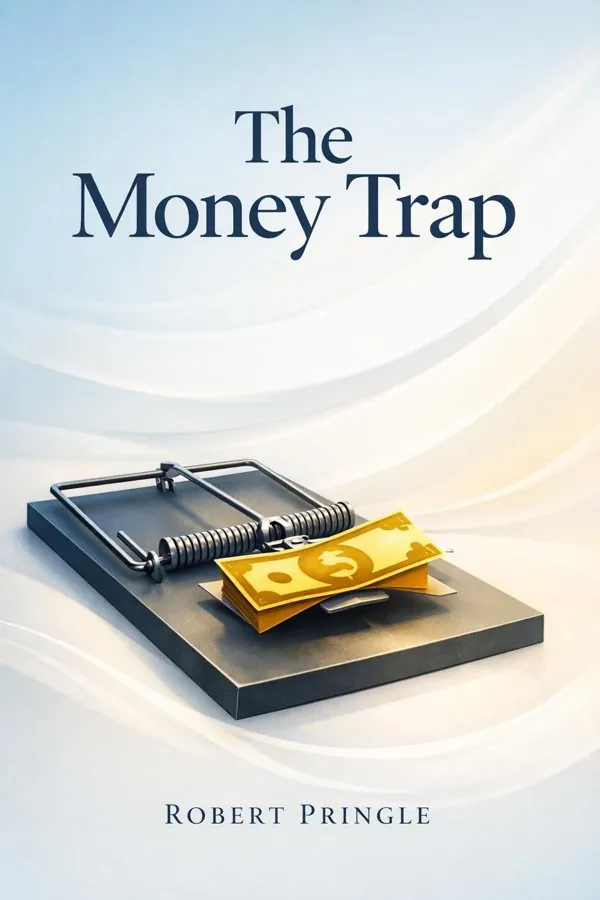
The Money Trap: Escaping the Grip of Global Finance: Summary & Key Insights
 10 min10 chaptersAudio available
What Is The Money Trap: Escaping the Grip of Global Finance About?
The Money Trap: Escaping the Grip of Global Finance by Robert Pringle is a economics book spanning 10 pages. The Money Trap explores the structural flaws in the global financial system that led to repeated crises. Robert Pringle, a veteran financial journalist and economist, argues that the world economy remains vulnerable because of the way money and credit are created and managed. He proposes reforms to restore stability and fairness to international finance, emphasizing the need for moral and institutional renewal.
This FizzRead summary covers all 10 key chapters of The Money Trap: Escaping the Grip of Global Finance in approximately 10 minutes, distilling the most important ideas, arguments, and takeaways from Robert Pringle's work. Also available as an audio summary and Key Quotes Podcast.
The Money Trap: Escaping the Grip of Global Finance
The Money Trap explores the structural flaws in the global financial system that led to repeated crises. Robert Pringle, a veteran financial journalist and economist, argues that the world economy remains vulnerable because of the way money and credit are created and managed. He proposes reforms to restore stability and fairness to international finance, emphasizing the need for moral and institutional renewal.
Who Should Read The Money Trap: Escaping the Grip of Global Finance?
This book is perfect for anyone interested in economics and looking to gain actionable insights in a short read. Whether you're a student, professional, or lifelong learner, the key ideas from The Money Trap: Escaping the Grip of Global Finance by Robert Pringle will help you think differently.
- ✓Readers who enjoy economics and want practical takeaways
- ✓Professionals looking to apply new ideas to their work and life
- ✓Anyone who wants the core insights of The Money Trap: Escaping the Grip of Global Finance in just 10 minutes
Want the full summary?
Get instant access to this book summary and 100K+ more with Fizz Moment.
Get Free SummaryAvailable on App Store • Free to download
Key Chapters
The history of money is, at its heart, the history of civilization’s trust in itself. For centuries, the gold standard provided an anchor of discipline—a tangible constraint linking money to real value. It imposed prudence on governments and restrained the impulse to expand credit recklessly. Yet as the 20th century unfolded, political demands, wars, and aspirations for economic control led nations to abandon this constraint. The transition to fiat currencies liberated governments and financial institutions from objective limits, ushering in an age of managed money and floating exchange rates.
After the collapse of Bretton Woods in 1971, the world entered uncharted territory. Currencies began to fluctuate freely, and central banks inherited enormous discretion over money and credit. This flexibility was meant to bring stability; instead, it invited excess. Without the discipline of convertibility, money creation became politicized, and credit expansion became the chief engine of growth. The institutional architecture of global finance—national central banks, private banking systems, and international bodies like the IMF—was never truly reformed for this new reality. The seeds of recurring crises were thus sown in the decades following the end of Bretton Woods.
Money is a human-made promise—a claim on the future. It functions as a medium of exchange, a unit of account, and a store of value. But when private banks create credit, they create money ex nihilo—out of nothing. This process amplifies the role of expectations, making money not merely a reflection of value but a source of it. When credit is abundant, asset prices soar and the illusion of wealth multiplies. When confidence collapses, the entire edifice crumbles.
Modern economies conflate money and credit, forgetting that while money should be impartial, credit is inherently risky. This confusion lies at the root of financial instability. The more the system depends on credit creation by private institutions, the less stable it becomes. Instead of serving society, banks have increasingly served themselves, treating credit as a commodity to be multiplied and sold. Meanwhile, central banks, in their effort to control the very credit they helped unleash, have reinforced the trap—responding to crises with more liquidity, more credit, more dependence.
+ 8 more chapters — available in the FizzRead app
All Chapters in The Money Trap: Escaping the Grip of Global Finance
About the Author
Robert Pringle is a British economist, author, and founder of Central Banking Publications. He has written extensively on monetary policy, central banking, and financial reform, drawing on decades of experience analyzing global economic systems.
Get This Summary in Your Preferred Format
Read or listen to the The Money Trap: Escaping the Grip of Global Finance summary by Robert Pringle anytime, anywhere. FizzRead offers multiple formats so you can learn on your terms — all free.
Available formats: App · Audio · PDF · EPUB — All included free with FizzRead
Download The Money Trap: Escaping the Grip of Global Finance PDF and EPUB Summary
Key Quotes from The Money Trap: Escaping the Grip of Global Finance
“The history of money is, at its heart, the history of civilization’s trust in itself.”
“Money is a human-made promise—a claim on the future.”
Frequently Asked Questions about The Money Trap: Escaping the Grip of Global Finance
The Money Trap: Escaping the Grip of Global Finance by Robert Pringle is a economics book that explores key ideas across 10 chapters. The Money Trap explores the structural flaws in the global financial system that led to repeated crises. Robert Pringle, a veteran financial journalist and economist, argues that the world economy remains vulnerable because of the way money and credit are created and managed. He proposes reforms to restore stability and fairness to international finance, emphasizing the need for moral and institutional renewal.
You Might Also Like

Business Adventures
John Brooks
10 min
Nudge
Richard H. Thaler, Cass R. Sunstein
10 min
The Hitchhiker"s Guide to the Galaxy
Douglas Adams
10 minThe Muqaddimah
Ibn Khaldun
10 minThe Outsiders
William N. Thorndike
10 min
A Little History of Economics
Niall Kishtainy
10 minBrowse by Category
Ready to read The Money Trap: Escaping the Grip of Global Finance?
Get the full summary and 100K+ more books with Fizz Moment.