
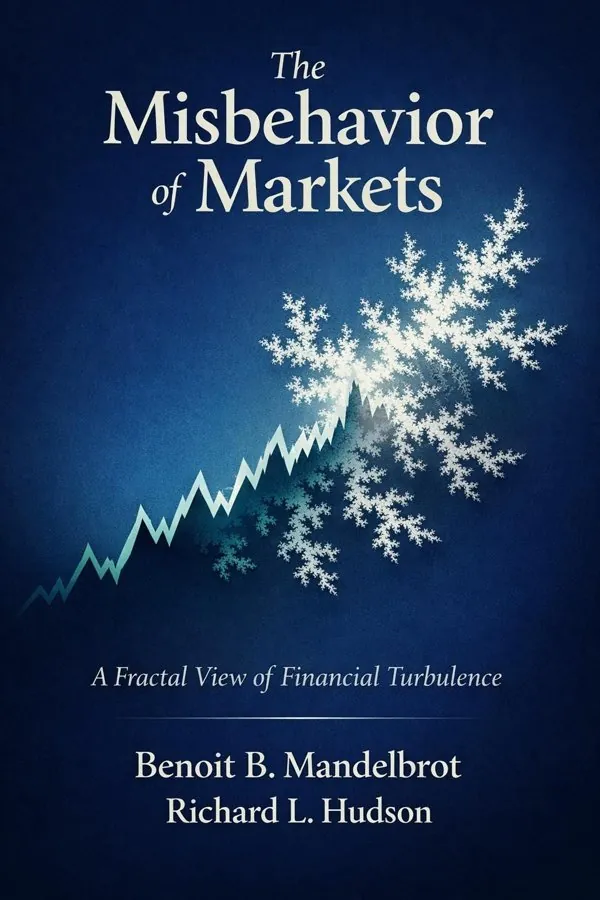
The Misbehavior of Markets: A Fractal View of Financial Turbulence: Summary & Key Insights
by Benoit B. Mandelbrot, Richard L. Hudson
 10 min6 chaptersAudio available
What Is The Misbehavior of Markets: A Fractal View of Financial Turbulence About?
The Misbehavior of Markets: A Fractal View of Financial Turbulence by Benoit B. Mandelbrot, Richard L. Hudson is a finance book spanning 6 pages. In this groundbreaking work, mathematician Benoit Mandelbrot and science journalist Richard L. Hudson challenge the traditional assumptions of financial theory. They argue that markets are far more turbulent and unpredictable than classical models suggest, and that fractal geometry provides a more accurate framework for understanding financial behavior. The book explores how fractal patterns can explain market volatility, risk, and the limits of prediction in economics.
This FizzRead summary covers all 6 key chapters of The Misbehavior of Markets: A Fractal View of Financial Turbulence in approximately 10 minutes, distilling the most important ideas, arguments, and takeaways from Benoit B. Mandelbrot, Richard L. Hudson's work. Also available as an audio summary and Key Quotes Podcast.
The Misbehavior of Markets: A Fractal View of Financial Turbulence
In this groundbreaking work, mathematician Benoit Mandelbrot and science journalist Richard L. Hudson challenge the traditional assumptions of financial theory. They argue that markets are far more turbulent and unpredictable than classical models suggest, and that fractal geometry provides a more accurate framework for understanding financial behavior. The book explores how fractal patterns can explain market volatility, risk, and the limits of prediction in economics.
Who Should Read The Misbehavior of Markets: A Fractal View of Financial Turbulence?
This book is perfect for anyone interested in finance and looking to gain actionable insights in a short read. Whether you're a student, professional, or lifelong learner, the key ideas from The Misbehavior of Markets: A Fractal View of Financial Turbulence by Benoit B. Mandelbrot, Richard L. Hudson will help you think differently.
- ✓Readers who enjoy finance and want practical takeaways
- ✓Professionals looking to apply new ideas to their work and life
- ✓Anyone who wants the core insights of The Misbehavior of Markets: A Fractal View of Financial Turbulence in just 10 minutes
Want the full summary?
Get instant access to this book summary and 100K+ more with Fizz Moment.
Get Free SummaryAvailable on App Store • Free to download
Key Chapters
The foundations of modern financial theory were built on an idealized vision of randomness. Louis Bachelier, in 1900, proposed that price changes follow a random walk—a mathematical model similar to the diffusion of particles. Later, this idea evolved through Markowitz’s portfolio theory, Sharpe’s capital asset pricing model, and the Black-Scholes option pricing formula. Each of these pillars assumes that returns are normally distributed, independent, and devoid of memory. The neatness of Gaussian statistics brought mathematics to the seemingly chaotic world of economics.
The trouble is that these assumptions work only in theory, not in the living marketplace. Gaussian curves predict a world in which extreme swings—say, a thirty-percent move in a single day—are all but impossible. Yet throughout history, such catastrophes have occurred regularly: the 1929 crash, the 1987 plunge, the 2008 meltdown. Each event, by Gaussian logic, should happen once in several billion years. Reality laughs at that forecast.
I never doubted the mathematics of Bachelier or Black-Scholes; I doubt their relevance to the real texture of data. My work began by examining cotton prices over decades, later expanding to currencies and equities. What I found was not a smooth spread of deviations, but jagged fluctuations—sequences of calm days punctuated by storm-like bursts of volatility. The behavior of markets resembles the wind more than the ticking of a metronome. This irregularity demands a new vocabulary, one that classical finance cannot supply.
In recognizing these flaws, we do not discard all that came before. Classical models offered a first step toward understanding risk, but they also encouraged complacency—a belief that statistical comfort could replace empirical vigilance. Their formulas were elegant, yet too simple. The world is rougher, wilder, and infinitely more intricate than any bell curve.
When we turn from theory to data, the anomalies reveal themselves starkly. If returns were truly Gaussian, then large deviations would be exceedingly rare. Yet, in every major market—stocks, commodities, foreign exchange—the tails of the distribution are fat. In simple terms, extreme changes happen more often than traditional theory allows. This phenomenon, known as ‘fat tails,’ undermines nearly every risk measure derived from normal assumptions.
Moreover, price movements are not independent. Volatility breeds volatility; quiet periods give way to storms. This clustering of variance means that markets have memory—a persistence that statistical theory forbids. The technical term is ‘long-term dependence,’ and it shows that the past does influence the likelihood of future turbulence.
The cotton market data I studied in the early 1960s already showed this pattern. It was visible in Japanese yen decades later, and in the Nasdaq during the technology bubble. Traders sense this intuitively: when panic hits, it stays; when optimism returns, it lingers. The geometry of market moves reflects these rhythms. The clustering is not random noise; it is fractal structure emerging over time.
For decades, these anomalies were brushed aside as statistical curiosities—minor imperfections in otherwise perfect models. But the scale of misfit is not minor. It is fundamental. When your theory insists that what happens daily in markets should happen only once in millions of years, it is time to revise the theory.
Markets do not misbehave; our models do. The data faithfully describe a world of irregular patterns, rich with bursts and lulls, where risk accumulates in unpredictable waves. By accepting this empirical truth, we open the door to a more realistic and powerful understanding of financial behavior.
+ 4 more chapters — available in the FizzRead app
All Chapters in The Misbehavior of Markets: A Fractal View of Financial Turbulence
About the Authors
Benoit B. Mandelbrot (1924–2010) was a French-American mathematician best known for developing fractal geometry, a concept that revolutionized mathematics and its applications in nature, art, and finance. Richard L. Hudson is a former Wall Street Journal editor and science writer who collaborated with Mandelbrot to make complex mathematical ideas accessible to a general audience.
Get This Summary in Your Preferred Format
Read or listen to the The Misbehavior of Markets: A Fractal View of Financial Turbulence summary by Benoit B. Mandelbrot, Richard L. Hudson anytime, anywhere. FizzRead offers multiple formats so you can learn on your terms — all free.
Available formats: App · Audio · PDF · EPUB — All included free with FizzRead
Download The Misbehavior of Markets: A Fractal View of Financial Turbulence PDF and EPUB Summary
Key Quotes from The Misbehavior of Markets: A Fractal View of Financial Turbulence
“The foundations of modern financial theory were built on an idealized vision of randomness.”
“When we turn from theory to data, the anomalies reveal themselves starkly.”
Frequently Asked Questions about The Misbehavior of Markets: A Fractal View of Financial Turbulence
The Misbehavior of Markets: A Fractal View of Financial Turbulence by Benoit B. Mandelbrot, Richard L. Hudson is a finance book that explores key ideas across 6 chapters. In this groundbreaking work, mathematician Benoit Mandelbrot and science journalist Richard L. Hudson challenge the traditional assumptions of financial theory. They argue that markets are far more turbulent and unpredictable than classical models suggest, and that fractal geometry provides a more accurate framework for understanding financial behavior. The book explores how fractal patterns can explain market volatility, risk, and the limits of prediction in economics.
You Might Also Like




Browse by Category
Ready to read The Misbehavior of Markets: A Fractal View of Financial Turbulence?
Get the full summary and 100K+ more books with Fizz Moment.