
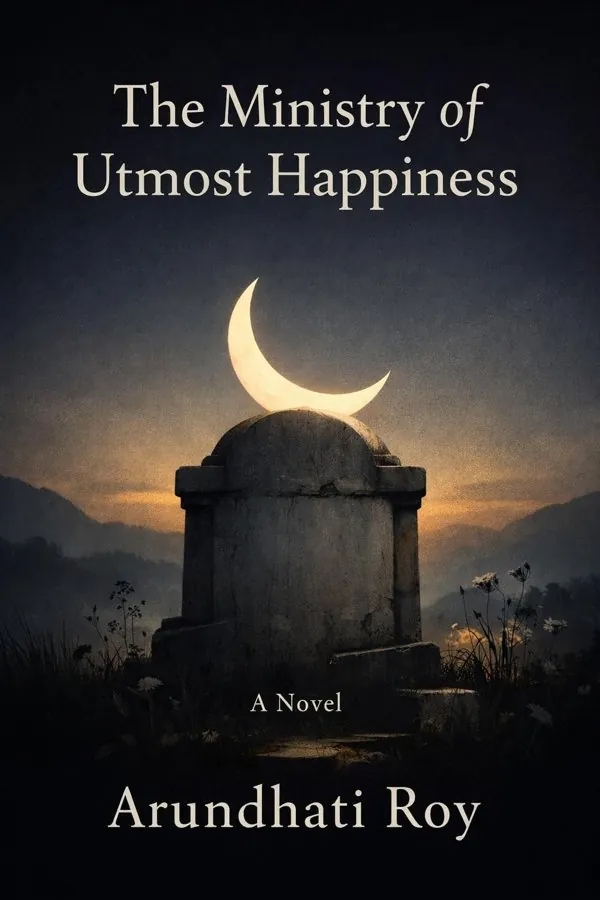
The Ministry of Utmost Happiness: A Novel: Summary & Key Insights
 10 min9 chaptersAudio available
Key Takeaways from The Ministry of Utmost Happiness: A Novel
Some lives begin with a question the world refuses to answer kindly.
Belonging is rarely handed over by the world; more often, it is assembled from fragments.
Violence does not end when the killing stops; it continues by rearranging the soul.
Love can become dangerous when history enters the room.
A place can be both breathtaking and unbearable at the same time.
What Is The Ministry of Utmost Happiness: A Novel About?
The Ministry of Utmost Happiness: A Novel by Arundhati Roy is a bestsellers book spanning 4 pages. The Ministry of Utmost Happiness is a vast, daring novel about people pushed to the margins of society and the strange, stubborn forms of community they build in response. Moving from the alleys of Old Delhi to protest sites, military zones, and the haunted beauty of Kashmir, Arundhati Roy tells a story that is both intimate and political. At its center are unforgettable figures like Anjum, a transgender woman who creates a home in a graveyard, and Tilo, an elusive architect whose personal relationships are entangled with state violence, resistance, and grief. Around them gathers a world of mourners, lovers, outcasts, bureaucrats, soldiers, mothers, and revolutionaries. What makes this novel matter is not only its emotional power, but its moral ambition. Roy examines identity, nationalism, religion, caste, gender, and memory without reducing any of them to simple slogans. She asks what survival looks like in a country fractured by inequality and conflict, and how tenderness can persist amid brutality. Roy brings unusual authority to these questions: as the Booker Prize-winning author of The God of Small Things and a prominent political essayist, she writes with both lyrical imagination and fierce historical awareness.
This FizzRead summary covers all 9 key chapters of The Ministry of Utmost Happiness: A Novel in approximately 10 minutes, distilling the most important ideas, arguments, and takeaways from Arundhati Roy's work. Also available as an audio summary and Key Quotes Podcast.
The Ministry of Utmost Happiness: A Novel
The Ministry of Utmost Happiness is a vast, daring novel about people pushed to the margins of society and the strange, stubborn forms of community they build in response. Moving from the alleys of Old Delhi to protest sites, military zones, and the haunted beauty of Kashmir, Arundhati Roy tells a story that is both intimate and political. At its center are unforgettable figures like Anjum, a transgender woman who creates a home in a graveyard, and Tilo, an elusive architect whose personal relationships are entangled with state violence, resistance, and grief. Around them gathers a world of mourners, lovers, outcasts, bureaucrats, soldiers, mothers, and revolutionaries.
What makes this novel matter is not only its emotional power, but its moral ambition. Roy examines identity, nationalism, religion, caste, gender, and memory without reducing any of them to simple slogans. She asks what survival looks like in a country fractured by inequality and conflict, and how tenderness can persist amid brutality. Roy brings unusual authority to these questions: as the Booker Prize-winning author of The God of Small Things and a prominent political essayist, she writes with both lyrical imagination and fierce historical awareness.
Who Should Read The Ministry of Utmost Happiness: A Novel?
This book is perfect for anyone interested in bestsellers and looking to gain actionable insights in a short read. Whether you're a student, professional, or lifelong learner, the key ideas from The Ministry of Utmost Happiness: A Novel by Arundhati Roy will help you think differently.
- ✓Readers who enjoy bestsellers and want practical takeaways
- ✓Professionals looking to apply new ideas to their work and life
- ✓Anyone who wants the core insights of The Ministry of Utmost Happiness: A Novel in just 10 minutes
Want the full summary?
Get instant access to this book summary and 100K+ more with Fizz Moment.
Get Free SummaryAvailable on App Store • Free to download
Key Chapters
Some lives begin with a question the world refuses to answer kindly. Anjum’s story starts as Aftab, born into a loving Muslim family in Old Delhi, yet marked from birth by a body and identity that do not fit the categories others expect. Roy presents this not as a private confusion alone, but as a collision between inner truth and social order. Aftab grows up hearing music, prayer, gossip, and market noise, all the sounds of a living city, while carrying a silence inside: the knowledge of being different in a world built around binaries.
That silence leads Aftab toward the Khwabgah, a house of hijras where new language, rituals, kinship, and recognition become possible. Here, Aftab becomes Anjum. This transformation is not portrayed as a neat moment of liberation, but as a difficult becoming. The Khwabgah offers shelter, performance, femininity, and chosen family, yet it cannot erase stigma, vulnerability, or loneliness. Roy’s insight is that identity is not simply discovered; it is negotiated through danger, desire, and community.
In practical terms, Anjum’s early life helps readers understand how marginalized people often survive by creating parallel structures of belonging when mainstream institutions fail them. Families, workplaces, schools, and states frequently demand conformity, but people make life livable through alternative homes, names, rituals, and friendships.
For readers, Anjum’s journey is an invitation to listen more carefully to lives that dominant culture misreads. Instead of asking whether someone fits inherited categories, ask what social conditions allow them dignity. Actionable takeaway: pay attention to the chosen spaces and chosen families people build, because they often reveal both the wounds society creates and the forms of healing it still makes possible.
Belonging is rarely handed over by the world; more often, it is assembled from fragments. In The Ministry of Utmost Happiness, the Khwabgah is more than a refuge for hijras. It is a counterworld, a place where those excluded by family respectability and public norms make room for one another. Roy uses this space to show that kinship does not depend only on blood, law, or convention. It can also arise from shared vulnerability, performance, memory, and mutual care.
Within the Khwabgah, hierarchy and tension still exist. It is not an idealized haven floating above material hardship. Yet its emotional significance is profound: it gives Anjum language for herself and a social structure within which she can live. This matters because the novel repeatedly returns to the idea that institutions officially designed to protect people often fail the vulnerable, while improvised communities step in to do the work of nurturing and recognition.
This idea has clear relevance beyond the novel. Many people, including queer communities, migrants, refugees, and the socially stigmatized, survive through chosen kinship networks. These may take the form of informal caregiving, shared housing, financial support, mentorship, or emotional solidarity. Roy reminds us that these networks are not secondary substitutes for “real” belonging; for many, they are the real thing.
The Khwabgah also complicates romantic notions of sanctuary. Safety is partial, negotiated, and always under pressure from the outside world. That realism is part of the novel’s power. It suggests that humane communities are not built through purity, but through persistence.
Actionable takeaway: reconsider narrow definitions of family and legitimacy. Notice who creates support systems outside conventional approval, and ask how society could better protect those forms of chosen belonging rather than forcing people to survive in spite of them.
Violence does not end when the killing stops; it continues by rearranging the soul. One of the novel’s great turning points comes when Anjum travels to Gujarat and encounters the devastation of communal massacre. The Gujarat riots are not treated as background context or political reference point alone. Roy presents them as a moral rupture, an event that shatters any lingering trust in the idea that ordinary life is stable or protected by law. For Anjum, what happens there leaves a permanent wound.
After surviving this horror, Anjum cannot simply return to her earlier life. She drifts toward a graveyard and slowly establishes a strange sanctuary there, eventually called Jannat Guest House. The location is symbolic and practical at once: among the dead, Anjum constructs a place for the living who have nowhere else to go. This is one of Roy’s boldest ideas. Out of catastrophe emerges not redemption, exactly, but a form of stubborn care. Jannat is part shelter, part commune, part refusal to disappear.
The graveyard setting makes visible what modern societies prefer to hide. The excluded are often expected to live as if they have no history, no grief, and no right to public space. Anjum reverses that logic. She builds a home in a site of memory and mourning, and in doing so turns abandonment into hospitality.
In real life, people and communities often respond to trauma by creating institutions of survival: mutual-aid groups, memorial spaces, informal shelters, neighborhood kitchens, or activist circles. Roy’s novel shows that these are not signs of weakness, but forms of political imagination.
Actionable takeaway: when faced with collective trauma, look for or help build spaces where grief can become solidarity. The most meaningful resistance often begins not with grand speeches, but with making room for those who have been left with nowhere to go.
Love can become dangerous when history enters the room. Tilo, one of the novel’s most enigmatic and compelling figures, moves through Delhi and Kashmir with a fierce inwardness that resists easy explanation. Her life intersects with three men from her past, especially Musa, whose involvement in Kashmir’s resistance transforms their relationship into something inseparable from political conflict. Through Tilo, Roy refuses the comforting separation between private feeling and public violence. Desire, loyalty, secrecy, and fear are all shaped by the machinery of the state.
Tilo is not written as a conventional heroine. She is watchful, emotionally complex, and often difficult to fully know. That opacity is part of Roy’s point. In heavily surveilled, militarized worlds, transparency is not always virtue; sometimes it is risk. Tilo’s relationships unfold in a landscape where armies, checkpoints, interrogations, and disappearances condition even the most intimate decisions. To love someone there is also to inherit danger.
Roy uses Tilo’s story to illuminate a larger truth: politics is not something that happens only in parliaments and headlines. It enters bedrooms, friendships, marriages, and silences. It shapes who can move freely, who can wait safely, who can speak, and who can disappear. This is especially vivid in the Kashmir sections, where beauty and terror coexist with unbearable intensity.
For readers, Tilo’s arc offers a way to think about how structural violence distorts emotional life. People living under conflict often cannot separate romance, trust, and survival in the ways more secure societies imagine.
Actionable takeaway: when considering any conflict, do not reduce it to ideology or strategy alone. Ask how power reshapes intimacy itself—who gets to love openly, grieve publicly, and live without fear. That question often reveals the human cost more clearly than statistics ever can.
A place can be both breathtaking and unbearable at the same time. Roy’s portrayal of Kashmir is one of the novel’s emotional and political centers. She rejects tourist images and patriotic abstractions, presenting instead a region marked by militarization, mourning, insurgency, betrayal, and endurance. Through Musa and others connected to the valley, Kashmir becomes not a distant issue but a lived reality where state power presses itself into daily existence.
What makes Roy’s treatment so striking is her refusal to simplify. Kashmir is neither romanticized as pure resistance nor flattened into a security problem. It is a world of mothers waiting for sons, lovers separated by fear, militants shaped by loss, soldiers implicated in cruelty, and civilians trapped between narratives imposed from outside. The valley’s natural beauty intensifies the tragedy rather than softening it. The loveliness of mountains and lakes sits beside torture, disappearance, and permanent suspicion.
This matters because political conflicts are often discussed in language so abstract that suffering disappears. Roy restores specificity. She shows how militarized environments reorder time, forcing people to live in anticipation of raids, funerals, interrogations, and betrayals. Resistance, then, is not always heroic spectacle. Sometimes it is memory, witness, refusal, or simply the act of continuing.
Readers can apply this insight widely. Whether considering occupied territories, conflict zones, or heavily policed communities, it is essential to look beyond official narratives. Ask whose testimony is missing, whose grief is normalized, and what forms of life become impossible under constant surveillance and force.
Actionable takeaway: approach contested political realities with moral patience and attention to lived experience. Instead of accepting simplified national stories, seek out voices from within the conflict itself, especially those describing how power enters ordinary life.
Some stories break apart because the world they describe is already broken. The Ministry of Utmost Happiness does not move in a straight line, and that is not a flaw to be corrected but a formal choice tied to its meaning. Roy builds the novel from fragments, detours, documents, memories, satirical glimpses, and sudden shifts in voice and setting. The result can feel unruly, but its unruliness mirrors the social and political chaos the book seeks to witness.
Roy’s language moves between lyricism and sharp irony. She can write with tenderness about fragility and then turn abruptly toward bureaucratic absurdity or state brutality. This tonal elasticity keeps readers off balance in a productive way. It prevents suffering from becoming aestheticized and prevents politics from becoming dry exposition. Her style insists that beauty and horror are not separate domains. In India as she imagines it, they coexist on the same street, in the same family, even in the same sentence.
This structural approach also resists the market expectation that novels should offer neat arcs, clear moral hierarchies, and emotionally manageable resolutions. Roy instead asks readers to inhabit uncertainty and contradiction. Marginalized lives do not unfold tidily; national histories do not either.
There is a practical lesson here for how we read and think. Complex realities often cannot be understood through single-issue frameworks or linear narratives. Whether analyzing politics, communities, or personal histories, we may need to tolerate fragmentation long enough for deeper patterns to emerge.
Actionable takeaway: do not rush to simplify difficult stories. When something feels structurally messy, ask what that form reveals about the subject itself. In reading and in life, complexity is sometimes not confusion but honesty.
A society reveals itself most clearly in what it throws away. As the novel unfolds, Roy brings together an astonishing range of people who have been abandoned, hunted, discredited, orphaned, or made invisible by official systems. Around Anjum’s graveyard sanctuary gathers a fragile community of the dispossessed: people divided by religion, class, gender, ideology, and personal history, yet linked by exclusion. This gathering is one of the book’s deepest achievements.
Roy does not pretend that shared suffering automatically creates harmony. The people who come together carry suspicion, trauma, ego, and difference. Yet their coexistence suggests another social principle: solidarity need not depend on sameness. In a polarized world, this is a radical proposition. The novel imagines community not as a purified identity group, but as an unstable, improvised alliance among those whom dominant structures cannot or will not hold.
The symbolic force of this collective is powerful. The graveyard, traditionally a place of final separation, becomes a space of social recomposition. The people gathered there challenge the logic of respectability and exclusion that shapes the nation beyond its walls. They embody a counterpublic, one organized around care for the unwanted.
This has obvious contemporary relevance. Many meaningful communities form at the edges of institutions: in shelters, protest camps, neighborhood kitchens, online mutual-aid networks, community centers, and informal caregiving circles. Their members may not share identity or politics perfectly, but they are united by the practical work of keeping one another alive.
Actionable takeaway: broaden your idea of solidarity. Instead of waiting for perfect agreement, look for opportunities to participate in imperfect but humane coalitions. Real community often begins when people decide that vulnerability, not similarity, is enough reason to stand together.
Nothing tests a broken world more than the arrival of a child. In the later movements of the novel, the presence of abandoned and vulnerable children introduces a different register of hope. Roy is too unsentimental to turn children into symbols of easy innocence, yet she uses them to ask a profound question: what does it mean to care for the future when the present is violent, unjust, and unstable?
The child who comes into Anjum’s orbit becomes more than a plot event. She draws people together, rearranges priorities, and exposes what true responsibility demands. Institutions that claim moral authority often fail children first—through poverty, prejudice, conflict, and neglect. In contrast, the makeshift community of the novel responds not from perfection but from attention. Care is improvised, messy, collective, and deeply human.
Roy’s treatment of this theme avoids sentimentality by grounding it in material conditions. A child needs shelter, food, safety, tenderness, and continuity. The novel reminds readers that love is not merely a feeling; it is an infrastructure. To care for the vulnerable is to create habits, spaces, and commitments that make survival possible.
This idea extends far beyond the story. Every society reveals its ethics in how it treats those with the least power. Children, especially those displaced by violence or social abandonment, force adults to confront whether their politics are compatible with care.
Actionable takeaway: translate compassion into structure. If you are moved by the idea of protecting the vulnerable, ask what concrete supports are needed—time, money, advocacy, childcare, housing, education, or community presence. In Roy’s world, as in ours, hope becomes credible only when someone takes responsibility for it.
The most honest hope is the kind that has seen everything and refuses despair anyway. The Ministry of Utmost Happiness is filled with brutality, dislocation, and sorrow, but it is not finally a novel of nihilism. Roy offers a harder, stranger hope: one stripped of illusions about the state, about justice arriving on schedule, or about history bending neatly toward moral progress. What remains is not optimism, but endurance shaped by care.
This hope lives in small acts. A place made habitable. A meal shared. A child protected. A dead person remembered. A friend not abandoned. Roy suggests that in times of political fracture, these gestures are not minor. They are the foundations of ethical life. They do not erase systemic violence, but they keep the human world from collapsing entirely into it.
Importantly, the novel does not ask readers to choose between tenderness and resistance. It presents tenderness as a form of resistance. To shelter the unwanted, to insist on the humanity of those marked disposable, to mourn publicly in a culture of denial—these are political acts. They challenge systems that depend on dehumanization.
This has practical force for readers living through polarized and exhausting times. Grand solutions may be unavailable, and institutions may fail. Yet the absence of total victory does not make local care meaningless. Roy asks us to measure value differently: not only by scale, but by fidelity to life.
Actionable takeaway: cultivate forms of hope that do not depend on denial. Practice concrete acts of care, remembrance, and solidarity even when outcomes remain uncertain. In Roy’s vision, hope is not a mood. It is a discipline of keeping the world human.
All Chapters in The Ministry of Utmost Happiness: A Novel
About the Author
Arundhati Roy is an Indian novelist, essayist, and activist whose work bridges literature and political critique. She rose to international prominence with her debut novel, The God of Small Things, which won the Booker Prize in 1997 and established her as one of the most distinctive voices in contemporary fiction. In the years that followed, Roy became equally known for her essays on democracy, militarization, environmental destruction, globalization, and human rights in India and beyond. Her writing combines lyrical intensity with fearless engagement in public life, often centering those marginalized by power. The Ministry of Utmost Happiness reflects both sides of her career: the imaginative reach of a major novelist and the sharp historical awareness of a committed political thinker.
Get This Summary in Your Preferred Format
Read or listen to the The Ministry of Utmost Happiness: A Novel summary by Arundhati Roy anytime, anywhere. FizzRead offers multiple formats so you can learn on your terms — all free.
Available formats: App · Audio · PDF · EPUB — All included free with FizzRead
Download The Ministry of Utmost Happiness: A Novel PDF and EPUB Summary
Key Quotes from The Ministry of Utmost Happiness: A Novel
“Some lives begin with a question the world refuses to answer kindly.”
“Belonging is rarely handed over by the world; more often, it is assembled from fragments.”
“Violence does not end when the killing stops; it continues by rearranging the soul.”
“Love can become dangerous when history enters the room.”
“A place can be both breathtaking and unbearable at the same time.”
Frequently Asked Questions about The Ministry of Utmost Happiness: A Novel
The Ministry of Utmost Happiness: A Novel by Arundhati Roy is a bestsellers book that explores key ideas across 9 chapters. The Ministry of Utmost Happiness is a vast, daring novel about people pushed to the margins of society and the strange, stubborn forms of community they build in response. Moving from the alleys of Old Delhi to protest sites, military zones, and the haunted beauty of Kashmir, Arundhati Roy tells a story that is both intimate and political. At its center are unforgettable figures like Anjum, a transgender woman who creates a home in a graveyard, and Tilo, an elusive architect whose personal relationships are entangled with state violence, resistance, and grief. Around them gathers a world of mourners, lovers, outcasts, bureaucrats, soldiers, mothers, and revolutionaries. What makes this novel matter is not only its emotional power, but its moral ambition. Roy examines identity, nationalism, religion, caste, gender, and memory without reducing any of them to simple slogans. She asks what survival looks like in a country fractured by inequality and conflict, and how tenderness can persist amid brutality. Roy brings unusual authority to these questions: as the Booker Prize-winning author of The God of Small Things and a prominent political essayist, she writes with both lyrical imagination and fierce historical awareness.
More by Arundhati Roy
You Might Also Like

The Godfather
Mario Puzo
10 min
The Handmaid's Tale
Margaret Atwood
10 min
The Hunger Games
Suzanne Collins
10 min
The Nightingale
Kristin Hannah
10 min
The Seven Husbands of Evelyn Hugo
Taylor Jenkins Reid
10 min
Backwater Justice
Fern Michaels
10 minBrowse by Category
Ready to read The Ministry of Utmost Happiness: A Novel?
Get the full summary and 100K+ more books with Fizz Moment.