
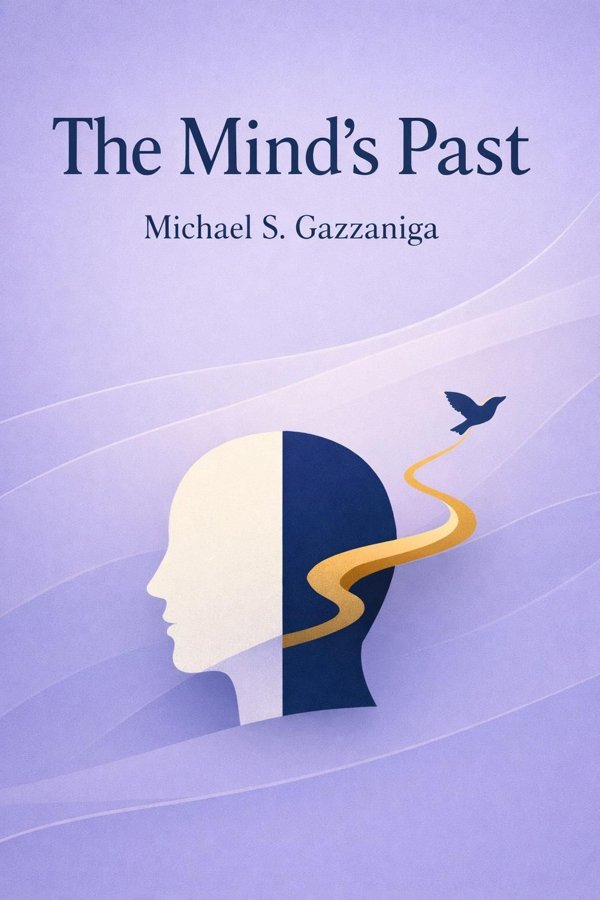
The Mind’s Past: Summary & Key Insights
 10 min12 chaptersAudio available
What Is The Mind’s Past About?
The Mind’s Past by Michael S. Gazzaniga is a neuroscience book spanning 12 pages. In this influential work, cognitive neuroscientist Michael S. Gazzaniga explores how the human mind constructs the sense of self and interprets the world. Drawing on split-brain research and evolutionary psychology, he argues that the brain’s left hemisphere acts as an 'interpreter,' weaving narratives to make sense of our actions and experiences. The book offers a compelling look at consciousness, free will, and the biological roots of human thought.
This FizzRead summary covers all 12 key chapters of The Mind’s Past in approximately 10 minutes, distilling the most important ideas, arguments, and takeaways from Michael S. Gazzaniga's work. Also available as an audio summary and Key Quotes Podcast.
The Mind’s Past
In this influential work, cognitive neuroscientist Michael S. Gazzaniga explores how the human mind constructs the sense of self and interprets the world. Drawing on split-brain research and evolutionary psychology, he argues that the brain’s left hemisphere acts as an 'interpreter,' weaving narratives to make sense of our actions and experiences. The book offers a compelling look at consciousness, free will, and the biological roots of human thought.
Who Should Read The Mind’s Past?
This book is perfect for anyone interested in neuroscience and looking to gain actionable insights in a short read. Whether you're a student, professional, or lifelong learner, the key ideas from The Mind’s Past by Michael S. Gazzaniga will help you think differently.
- ✓Readers who enjoy neuroscience and want practical takeaways
- ✓Professionals looking to apply new ideas to their work and life
- ✓Anyone who wants the core insights of The Mind’s Past in just 10 minutes
Want the full summary?
Get instant access to this book summary and 100K+ more with Fizz Moment.
Get Free SummaryAvailable on App Store • Free to download
Key Chapters
To understand how we reached this modern conception of mind, we must first honor the lineage of inquiry stretching back through centuries of scientific curiosity. Early neurologists such as Broca and Wernicke revealed that specific mental functions—speech, comprehension—could be localized to particular regions of the brain. Psychologists like William James began to consider the stream of consciousness as a dynamic, selective process, not a fixed entity.
By the mid-twentieth century, however, a new wave of neuroscience allowed us to move beyond anatomy into function. With direct analysis of brain activity, we could explore how distributed networks cooperate to form perception and thought. When I first entered this field, the intellectual climate was dominated by behaviorism and reductionist thinking. Yet, through the lens of cognitive neuroscience, we began to see that it was possible to unite the physical brain and the psychological mind under one scientific framework. It was no longer necessary to separate soul from neuron: they were expressions of the same system viewed from different levels of description.
This historical context shapes everything in *The Mind’s Past*. Consciousness itself became the next grand frontier not because it was mystical, but because it refused to yield to simple localization. The lesson that emerged was humbling—if we are to understand the self, we must accept that it is not a single place or function, but a pattern arising from the orchestration of countless processes. It is in this scientific humility that our modern picture of the mind was born.
The story of split-brain research transformed our understanding of what it means to be conscious. In patients whose corpus callosum—the bridge connecting both hemispheres—had been surgically severed to treat epilepsy, we observed something astonishing: the two halves of the brain operated with independent awareness.
When one hemisphere received visual information that the other did not, each generated its own behavior consistent with its access to knowledge. A patient might respond verbally—using the left hemisphere’s language system—to a stimulus they had not seen, because it had been presented only to the right hemisphere. Yet their nonverbal action, guided by the right hemisphere, could reveal understanding. This duality was shocking: two centers of awareness, living within one body.
From this, I began to grasp that the unity we experience daily is not inherent. It is constructed. The interpreter mechanism in the left hemisphere actively stitches together perceptions, actions, and memories into a continuous story. It turns disjointed events into meaningful sequences. Without realizing it, we are constantly editing reality to make sense of it.
This research pushed me beyond laboratory data and into philosophical territory. It forced me to confront the possibility that consciousness itself could be modular and discontinuous, that ‘self’ was not monolithic but rather an emergent coalition. Split-brain patients offered direct evidence that our sense of personal unity is sustained by neural processes—fragile yet beautifully efficient—that evolved to make us coherent social beings.
+ 10 more chapters — available in the FizzRead app
All Chapters in The Mind’s Past
About the Author
Michael S. Gazzaniga is an American cognitive neuroscientist known for his pioneering research on split-brain patients, which has profoundly influenced our understanding of hemispheric specialization and consciousness. He is a professor at the University of California, Santa Barbara, and the author of numerous books on neuroscience and the mind.
Get This Summary in Your Preferred Format
Read or listen to the The Mind’s Past summary by Michael S. Gazzaniga anytime, anywhere. FizzRead offers multiple formats so you can learn on your terms — all free.
Available formats: App · Audio · PDF · EPUB — All included free with FizzRead
Download The Mind’s Past PDF and EPUB Summary
Key Quotes from The Mind’s Past
“To understand how we reached this modern conception of mind, we must first honor the lineage of inquiry stretching back through centuries of scientific curiosity.”
“The story of split-brain research transformed our understanding of what it means to be conscious.”
Frequently Asked Questions about The Mind’s Past
The Mind’s Past by Michael S. Gazzaniga is a neuroscience book that explores key ideas across 12 chapters. In this influential work, cognitive neuroscientist Michael S. Gazzaniga explores how the human mind constructs the sense of self and interprets the world. Drawing on split-brain research and evolutionary psychology, he argues that the brain’s left hemisphere acts as an 'interpreter,' weaving narratives to make sense of our actions and experiences. The book offers a compelling look at consciousness, free will, and the biological roots of human thought.
You Might Also Like
Anxious
Joseph LeDoux
10 min
Hallucinations
Oliver Sacks
10 min
The Biological Mind: How Brain, Body, and Environment Collaborate to Make Us Who We Are
Alan Jasanoff
10 min
The Feeling of Life Itself: Why Consciousness Is Widespread but Can't Be Computed
Christof Koch
10 min
The No-Nonsense Meditation Book
Steven Laureys
10 min
A General Theory of Love
Thomas Lewis, Fari Amini, Richard Lannon
10 minBrowse by Category
Ready to read The Mind’s Past?
Get the full summary and 100K+ more books with Fizz Moment.