
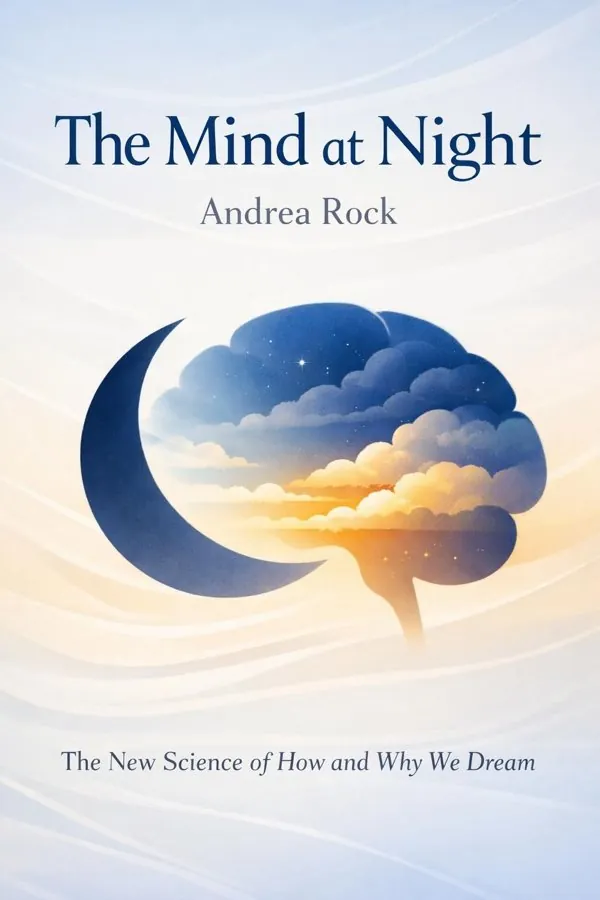
The Mind at Night: The New Science of How and Why We Dream: Summary & Key Insights
by Andrea Rock
 10 min8 chaptersAudio available
What Is The Mind at Night: The New Science of How and Why We Dream About?
The Mind at Night: The New Science of How and Why We Dream by Andrea Rock is a neuroscience book spanning 8 pages. This book explores the neuroscience and psychology of dreaming, revealing how the brain constructs dreams and what they reveal about memory, emotion, and consciousness. Andrea Rock synthesizes scientific research to explain the biological and cognitive functions of dreams, offering insight into their role in mental health and creativity.
This FizzRead summary covers all 8 key chapters of The Mind at Night: The New Science of How and Why We Dream in approximately 10 minutes, distilling the most important ideas, arguments, and takeaways from Andrea Rock's work. Also available as an audio summary and Key Quotes Podcast.
The Mind at Night: The New Science of How and Why We Dream
This book explores the neuroscience and psychology of dreaming, revealing how the brain constructs dreams and what they reveal about memory, emotion, and consciousness. Andrea Rock synthesizes scientific research to explain the biological and cognitive functions of dreams, offering insight into their role in mental health and creativity.
Who Should Read The Mind at Night: The New Science of How and Why We Dream?
This book is perfect for anyone interested in neuroscience and looking to gain actionable insights in a short read. Whether you're a student, professional, or lifelong learner, the key ideas from The Mind at Night: The New Science of How and Why We Dream by Andrea Rock will help you think differently.
- ✓Readers who enjoy neuroscience and want practical takeaways
- ✓Professionals looking to apply new ideas to their work and life
- ✓Anyone who wants the core insights of The Mind at Night: The New Science of How and Why We Dream in just 10 minutes
Want the full summary?
Get instant access to this book summary and 100K+ more with Fizz Moment.
Get Free SummaryAvailable on App Store • Free to download
Key Chapters
My story starts with the historical arc that carried dream study from the psychoanalytic clinic into the neuroscience lab. In Freud’s time, dreams were seen as wish fulfillments, disguised messages of forbidden desires emerging from the unconscious. Jung added his own perspective, seeing dreams as archetypal expressions of the psyche. But as technology allowed scientists to record electrical impulses from sleeping brains, these interpretive models began to meet their limits. The discovery of REM—rapid eye movement sleep—in the 1950s changed everything.
REM sleep coincides with a surge of brain activity, yet the body remains effectively paralyzed. Researchers like Aserinsky and Kleitman demonstrated that vivid dreaming happens during REM, and the cyclical nature of this stage suggests that the brain has its own rhythm for processing internal information. Whereas Freud imagined dreams as theater performances of suppressed desire, modern science revealed them as active neurological productions with distinct cognitive purposes.
This transition from interpretation to empiricism does not dismiss meaning—it reframes it. Dreams are meaningful not because they hold secret codes, but because they reflect what the brain is doing when freed from external stimuli. When the waking world fades, the brain rehearses emotions, tests hypothetical scenarios, and reorganizes memories. From this perspective, the dream becomes a window into cognition rather than confession—a record of neural work rather than psychic disguise.
To understand dreams, we must understand REM. During this unique stage of sleep, the brain operates almost like it does during waking life—except sensory input is shut off and motor output is restricted. Brain scans show that the visual cortex and limbic system are intensely active, while the prefrontal cortex, which handles rational control, quiets down. That imbalance explains why dreams feel vivid yet irrational, emotional yet unbound by logic.
This is where the marvel of dreaming lies. In REM, the mind builds entire worlds out of memory fragments, emotional tones, and imagination. The randomness of certain details comes from the brain’s attempt to integrate disparate neural activations into coherent narratives. It’s as if the brain is running a simulation—testing how we might feel, act, or react to various internal and external cues—but without real-world consequences.
As we observe REM behavior, its connection to cognition becomes clear. The same neural networks that interpret sensory data while awake are replaying internal experiences when dreaming. Memory, emotion, and perception are unified under different rules. The dreaming brain mirrors waking thought but operates more intuitively, creatively, and emotionally.
+ 6 more chapters — available in the FizzRead app
All Chapters in The Mind at Night: The New Science of How and Why We Dream
About the Author
Andrea Rock is an American science journalist known for her work on neuroscience and psychology. She has written for publications such as Discover and Psychology Today, focusing on the intersection of brain science and everyday life.
Get This Summary in Your Preferred Format
Read or listen to the The Mind at Night: The New Science of How and Why We Dream summary by Andrea Rock anytime, anywhere. FizzRead offers multiple formats so you can learn on your terms — all free.
Available formats: App · Audio · PDF · EPUB — All included free with FizzRead
Download The Mind at Night: The New Science of How and Why We Dream PDF and EPUB Summary
Key Quotes from The Mind at Night: The New Science of How and Why We Dream
“My story starts with the historical arc that carried dream study from the psychoanalytic clinic into the neuroscience lab.”
“To understand dreams, we must understand REM.”
Frequently Asked Questions about The Mind at Night: The New Science of How and Why We Dream
The Mind at Night: The New Science of How and Why We Dream by Andrea Rock is a neuroscience book that explores key ideas across 8 chapters. This book explores the neuroscience and psychology of dreaming, revealing how the brain constructs dreams and what they reveal about memory, emotion, and consciousness. Andrea Rock synthesizes scientific research to explain the biological and cognitive functions of dreams, offering insight into their role in mental health and creativity.
You Might Also Like
Anxious
Joseph LeDoux
10 min
Hallucinations
Oliver Sacks
10 min
The Biological Mind: How Brain, Body, and Environment Collaborate to Make Us Who We Are
Alan Jasanoff
10 min
The Feeling of Life Itself: Why Consciousness Is Widespread but Can't Be Computed
Christof Koch
10 min
The No-Nonsense Meditation Book
Steven Laureys
10 min
A General Theory of Love
Thomas Lewis, Fari Amini, Richard Lannon
10 minBrowse by Category
Ready to read The Mind at Night: The New Science of How and Why We Dream?
Get the full summary and 100K+ more books with Fizz Moment.