
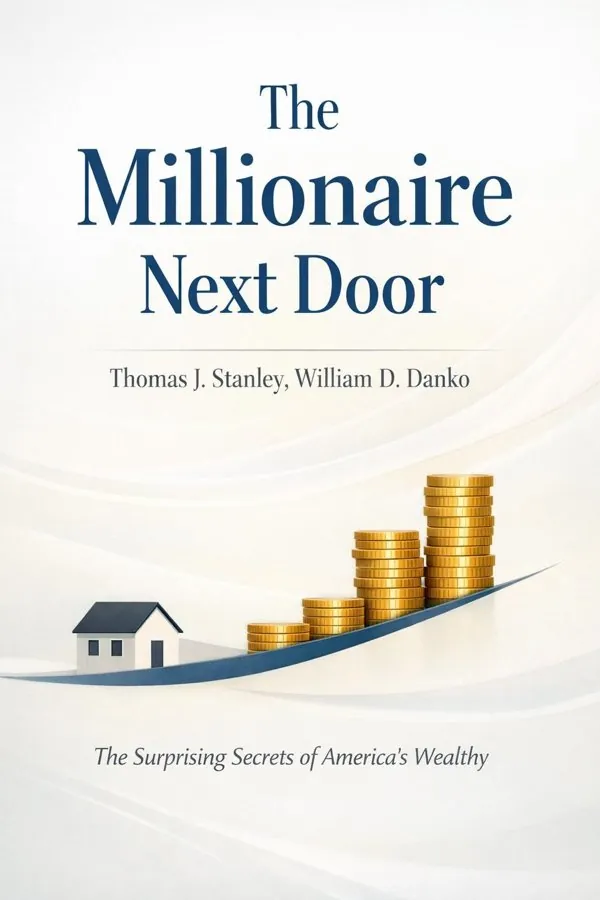
The Millionaire Next Door: The Surprising Secrets of America's Wealthy: Summary & Key Insights
by Thomas J. Stanley, William D. Danko
 10 min10 chaptersAudio available
Key Takeaways from The Millionaire Next Door: The Surprising Secrets of America's Wealthy
A high income can hide a low net worth more easily than most people imagine.
People often confuse cash flow with financial strength, but the two can move in opposite directions.
Wealth often grows quietly in the space created by restraint.
Most people say they want financial independence, but far fewer organize their lives around it.
Being busy is not the same as being productive, and earning well is not the same as building wealth.
What Is The Millionaire Next Door: The Surprising Secrets of America's Wealthy About?
The Millionaire Next Door: The Surprising Secrets of America's Wealthy by Thomas J. Stanley, William D. Danko is a finance book spanning 11 pages. What if most millionaires looked nothing like the wealthy people we see in ads, movies, or on social media? That is the unsettling and liberating idea at the heart of The Millionaire Next Door. Drawing on years of rigorous surveys, interviews, and behavioral research, Thomas J. Stanley and William D. Danko challenge the popular belief that wealth is defined by visible luxury. Instead, they show that many truly affluent Americans live in ordinary neighborhoods, drive modest cars, avoid status spending, and build financial security through discipline rather than spectacle. This book matters because it shifts the conversation from income to net worth, from appearance to substance, and from consumption to ownership. Stanley, a respected researcher of affluent households, and Danko, a scholar of wealth and consumer behavior, bring unusual authority to a topic often dominated by myths. Their findings reveal that financial independence is less about earning an extraordinary salary and more about consistently making ordinary but wise decisions over time. For anyone trying to understand how wealth is actually built, preserved, and passed on, this book offers a practical and surprisingly hopeful blueprint.
This FizzRead summary covers all 10 key chapters of The Millionaire Next Door: The Surprising Secrets of America's Wealthy in approximately 10 minutes, distilling the most important ideas, arguments, and takeaways from Thomas J. Stanley, William D. Danko's work. Also available as an audio summary and Key Quotes Podcast.
The Millionaire Next Door: The Surprising Secrets of America's Wealthy
What if most millionaires looked nothing like the wealthy people we see in ads, movies, or on social media? That is the unsettling and liberating idea at the heart of The Millionaire Next Door. Drawing on years of rigorous surveys, interviews, and behavioral research, Thomas J. Stanley and William D. Danko challenge the popular belief that wealth is defined by visible luxury. Instead, they show that many truly affluent Americans live in ordinary neighborhoods, drive modest cars, avoid status spending, and build financial security through discipline rather than spectacle.
This book matters because it shifts the conversation from income to net worth, from appearance to substance, and from consumption to ownership. Stanley, a respected researcher of affluent households, and Danko, a scholar of wealth and consumer behavior, bring unusual authority to a topic often dominated by myths. Their findings reveal that financial independence is less about earning an extraordinary salary and more about consistently making ordinary but wise decisions over time. For anyone trying to understand how wealth is actually built, preserved, and passed on, this book offers a practical and surprisingly hopeful blueprint.
Who Should Read The Millionaire Next Door: The Surprising Secrets of America's Wealthy?
This book is perfect for anyone interested in finance and looking to gain actionable insights in a short read. Whether you're a student, professional, or lifelong learner, the key ideas from The Millionaire Next Door: The Surprising Secrets of America's Wealthy by Thomas J. Stanley, William D. Danko will help you think differently.
- ✓Readers who enjoy finance and want practical takeaways
- ✓Professionals looking to apply new ideas to their work and life
- ✓Anyone who wants the core insights of The Millionaire Next Door: The Surprising Secrets of America's Wealthy in just 10 minutes
Want the full summary?
Get instant access to this book summary and 100K+ more with Fizz Moment.
Get Free SummaryAvailable on App Store • Free to download
Key Chapters
A high income can hide a low net worth more easily than most people imagine. One of the book’s most powerful insights is the distinction between how much people earn and how much they actually keep. Stanley and Danko categorize individuals as either prodigious accumulators of wealth or under accumulators of wealth. The difference is not usually intelligence, prestige, or even income level. It is behavior.
A prodigious accumulator of wealth lives below their means, saves consistently, and lets time and discipline do the heavy lifting. An under accumulator may earn a great salary but spends nearly all of it maintaining an expensive lifestyle. The book makes this visible by comparing expected wealth with actual wealth based on age and income. Many professionals who look rich are actually financially fragile, while some business owners, tradespeople, and disciplined savers quietly build substantial assets.
This framework matters because it changes how we measure progress. Instead of asking, “How much do I make?” the better question becomes, “How much of what I make do I keep and grow?” A doctor with luxury cars, private schools, and a large mortgage may have less wealth than a small business owner who lives modestly and invests steadily.
A practical application is to calculate your own net worth and compare it to your age and income trajectory. If your lifestyle has expanded as fast as your paycheck, you may be drifting into under-accumulation. The actionable takeaway: judge your financial health by assets accumulated, not income displayed.
People often confuse cash flow with financial strength, but the two can move in opposite directions. The Millionaire Next Door argues that income is what you earn, while wealth is what you retain after spending. This sounds simple, yet much of modern consumer culture encourages the opposite mindset. People celebrate earnings, promotions, and expensive purchases while ignoring savings rates, debt burdens, and long-term ownership.
The authors show that many high-income households are trapped in a cycle of earning and spending. Their lifestyles become expensive to maintain, leaving little room for investing. By contrast, genuine wealth gives freedom. It allows people to withstand setbacks, make career choices without panic, help their families responsibly, and retire with dignity.
A practical example is the household that earns $250,000 a year but saves almost nothing because of luxury housing, car payments, dining habits, and constant upgrades. On paper, they look successful. In reality, their future depends on continued high earnings. Compare that with a household earning half as much but saving 20 percent consistently into diversified investments. Over time, the second household is likely to become far more financially independent.
This distinction is especially important for professionals and entrepreneurs whose income fluctuates. A large year does not equal lasting wealth unless a meaningful portion is converted into assets.
The actionable takeaway: track net worth growth with the same seriousness that you track salary, and make wealth retention your primary financial scorecard.
Wealth often grows quietly in the space created by restraint. One of the book’s clearest findings is that most millionaires are not extravagant consumers. They are value-oriented, cost-conscious, and intentional with spending. Frugality here does not mean deprivation or misery. It means directing money toward what matters and refusing to overpay for status.
The authors found that many affluent households buy used cars, stay in the same homes for long periods, comparison-shop carefully, and avoid impulse spending. Their financial lives are shaped less by dramatic investment genius than by a thousand ordinary choices made prudently. Frugality compounds because every dollar not consumed can be saved, invested, and grown.
This idea runs against a culture that treats visible luxury as proof of success. Yet the truly wealthy often understand that every unnecessary purchase carries an invisible cost: lost future earnings on the money spent. A premium car is not just a vehicle expense. It may also represent years of forgone investment returns.
In practice, frugality can mean buying a reliable car instead of a prestige brand, choosing a smaller house than the bank says you can afford, or negotiating recurring expenses like insurance and phone plans. It can also mean resisting social pressure to upgrade simply because peers are doing so.
The point is not to spend nothing, but to spend deliberately. Wealth builders know the difference between enjoying life and financing an image. The actionable takeaway: identify three high-cost areas where status drives spending, and redesign them around value rather than appearance.
Most people say they want financial independence, but far fewer organize their lives around it. Stanley and Danko show that wealthy households are unusually likely to budget, plan, and set concrete long-term goals. This is not glamorous advice, but it is foundational. Wealth rarely appears by accident. It is usually the result of structured habits sustained over decades.
Planning matters because money tends to flow toward whatever feels urgent in the moment unless it is assigned a purpose in advance. Households that budget are more likely to save consistently, avoid destructive debt, and make progress toward retirement, education funding, or business ownership. They are less vulnerable to lifestyle drift because they know what they are trying to build.
The book also emphasizes efficiency. Many affluent people allocate time carefully, outsource selectively, and focus attention on activities that increase productivity or preserve wealth. Financial planning is not separate from life planning. It is part of deciding how one’s energy and resources will be used.
A practical example is automatic investing. Instead of hoping to save whatever remains at the end of the month, a planner contributes to retirement and investment accounts first, then builds a lifestyle around the remainder. Another example is reviewing spending categories quarterly to make sure money still reflects priorities.
The actionable takeaway: create a written annual financial plan with savings targets, investment contributions, and spending limits, then automate the most important actions so discipline does not depend on mood.
Being busy is not the same as being productive, and earning well is not the same as building wealth. A subtler theme in the book is that affluent people often use their time, energy, and attention more efficiently than others. They recognize that wealth creation is not just about money management but also about how personal effort is directed.
This means focusing on high-value work, limiting distractions, and avoiding wasteful consumption of both time and cash. Many millionaires are highly organized in practical ways. They know their financial details, monitor investments, compare options, and remain attentive to the economics of daily life. They are not passive.
The authors also suggest that strong accumulators do not chase every prestige signal. They are willing to look ordinary while devoting their effort to productive pursuits. This often gives them an advantage over those who spend significant energy maintaining a visible image of success. Real wealth builders spend more time owning assets and less time performing wealth.
In everyday terms, this can mean using commute time to learn about business or investing, spending weekends on home maintenance rather than expensive entertainment, or focusing on a profitable side venture instead of endless consumption. It can also mean reducing emotional spending triggers that consume both money and mental bandwidth.
The larger lesson is that wealth grows where resources are concentrated. Attention is one of those resources. The actionable takeaway: review where your time goes each week and redirect at least five hours toward activities that increase income, reduce expenses, or improve investment knowledge.
Helping children too much can quietly weaken the very qualities that create wealth. One of the book’s most debated insights is that financially successful parents often undermine their adult children by providing excessive economic support. While generosity feels loving, repeated financial rescue can discourage self-reliance, discipline, and ambition.
Stanley and Danko found that many wealthy households raised children with expectations of independence. They taught budgeting, delayed gratification, and personal responsibility rather than cushioning every consequence. The goal was not harshness but capability. Economic independence is easier to achieve when people learn early that lifestyle must be earned, not subsidized indefinitely.
This insight also applies beyond parenting. Adults who rely heavily on family money may postpone difficult but necessary financial skills such as planning, saving, and prioritizing. By contrast, those who must manage with finite resources often become more competent wealth builders over time.
A practical example is education funding. Parents may choose to support college while still requiring children to work part-time, budget their expenses, or contribute to certain costs. Another is resisting the urge to fund luxury consumption for adult children in the name of love or fairness. Support aimed at capability, such as helping with training or a first business, may be more valuable than support aimed at lifestyle.
The central point is that financial maturity grows through responsibility. The actionable takeaway: if you support family members financially, shift the focus from comfort to competence by attaching help to clear goals, boundaries, and increasing independence.
Prestigious careers do not automatically produce wealth, and ordinary occupations do not prevent it. The book reveals that the path to millionaire status is often less glamorous than people expect. Many wealthy individuals work in steady, uncelebrated fields, especially in businesses or niches where demand is reliable and competition is manageable. They choose economic productivity over social prestige.
Education can help, but the authors warn against assuming that elite credentials guarantee financial success. In fact, advanced degrees sometimes come with delayed earning, high student debt, and pressure to maintain a costly professional image. Some highly educated people become under accumulators precisely because they spend to match the status of their occupation.
Meanwhile, entrepreneurs and self-employed individuals in practical industries often accumulate significant wealth by controlling costs, understanding customers, and reinvesting profits. Think of the owner of a plumbing company, a regional distributor, or a small manufacturer. These careers may not draw admiration at cocktail parties, but they can generate durable wealth.
This idea is useful because it directs attention toward economic reality rather than reputation. The best occupation is not necessarily the one that sounds impressive. It is the one that allows saving, ownership, and compounding.
For readers making career decisions, this means evaluating fields by their long-term financial structure: barriers to entry, debt required, earnings stability, and opportunities for ownership. The actionable takeaway: choose or shape your career around asset-building potential, not just income level or social prestige.
A household can earn well and still fail financially if the people inside it want different things. The Millionaire Next Door makes clear that wealth building is often a team effort, especially in marriage. Couples who accumulate wealth tend to share core values around spending, saving, risk, and long-term planning. Without this alignment, financial progress is repeatedly undermined.
The authors note that many affluent households are anchored by spouses who are disciplined managers of resources. This does not mean one partner must be controlling. It means both partners understand the household mission and resist the pressures of status consumption. A modest lifestyle is far easier to sustain when both people believe in it.
Misalignment can be expensive. One spouse may want financial independence while the other wants visible symbols of success. One may prioritize investment contributions while the other normalizes debt and upgrades. Over time, these tensions can erode wealth, create resentment, and keep income tied up in appearances.
A practical example is agreeing on housing. The house is often the single biggest lifestyle decision a couple makes. Choosing a home that leaves room for saving can accelerate every other goal. Similar alignment matters for cars, vacations, gifts, and support for relatives.
Healthy communication around money is therefore a major wealth skill. Couples who discuss goals openly are more likely to make coherent decisions. The actionable takeaway: schedule a monthly household money meeting to review spending, savings, and upcoming decisions so financial values stay aligned before conflicts become expensive.
Many millionaires are business owners, but not in the flashy way people imagine. The book shows that entrepreneurship is one of the strongest paths to wealth because it creates opportunities for ownership, control, and scale. Yet the successful entrepreneurs in Stanley and Danko’s research are often disciplined operators in mundane sectors, not risk-addicted visionaries chasing headlines.
They tend to run businesses that meet practical needs, manage cash carefully, and emphasize efficiency. Their wealth often comes from equity in a company built over many years, not from a sudden windfall. They understand costs, customer behavior, and the value of staying in a profitable niche. This is a powerful corrective to the myth that only extraordinary innovation leads to financial independence.
Entrepreneurship also fosters habits that support wealth: delayed gratification, accountability, and close attention to numbers. But it is not a guarantee. Business owners who overspend personally, confuse revenue with profit, or seek status before stability can fail just as dramatically as high-income employees.
For readers, the lesson is not that everyone must start a business. It is that ownership matters. Owning part of a productive enterprise, whether as a founder, investor, or shareholder, creates a different financial trajectory than relying only on wages.
A practical application might be launching a modest side business, acquiring a local service company, or increasing investment in productive assets rather than consumption. The actionable takeaway: look for realistic ways to increase ownership in income-producing assets, even if the first step is small and unglamorous.
One of the book’s most enduring lessons is that appearances are deeply misleading. Many people assume wealth is visible: luxury cars, upscale neighborhoods, designer labels, and constant consumption. Stanley and Danko argue that this image is often a social illusion. The people who look rich are frequently high spenders, while the people who are rich may look entirely average.
This matters because social comparison drives poor decisions. If you use visible consumption as your benchmark, you may feel pressured to keep up with people whose finances are weaker than they appear. The illusion is reinforced by marketing, credit, and cultural narratives that equate spending with success. But true wealth is usually hidden in balance sheets, not wardrobes.
The psychological cost of this illusion is significant. People chase symbols instead of security. They optimize for admiration instead of autonomy. They spend money to signal status while quietly reducing the freedom that actual wealth provides.
A practical way to apply this idea is to become skeptical of outward signs of success. Instead of envying a neighbor’s car or home, ask what unseen obligations might support it. More importantly, redefine success personally: less as display, more as control over time, work, and future choices.
This shift can be emotionally freeing. When you stop performing wealth, you can start building it. The actionable takeaway: replace status-based financial goals with independence-based goals, such as years of living expenses saved, debt reduction, or investment milestones.
All Chapters in The Millionaire Next Door: The Surprising Secrets of America's Wealthy
About the Authors
Thomas J. Stanley was an American author, researcher, and speaker best known for his groundbreaking work on the habits of wealthy households. Trained in business and marketing, he spent years studying how people accumulate wealth and why many affluent individuals live far more modestly than popular culture suggests. His research helped reshape public understanding of money, status, and financial independence. William D. Danko is a professor, researcher, and co-author whose academic work has focused on consumer behavior, financial success, and the characteristics of self-made wealth. Together, Stanley and Danko combined empirical research with accessible writing to produce one of the most influential personal finance books of its era, showing that discipline, frugality, and long-term planning matter more than outward displays of success.
Get This Summary in Your Preferred Format
Read or listen to the The Millionaire Next Door: The Surprising Secrets of America's Wealthy summary by Thomas J. Stanley, William D. Danko anytime, anywhere. FizzRead offers multiple formats so you can learn on your terms — all free.
Available formats: App · Audio · PDF · EPUB — All included free with FizzRead
Download The Millionaire Next Door: The Surprising Secrets of America's Wealthy PDF and EPUB Summary
Key Quotes from The Millionaire Next Door: The Surprising Secrets of America's Wealthy
“A high income can hide a low net worth more easily than most people imagine.”
“People often confuse cash flow with financial strength, but the two can move in opposite directions.”
“Wealth often grows quietly in the space created by restraint.”
“Most people say they want financial independence, but far fewer organize their lives around it.”
“Being busy is not the same as being productive, and earning well is not the same as building wealth.”
Frequently Asked Questions about The Millionaire Next Door: The Surprising Secrets of America's Wealthy
The Millionaire Next Door: The Surprising Secrets of America's Wealthy by Thomas J. Stanley, William D. Danko is a finance book that explores key ideas across 10 chapters. What if most millionaires looked nothing like the wealthy people we see in ads, movies, or on social media? That is the unsettling and liberating idea at the heart of The Millionaire Next Door. Drawing on years of rigorous surveys, interviews, and behavioral research, Thomas J. Stanley and William D. Danko challenge the popular belief that wealth is defined by visible luxury. Instead, they show that many truly affluent Americans live in ordinary neighborhoods, drive modest cars, avoid status spending, and build financial security through discipline rather than spectacle. This book matters because it shifts the conversation from income to net worth, from appearance to substance, and from consumption to ownership. Stanley, a respected researcher of affluent households, and Danko, a scholar of wealth and consumer behavior, bring unusual authority to a topic often dominated by myths. Their findings reveal that financial independence is less about earning an extraordinary salary and more about consistently making ordinary but wise decisions over time. For anyone trying to understand how wealth is actually built, preserved, and passed on, this book offers a practical and surprisingly hopeful blueprint.
You Might Also Like



Browse by Category
Ready to read The Millionaire Next Door: The Surprising Secrets of America's Wealthy?
Get the full summary and 100K+ more books with Fizz Moment.