
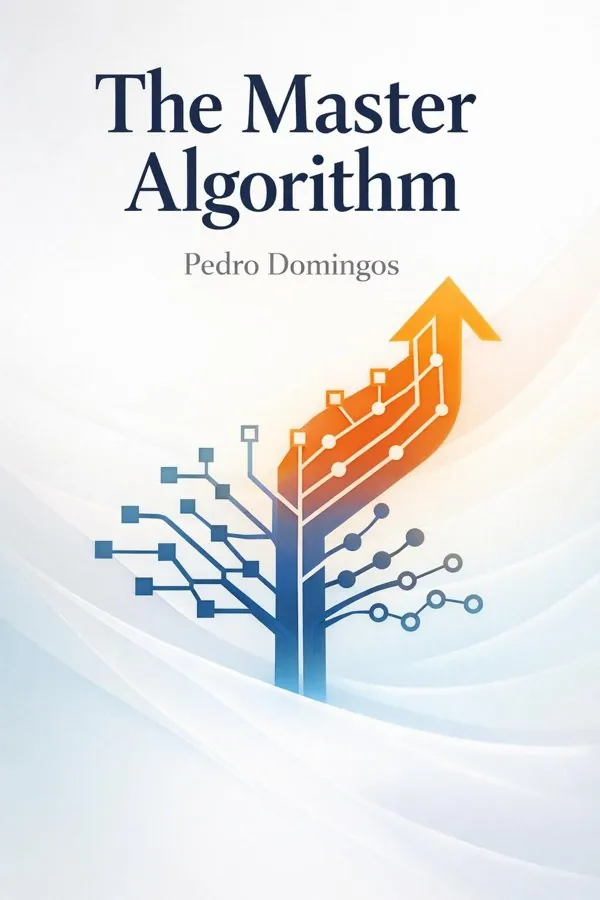
The Master Algorithm: How the Quest for the Ultimate Learning Machine Will Remake Our World: Summary & Key Insights
 10 min9 chaptersAudio available
Key Takeaways from The Master Algorithm: How the Quest for the Ultimate Learning Machine Will Remake Our World
The modern world does not suffer from a shortage of data; it suffers from a shortage of understanding.
Machine learning looks unified from the outside, but inside it has long been divided into rival intellectual camps.
Big breakthroughs often come not from inventing one more specialized tool, but from discovering a deeper framework that connects many tools at once.
One of the book’s most provocative claims is that much of what we call knowledge can be discovered automatically from data.
Technology matters most when it disappears into the background and quietly changes how entire systems operate.
What Is The Master Algorithm: How the Quest for the Ultimate Learning Machine Will Remake Our World About?
The Master Algorithm: How the Quest for the Ultimate Learning Machine Will Remake Our World by Pedro Domingos is a ai_ml book spanning 7 pages. What if all the world’s knowledge could be inferred from data by a single, universal learning method? In The Master Algorithm, Pedro Domingos takes this bold idea seriously and uses it to explain both the past and future of artificial intelligence. Rather than treating machine learning as a mysterious black box, he shows that the field is built from competing traditions, each with its own view of how machines learn. His central claim is that these approaches are not dead ends but partial truths—pieces of a larger puzzle that could eventually be unified into a “master algorithm.” This matters because learning systems already shape search engines, online shopping, medicine, finance, social media, and national security. Understanding how they work is no longer just a technical concern; it is a civic and economic necessity. Domingos writes with the authority of a leading computer scientist and AI researcher, yet he makes big ideas accessible without flattening their complexity. The result is a rare book that combines intellectual ambition, practical relevance, and scientific clarity, inviting readers to see machine learning not merely as a tool, but as a force that may redefine how society creates knowledge.
This FizzRead summary covers all 9 key chapters of The Master Algorithm: How the Quest for the Ultimate Learning Machine Will Remake Our World in approximately 10 minutes, distilling the most important ideas, arguments, and takeaways from Pedro Domingos's work. Also available as an audio summary and Key Quotes Podcast.
The Master Algorithm: How the Quest for the Ultimate Learning Machine Will Remake Our World
What if all the world’s knowledge could be inferred from data by a single, universal learning method? In The Master Algorithm, Pedro Domingos takes this bold idea seriously and uses it to explain both the past and future of artificial intelligence. Rather than treating machine learning as a mysterious black box, he shows that the field is built from competing traditions, each with its own view of how machines learn. His central claim is that these approaches are not dead ends but partial truths—pieces of a larger puzzle that could eventually be unified into a “master algorithm.”
This matters because learning systems already shape search engines, online shopping, medicine, finance, social media, and national security. Understanding how they work is no longer just a technical concern; it is a civic and economic necessity. Domingos writes with the authority of a leading computer scientist and AI researcher, yet he makes big ideas accessible without flattening their complexity. The result is a rare book that combines intellectual ambition, practical relevance, and scientific clarity, inviting readers to see machine learning not merely as a tool, but as a force that may redefine how society creates knowledge.
Who Should Read The Master Algorithm: How the Quest for the Ultimate Learning Machine Will Remake Our World?
This book is perfect for anyone interested in ai_ml and looking to gain actionable insights in a short read. Whether you're a student, professional, or lifelong learner, the key ideas from The Master Algorithm: How the Quest for the Ultimate Learning Machine Will Remake Our World by Pedro Domingos will help you think differently.
- ✓Readers who enjoy ai_ml and want practical takeaways
- ✓Professionals looking to apply new ideas to their work and life
- ✓Anyone who wants the core insights of The Master Algorithm: How the Quest for the Ultimate Learning Machine Will Remake Our World in just 10 minutes
Want the full summary?
Get instant access to this book summary and 100K+ more with Fizz Moment.
Get Free SummaryAvailable on App Store • Free to download
Key Chapters
The modern world does not suffer from a shortage of data; it suffers from a shortage of understanding. Every online purchase, GPS signal, medical image, customer review, and social media interaction produces information. But raw data, by itself, does not generate insight. It becomes useful only when a system can detect patterns, make predictions, and adapt based on experience. That is why machine learning sits at the center of today’s technological revolution.
Domingos argues that traditional programming reaches its limits in a world too complex and fast-changing for humans to specify every rule in advance. A spam filter, for example, cannot rely on a static list of forbidden words forever, because spammers constantly invent new tactics. A self-driving car cannot be manually programmed for every possible road hazard. In these domains, machines must learn from examples rather than simply execute hand-coded instructions.
This shift changes the nature of computing itself. Instead of telling computers exactly what to do, we increasingly provide them with data and objectives, then let them discover workable rules. Companies use this approach to recommend products, detect fraud, forecast demand, and personalize advertising. Hospitals use it to assist diagnosis and identify high-risk patients. Scientists use it to search for promising drugs and uncover hidden relationships in biological systems.
The deeper point is that learning is becoming the universal engine of software. The systems that win are not necessarily those with the most elegant code, but those that can improve most effectively from experience. In this view, data is the new raw material, and learning algorithms are the new industrial machinery.
Actionable takeaway: When evaluating any modern technology, ask not just what it does today, but how it learns and improves over time. That question reveals its true power.
Machine learning looks unified from the outside, but inside it has long been divided into rival intellectual camps. Domingos calls these camps the five tribes: Symbolists, Connectionists, Evolutionaries, Bayesians, and Analogizers. Each tribe offers a distinct answer to a foundational question: how should a machine learn?
Symbolists believe learning means discovering rules and logical structures. They favor decision trees, inverse deduction, and interpretable models. Connectionists, inspired by the brain, build artificial neural networks that learn by adjusting connections among units. Evolutionaries borrow from natural selection, evolving programs or model structures through variation and competition. Bayesians treat learning as probabilistic inference, updating beliefs in light of evidence. Analogizers focus on similarity, reasoning from comparable examples through methods like support vector machines and nearest-neighbor classification.
Domingos’s insight is that none of these tribes is wholly right or wholly wrong. Each tribe excels in some environments and fails in others. Neural networks may dominate image recognition, but Bayesian methods often shine when uncertainty must be explicitly modeled. Symbolic systems can represent logic and causality more transparently than deep networks. Analogical methods can perform remarkably well when similarity structure matters most.
Understanding these tribes helps readers avoid simplistic stories about AI. There is no single magic technique that solves every problem today. Instead, machine learning has progressed through a competition of ideas, where each school contributes useful tools and philosophical assumptions.
In practical terms, the five-tribe framework also helps explain why AI products vary so widely. A medical risk model, a voice assistant, and a logistics optimizer may all be “AI,” but they can rely on radically different learning principles.
Actionable takeaway: Whenever you encounter an AI system, ask which learning philosophy is driving it. The answer often reveals its strengths, limits, and likely blind spots.
Big breakthroughs often come not from inventing one more specialized tool, but from discovering a deeper framework that connects many tools at once. Domingos argues that machine learning is moving toward such a unification. The five tribes have each captured part of the truth, but the ultimate goal is a master algorithm that can integrate their strengths into one general learning system.
This does not mean a single piece of code will instantly solve every problem. Instead, it means finding the underlying principles that let a machine infer knowledge from data across many domains. Physics progressed by unifying diverse phenomena under shared laws. Biology advanced by connecting inheritance, evolution, and molecular mechanisms. In the same way, machine learning may mature by reconciling logic, probability, optimization, analogy, and adaptation.
Domingos presents this quest as both scientific and practical. Today’s learning systems are often narrow: one model translates text, another classifies tumors, another plays games. A master algorithm would make transfer easier. It could learn efficiently in one domain, then apply that knowledge elsewhere. It would require less handcrafted feature engineering, fewer brittle assumptions, and more autonomous knowledge building.
You can see the need for unification in real-world business problems. A retailer may need to predict demand, detect fraud, personalize marketing, optimize pricing, and forecast supply-chain disruption. Using isolated techniques for each task creates fragmented intelligence. A more unified learner could connect insights across the whole system.
Domingos does not claim the final answer has already arrived. His point is that the search itself organizes the field and clarifies what is missing. Progress in AI depends not only on better benchmarks, but on better conceptual foundations.
Actionable takeaway: Think of machine learning tools as partial solutions. The long-term opportunity lies in combining approaches rather than becoming loyal to just one methodology.
One of the book’s most provocative claims is that much of what we call knowledge can be discovered automatically from data. This idea sounds obvious in narrow applications, like predicting house prices from past sales, but Domingos pushes it much further. He suggests that learning algorithms can recover patterns, rules, relationships, and even aspects of scientific understanding if given enough structured experience.
At first glance, this challenges the older model of knowledge creation in which experts define theories and machines merely execute them. In the learning-centered view, human expertise remains valuable, but data becomes the primary source from which systems infer useful structure. Search engines learn what information people likely want. Credit systems infer financial risk from behavior patterns. Streaming platforms infer taste from viewing choices. Even in science, machine learning can surface molecular interactions or astronomical regularities that no human would have spotted unaided.
This does not mean data automatically yields truth. Data can be noisy, biased, incomplete, or misleading. Correlation can masquerade as causation. Historical records can encode social inequality. Domingos is not saying all knowledge can be naively mined. Rather, he is arguing that learning is a powerful and increasingly general way to transform observations into usable models of the world.
The practical implication is enormous: organizations that know how to turn data into learning gain a compounding advantage. Their models improve, their decisions sharpen, and their products become more adaptive. Organizations that merely collect data without learning from it are sitting on unused potential.
Actionable takeaway: Treat data as a renewable source of insight, but pair it with rigorous validation. The value lies not in collecting more information alone, but in learning responsibly from what you already have.
Technology matters most when it disappears into the background and quietly changes how entire systems operate. Domingos emphasizes that machine learning is not just another software trend; it is a general-purpose capability that can transform nearly every field. Once machines can learn patterns from experience, any domain rich in data becomes open to reinvention.
In medicine, learning systems can help detect disease from scans, estimate treatment outcomes, identify hidden patient subgroups, and accelerate drug discovery. In finance, they can model creditworthiness, detect anomalous transactions, and optimize portfolios. In retail, they drive recommendations, inventory planning, and customer segmentation. In manufacturing, they support predictive maintenance by identifying signs of equipment failure before breakdowns happen. In agriculture, they can interpret satellite imagery, optimize irrigation, and improve crop forecasting.
The same logic extends into education, law, marketing, transportation, and public policy. Adaptive tutoring systems learn where students struggle. Logistics networks learn from traffic, weather, and demand patterns. Recruitment systems learn from historical hiring data, though that also raises concerns about reproducing bias. Even everyday consumer experiences, from autocomplete to voice assistants, rely on learned rather than fully programmed behavior.
Domingos’s point is not simply that AI can automate tasks. More importantly, it can improve decisions at scale by continuously updating itself from feedback. That is why machine learning becomes more valuable the longer it is deployed well. A recommendation engine with millions of interactions becomes smarter than one launched last week.
Actionable takeaway: In any industry, look for repetitive decision points backed by data. Those are the places where machine learning is most likely to create immediate and lasting value.
Whoever learns best from data gains influence far beyond the lab. Domingos shows that machine learning is not just a technical development but a social force. The institutions that collect the most data and build the best learning systems can shape markets, attention, behavior, and even public opinion. This gives learning algorithms a political dimension as well as an economic one.
Digital platforms are the clearest example. Search engines learn what results users click. Social networks learn what content captures attention. Online retailers learn purchasing patterns, price sensitivity, and demand cycles. Over time, these systems become hard to compete with because more users generate more data, more data improves learning, and better learning attracts more users. This feedback loop creates strong concentration of power.
There is also a subtler effect: when algorithms mediate what we see, buy, read, and believe, they help shape the environment in which choices are made. News feeds influence civic awareness. Recommendation systems can amplify niche interests or trap people in narrow informational bubbles. Predictive systems in policing, lending, or hiring can reinforce historical inequities if their training data reflects biased institutions.
Domingos’s broader argument is that society needs algorithmic literacy. Citizens, leaders, and regulators must understand enough about learning systems to question their incentives and consequences. Otherwise, technical complexity becomes a shield behind which power operates without accountability.
The challenge is not to reject machine learning, but to govern it intelligently. Transparency, auditability, competition policy, and data rights all become more important in a learning-driven world.
Actionable takeaway: Whenever an algorithm affects people’s opportunities or beliefs, ask who trained it, on what data, for what objective, and with what oversight.
The excitement around AI often creates the illusion that more data and bigger models will solve everything. Domingos pushes back against this simplistic optimism. Machine learning is powerful, but it is not magic. Every algorithm reflects assumptions about the world, and those assumptions can fail in important ways.
One major limitation is data quality. If training data is sparse, skewed, noisy, or unrepresentative, a model may perform well in testing yet fail in real conditions. A system trained on one population may not generalize to another. Another limitation is overfitting: a model may memorize quirks of historical data instead of learning durable structure. There is also the issue of interpretability. Some highly accurate models are difficult to explain, which matters in domains like healthcare, law, and public administration.
Domingos also highlights a conceptual limit: learning from data alone does not automatically produce deep causal understanding. A model may predict that certain customers cancel subscriptions, but not truly explain why. It may identify statistical associations without grasping the mechanisms behind them. This matters because interventions depend on causes, not just correlations.
There are practical constraints too. Gathering labeled data can be expensive. Optimizing large models can require enormous computational resources. Feedback loops can distort outcomes when model predictions influence the behavior they are trying to predict.
Recognizing limitations is not a reason for despair. It is the basis for maturity. The best practitioners know when to trust a model, when to combine it with domain expertise, and when to redesign the problem entirely.
Actionable takeaway: Before trusting any AI system, examine its data, assumptions, failure modes, and deployment context. Responsible use begins with disciplined skepticism.
The future of AI is not simply a story of machines replacing people; it is also a story of people adapting to machines that learn. Domingos frames learning systems as collaborators, amplifiers, and competitors depending on the context. The real transformation comes from coevolution: humans redesign institutions, jobs, and habits in response to what machines can now do.
This is already visible across professions. Doctors increasingly work with diagnostic support systems. Marketers rely on predictive models to allocate spending. Scientists use machine learning to narrow vast search spaces and generate hypotheses. Teachers can use adaptive platforms to identify students who need different interventions. In each case, the machine does not eliminate human judgment; it changes where judgment is applied.
Some tasks become automated, especially routine prediction and pattern recognition. But other tasks become more valuable: framing the right problem, curating data, evaluating ethical trade-offs, designing incentives, interpreting uncertain outputs, and deciding what goals systems should pursue. If machines become better at discovering means, humans must become clearer about ends.
Domingos’s idea of a master algorithm amplifies this point. The more general and capable learning systems become, the more essential it is that humans guide their use wisely. A powerful learner can optimize almost anything, but optimization without judgment can produce harmful outcomes. A recommendation system can maximize engagement while degrading well-being; a hiring model can optimize for historical fit while reducing diversity.
Actionable takeaway: Build skills that complement machine learning rather than compete with it directly—problem framing, ethical reasoning, domain expertise, communication, and strategic decision-making.
The highest form of intelligence may not be learning one task well, but learning how to learn. Running through Domingos’s book is the idea that the next leap in AI will come from systems that can choose representations, adapt methods, and transfer knowledge across problems. This is the spirit behind the master algorithm: a learner that generalizes not just within tasks, but across the space of tasks itself.
Today, many machine learning models are still narrow specialists. They may beat humans in chess, detect objects in images, or predict click-through rates, yet fail completely outside their training regimes. Meta-learning aims to reduce this brittleness. Instead of being retrained from scratch for every new problem, a system can accumulate reusable structure. It can learn priors, representations, and strategies that make future learning faster and more effective.
This matters because the world changes constantly. Consumer behavior shifts. Diseases mutate. Markets move. Languages evolve. Static intelligence quickly becomes obsolete. A system that can improve its own learning process is better suited to a dynamic environment.
For organizations, this means the ultimate advantage may come not from any single model, but from building learning architectures that continuously refine themselves. In product design, this might look like experimentation platforms that adjust recommendations in real time. In cybersecurity, it could mean systems that adapt to emerging attack patterns. In science, it could accelerate discovery by learning which hypotheses are worth testing next.
Actionable takeaway: Focus not only on solving today’s prediction problem, but on building feedback loops that help your systems learn faster from tomorrow’s data.
All Chapters in The Master Algorithm: How the Quest for the Ultimate Learning Machine Will Remake Our World
About the Author
Pedro Domingos is a professor of computer science at the University of Washington and a prominent voice in machine learning and artificial intelligence. His research has focused on data mining, probabilistic reasoning, and the development of systems that can learn effectively from large amounts of data. He is especially known as one of the inventors of Markov logic networks, which combine logical structure with probabilistic modeling. Over the course of his career, he has received multiple honors for his contributions to AI research and has published widely in leading academic venues. Domingos is also admired for his ability to translate complex technical ideas into clear, engaging explanations for broader audiences. In The Master Algorithm, he brings together scholarly expertise, historical perspective, and a bold vision for the future of learning machines.
Get This Summary in Your Preferred Format
Read or listen to the The Master Algorithm: How the Quest for the Ultimate Learning Machine Will Remake Our World summary by Pedro Domingos anytime, anywhere. FizzRead offers multiple formats so you can learn on your terms — all free.
Available formats: App · Audio · PDF · EPUB — All included free with FizzRead
Download The Master Algorithm: How the Quest for the Ultimate Learning Machine Will Remake Our World PDF and EPUB Summary
Key Quotes from The Master Algorithm: How the Quest for the Ultimate Learning Machine Will Remake Our World
“The modern world does not suffer from a shortage of data; it suffers from a shortage of understanding.”
“Machine learning looks unified from the outside, but inside it has long been divided into rival intellectual camps.”
“Big breakthroughs often come not from inventing one more specialized tool, but from discovering a deeper framework that connects many tools at once.”
“One of the book’s most provocative claims is that much of what we call knowledge can be discovered automatically from data.”
“Technology matters most when it disappears into the background and quietly changes how entire systems operate.”
Frequently Asked Questions about The Master Algorithm: How the Quest for the Ultimate Learning Machine Will Remake Our World
The Master Algorithm: How the Quest for the Ultimate Learning Machine Will Remake Our World by Pedro Domingos is a ai_ml book that explores key ideas across 9 chapters. What if all the world’s knowledge could be inferred from data by a single, universal learning method? In The Master Algorithm, Pedro Domingos takes this bold idea seriously and uses it to explain both the past and future of artificial intelligence. Rather than treating machine learning as a mysterious black box, he shows that the field is built from competing traditions, each with its own view of how machines learn. His central claim is that these approaches are not dead ends but partial truths—pieces of a larger puzzle that could eventually be unified into a “master algorithm.” This matters because learning systems already shape search engines, online shopping, medicine, finance, social media, and national security. Understanding how they work is no longer just a technical concern; it is a civic and economic necessity. Domingos writes with the authority of a leading computer scientist and AI researcher, yet he makes big ideas accessible without flattening their complexity. The result is a rare book that combines intellectual ambition, practical relevance, and scientific clarity, inviting readers to see machine learning not merely as a tool, but as a force that may redefine how society creates knowledge.
You Might Also Like
Life 3.0
Max Tegmark
10 min
Superintelligence
Nick Bostrom
10 min
TensorFlow in Action
Thushan Ganegedara
10 min
AI Made Simple: A Beginner’s Guide to Generative AI, ChatGPT, and the Future of Work
Rajeev Kapur
10 min
AI Snake Oil
Arvind Narayanan, Sayash Kapoor
10 min
AI Superpowers: China, Silicon Valley, and the New World Order
Kai-Fu Lee
10 minBrowse by Category
Ready to read The Master Algorithm: How the Quest for the Ultimate Learning Machine Will Remake Our World?
Get the full summary and 100K+ more books with Fizz Moment.