
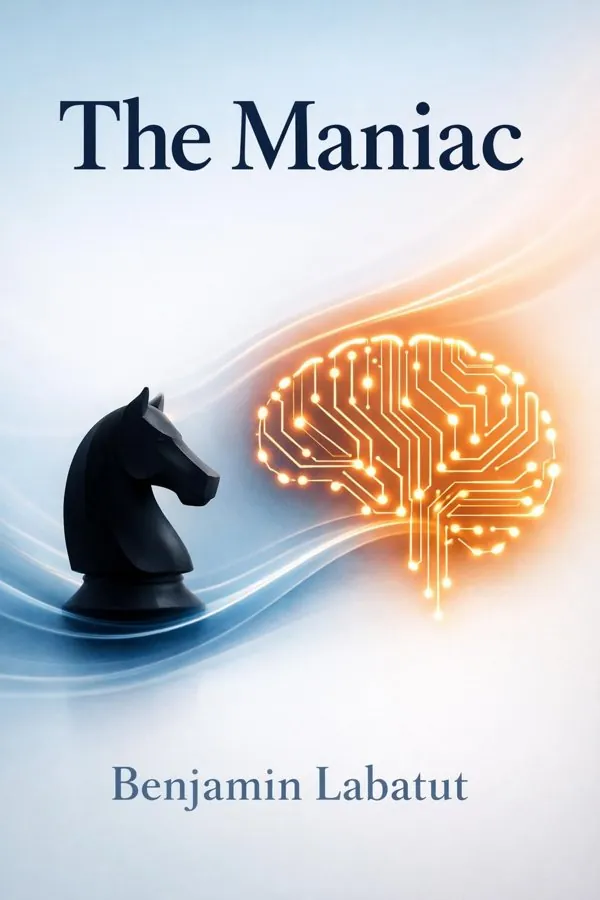
The Maniac: Summary & Key Insights
 10 min9 chaptersAudio available
Key Takeaways from The Maniac
A single mind can alter the destiny of millions, not through charisma or armies, but through equations.
Perfect logic can coexist with catastrophic blindness.
Numbers seem neutral until they begin directing human behavior.
Some of humanity’s greatest technical breakthroughs emerge from its darkest fears.
Machines do not emerge from nowhere; they inherit the desires of those who build them.
What Is The Maniac About?
The Maniac by Benjamin Labatut is a bestsellers book. Benjamin Labatut’s The Maniac is a daring, unsettling novel about brilliance pushed to its limits. Centered on the life and legacy of mathematician John von Neumann, the book blends documented history with imaginative reconstruction to explore how one extraordinary mind helped shape the modern world. From game theory and computing to nuclear weapons and artificial intelligence, von Neumann appears here not simply as a genius, but as a force whose ideas continue to govern systems far beyond human control. Labatut is uniquely suited to tell this story. Known for When We Cease to Understand the World, he has built a reputation for transforming the history of science into gripping literary investigations of obsession, discovery, and catastrophe. In The Maniac, he widens that project, showing how abstract thought can become material power, and how intelligence can create futures no one fully understands. This is not a conventional biography or a standard science novel. It is a meditation on reason, madness, ambition, and the terrifying beauty of ideas that refuse to remain on the page. For readers interested in science, history, technology, or the moral cost of genius, The Maniac is both provocative and unforgettable.
This FizzRead summary covers all 9 key chapters of The Maniac in approximately 10 minutes, distilling the most important ideas, arguments, and takeaways from Benjamin Labatut's work. Also available as an audio summary and Key Quotes Podcast.
The Maniac
Benjamin Labatut’s The Maniac is a daring, unsettling novel about brilliance pushed to its limits. Centered on the life and legacy of mathematician John von Neumann, the book blends documented history with imaginative reconstruction to explore how one extraordinary mind helped shape the modern world. From game theory and computing to nuclear weapons and artificial intelligence, von Neumann appears here not simply as a genius, but as a force whose ideas continue to govern systems far beyond human control. Labatut is uniquely suited to tell this story. Known for When We Cease to Understand the World, he has built a reputation for transforming the history of science into gripping literary investigations of obsession, discovery, and catastrophe. In The Maniac, he widens that project, showing how abstract thought can become material power, and how intelligence can create futures no one fully understands. This is not a conventional biography or a standard science novel. It is a meditation on reason, madness, ambition, and the terrifying beauty of ideas that refuse to remain on the page. For readers interested in science, history, technology, or the moral cost of genius, The Maniac is both provocative and unforgettable.
Who Should Read The Maniac?
This book is perfect for anyone interested in bestsellers and looking to gain actionable insights in a short read. Whether you're a student, professional, or lifelong learner, the key ideas from The Maniac by Benjamin Labatut will help you think differently.
- ✓Readers who enjoy bestsellers and want practical takeaways
- ✓Professionals looking to apply new ideas to their work and life
- ✓Anyone who wants the core insights of The Maniac in just 10 minutes
Want the full summary?
Get instant access to this book summary and 100K+ more with Fizz Moment.
Get Free SummaryAvailable on App Store • Free to download
Key Chapters
A single mind can alter the destiny of millions, not through charisma or armies, but through equations. One of the most powerful ideas in The Maniac is that John von Neumann’s intellect did not remain confined to mathematics; it spilled outward into warfare, economics, computing, and the logic of modern institutions. Labatut portrays him as a figure whose thinking transformed not just academic disciplines but the operating rules of the twentieth and twenty-first centuries. This makes the novel feel larger than one life story. It becomes a study of how abstract intelligence can reorganize reality.
Von Neumann’s work touched nearly every major system that defines modernity: the architecture of digital computers, the strategic logic of deterrence, the development of game theory, and the dream of machines that might one day think. Labatut shows that ideas born in highly specialized contexts rarely stay there. A theorem can become a weapon. A model can become government policy. A technical insight can evolve into the invisible framework behind finance, surveillance, automation, and war planning.
This has practical relevance far beyond the novel. Today, innovators in artificial intelligence, biotechnology, and algorithmic governance are producing tools whose consequences may outgrow their original intentions. The book invites readers to ask not only whether an idea works, but what world it creates once institutions adopt it. In business, policy, and research, this means evaluating downstream effects, not just immediate utility.
The actionable takeaway is simple: whenever you encounter a powerful new idea, ask where it might spread, who might use it, and what human costs could follow from its success.
Perfect logic can coexist with catastrophic blindness. The Maniac repeatedly challenges the comforting assumption that intelligence naturally leads to wisdom or moral clarity. Von Neumann is presented as dazzlingly rational, able to calculate, model, and predict with superhuman precision. Yet Labatut uses that brilliance to reveal a disturbing truth: a mind can understand systems deeply while remaining detached from the human suffering those systems produce.
This tension becomes especially vivid in the context of nuclear strategy and military planning. Game theory, probability, and optimization promise clean frameworks for decision-making, but real life contains fear, ego, ideology, and death. In the book, rationality often appears not as a safeguard against disaster, but as a machine that can normalize it. If destruction can be framed as mathematically efficient, it risks becoming intellectually acceptable. That is one of Labatut’s most chilling insights.
The theme resonates strongly in contemporary life. Organizations often praise data-driven thinking, optimization, and analytical rigor. These are valuable tools, but they can also hide moral evasions. A company may maximize efficiency while degrading employee well-being. A platform may optimize engagement while amplifying addiction or outrage. A government may rely on models that ignore the people most harmed by policy.
The lesson is not to reject rational thought, but to pair it with ethical reflection, emotional intelligence, and historical awareness. Metrics alone cannot tell us what is worth wanting.
The actionable takeaway: before accepting the most efficient solution, pause to ask whether it is humane, just, and aligned with the kind of world you actually want to build.
Numbers seem neutral until they begin directing human behavior. In The Maniac, Labatut explores the moment when pure mathematics crosses into the world of institutions, machines, and military systems. Von Neumann’s extraordinary theoretical gifts did not remain abstract; they became instruments of control, prediction, and design. This movement from thought to application is one of the book’s central fascinations and one of its most unsettling warnings.
The novel suggests that mathematics acquires real power when it is embedded in technology and administration. A model of strategic choice becomes game theory in diplomacy and economics. A theoretical architecture becomes the foundation of computing. A calculation about explosive force becomes part of nuclear warfare. Once ideas are operationalized, they stop being mere descriptions of reality and begin shaping reality itself.
This matters deeply in the present. Algorithms now influence hiring, lending, policing, pricing, logistics, social feeds, and national security. Their mathematical basis can make them appear objective, even inevitable. But Labatut’s portrayal reminds us that every formal system carries assumptions about what matters, what counts, and what can be ignored. Those assumptions become powerful when coded into decision-making systems.
Readers can apply this insight in everyday contexts. If you work with data, software, policy, or finance, do not treat models as truth. Treat them as tools designed by humans, with human limitations. Ask what variables were chosen, which outcomes are prioritized, and who bears the consequences of errors.
The actionable takeaway is to interrogate every powerful model: understand its assumptions before trusting its outputs, especially when real lives will be affected by the decisions it informs.
Some of humanity’s greatest technical breakthroughs emerge from its darkest fears. The Maniac shows how war and the anticipation of war create intense pressure for innovation, concentrating talent, money, secrecy, and urgency in ways ordinary society rarely can. Von Neumann’s career unfolded inside that charged atmosphere, where mathematical insight was not only admired but weaponized. Labatut presents this as a profound moral paradox: conflict drives discovery, yet the discoveries it drives are often inseparable from destruction.
The development of nuclear strategy and computation in the mid-twentieth century illustrates this dynamic. War did not merely fund science; it changed the kinds of questions scientists asked and the purposes their work served. Urgency rewarded abstraction that could be turned into operational advantage. Brilliant minds were recruited into projects where success meant increased power, deterrence, or lethality. In Labatut’s telling, the laboratory and the battlefield become difficult to separate.
This idea still applies today. Competition between nations fuels advances in cybersecurity, AI, drones, quantum computing, and surveillance. Corporate rivalry can create similar effects on a smaller scale, pushing teams to move fast while neglecting ethics, transparency, or long-term consequences. Pressure can produce extraordinary innovation, but it can also distort judgment and normalize harmful trade-offs.
For leaders, creators, and citizens, the challenge is to recognize when urgency is beginning to hollow out responsibility. Not every breakthrough deserves acceleration. Not every strategic advantage deserves pursuit.
The actionable takeaway: when high-stakes competition drives innovation, build deliberate ethical checkpoints into the process so speed and fear do not become excuses for irreversible harm.
Machines do not emerge from nowhere; they inherit the desires of those who build them. In The Maniac, the rise of computing is not treated as a neutral technological march but as an extension of human ambition, anxiety, and control. Von Neumann appears as one of the architects of this new world, helping design systems that could calculate faster, simulate more accurately, and execute instructions with unprecedented precision. Labatut uses these developments to ask a larger question: when we build smarter machines, what parts of ourselves are we amplifying?
The answer is not entirely reassuring. Computers promise mastery over complexity, but they also magnify the goals embedded in their design. If built for military planning, they accelerate war calculation. If built for profit optimization, they intensify extraction and efficiency. If built for convenience, they may also deepen dependency. The machine becomes a mirror, reflecting not only intelligence but appetite.
This is especially relevant in the age of artificial intelligence. People often discuss advanced systems as if they possess independent intentions, yet their impact still depends heavily on human incentives, institutional pressures, and design choices. The book invites readers to look past the glamour of capability and examine purpose. What is this machine for? Who controls it? What behaviors does it reward?
In practical terms, this insight applies to workplace software, recommendation engines, decision tools, and AI assistants. Their technical sophistication matters, but their values matter more.
The actionable takeaway is to evaluate technology not just by what it can do, but by what human motives it serves and what forms of behavior it quietly encourages.
Civilization often advances through people who do not fit comfortably within it. Labatut has long been interested in the volatile edge where genius shades into obsession, and The Maniac continues that inquiry with unusual force. Von Neumann is depicted not only as brilliant but as excessive, relentless, and almost inhuman in cognitive range. The novel suggests that many of the ideas that change history come from minds that see too much, move too fast, or feel too little connection to ordinary limits.
This does not romanticize instability so much as examine its consequences. Great leaps in knowledge often require a refusal of convention, an indifference to social norms, or an ability to dwell in abstraction longer than most people can bear. Yet the same traits that enable innovation may also produce moral detachment, personal chaos, or institutional danger. The world rewards extraordinary results while often ignoring the damage done along the way.
The idea has broad relevance beyond scientific history. Founders, artists, researchers, and high performers are often celebrated for intensity, but intensity can become destructive when not balanced by accountability and care. Organizations that idolize brilliance may excuse cruelty, burnout, or recklessness because the output seems worth it. Labatut challenges that bargain.
For readers, the practical application is to resist simplistic myths about genius. Admire insight, but do not confuse exceptional ability with sound judgment or ethical reliability. In teams and institutions, sustainable excellence usually requires more than singular brilliance; it requires structures that contain and guide it.
The actionable takeaway: appreciate extraordinary talent, but never stop asking what safeguards are needed when brilliance begins to outrun conscience, empathy, or collective control.
Sometimes strict factual reporting cannot capture the emotional reality of history. One of the most distinctive features of The Maniac is Labatut’s hybrid method: he combines documented events, real figures, and imaginative narration to create something between a novel, a philosophical inquiry, and a literary biography. This approach is not a gimmick. It reflects the book’s deeper concern with truths that exceed simple chronology, especially when dealing with minds and forces that seem almost impossible to represent directly.
By blending fact and fiction, Labatut can dramatize the atmosphere around von Neumann and the intellectual revolutions he helped unleash. The result is less a conventional life story than a chorus of perspectives, anxieties, and interpretations. This technique allows readers to feel the aura of historical transformation, not just learn its timeline. We encounter science as lived experience: obsessive, fragmented, seductive, and frightening.
There is a practical lesson here about how we understand complex subjects. Data and facts are essential, but they do not automatically produce comprehension. Stories help people grasp stakes, motives, and consequences. That is why fields from leadership to education increasingly rely on narrative to communicate difficult ideas. A well-crafted story can reveal the human meaning inside technical material.
Still, readers should remain alert. Literary truth is not the same as documentary certainty. The value lies in using the book as a prompt for reflection, not as a substitute for every historical source.
The actionable takeaway: use storytelling to deepen your understanding of complex issues, but pair narrative power with critical thinking so emotional resonance does not replace careful judgment.
The most dangerous inventions are often the ones that keep evolving after their creators are gone. A haunting current in The Maniac is the sense that von Neumann helped set processes in motion that no individual, however brilliant, could fully contain. Whether in nuclear doctrine, computational systems, or the early logic of machine intelligence, the book portrays modernity as a chain reaction: one insight leads to another, institutions adopt it, and eventually humanity finds itself governed by mechanisms it barely understands.
This is not merely a science-fiction fear. Labatut links it to real historical transitions in which technical systems became too complex, too distributed, or too entrenched to be directed by simple human intention. The problem is not only that machines may think. It is that networks of strategy, automation, prediction, and competition may develop their own momentum. Once a system rewards speed, escalation, or relentless optimization, stepping back becomes difficult.
Readers can see this pattern in financial markets run by algorithms, social media systems that amplify conflict, or AI tools deployed before safeguards are mature. The issue is not evil intent but runaway dynamics. Systems optimized for one goal often generate side effects that no one is accountable enough to stop.
The book’s warning is therefore profoundly practical. We need governance, humility, and friction in systems that scale rapidly. Innovation without brakes is not freedom; it is vulnerability.
The actionable takeaway: whenever a tool or institution begins operating faster than human oversight can keep pace, treat that as a signal to slow down, add safeguards, and restore meaningful accountability.
Not everything important can be computed, even in a world built by computation. For all its fascination with logic, models, and machines, The Maniac ultimately points toward a limit. Von Neumann’s life and legacy exemplify the astonishing reach of formal thought, yet Labatut also suggests that reality exceeds what can be reduced to strategic games or numerical systems. Human beings love, fear, grieve, and hope in ways that resist clean abstraction. This tension gives the book much of its emotional and philosophical depth.
The drive to calculate promises clarity. If a problem can be modeled, perhaps it can be solved. But people are not only players in a game, and societies are not merely systems waiting for optimization. When everything is translated into utility, payoff, or efficiency, something essential may be lost. The novel’s atmosphere of dread comes partly from this recognition: as our tools grow more powerful, we may become increasingly tempted to mistake what can be measured for what truly matters.
This applies directly to daily life. Individuals often use metrics to guide health, productivity, finances, and even relationships. Measurement can be helpful, but a metric is never the whole person. A teacher’s impact is not captured only by scores. A friendship is not defined by frequency of contact. A life is not reducible to output.
The book therefore invites a deeper form of discernment. Use calculation where it helps, but remain loyal to forms of value that cannot be fully quantified: dignity, wonder, responsibility, mercy.
The actionable takeaway: let numbers inform your decisions, but never allow measurement alone to define success, meaning, or what deserves your care.
All Chapters in The Maniac
About the Author
Benjamin Labatut is a Chilean writer celebrated for his intellectually adventurous fiction about science, mathematics, and the dangerous edge of human knowledge. Born in Rotterdam and raised in several countries before settling in Chile, he brings an international perspective to subjects that cross borders between disciplines and eras. He gained worldwide recognition with When We Cease to Understand the World, a book that fused historical fact and literary invention to explore the minds of scientists whose discoveries transformed reality. His work is known for its intensity, elegance, and ability to make complex ideas feel urgent and emotionally charged. In The Maniac, Labatut continues his exploration of genius, obsession, and catastrophe, confirming his reputation as one of the most distinctive contemporary writers working at the intersection of literature and scientific history.
Get This Summary in Your Preferred Format
Read or listen to the The Maniac summary by Benjamin Labatut anytime, anywhere. FizzRead offers multiple formats so you can learn on your terms — all free.
Available formats: App · Audio · PDF · EPUB — All included free with FizzRead
Download The Maniac PDF and EPUB Summary
Key Quotes from The Maniac
“A single mind can alter the destiny of millions, not through charisma or armies, but through equations.”
“Perfect logic can coexist with catastrophic blindness.”
“Numbers seem neutral until they begin directing human behavior.”
“Some of humanity’s greatest technical breakthroughs emerge from its darkest fears.”
“Machines do not emerge from nowhere; they inherit the desires of those who build them.”
Frequently Asked Questions about The Maniac
The Maniac by Benjamin Labatut is a bestsellers book that explores key ideas across 9 chapters. Benjamin Labatut’s The Maniac is a daring, unsettling novel about brilliance pushed to its limits. Centered on the life and legacy of mathematician John von Neumann, the book blends documented history with imaginative reconstruction to explore how one extraordinary mind helped shape the modern world. From game theory and computing to nuclear weapons and artificial intelligence, von Neumann appears here not simply as a genius, but as a force whose ideas continue to govern systems far beyond human control. Labatut is uniquely suited to tell this story. Known for When We Cease to Understand the World, he has built a reputation for transforming the history of science into gripping literary investigations of obsession, discovery, and catastrophe. In The Maniac, he widens that project, showing how abstract thought can become material power, and how intelligence can create futures no one fully understands. This is not a conventional biography or a standard science novel. It is a meditation on reason, madness, ambition, and the terrifying beauty of ideas that refuse to remain on the page. For readers interested in science, history, technology, or the moral cost of genius, The Maniac is both provocative and unforgettable.
You Might Also Like

The Godfather
Mario Puzo
10 min
The Handmaid's Tale
Margaret Atwood
10 min
The Hunger Games
Suzanne Collins
10 min
The Nightingale
Kristin Hannah
10 min
The Seven Husbands of Evelyn Hugo
Taylor Jenkins Reid
10 min
Backwater Justice
Fern Michaels
10 minBrowse by Category
Ready to read The Maniac?
Get the full summary and 100K+ more books with Fizz Moment.