
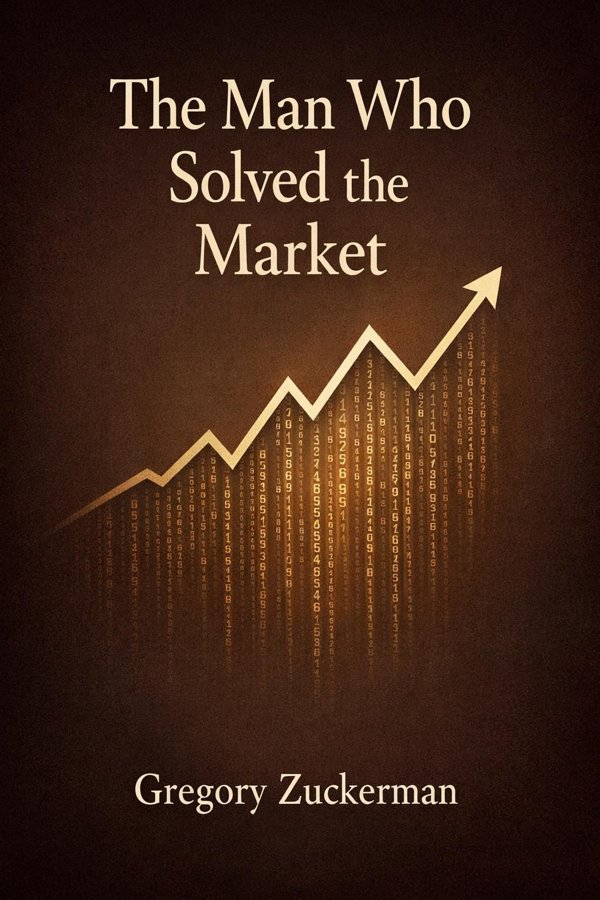
The Man Who Solved the Market: How Jim Simons Launched the Quant Revolution: Summary & Key Insights
 10 min6 chaptersAudio available
What Is The Man Who Solved the Market: How Jim Simons Launched the Quant Revolution About?
The Man Who Solved the Market: How Jim Simons Launched the Quant Revolution by Gregory Zuckerman is a finance book spanning 6 pages. The book chronicles the life and career of Jim Simons, a mathematician and former codebreaker who founded Renaissance Technologies, one of the most successful hedge funds in history. It explores how Simons and his team of scientists and mathematicians revolutionized investing by applying quantitative models and algorithms to financial markets, achieving unprecedented returns and transforming the world of finance.
This FizzRead summary covers all 6 key chapters of The Man Who Solved the Market: How Jim Simons Launched the Quant Revolution in approximately 10 minutes, distilling the most important ideas, arguments, and takeaways from Gregory Zuckerman's work. Also available as an audio summary and Key Quotes Podcast.
The Man Who Solved the Market: How Jim Simons Launched the Quant Revolution
The book chronicles the life and career of Jim Simons, a mathematician and former codebreaker who founded Renaissance Technologies, one of the most successful hedge funds in history. It explores how Simons and his team of scientists and mathematicians revolutionized investing by applying quantitative models and algorithms to financial markets, achieving unprecedented returns and transforming the world of finance.
Who Should Read The Man Who Solved the Market: How Jim Simons Launched the Quant Revolution?
This book is perfect for anyone interested in finance and looking to gain actionable insights in a short read. Whether you're a student, professional, or lifelong learner, the key ideas from The Man Who Solved the Market: How Jim Simons Launched the Quant Revolution by Gregory Zuckerman will help you think differently.
- ✓Readers who enjoy finance and want practical takeaways
- ✓Professionals looking to apply new ideas to their work and life
- ✓Anyone who wants the core insights of The Man Who Solved the Market: How Jim Simons Launched the Quant Revolution in just 10 minutes
Want the full summary?
Get instant access to this book summary and 100K+ more with Fizz Moment.
Get Free SummaryAvailable on App Store • Free to download
Key Chapters
My path through mathematics was never just about numbers; it was about beauty. The elegance of geometry, the clarity of symmetry, the sense that beneath complexity lies order—those ideas shaped my thinking long before finance entered my world. At MIT and Harvard, I wasn’t concerned with money. I was captivated by the power of abstraction, by seeing what others couldn’t. Later, at the Institute for Defense Analyses, while working as a codebreaker, my fascination shifted toward pattern recognition. Every encrypted message held a secret structure, and decoding it required not brute force but insight—finding meaning where none appeared.
Those years at IDA were critical. Surrounded by some of the brightest minds in national security, I learned how to handle vast amounts of data, to look for subtle correlations hidden beneath noise. The work demanded precision and persistence, often dealing with signals that made no immediate sense. You could say I was training my mind to see order within chaos—a skill that would later define my approach to markets.
But research for its own sake eventually began to feel limiting. I loved mathematics, yet the idea grew in me that these abstract methods could shape the real world. I wanted to explore problems that had visible, tangible consequences. As I left IDA and reentered academia, teaching geometry at Stony Brook University, I continued pushing the boundaries of pure research. But soon I realized something: the intellectual rigor I applied to mathematics might have unexplored applications in the most complex system of all—human economic behavior.
Leaving academia was one of the hardest decisions I made, but curiosity compelled it. Around me, markets seemed chaotic, full of inefficiency and irrationality. Traders acted on gossip, rumor, and emotion. Yet I suspected that, behind the noise, there were patterns—statistical relationships waiting to be discovered. That intuition led to my first experiment in finance: a venture called Monemetrics.
With a small team, I began using mathematical models to predict market movements. We gathered historical data, built algorithms, tested hypotheses, and searched for signals in price histories. It was exhilarating but humbling. Nothing worked as smoothly as mathematics. The markets punished premature conclusions. Every model failed until one variable was rethought, every idea defeated until refined. Our results were inconsistent, reminding me of the difference between precise theory and messy reality.
These failures were formative. They forced me to acknowledge the limits of human intuition. No trader—no matter how gifted—could consistently outperform randomness. But machines might. With enough data, enough computation, and enough disciplined testing, perhaps a system could learn from the past and anticipate the future—not perfectly, but probabilistically. This was the germ of Renaissance Technologies: a hedge fund governed not by emotion but by mathematics.
+ 4 more chapters — available in the FizzRead app
All Chapters in The Man Who Solved the Market: How Jim Simons Launched the Quant Revolution
About the Author
Gregory Zuckerman is a special writer at The Wall Street Journal, where he covers business, finance, and investing. He is a three-time winner of the Gerald Loeb Award and the author of several bestselling books on finance and innovation.
Get This Summary in Your Preferred Format
Read or listen to the The Man Who Solved the Market: How Jim Simons Launched the Quant Revolution summary by Gregory Zuckerman anytime, anywhere. FizzRead offers multiple formats so you can learn on your terms — all free.
Available formats: App · Audio · PDF · EPUB — All included free with FizzRead
Download The Man Who Solved the Market: How Jim Simons Launched the Quant Revolution PDF and EPUB Summary
Key Quotes from The Man Who Solved the Market: How Jim Simons Launched the Quant Revolution
“My path through mathematics was never just about numbers; it was about beauty.”
“Leaving academia was one of the hardest decisions I made, but curiosity compelled it.”
Frequently Asked Questions about The Man Who Solved the Market: How Jim Simons Launched the Quant Revolution
The Man Who Solved the Market: How Jim Simons Launched the Quant Revolution by Gregory Zuckerman is a finance book that explores key ideas across 6 chapters. The book chronicles the life and career of Jim Simons, a mathematician and former codebreaker who founded Renaissance Technologies, one of the most successful hedge funds in history. It explores how Simons and his team of scientists and mathematicians revolutionized investing by applying quantitative models and algorithms to financial markets, achieving unprecedented returns and transforming the world of finance.
More by Gregory Zuckerman

You Might Also Like





Browse by Category
Ready to read The Man Who Solved the Market: How Jim Simons Launched the Quant Revolution?
Get the full summary and 100K+ more books with Fizz Moment.