
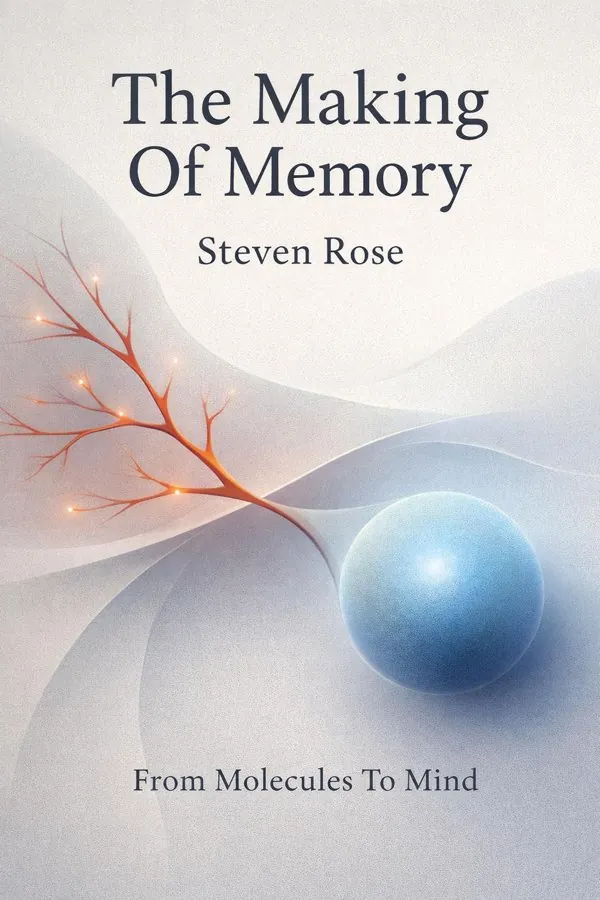
The Making Of Memory: From Molecules To Mind: Summary & Key Insights
by Steven Rose
 10 min10 chaptersAudio available
Key Takeaways from The Making Of Memory: From Molecules To Mind
Before memory became a subject for brain scans and molecular biology, it was a philosophical puzzle.
A memory is not stored in one tiny mental drawer; it emerges from a living system designed for change.
Every memory begins as an event in time, but for it to last, something in the brain must change materially.
One of the most misleading questions we can ask is, “Where is a memory stored?
To study memory scientifically, researchers often begin with animals.
What Is The Making Of Memory: From Molecules To Mind About?
The Making Of Memory: From Molecules To Mind by Steven Rose is a neuroscience book spanning 10 pages. Memory feels intimate and personal, yet Steven Rose shows that it is also a biological process unfolding in cells, circuits, bodies, and social worlds. In The Making Of Memory: From Molecules To Mind, Rose tackles one of the oldest and hardest questions in science: how fleeting experience becomes a lasting trace. He moves from the chemistry of neurons and the architecture of synapses to learning in animals, the development of the brain across a lifetime, the breakdown of memory in amnesia, and the way memory helps construct identity itself. What makes the book especially powerful is its refusal to accept simplistic answers. Rose does not reduce memory to a single molecule, a single brain region, or a neat metaphor. Instead, he presents memory as dynamic, distributed, and deeply embedded in lived experience. As a leading neuroscientist whose career focused on the biology of learning and memory, Rose writes with both technical authority and philosophical breadth. The result is a richly layered exploration of how remembering works, why forgetting matters, and why memory remains central to understanding what it means to be human.
This FizzRead summary covers all 10 key chapters of The Making Of Memory: From Molecules To Mind in approximately 10 minutes, distilling the most important ideas, arguments, and takeaways from Steven Rose's work. Also available as an audio summary and Key Quotes Podcast.
The Making Of Memory: From Molecules To Mind
Memory feels intimate and personal, yet Steven Rose shows that it is also a biological process unfolding in cells, circuits, bodies, and social worlds. In The Making Of Memory: From Molecules To Mind, Rose tackles one of the oldest and hardest questions in science: how fleeting experience becomes a lasting trace. He moves from the chemistry of neurons and the architecture of synapses to learning in animals, the development of the brain across a lifetime, the breakdown of memory in amnesia, and the way memory helps construct identity itself. What makes the book especially powerful is its refusal to accept simplistic answers. Rose does not reduce memory to a single molecule, a single brain region, or a neat metaphor. Instead, he presents memory as dynamic, distributed, and deeply embedded in lived experience. As a leading neuroscientist whose career focused on the biology of learning and memory, Rose writes with both technical authority and philosophical breadth. The result is a richly layered exploration of how remembering works, why forgetting matters, and why memory remains central to understanding what it means to be human.
Who Should Read The Making Of Memory: From Molecules To Mind?
This book is perfect for anyone interested in neuroscience and looking to gain actionable insights in a short read. Whether you're a student, professional, or lifelong learner, the key ideas from The Making Of Memory: From Molecules To Mind by Steven Rose will help you think differently.
- ✓Readers who enjoy neuroscience and want practical takeaways
- ✓Professionals looking to apply new ideas to their work and life
- ✓Anyone who wants the core insights of The Making Of Memory: From Molecules To Mind in just 10 minutes
Want the full summary?
Get instant access to this book summary and 100K+ more with Fizz Moment.
Get Free SummaryAvailable on App Store • Free to download
Key Chapters
Before memory became a subject for brain scans and molecular biology, it was a philosophical puzzle. That history matters because each era has explained memory through its own dominant metaphors: wax tablets, storehouses, filing systems, computers, and now neural networks. Rose begins by reminding us that the search to understand memory did not start in the laboratory. Philosophers such as Plato and Aristotle asked how past experience could persist in the mind, while later thinkers debated whether memory was a passive recording device or an active reconstructive process. These earlier ideas shaped the questions scientists would later ask.
Rose shows that scientific progress did not simply replace philosophy; it refined and tested old intuitions. For example, the idea that memories leave some kind of trace evolved into the biological search for the engram, a physical basis of memory in the brain. At the same time, psychology challenged the notion of perfect recording by demonstrating that memory is selective, interpretive, and often unreliable. Historical reflection helps us avoid simplistic assumptions, such as treating memory like a camera or a hard drive.
In practical terms, this matters anytime we rely on recollection as if it were exact. Eyewitness testimony, family disputes about the past, and even our own sense of personal continuity are shaped by the fact that memory is constructed, not merely retrieved. Understanding the history of ideas about memory also makes us more critical consumers of modern neuroscience claims that promise easy explanations.
Actionable takeaway: When thinking about your own memories, replace the metaphor of storage with the metaphor of reconstruction, and ask not only what you remember, but how and why you remember it that way.
A memory is not stored in one tiny mental drawer; it emerges from a living system designed for change. Rose explains that the biological basis of memory lies in the brain’s vast network of neurons and synapses, where patterns of activity can be modified by experience. The sheer scale is astonishing: billions of neurons, each capable of connecting with thousands of others, create an adaptive architecture through which learning becomes possible.
Rather than searching for a single “memory center,” Rose emphasizes distributed processing. Different aspects of experience may involve different brain systems: sensory features, emotional tone, motor habits, and contextual information can all be handled in partially distinct but interacting networks. This helps explain why memory can be uneven. A person may forget names but recall melodies, or lose episodic detail while retaining procedural skills.
Synapses are central here because they are the points where neurons influence one another. Experience can strengthen or weaken these connections, making future activation more or less likely. This is the groundwork for learning. Yet Rose is careful: memory is not reducible to synapses alone. Cells exist within broader circuits, and circuits within an organism acting in an environment.
In everyday life, the brain’s plastic nature means practice matters. Repetition, emotional significance, sleep, attention, and context all affect whether an experience leaves a lasting neural impact. A student reviewing material actively, a pianist rehearsing difficult passages, or a child learning language all rely on the brain’s capacity to reorganize itself through use.
Actionable takeaway: If you want to remember better, create repeated, meaningful engagement with information instead of passively exposing yourself to it once.
Every memory begins as an event in time, but for it to last, something in the brain must change materially. Rose explores the molecular mechanisms behind that transition, asking how fleeting neural activity becomes a more durable biological trace. This is where neurotransmitters, receptors, protein synthesis, and intracellular signaling pathways enter the story. Although these processes can sound technical, their importance is simple: without molecular change, experience would vanish as quickly as it appeared.
Rose discusses how learning can trigger cascades inside neurons. Chemical messengers activate receptors, which alter the cell’s internal state and can ultimately influence gene expression and protein production. These changes help stabilize altered synaptic connections. In some cases, short-term memory may depend on transient biochemical modifications, while long-term memory requires more lasting structural changes. This distinction explains why some impressions fade within minutes while others persist for years.
Importantly, Rose resists exaggerated claims that one molecule can explain memory as a whole. There is no magic “memory chemical.” Molecular events are necessary, but they operate within cells, networks, behavior, and social context. A laboratory finding about protein synthesis becomes meaningful only when connected to actual learning in organisms.
For practical purposes, this idea underscores that memory depends on physical conditions. Fatigue, stress, intoxication, illness, and aging can all influence the brain’s chemistry and therefore the likelihood of encoding and consolidating memories. Conversely, healthy routines support the molecular conditions under which learning can be strengthened.
Actionable takeaway: Treat memory as a biological process by protecting sleep, nutrition, and recovery, since your brain needs the right physical conditions to turn experience into lasting change.
One of the most misleading questions we can ask is, “Where is a memory stored?” Rose argues that memory is better understood as an activity of systems than as an object hidden in a specific location. Although certain brain regions play especially important roles, remembering usually depends on coordinated interaction across multiple areas. The hippocampus, cortex, sensory regions, emotional circuits, and motor systems each contribute differently depending on the kind of memory involved.
This systems view helps explain why memory has many forms. Remembering a childhood birthday, riding a bicycle, recognizing a face, and fearing a sound associated with danger are not the same process. They recruit overlapping but distinct neural resources. Damage to one system may impair one kind of memory while leaving others largely intact. This is why some neurological patients can no longer form new autobiographical memories but still improve on motor tasks through practice.
Rose’s approach also bridges laboratory neuroscience and real life. In actual experience, memory is rarely isolated from perception, action, and emotion. You do not merely store an event; you live it through your body, your expectations, and your environment. Systems neuroscience captures this complexity better than a single-site explanation.
A useful application appears in education and skill learning. When you combine words with images, movement, emotion, and context, you recruit more systems and create richer retrieval routes. A language learner who speaks aloud, writes by hand, listens to native speech, and uses new words in conversation is engaging memory more effectively than someone who only rereads a list.
Actionable takeaway: Build memories through multiple channels at once—visual, verbal, emotional, and physical—to create stronger and more accessible recall.
To study memory scientifically, researchers often begin with animals. That can seem distant from human experience, but Rose shows why animal models are indispensable for understanding mechanisms that would otherwise remain hidden. By observing how chicks, rats, birds, and other animals learn, researchers can connect behavior to cellular and molecular changes in the brain with a precision impossible in most human studies.
Rose is especially attentive to the strengths and limits of such experiments. Animal learning tasks reveal core processes like conditioning, habituation, spatial learning, and imprinting. These forms of learning help scientists identify how memories are formed, consolidated, and disrupted. For example, a controlled experiment might show that interfering with specific biochemical processes shortly after learning weakens later recall, suggesting a critical window in memory consolidation.
Yet Rose warns against crude extrapolation. Human memory includes language, self-narrative, culture, and symbolic meaning on a scale no animal model can fully capture. The point is not that a chick’s memory is the same as a person’s, but that biological continuity allows us to investigate shared principles. Good science respects both similarity and difference.
This has practical implications for how we interpret neuroscience headlines. Claims that a study in rodents has “explained memory” should be read with care. Animal work often reveals mechanisms, not complete human realities. Still, it is foundational for developing treatments, generating hypotheses, and understanding the basic biology of learning.
Actionable takeaway: When reading about brain research, ask what species was studied and what level of memory was examined before applying the findings directly to human life.
Memory is not a fixed capacity that simply appears in childhood and declines in old age. Rose presents it as a developmental achievement shaped by maturation, experience, and plasticity across the entire lifespan. In infancy and childhood, the brain is especially dynamic, with synaptic growth and pruning helping to organize the systems that support learning. Early experiences do not merely fill the mind with content; they help shape the very architecture through which future memories will be formed.
As we age, memory continues to change. Children often learn quickly but may lack the strategies adults use for organizing and retrieving information. Adults typically gain structure, language, and world knowledge that support complex memory, even as some forms of speed or flexibility may plateau. In later life, certain kinds of recall may become less reliable, but not all memory declines equally. Skills, emotional understanding, and accumulated knowledge can remain strong.
Rose’s emphasis on plasticity is especially important. The brain remains modifiable throughout life. Practice, novelty, social engagement, and mental challenge can all help sustain memory functions. This perspective counters fatalism. Aging affects memory, but decline is neither uniform nor wholly predetermined.
The practical lesson is visible in everyday routines. Children benefit from rich, interactive environments rather than rote drilling alone. Adults can strengthen memory by organizing information meaningfully. Older individuals often do well with structure, repetition, and active engagement rather than withdrawal from challenge.
Actionable takeaway: Match your memory strategies to your life stage, but at every age keep learning actively, because the brain remains more adaptable than most people assume.
We often think of memory as a tool for recalling facts, but Rose pushes further: memory is one of the foundations of consciousness and personal identity. Without memory, there would be no coherent sense of a self moving through time. To know who you are, you must be able to connect present awareness with past experience. This is why memory is not just a cognitive function; it is part of the fabric of personhood.
Rose explores the relationship between biological processes and subjective life. Molecular changes in neurons may seem far removed from love, grief, shame, ambition, or belonging, yet these experiences become part of us through memory. Our personal narrative depends on selecting, organizing, and revisiting past events. At the same time, memory is not a flawless archive. Because it is reconstructive, identity itself is partly a creative act.
This idea becomes especially powerful when considering trauma, therapy, or major life transitions. People do not simply remember events; they reinterpret them. A failure once experienced as humiliation may later become a turning point. A childhood memory may acquire new meaning in adulthood. Memory therefore does not only preserve identity; it continually reshapes it.
The book’s broader contribution is to show that understanding memory biologically does not diminish human experience. On the contrary, it reveals how deeply embodied our inner lives are. The chemistry of memory and the story of the self are not rivals; they are different levels of the same phenomenon.
Actionable takeaway: Reflect regularly on the stories you tell about your past, because changing the meaning of a memory can change how you understand yourself in the present.
It is tempting to treat forgetting as failure, but Rose shows that forgetting is built into the nature of memory itself. A system that remembered everything perfectly would not necessarily function well. Memory must be selective, adaptive, and open to revision. Forgetting helps prevent overload, filters what is useful, and allows updating in response to new experience.
Rose also examines what happens when memory breaks down more dramatically, as in amnesia. These cases are scientifically revealing because they show that memory is not unitary. Some amnesic patients can lose recent episodic memory while retaining old knowledge, emotional responses, or procedural skills. Such patterns reveal the layered organization of remembering and the dependence of different forms of memory on different neural systems.
At a human level, the fragility of memory has profound consequences. Disorders of memory can alter relationships, autonomy, and identity. Families coping with dementia or brain injury experience not only practical challenges but existential ones: when memory changes, the person’s connection to shared history can seem altered too. Rose handles this vulnerability with seriousness, showing why memory science matters far beyond the laboratory.
There are practical implications even for healthy people. We often assume that strong memory means hoarding detail, but effective memory often depends more on meaningful selection, retrieval cues, and reinforcement. Strategic forgetting of trivial information can make room for what matters most.
Actionable takeaway: Do not measure your memory by how much you can retain indiscriminately; focus on prioritizing, revisiting, and emotionally anchoring the information and experiences that truly matter.
The closer science gets to the mechanisms of memory, the more philosophical questions it uncovers. Rose concludes by confronting the limits of explanation. Even if we map the molecules, synapses, and circuits involved in remembering, have we fully explained memory? Or have we described only one level of a richer phenomenon that also includes meaning, subjectivity, and culture? For Rose, good neuroscience must remain intellectually ambitious without becoming reductionist.
He challenges the fantasy that one master concept will dissolve all mystery. Memory can be studied biologically, psychologically, and socially, and no single level can replace the others. This is not a weakness but a recognition of complexity. The neural trace matters, but so does the remembered story. The brain’s chemistry matters, but so does the world in which experience acquires significance.
These questions have ethical implications too. If memory contributes to identity, what follows for technologies that might alter or manipulate memory? How should we think about responsibility, authenticity, or treatment when intervening in memory systems? Scientific knowledge brings power, and power requires judgment.
For readers, the value of this final perspective is humility. Rose invites us to admire the achievements of neuroscience while resisting the temptation to collapse the human person into a diagram. Memory is measurable in some ways, but it is also lived.
Actionable takeaway: Use neuroscience to deepen your understanding of memory, but always ask what level of explanation you are hearing—molecular, neural, psychological, or social—and what important dimensions might still be missing.
All Chapters in The Making Of Memory: From Molecules To Mind
About the Author
Steven Peter Russell Rose is a British neuroscientist, writer, and professor emeritus of biology at the Open University. Born in 1938, he built his reputation through influential research on the neurobiology of learning and memory, especially the biological processes by which experience alters the brain. Beyond the laboratory, Rose became widely known as a public intellectual who helped bring neuroscience into broader cultural debate. His writing often combines scientific rigor with philosophical reflection, and he has consistently challenged simplistic or overly deterministic accounts of human behavior. Across his career, he has explored not only how brains work, but also how scientific knowledge should be interpreted within social and ethical contexts. This combination of experimental expertise and critical breadth makes him a distinctive and authoritative voice on memory.
Get This Summary in Your Preferred Format
Read or listen to the The Making Of Memory: From Molecules To Mind summary by Steven Rose anytime, anywhere. FizzRead offers multiple formats so you can learn on your terms — all free.
Available formats: App · Audio · PDF · EPUB — All included free with FizzRead
Download The Making Of Memory: From Molecules To Mind PDF and EPUB Summary
Key Quotes from The Making Of Memory: From Molecules To Mind
“Before memory became a subject for brain scans and molecular biology, it was a philosophical puzzle.”
“A memory is not stored in one tiny mental drawer; it emerges from a living system designed for change.”
“Every memory begins as an event in time, but for it to last, something in the brain must change materially.”
“One of the most misleading questions we can ask is, “Where is a memory stored?”
“To study memory scientifically, researchers often begin with animals.”
Frequently Asked Questions about The Making Of Memory: From Molecules To Mind
The Making Of Memory: From Molecules To Mind by Steven Rose is a neuroscience book that explores key ideas across 10 chapters. Memory feels intimate and personal, yet Steven Rose shows that it is also a biological process unfolding in cells, circuits, bodies, and social worlds. In The Making Of Memory: From Molecules To Mind, Rose tackles one of the oldest and hardest questions in science: how fleeting experience becomes a lasting trace. He moves from the chemistry of neurons and the architecture of synapses to learning in animals, the development of the brain across a lifetime, the breakdown of memory in amnesia, and the way memory helps construct identity itself. What makes the book especially powerful is its refusal to accept simplistic answers. Rose does not reduce memory to a single molecule, a single brain region, or a neat metaphor. Instead, he presents memory as dynamic, distributed, and deeply embedded in lived experience. As a leading neuroscientist whose career focused on the biology of learning and memory, Rose writes with both technical authority and philosophical breadth. The result is a richly layered exploration of how remembering works, why forgetting matters, and why memory remains central to understanding what it means to be human.
You Might Also Like
Anxious
Joseph LeDoux
10 min
Hallucinations
Oliver Sacks
10 min
The Biological Mind: How Brain, Body, and Environment Collaborate to Make Us Who We Are
Alan Jasanoff
10 min
The Feeling of Life Itself: Why Consciousness Is Widespread but Can't Be Computed
Christof Koch
10 min
The No-Nonsense Meditation Book
Steven Laureys
10 min
A General Theory of Love
Thomas Lewis, Fari Amini, Richard Lannon
10 minBrowse by Category
Ready to read The Making Of Memory: From Molecules To Mind?
Get the full summary and 100K+ more books with Fizz Moment.