
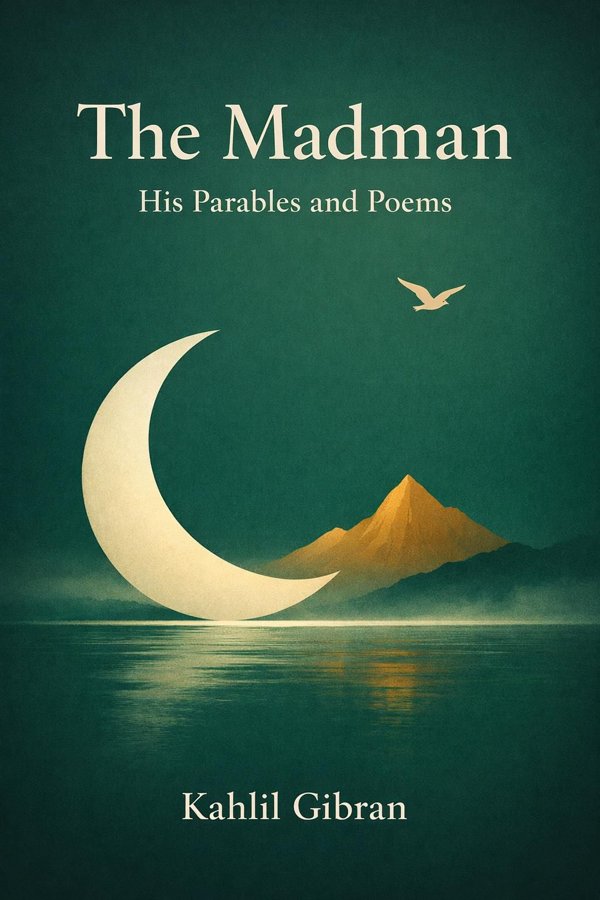
The Madman: His Parables and Poems: Summary & Key Insights
 10 min10 chaptersAudio available
Key Takeaways from The Madman: His Parables and Poems
Sometimes what the world calls madness is simply the refusal to keep performing.
The fear of being misunderstood often keeps people spiritually asleep.
Direct instruction often hardens the mind, but paradox slips past defenses.
Love is not merely comfort; it is a force that breaks open the self.
One of Gibran’s most enduring insights is that love does not justify possession.
What Is The Madman: His Parables and Poems About?
The Madman: His Parables and Poems by Kahlil Gibran is a classics book spanning 8 pages. The Madman: His Parables and Poems is Kahlil Gibran’s first major book written in English, a brief but luminous collection of parables, poetic fragments, and philosophical reflections that explores what happens when a person sheds society’s masks and begins to speak from the deepest self. The title figure, the “madman,” is not merely insane in any ordinary sense; he is someone who has lost the false identities others imposed on him and, in that loss, gained a fierce kind of freedom. Across short allegories and lyrical meditations, Gibran examines individuality, love, hypocrisy, freedom, suffering, pride, and the strange wisdom that often appears foolish to the world. What makes the book endure is its ability to compress profound spiritual and psychological truths into images that are simple, memorable, and unsettling. Gibran writes with the cadence of a poet and the insight of a mystic, blending Eastern spirituality, biblical resonance, and modern existential feeling. For readers interested in classic wisdom literature, symbolic storytelling, and inward awakening, The Madman offers a compact yet deeply rewarding encounter with one of the twentieth century’s most distinctive literary voices.
This FizzRead summary covers all 10 key chapters of The Madman: His Parables and Poems in approximately 10 minutes, distilling the most important ideas, arguments, and takeaways from Kahlil Gibran's work. Also available as an audio summary and Key Quotes Podcast.
The Madman: His Parables and Poems
The Madman: His Parables and Poems is Kahlil Gibran’s first major book written in English, a brief but luminous collection of parables, poetic fragments, and philosophical reflections that explores what happens when a person sheds society’s masks and begins to speak from the deepest self. The title figure, the “madman,” is not merely insane in any ordinary sense; he is someone who has lost the false identities others imposed on him and, in that loss, gained a fierce kind of freedom. Across short allegories and lyrical meditations, Gibran examines individuality, love, hypocrisy, freedom, suffering, pride, and the strange wisdom that often appears foolish to the world. What makes the book endure is its ability to compress profound spiritual and psychological truths into images that are simple, memorable, and unsettling. Gibran writes with the cadence of a poet and the insight of a mystic, blending Eastern spirituality, biblical resonance, and modern existential feeling. For readers interested in classic wisdom literature, symbolic storytelling, and inward awakening, The Madman offers a compact yet deeply rewarding encounter with one of the twentieth century’s most distinctive literary voices.
Who Should Read The Madman: His Parables and Poems?
This book is perfect for anyone interested in classics and looking to gain actionable insights in a short read. Whether you're a student, professional, or lifelong learner, the key ideas from The Madman: His Parables and Poems by Kahlil Gibran will help you think differently.
- ✓Readers who enjoy classics and want practical takeaways
- ✓Professionals looking to apply new ideas to their work and life
- ✓Anyone who wants the core insights of The Madman: His Parables and Poems in just 10 minutes
Want the full summary?
Get instant access to this book summary and 100K+ more with Fizz Moment.
Get Free SummaryAvailable on App Store • Free to download
Key Chapters
Sometimes what the world calls madness is simply the refusal to keep performing. In the opening parable, the narrator discovers that his masks have been stolen, and instead of despairing forever, he experiences a shocking liberation. Those masks represent the many roles people wear to satisfy family, society, religion, class, or reputation. We present one face to gain approval, another to avoid conflict, and another to hide fear. Gibran’s point is that identity built from borrowed expectations may protect us, but it also imprisons us. The madman becomes “mad” because he no longer participates in the polite deception that keeps ordinary life running smoothly.
This idea is central to the entire book. Gibran suggests that spiritual awakening often begins as social discomfort. When a person stops speaking in conventional ways, asking safe questions, or seeking constant praise, others may judge them harshly. Yet this estrangement can be the first step toward authenticity. The self is not discovered through performance but through stripping away illusion.
In practical life, this may mean noticing where you are acting from habit rather than conviction. Perhaps you say yes when you mean no, pursue a career chosen for status rather than purpose, or avoid honest conversation to preserve an image. Gibran is not advising reckless rebellion for its own sake. He is asking readers to examine which parts of their identity are alive and which are costumes.
A useful application is to list the roles you play—professional, parent, friend, child, partner—and ask: where am I most genuine, and where am I hiding? The goal is not to abandon responsibility, but to speak and act with greater inward truth. Actionable takeaway: identify one mask you wear for approval and practice removing it in one small, honest act this week.
Direct instruction often hardens the mind, but paradox slips past defenses. One of Gibran’s great gifts in The Madman is his use of parables—short, symbolic stories that do not simply tell readers what to think but invite them to see through contradiction. A king asks for meaning yet cannot hear it; a wise figure appears foolish; a simple image exposes a complex truth. Gibran understands that human beings rarely change through argument alone. We change when an image lodges in memory and starts working on us from within.
Parables matter because life itself is rarely straightforward. People can be generous and vain, devout and cruel, successful and empty. Gibran’s stories preserve that ambiguity. Instead of resolving tension, they reveal it. This is why his writing feels both mystical and psychologically acute. He is less interested in rules than in awakening perception.
In everyday life, we can use this method by looking for the symbolic meaning in ordinary events. A conflict at work may not only be about disagreement; it may reveal your fear of invisibility. A broken plan may not only be frustration; it may expose your dependence on control. Gibran trains readers to read life metaphorically, to ask what deeper truth is hidden inside the surface event.
This also makes the book powerful for reflection groups, classrooms, or journaling. A single parable can generate very different interpretations, and that is part of its wisdom. Truth becomes personal when readers must participate in discovering it.
Actionable takeaway: choose one short episode from your day that stirred emotion, and ask yourself, “If this were a parable, what truth would it be teaching me?” Write the answer in one sentence and revisit it tomorrow.
Love is not merely comfort; it is a force that breaks open the self. Although The Madman is not structured like Gibran’s later The Prophet, it contains the same conviction that love is both blessing and ordeal. Gibran rejects sentimental notions of love as endless sweetness. True love disturbs, exposes, and transforms. It strips pride, awakens vulnerability, and asks for surrender. What makes love sacred is not that it spares us pain, but that it uses pain to deepen us.
This theme appears throughout Gibran’s work because love, for him, is a spiritual event. To love another person honestly is to encounter the limits of possession, control, and ego. We want love to guarantee security, yet it often teaches uncertainty. We want it to confirm our image of ourselves, yet it reveals our selfishness and fear. That is why love feels both ecstatic and dangerous.
In practical terms, this idea can reshape how we interpret relational difficulty. Not every painful experience is meaningful, of course; some relationships are harmful and should be left. But when love is sincere and mutual, discomfort may signal growth rather than failure. For instance, learning to apologize, to listen without defensiveness, or to let another person remain fully themselves can feel like a wound to pride. Yet these are often signs of maturing love.
Gibran’s wisdom also applies beyond romance. Friendship, family bonds, and devotion to humanity all require the heart to expand beyond self-interest. Love is not validated by intensity alone but by the quality of transformation it brings.
Actionable takeaway: in one important relationship, identify whether your current struggle comes from genuine incompatibility or from the ego’s resistance to growth. Then respond with either honest repair or honest release.
One of Gibran’s most enduring insights is that love does not justify possession. Though best known from The Prophet, the spirit of this teaching also belongs to The Madman’s larger vision of freedom and individuality. Human beings suffer when they try to own what was only ever entrusted to them. Children, especially, are not extensions of parental ambition, fear, or identity. They come through us, but not from us in any ultimate sense. They carry their own becoming.
This idea challenges one of the most common forms of disguised control: loving someone by trying to shape them into our preferred image. Parents may insist they are acting for a child’s good while unconsciously demanding obedience to old wounds, social anxieties, or unrealized dreams. The same pattern appears in mentoring, teaching, and even friendship. We confuse care with authorship.
Gibran’s perspective is not a rejection of guidance or responsibility. Children need discipline, structure, and wisdom. But true guidance serves the child’s unfolding nature instead of replacing it. A parent can protect, nurture, educate, and encourage without treating the child as property. The same principle applies to anyone under our influence. Leadership becomes healthier when it empowers rather than dominates.
In modern life, this can mean listening more carefully to who a young person is instead of only who we want them to become. A practical example: rather than pushing a child toward prestige alone, notice where curiosity, character, and joy naturally arise. Ask questions before giving instructions. Support effort, not only outcome.
Actionable takeaway: if you guide or care for someone younger or more dependent, replace one controlling habit with one act of attentive listening this week. Ask what they truly want, fear, or dream before offering your answer.
A task does not become noble because it is admired; it becomes noble when it is infused with presence. Gibran’s worldview consistently resists the split between the spiritual and the ordinary. In The Madman, as in much of his writing, labor is not merely economic necessity. Work can be drudgery when done mechanically, but it can also become a form of participation in life itself. What matters is not only what we do, but how deeply we inhabit it.
This idea helps correct two common mistakes. The first is believing that only grand, public, or artistic work has value. The second is assuming that routine labor has no spiritual significance. Gibran suggests that tending a field, making a meal, writing a letter, teaching a lesson, or building a chair can all become expressions of care, dignity, and communion. Work loses meaning when detached from service and soul; it regains meaning when we connect it to contribution.
In practical terms, many people feel alienated from their jobs because they experience labor only as pressure, output, and survival. While not all work is fulfilling, Gibran invites us to recover intention. A nurse may remember that paperwork supports healing. A manager may shift from control to stewardship. A student may see study not as performance alone but as preparation to serve. Even in imperfect systems, inward attitude changes the moral texture of labor.
This does not excuse exploitation or burnout. Sacred work still requires boundaries and justice. Meaning is not a substitute for fair conditions. But when conditions are reasonable, attention and purpose can transform routine effort.
Actionable takeaway: before beginning tomorrow’s work, name one person, community, or value your labor serves. Let that purpose shape how you perform even the smallest task.
People often imagine freedom as the absence of restraint, yet Gibran sees a subtler danger: we can rebel outwardly while remaining inwardly enslaved. The Madman critiques not only rigid law and social conformity but also the ego’s pride in merely opposing them. True freedom is not achieved by saying no to every authority. It emerges when a person is no longer ruled by fear, vanity, resentment, or craving. Without inner discipline, rebellion becomes another form of captivity.
This makes Gibran far more profound than a simple celebrant of individualism. He understands that external laws can be oppressive, but he also knows that human beings often carry their prison within. Someone may reject custom yet still be controlled by anger. Another may leave a restrictive group yet remain obsessed with proving independence. Freedom, then, is not just separation from constraint; it is right relation to self.
This concept has clear contemporary relevance. People speak often of authenticity and personal liberty, but many choices advertised as free are reactions to pressure, comparison, or insecurity. Overspending to signal autonomy, provoking others for attention, or abandoning commitments to avoid discomfort may feel liberating in the moment, yet they deepen dependence on impulse.
A practical application is to test your desires. Ask: if no one were watching, praising, or resisting me, would I still want this? That question distinguishes genuine longing from reaction. It can help in decisions about lifestyle, relationships, career shifts, and beliefs.
Actionable takeaway: choose one area where you claim freedom—speech, work, love, belief—and examine what still controls you there. Then create one small practice of inner mastery, such as pausing before reacting or choosing a value over an impulse.
What hurts us may also reveal us. Gibran does not glorify suffering, but he insists that pain can become meaningful when it awakens self-knowledge. In The Madman, wounds are not merely punishments from life; they are openings through which hidden truths emerge. Pride is exposed by humiliation, attachment by loss, fear by uncertainty, and compassion by shared vulnerability. Pain can strip away illusions we would never surrender voluntarily.
This idea matters because most people instinctively resist discomfort or reduce it to bad luck. Yet some forms of suffering contain instruction. A betrayal may reveal where trust was blind. Exhaustion may expose a life built on pleasing others. Anxiety may signal that one’s outer success has become disconnected from inner values. The painful event is not good in itself, but our encounter with it can become transformative.
Gibran’s perspective is especially useful when paired with discernment. Not all pain should be endured quietly; some pain is a call to seek help, set boundaries, or leave harmful conditions. But even necessary endings can teach. The question is not simply “Why did this happen?” but “What falsehood can I no longer maintain because this happened?”
In practical life, pain becomes a doorway when reflected upon honestly. Journaling, therapy, prayer, or deep conversation can help turn raw suffering into wisdom. Without reflection, pain hardens into bitterness. With reflection, it may deepen humility and clarity.
Actionable takeaway: think of one recent hurt and ask what it uncovered about your needs, limits, or illusions. Name that lesson plainly, and let it inform one concrete change in how you live or relate.
Prayer is not only spoken in temples; it is also uttered in wonder. Gibran treats beauty, reverence, and spiritual longing as deeply connected. In The Madman, moments of contemplation—encounters with nature, silence, longing, or inner vision—become forms of communion. Prayer is not reduced to petition or ritual performance. It is the soul recognizing its participation in something greater than the narrow self. Beauty matters because it interrupts our utilitarian habits and reminds us that life is not only to be managed, but also beheld.
This is one of Gibran’s most healing ideas. Many people feel spiritually estranged because they equate prayer with formal correctness or institutional language. Gibran widens the field. A sincere pause at dawn, gratitude before work, tears at music, awe before the sea, or silent attention to another person’s suffering can all become prayerful acts. Beauty is not decorative here; it is revelatory. It discloses depth.
Practically, this means cultivating receptivity rather than only seeking answers. A person overwhelmed by stress may not need a perfect doctrine in the moment; they may need five minutes of stillness, a walk among trees, or the courage to speak gratitude aloud. Such moments reorient the heart. They remind us we are more than productivity, noise, and demand.
This insight also encourages moral sensitivity. When we perceive beauty rightly, we are less likely to treat the world carelessly. Reverence can lead to kindness, ecological awareness, and deeper presence with others.
Actionable takeaway: create one daily ritual of attention—a brief silence, a line of gratitude, a walk without your phone, or observing the sky—and treat it as a form of prayerful returning to yourself and the world.
All Chapters in The Madman: His Parables and Poems
About the Author
Kahlil Gibran (1883–1931) was a Lebanese-American writer, poet, and visual artist whose work fused mysticism, philosophy, and lyrical prose. Born in Bsharri, in present-day Lebanon, he emigrated with his family to the United States and later studied art in Paris. Gibran wrote in both Arabic and English, becoming a major figure in modern Arabic literature while also reaching a vast international audience in English. His works often explore love, freedom, suffering, beauty, and the soul’s search for truth, drawing on Christian, Sufi, and universal spiritual influences. He is best known for The Prophet, one of the most beloved poetic classics of the twentieth century, but The Madman was his first major English-language book and introduced the symbolic, aphoristic style that defined his legacy.
Get This Summary in Your Preferred Format
Read or listen to the The Madman: His Parables and Poems summary by Kahlil Gibran anytime, anywhere. FizzRead offers multiple formats so you can learn on your terms — all free.
Available formats: App · Audio · PDF · EPUB — All included free with FizzRead
Download The Madman: His Parables and Poems PDF and EPUB Summary
Key Quotes from The Madman: His Parables and Poems
“Sometimes what the world calls madness is simply the refusal to keep performing.”
“The fear of being misunderstood often keeps people spiritually asleep.”
“Direct instruction often hardens the mind, but paradox slips past defenses.”
“Love is not merely comfort; it is a force that breaks open the self.”
“One of Gibran’s most enduring insights is that love does not justify possession.”
Frequently Asked Questions about The Madman: His Parables and Poems
The Madman: His Parables and Poems by Kahlil Gibran is a classics book that explores key ideas across 10 chapters. The Madman: His Parables and Poems is Kahlil Gibran’s first major book written in English, a brief but luminous collection of parables, poetic fragments, and philosophical reflections that explores what happens when a person sheds society’s masks and begins to speak from the deepest self. The title figure, the “madman,” is not merely insane in any ordinary sense; he is someone who has lost the false identities others imposed on him and, in that loss, gained a fierce kind of freedom. Across short allegories and lyrical meditations, Gibran examines individuality, love, hypocrisy, freedom, suffering, pride, and the strange wisdom that often appears foolish to the world. What makes the book endure is its ability to compress profound spiritual and psychological truths into images that are simple, memorable, and unsettling. Gibran writes with the cadence of a poet and the insight of a mystic, blending Eastern spirituality, biblical resonance, and modern existential feeling. For readers interested in classic wisdom literature, symbolic storytelling, and inward awakening, The Madman offers a compact yet deeply rewarding encounter with one of the twentieth century’s most distinctive literary voices.
More by Kahlil Gibran

You Might Also Like



Browse by Category
Ready to read The Madman: His Parables and Poems?
Get the full summary and 100K+ more books with Fizz Moment.