
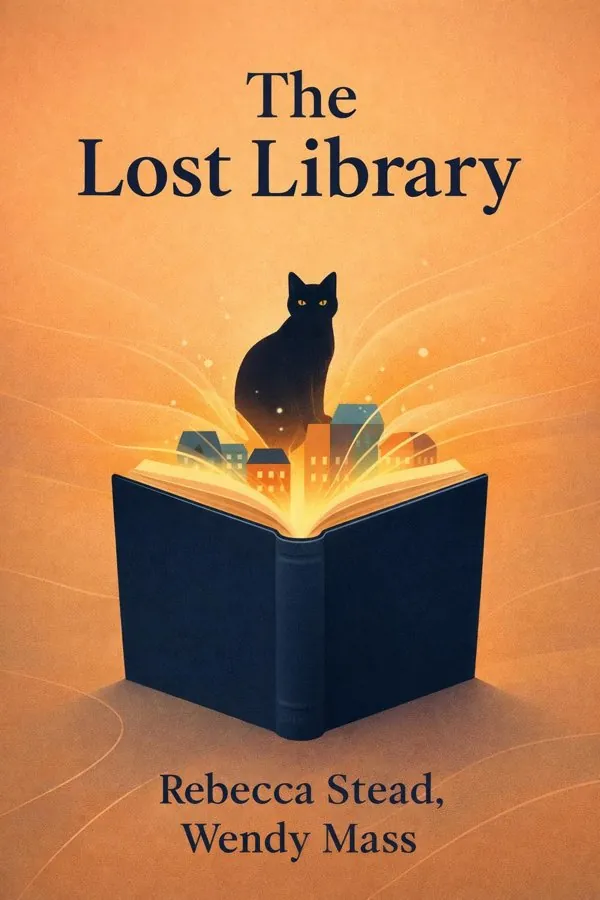
The Lost Library: Summary & Key Insights
 10 min3 chaptersAudio available
What Is The Lost Library About?
The Lost Library by Rebecca Stead, Wendy Mass is a bestsellers book spanning 3 pages. A heartwarming middle-grade novel about a mysterious library, a curious cat, and the power of stories to connect people. When a small-town library reopens, a group of children uncover secrets about the past and learn how books can change lives.
This FizzRead summary covers all 3 key chapters of The Lost Library in approximately 10 minutes, distilling the most important ideas, arguments, and takeaways from Rebecca Stead, Wendy Mass's work. Also available as an audio summary and Key Quotes Podcast.
The Lost Library
A heartwarming middle-grade novel about a mysterious library, a curious cat, and the power of stories to connect people. When a small-town library reopens, a group of children uncover secrets about the past and learn how books can change lives.
Who Should Read The Lost Library?
This book is perfect for anyone interested in bestsellers and looking to gain actionable insights in a short read. Whether you're a student, professional, or lifelong learner, the key ideas from The Lost Library by Rebecca Stead, Wendy Mass will help you think differently.
- ✓Readers who enjoy bestsellers and want practical takeaways
- ✓Professionals looking to apply new ideas to their work and life
- ✓Anyone who wants the core insights of The Lost Library in just 10 minutes
Want the full summary?
Get instant access to this book summary and 100K+ more with Fizz Moment.
Get Free SummaryAvailable on App Store • Free to download
Key Chapters
Evan’s story begins in the heart of Martinville, where the new library stands as a quiet monument to both remembrance and renewal. To outsiders, it’s a charming community space filled with the simple hum of everyday life: children reading in corners, townspeople exchanging greetings, the scent of coffee drifting from the librarian’s desk. But for Evan, there’s an invisible weight pressing against the building’s cheerful exterior—a question that nobody seems willing to answer. What really happened when the old library burned?
I wanted Evan’s curiosity to be more than a plot device; it represents the spark of empathy. His quest starts unintentionally, when he stumbles upon a box of old library cards while helping the new librarian, Rafe, organize some dusty archives. Each card bears the name of someone from Martinville’s past—a collection of ordinary lives frozen in time, tied together by books they once borrowed. For Evan, each name becomes a doorway into another life, a thread in the woven story of a community.
Rafe, a man carrying his own quiet shadows, becomes both mentor and accomplice in Evan’s discovery. Their friendship flourishes not through grand gestures but through simple trust and the rhythm of shared purpose. As they peel back the layers of Martinville’s history, Rafe confides that he, too, has always wondered about the fire that erased the old library from the town’s map. Yet there’s hesitation in him—a recognition that the truth might hurt as much as it heals.
The deeper Evan digs, the more he senses that the library is alive—not just metaphorically, but spiritually. Mortimer, the cat who watches from high shelves, seems to guide him subtly, appearing whenever he’s on the brink of revelation. To Evan, Mortimer becomes a silent guardian, as if the library itself had chosen him to uncover what others have hidden.
This chapter of the story is about the awakening of purpose. Evan begins as a boy chasing curiosity; he becomes, quietly, a keeper of communal memory, a detective of empathy. His journey teaches him that stories don’t vanish with time—they hide in spaces we overlook: a faded card, an unspoken memory, a name someone has stopped saying aloud. The library, newly reopened, represents that sacred space where those fragments come together again, reminding its visitors that the past, when faced honestly, can illuminate the present.
While Evan provides the lens of youthful discovery, Al—our retired firefighter—offers the voice of the past, marked by loss and silence. His memories are the bridge between what Martinville was and what it struggles to become again. Through Al’s recollections, I wanted readers to feel the tension of time itself: how moments of tragedy stretch forward into decades, shaping people’s lives long after the flames have died.
Al remembers the night of the old library fire vividly—its scent, its glow, the rush of panic as he and his crew fought to save what could not be saved. But what he carries is not only the physical memory of loss; it’s the moral weight of unanswered questions. Did someone cause it? Was it an accident, or something darker? I wanted this uncertainty to mirror how communities live with secrets—how silence becomes a survival mechanism, until someone like Evan comes along and invites truth back in.
Through conversations between Al and Evan, a beautiful intergenerational bond forms. It’s the kind of relationship I treasure in storytelling—the passing of wisdom between old and young, forged not through authority but through shared vulnerability. Al’s voice trembles with guilt and nostalgia, but Evan’s openness softens him. Slowly, Al begins to tell what he’s buried for years: that the fire wasn’t merely accidental, that certain decisions made out of fear and shame altered the course of Martinville’s story.
Yet the point isn’t simply to expose blame; it’s to explore responsibility and forgiveness. Al’s admissions begin to heal the rift between past and present. As Evan listens, he understands that uncovering the truth isn’t about punishment—it’s about giving silence a chance to speak. The burned library becomes a metaphor for memory itself: fragile, blackened, yet capable of regeneration.
In giving Al his voice back, I hoped to show how stories can redeem history. When he finally walks into the new library, seeing shelves rebuilt and children reading where there was once ruin, the act itself becomes a kind of absolution. His regret transforms into gratitude, his sorrow into hope. Through Al’s perspective, we grasp the lesson that communities heal when they allow truth—not comfort—to guide their remembrance. And that healing often begins with the kind of courage that books inspire—the courage to finally face the page of our own history.
+ 1 more chapters — available in the FizzRead app
All Chapters in The Lost Library
About the Authors
Rebecca Stead is an American author known for her award-winning children's novels, including 'When You Reach Me'. Wendy Mass is an American writer celebrated for her middle-grade fiction such as 'A Mango-Shaped Space' and '11 Birthdays'.
Get This Summary in Your Preferred Format
Read or listen to the The Lost Library summary by Rebecca Stead, Wendy Mass anytime, anywhere. FizzRead offers multiple formats so you can learn on your terms — all free.
Available formats: App · Audio · PDF · EPUB — All included free with FizzRead
Download The Lost Library PDF and EPUB Summary
Key Quotes from The Lost Library
“Evan’s story begins in the heart of Martinville, where the new library stands as a quiet monument to both remembrance and renewal.”
“While Evan provides the lens of youthful discovery, Al—our retired firefighter—offers the voice of the past, marked by loss and silence.”
Frequently Asked Questions about The Lost Library
The Lost Library by Rebecca Stead, Wendy Mass is a bestsellers book that explores key ideas across 3 chapters. A heartwarming middle-grade novel about a mysterious library, a curious cat, and the power of stories to connect people. When a small-town library reopens, a group of children uncover secrets about the past and learn how books can change lives.
You Might Also Like
The Godfather
Mario Puzo
10 min
The Handmaid's Tale
Margaret Atwood
10 min
The Hunger Games
Suzanne Collins
10 min
The Nightingale
Kristin Hannah
10 min
The Seven Husbands of Evelyn Hugo
Taylor Jenkins Reid
10 min
Backwater Justice
Fern Michaels
10 minBrowse by Category
Ready to read The Lost Library?
Get the full summary and 100K+ more books with Fizz Moment.