
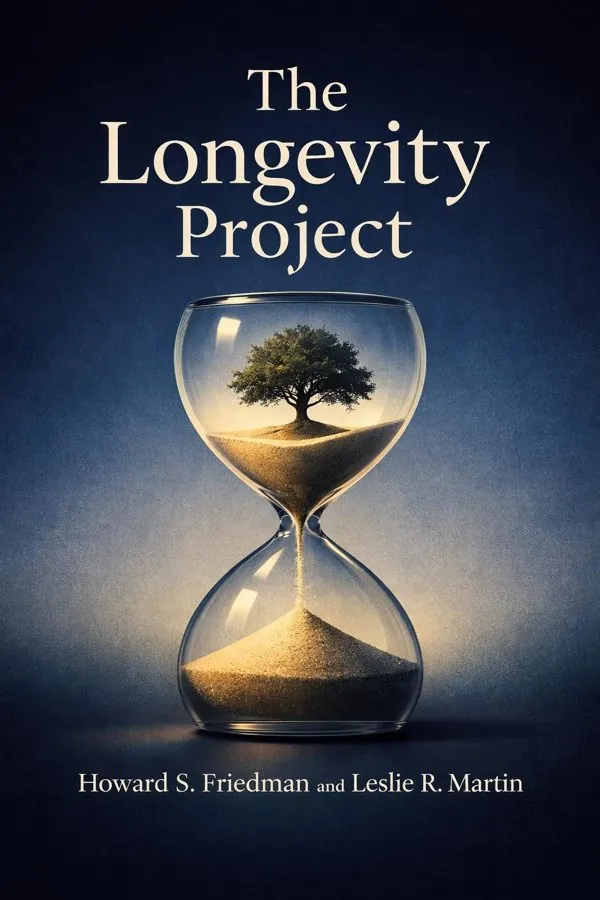
The Longevity Project: Surprising Discoveries for Health and Long Life from the Landmark Eight-Decade Study: Summary & Key Insights
by Howard S. Friedman, Leslie R. Martin
 10 min9 chaptersAudio available
What Is The Longevity Project: Surprising Discoveries for Health and Long Life from the Landmark Eight-Decade Study About?
The Longevity Project: Surprising Discoveries for Health and Long Life from the Landmark Eight-Decade Study by Howard S. Friedman and Leslie R. Martin is a longevity book spanning 9 pages. Based on an eight-decade study that began in 1921, this book explores the factors that contribute to long life and well-being. Psychologists Howard S. Friedman and Leslie R. Martin analyze data from over 1,500 individuals to reveal that personality traits, social relationships, and life choices—rather than simple health advice—play crucial roles in longevity. The authors challenge common myths about happiness, stress, and optimism, offering evidence-based insights into how people can live longer and healthier lives.
This FizzRead summary covers all 9 key chapters of The Longevity Project: Surprising Discoveries for Health and Long Life from the Landmark Eight-Decade Study in approximately 10 minutes, distilling the most important ideas, arguments, and takeaways from Howard S. Friedman and Leslie R. Martin's work. Also available as an audio summary and Key Quotes Podcast.
The Longevity Project: Surprising Discoveries for Health and Long Life from the Landmark Eight-Decade Study
Based on an eight-decade study that began in 1921, this book explores the factors that contribute to long life and well-being. Psychologists Howard S. Friedman and Leslie R. Martin analyze data from over 1,500 individuals to reveal that personality traits, social relationships, and life choices—rather than simple health advice—play crucial roles in longevity. The authors challenge common myths about happiness, stress, and optimism, offering evidence-based insights into how people can live longer and healthier lives.
Who Should Read The Longevity Project: Surprising Discoveries for Health and Long Life from the Landmark Eight-Decade Study?
This book is perfect for anyone interested in longevity and looking to gain actionable insights in a short read. Whether you're a student, professional, or lifelong learner, the key ideas from The Longevity Project: Surprising Discoveries for Health and Long Life from the Landmark Eight-Decade Study by Howard S. Friedman and Leslie R. Martin will help you think differently.
- ✓Readers who enjoy longevity and want practical takeaways
- ✓Professionals looking to apply new ideas to their work and life
- ✓Anyone who wants the core insights of The Longevity Project: Surprising Discoveries for Health and Long Life from the Landmark Eight-Decade Study in just 10 minutes
Want the full summary?
Get instant access to this book summary and 100K+ more with Fizz Moment.
Get Free SummaryAvailable on App Store • Free to download
Key Chapters
The foundation of our work is the Terman Life Cycle Study, initiated in 1921 to follow the lives of more than 1,500 highly intelligent children. The project was designed to explore how giftedness shaped life outcomes, but its value soon transcended that original focus. From their childhood laboratories and early questionnaires, Terman’s team gathered detailed data about personality, home environment, aspirations, and social attitudes. Over time, these bright young participants grew up, worked, married, raised families, and faced crises—and every major turn of their lives was recorded.
This layered chronicle became the perfect lens through which to examine longevity. For eight decades, researchers tracked every significant factor—from medical history to psychological disposition—through wars, technological revolutions, and changing social norms. Because these participants were followed continuously, we could see how early attitudes and choices echoed forward into late adulthood.
We later saw that this cohort’s uniform intelligence did not determine how long they lived; their longevity was far more affected by their patterns of living. Those with similar IQs diverged dramatically in lifespan depending on their conscientiousness, social involvement, and sense of purpose. What began as a study of genius became an unparalleled window into health and human development.
Among all the traits measured, conscientiousness emerged as the most reliable predictor of long-term health and survival. From childhood questionnaires, we identified those who were prudent, careful, and persistent. Over decades, such individuals were less likely to engage in risky behaviors, more likely to build stable relationships, and showed resilience under stress.
It was not simply about being rule-abiding; conscientious people tended to plan, to think ahead, and to make realistic decisions about their work and family. They applied effort consistently, and their lives reflected a balance that proved protective. Even in adversity—unemployment, illness, loss—they demonstrated adaptability. Personality guided behavior, which in turn shaped health outcomes.
As we examined medical data, it became evident that these conscientious individuals died later and lived healthier lives. Their stress responses were moderate; they seldom experienced the extremes of anxiety or reckless impulsivity that undermine long-term wellness. In essence, conscientiousness functioned as an invisible shield—one built over years, through careful living and sustained commitment to meaningful goals.
+ 7 more chapters — available in the FizzRead app
All Chapters in The Longevity Project: Surprising Discoveries for Health and Long Life from the Landmark Eight-Decade Study
About the Authors
Howard S. Friedman is a professor of psychology at the University of California, Riverside, known for his research on health psychology and personality. Leslie R. Martin is a professor of psychology at La Sierra University, specializing in health and social psychology. Together, they have conducted extensive research on the connections between personality and long-term health outcomes.
Get This Summary in Your Preferred Format
Read or listen to the The Longevity Project: Surprising Discoveries for Health and Long Life from the Landmark Eight-Decade Study summary by Howard S. Friedman and Leslie R. Martin anytime, anywhere. FizzRead offers multiple formats so you can learn on your terms — all free.
Available formats: App · Audio · PDF · EPUB — All included free with FizzRead
Download The Longevity Project: Surprising Discoveries for Health and Long Life from the Landmark Eight-Decade Study PDF and EPUB Summary
Key Quotes from The Longevity Project: Surprising Discoveries for Health and Long Life from the Landmark Eight-Decade Study
“The foundation of our work is the Terman Life Cycle Study, initiated in 1921 to follow the lives of more than 1,500 highly intelligent children.”
“Among all the traits measured, conscientiousness emerged as the most reliable predictor of long-term health and survival.”
Frequently Asked Questions about The Longevity Project: Surprising Discoveries for Health and Long Life from the Landmark Eight-Decade Study
The Longevity Project: Surprising Discoveries for Health and Long Life from the Landmark Eight-Decade Study by Howard S. Friedman and Leslie R. Martin is a longevity book that explores key ideas across 9 chapters. Based on an eight-decade study that began in 1921, this book explores the factors that contribute to long life and well-being. Psychologists Howard S. Friedman and Leslie R. Martin analyze data from over 1,500 individuals to reveal that personality traits, social relationships, and life choices—rather than simple health advice—play crucial roles in longevity. The authors challenge common myths about happiness, stress, and optimism, offering evidence-based insights into how people can live longer and healthier lives.
You Might Also Like
Age-Proof: Living Longer Without Running Out of Money or Breaking a Hip
Jean Chatzky, Michael F. Roizen
10 min
Ageless Body, Timeless Mind: The Quantum Alternative to Growing Old
Deepak Chopra
10 min
How to Live Forever: The Enduring Power of Connecting the Generations
Marc Freedman
10 min
Outlive: The Science and Art of Longevity
Peter Attia
10 min
The Longevity Formula: How to Live Longer, Stronger, and Healthier
Dr. James DiNicolantonio
10 min
The Longevity Plan: Seven Life-Transforming Lessons from Ancient China
Dr. John D. Day, Dr. Matthew D. LaPlante
10 minBrowse by Category
Ready to read The Longevity Project: Surprising Discoveries for Health and Long Life from the Landmark Eight-Decade Study?
Get the full summary and 100K+ more books with Fizz Moment.