
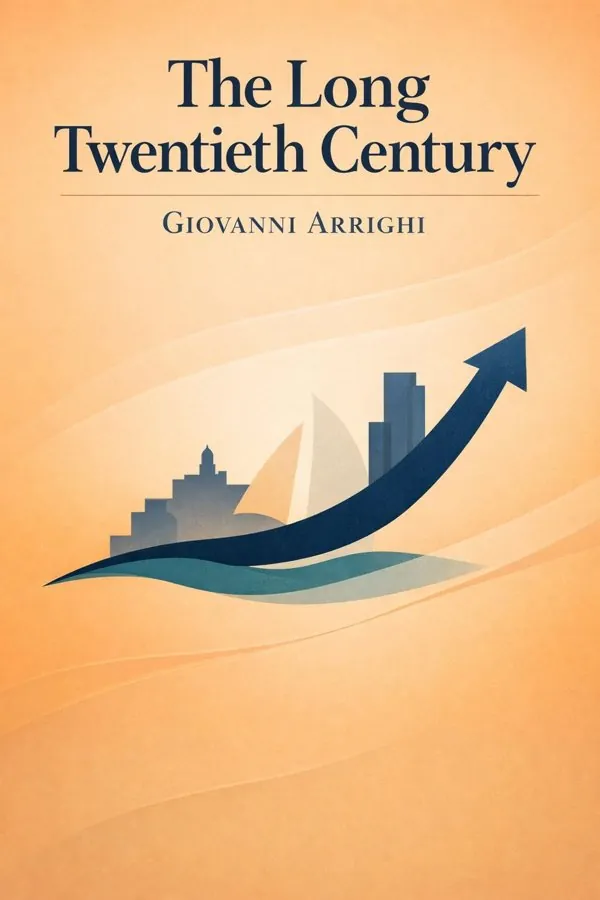
The Long Twentieth Century: Money, Power, and the Origins of Our Times: Summary & Key Insights
 10 min9 chaptersAudio available
What Is The Long Twentieth Century: Money, Power, and the Origins of Our Times About?
The Long Twentieth Century: Money, Power, and the Origins of Our Times by Giovanni Arrighi is a economics book spanning 9 pages. The Long Twentieth Century explores the historical evolution of capitalism from the late Middle Ages to the modern era. Giovanni Arrighi traces how cycles of capital accumulation and state power have shifted geographically—from Genoa and Venice to the Dutch Republic, Britain, and finally the United States—revealing the systemic logic of global capitalism and its crises.
This FizzRead summary covers all 9 key chapters of The Long Twentieth Century: Money, Power, and the Origins of Our Times in approximately 10 minutes, distilling the most important ideas, arguments, and takeaways from Giovanni Arrighi's work. Also available as an audio summary and Key Quotes Podcast.
The Long Twentieth Century: Money, Power, and the Origins of Our Times
The Long Twentieth Century explores the historical evolution of capitalism from the late Middle Ages to the modern era. Giovanni Arrighi traces how cycles of capital accumulation and state power have shifted geographically—from Genoa and Venice to the Dutch Republic, Britain, and finally the United States—revealing the systemic logic of global capitalism and its crises.
Who Should Read The Long Twentieth Century: Money, Power, and the Origins of Our Times?
This book is perfect for anyone interested in economics and looking to gain actionable insights in a short read. Whether you're a student, professional, or lifelong learner, the key ideas from The Long Twentieth Century: Money, Power, and the Origins of Our Times by Giovanni Arrighi will help you think differently.
- ✓Readers who enjoy economics and want practical takeaways
- ✓Professionals looking to apply new ideas to their work and life
- ✓Anyone who wants the core insights of The Long Twentieth Century: Money, Power, and the Origins of Our Times in just 10 minutes
Want the full summary?
Get instant access to this book summary and 100K+ more with Fizz Moment.
Get Free SummaryAvailable on App Store • Free to download
Key Chapters
The origins of capitalism were not born in the factories of the Industrial Revolution but in the mercantile experiments of late medieval Europe. In the fragmented political landscape of the fourteenth and fifteenth centuries, Italian city-states like Venice and Genoa pioneered a new form of wealth accumulation that transcended feudal norms. Where feudal lords amassed power through land and coercion, these maritime republics pursued profit through trade, credit, and political brokerage.
This setting of multiple, competing city-states created the perfect laboratory for capitalism’s birth. Venice thrived on control of trade routes and mastery of maritime empire, while Genoa specialized in finance, acting as Europe’s banker even before the concept fully matured. The decline of feudalism, accelerated by the Black Death and the spread of global trade, allowed merchants to operate beyond the rigidities of lord and peasant relations. In this space between old power structures, a new logic of profit-seeking took hold — flexible, mobile, and transnational.
The core insight here is that capitalism emerged not merely from production but from the circulation of money and goods on a global scale. The transition from feudalism to capitalism thus occurred as power shifted from static landholding elites to dynamic networks of capital. This transformation set the scene for the first full cycle of accumulation that would define the Genoese era.
The Genoese merchants of the sixteenth century occupy a unique place in the genealogy of capitalism. They were not great territorial rulers but arch-strategists of finance, weaving intricate webs of credit that linked Spain’s imperial conquests to Europe’s evolving trade networks. Genoa’s genius lay in its partnership with the Spanish Empire: Spanish armies and conquests supplied silver from the Americas, while Genoese bankers managed, lent, and multiplied that wealth.
The Genoese system exemplifies what I call a 'financial expansion' — a phase when money builds upon itself, temporarily freeing capital from the constraints of material production. Genoese financiers did not build factories or farms; they built financial circuits. In doing so, they introduced the first world-spanning system of credit and speculation. Yet this was also their weakness. As the Spanish Empire overextended itself and its debts mounted, Genoa’s fortunes collapsed with it.
This pattern — expansion through finance followed by crisis — would echo through every subsequent systemic cycle. When profits from production decline, capital seeks refuge in finance, driving short-term gains but sowing the seeds of structural reorganization. The Genoese cycle set the template for this recurring logic, marking the birth of a truly global capitalism centered on the dynamic interplay between state power and private accumulation.
+ 7 more chapters — available in the FizzRead app
All Chapters in The Long Twentieth Century: Money, Power, and the Origins of Our Times
About the Author
Giovanni Arrighi (1937–2009) was an Italian sociologist and economist known for his work in world-systems theory. He taught at Johns Hopkins University and authored several influential books on global capitalism, including 'Adam Smith in Beijing' and 'Chaos and Governance in the Modern World System.'
Get This Summary in Your Preferred Format
Read or listen to the The Long Twentieth Century: Money, Power, and the Origins of Our Times summary by Giovanni Arrighi anytime, anywhere. FizzRead offers multiple formats so you can learn on your terms — all free.
Available formats: App · Audio · PDF · EPUB — All included free with FizzRead
Download The Long Twentieth Century: Money, Power, and the Origins of Our Times PDF and EPUB Summary
Key Quotes from The Long Twentieth Century: Money, Power, and the Origins of Our Times
“The origins of capitalism were not born in the factories of the Industrial Revolution but in the mercantile experiments of late medieval Europe.”
“The Genoese merchants of the sixteenth century occupy a unique place in the genealogy of capitalism.”
Frequently Asked Questions about The Long Twentieth Century: Money, Power, and the Origins of Our Times
The Long Twentieth Century: Money, Power, and the Origins of Our Times by Giovanni Arrighi is a economics book that explores key ideas across 9 chapters. The Long Twentieth Century explores the historical evolution of capitalism from the late Middle Ages to the modern era. Giovanni Arrighi traces how cycles of capital accumulation and state power have shifted geographically—from Genoa and Venice to the Dutch Republic, Britain, and finally the United States—revealing the systemic logic of global capitalism and its crises.
You Might Also Like
Business Adventures
John Brooks
10 min
Nudge
Richard H. Thaler, Cass R. Sunstein
10 min
The Hitchhiker"s Guide to the Galaxy
Douglas Adams
10 minThe Muqaddimah
Ibn Khaldun
10 minThe Outsiders
William N. Thorndike
10 min
A Little History of Economics
Niall Kishtainy
10 minBrowse by Category
Ready to read The Long Twentieth Century: Money, Power, and the Origins of Our Times?
Get the full summary and 100K+ more books with Fizz Moment.