
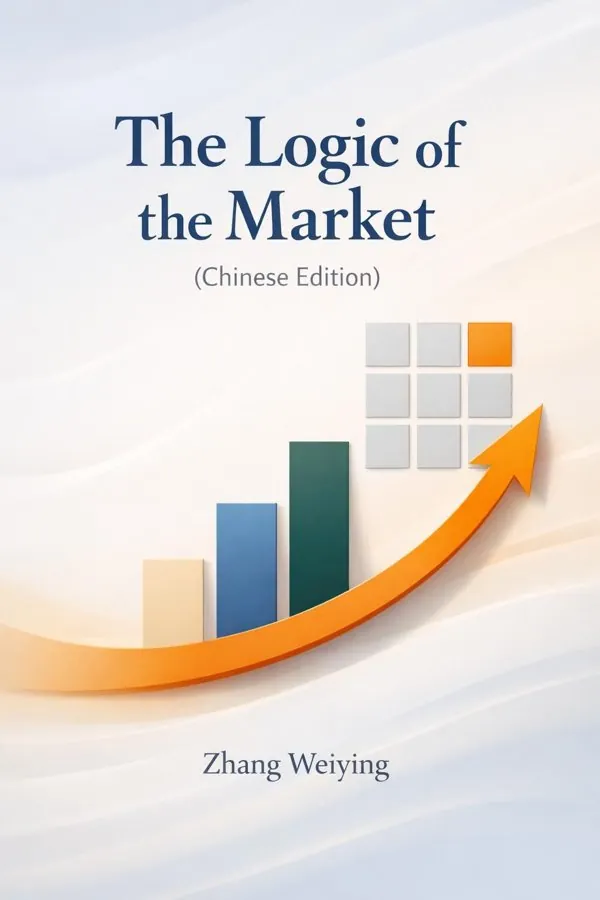
The Logic of the Market (Chinese Edition): Summary & Key Insights
 10 min6 chaptersAudio available
What Is The Logic of the Market (Chinese Edition) About?
The Logic of the Market (Chinese Edition) by Zhang Weiying is a economics book spanning 6 pages. The Logic of the Market is a major work by Chinese economist Zhang Weiying, systematically explaining the fundamental principles and institutional logic of the market economy. The author explores how markets achieve efficient resource allocation through spontaneous order, analyzing entrepreneurship, competition, and institutional change, while critiquing the limitations of planned economies and government intervention. With clear logic and real-world examples, the book reveals the economic and social significance behind market mechanisms.
This FizzRead summary covers all 6 key chapters of The Logic of the Market (Chinese Edition) in approximately 10 minutes, distilling the most important ideas, arguments, and takeaways from Zhang Weiying's work. Also available as an audio summary and Key Quotes Podcast.
The Logic of the Market (Chinese Edition)
The Logic of the Market is a major work by Chinese economist Zhang Weiying, systematically explaining the fundamental principles and institutional logic of the market economy. The author explores how markets achieve efficient resource allocation through spontaneous order, analyzing entrepreneurship, competition, and institutional change, while critiquing the limitations of planned economies and government intervention. With clear logic and real-world examples, the book reveals the economic and social significance behind market mechanisms.
Who Should Read The Logic of the Market (Chinese Edition)?
This book is perfect for anyone interested in economics and looking to gain actionable insights in a short read. Whether you're a student, professional, or lifelong learner, the key ideas from The Logic of the Market (Chinese Edition) by Zhang Weiying will help you think differently.
- ✓Readers who enjoy economics and want practical takeaways
- ✓Professionals looking to apply new ideas to their work and life
- ✓Anyone who wants the core insights of The Logic of the Market (Chinese Edition) in just 10 minutes
Want the full summary?
Get instant access to this book summary and 100K+ more with Fizz Moment.
Get Free SummaryAvailable on App Store • Free to download
Key Chapters
The phenomenon of spontaneous order lies at the heart of the market’s logic. It defies the assumption that order must always be designed or imposed from above. In planned systems, someone must decide what to produce, how much to produce, and for whom. But in markets, no one decides these things directly. Instead, millions of individuals make independent decisions, guided by prices and self-interest, yet the result is a coherent social order that no single person could have foreseen.
To understand this, we must appreciate that knowledge in society is dispersed — it exists in fragments scattered among individuals. No central authority can gather and process this information effectively. The beauty of the market is that it coordinates this dispersed knowledge through prices. Every price encapsulates a signal: of scarcity, of opportunity, of changing preferences. When the price of a commodity rises, it tells producers to supply more and consumers to economize; when it falls, the message reverses. This constant feedback loop generates an adaptive system that responds faster and more efficiently than any planned directive could.
Consider China’s own reform experience. In the early years of planned economy, countless resources were misallocated due to the absence of price signals. Only when markets began to re-emerge — first in rural household contracts, later in urban enterprises — did coordination improve dramatically. What changed was not simply the incentive structure but the informational structure. Once individuals were free to make decisions and bear responsibility for outcomes, the invisible hand began to restore balance and vitality.
Spontaneous order teaches us humility. It reminds us that no leader, no economist, no government can fully comprehend the complexity of social cooperation. The task of economic policy, therefore, is not to design perfection but to preserve the conditions under which spontaneous order can function — namely, freedom of choice, rule of law, and protection of property. In short, the best governance is not control but restraint.
Prices are the lifeblood of market order. They embody information — information about relative scarcities, technological changes, and consumer preferences. Yet this information is tacit, local, and constantly changing. A functioning price system translates that dispersed knowledge into a form understandable to everyone without requiring anyone to know the whole picture.
What makes the market extraordinary is that it solves the coordination problem without central instructions. Imagine a global network of producers and consumers who never meet and yet achieve astonishing coherence. This happens because every participant observes and reacts to price signals, which summarize vast amounts of data in a few simple numbers. When oil becomes scarce and prices rise, countless decisions adjust automatically: drivers use cars less, firms seek alternatives, investors fund exploration — and equilibrium is restored.
In contrast, when governments attempt to fix prices or allocate resources bureaucratically, they disrupt this information system. The result is shortage or waste because the signals are distorted. During the planned period in China, factories produced goods that nobody wanted while essential materials lay idle. Only when the price mechanism was restored could producers and consumers rediscover balance.
But price is not merely an indicator of costs; it is a signal of value. It reflects human judgment, shaped by expectations and emotions. Hence, understanding the market requires recognizing prices as dynamic, communicative instruments of knowledge. They help society discover truth through the process of exchange. My consistent argument has been that we must defend the integrity of this signal. Policies that obscure, manipulate, or silence prices destroy the voice of the market — and ultimately, the well-being of its participants.
+ 4 more chapters — available in the FizzRead app
All Chapters in The Logic of the Market (Chinese Edition)
About the Author
Zhang Weiying (born 1959 in Shaanxi Province) is a prominent Chinese economist and professor at the National School of Development, Peking University. His research focuses on institutional economics, the theory of the firm, and market economy reforms. His representative works include The Firm and the Entrepreneur, Game and Society, and The Logic of the Market. He is recognized as one of the key advocates of market economy theory in China.
Get This Summary in Your Preferred Format
Read or listen to the The Logic of the Market (Chinese Edition) summary by Zhang Weiying anytime, anywhere. FizzRead offers multiple formats so you can learn on your terms — all free.
Available formats: App · Audio · PDF · EPUB — All included free with FizzRead
Download The Logic of the Market (Chinese Edition) PDF and EPUB Summary
Key Quotes from The Logic of the Market (Chinese Edition)
“The phenomenon of spontaneous order lies at the heart of the market’s logic.”
“Prices are the lifeblood of market order.”
Frequently Asked Questions about The Logic of the Market (Chinese Edition)
The Logic of the Market (Chinese Edition) by Zhang Weiying is a economics book that explores key ideas across 6 chapters. The Logic of the Market is a major work by Chinese economist Zhang Weiying, systematically explaining the fundamental principles and institutional logic of the market economy. The author explores how markets achieve efficient resource allocation through spontaneous order, analyzing entrepreneurship, competition, and institutional change, while critiquing the limitations of planned economies and government intervention. With clear logic and real-world examples, the book reveals the economic and social significance behind market mechanisms.
You Might Also Like

Business Adventures
John Brooks
10 min
Nudge
Richard H. Thaler, Cass R. Sunstein
10 min
The Hitchhiker"s Guide to the Galaxy
Douglas Adams
10 minThe Muqaddimah
Ibn Khaldun
10 minThe Outsiders
William N. Thorndike
10 min
A Little History of Economics
Niall Kishtainy
10 minBrowse by Category
Ready to read The Logic of the Market (Chinese Edition)?
Get the full summary and 100K+ more books with Fizz Moment.