
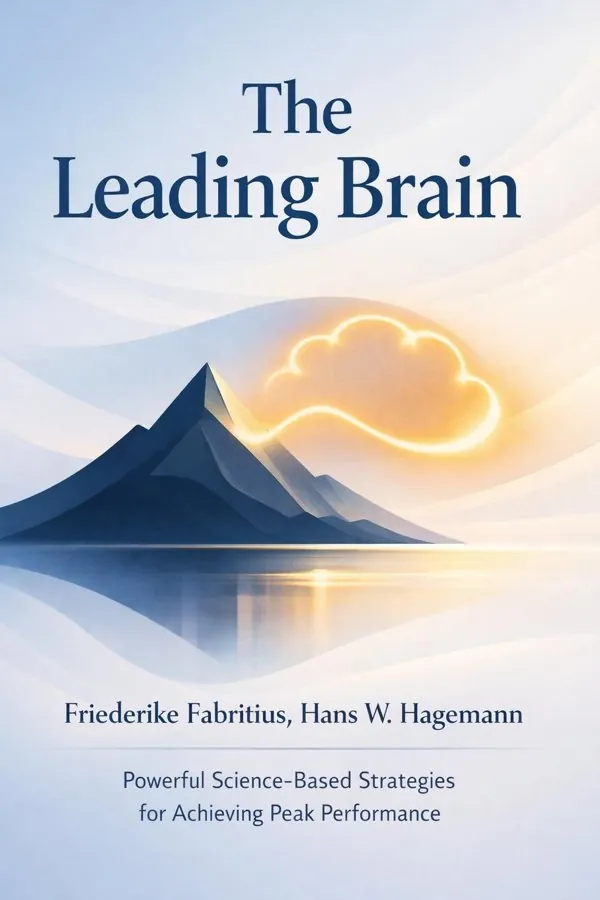
The Leading Brain: Powerful Science-Based Strategies for Achieving Peak Performance: Summary & Key Insights
by Friederike Fabritius, Hans W. Hagemann
 10 min5 chaptersAudio available
What Is The Leading Brain: Powerful Science-Based Strategies for Achieving Peak Performance About?
The Leading Brain: Powerful Science-Based Strategies for Achieving Peak Performance by Friederike Fabritius, Hans W. Hagemann is a leadership book spanning 5 pages. The Leading Brain combines neuroscience and leadership science to explain how brain-based strategies can enhance performance, creativity, and decision-making. Drawing on cutting-edge research, the authors show how leaders can optimize motivation, focus, and emotional balance to achieve peak performance in themselves and their teams.
This FizzRead summary covers all 5 key chapters of The Leading Brain: Powerful Science-Based Strategies for Achieving Peak Performance in approximately 10 minutes, distilling the most important ideas, arguments, and takeaways from Friederike Fabritius, Hans W. Hagemann's work. Also available as an audio summary and Key Quotes Podcast.
The Leading Brain: Powerful Science-Based Strategies for Achieving Peak Performance
The Leading Brain combines neuroscience and leadership science to explain how brain-based strategies can enhance performance, creativity, and decision-making. Drawing on cutting-edge research, the authors show how leaders can optimize motivation, focus, and emotional balance to achieve peak performance in themselves and their teams.
Who Should Read The Leading Brain: Powerful Science-Based Strategies for Achieving Peak Performance?
This book is perfect for anyone interested in leadership and looking to gain actionable insights in a short read. Whether you're a student, professional, or lifelong learner, the key ideas from The Leading Brain: Powerful Science-Based Strategies for Achieving Peak Performance by Friederike Fabritius, Hans W. Hagemann will help you think differently.
- ✓Readers who enjoy leadership and want practical takeaways
- ✓Professionals looking to apply new ideas to their work and life
- ✓Anyone who wants the core insights of The Leading Brain: Powerful Science-Based Strategies for Achieving Peak Performance in just 10 minutes
Want the full summary?
Get instant access to this book summary and 100K+ more with Fizz Moment.
Get Free SummaryAvailable on App Store • Free to download
Key Chapters
Every moment of our lives is shaped by the silent choreography of neurochemicals. Dopamine, serotonin, and cortisol dance together in patterns that determine our emotions, our focus, and our decision-making. As leaders, understanding this chemistry is not optional—it’s pivotal. Dopamine is the molecule of anticipation and reward. When we set clear goals and experience progress, dopamine surges through our neural pathways, energizing us, sharpening attention, and making challenges feel exciting rather than daunting. This is why leaders who articulate vision so vividly can unlock motivation in their teams—the brain loves the promise of success as much as success itself.
Serotonin operates differently. It stabilizes mood and nurtures belonging. High serotonin levels signal that we are safe, respected, and valued. In organizational settings, that translates to trust and inclusion. A leader’s emotional presence can elevate serotonin across a team—creating psychological safety that allows creativity and risk-taking to flourish. Conversely, cortisol is the stress hormone. In moderate doses, it primes the brain for action. In excess, it corrodes focus and empathy, shrinking the brain’s capacity for planning and connection. Chronic stress dulls dopamine’s spark and suppresses serotonin’s calm, trapping teams in survival mode rather than growth.
When leaders perceive their team’s dips in morale or bursts of energy, what they’re really witnessing is the neurochemical symphony playing underneath behavior. The most effective leaders learn how to adjust the environment to tune that symphony—introducing meaningful challenges that ignite dopamine, ensuring respect and stability to maintain serotonin, and managing workload and uncertainty to keep cortisol under control. Leadership, at its best, becomes an act of chemical balance.
But this balance must start with self-awareness. Every leader operates under a unique neurochemical signature. When you know your own triggers—what excites you, what overwhelms you, what brings calm—you can self-regulate your performance and model that awareness for your team. Neuroscience teaches that high-performing environments are not created by removing all stress, but by calibrating it: enough tension to activate dopamine and drive focus, but not so much as to flood cortisol and hinder clarity. The coming chapters reveal how to find that delicate, powerful equilibrium—the brain’s sweet spot for performance.
If there’s one principle that underpins everything in this book, it is the concept of the sweet spot. In neuroscience, the sweet spot represents the state where the brain is stimulated enough to feel alert and motivated but not overwhelmed by anxiety or fatigue. In this zone, neurochemicals like dopamine and noradrenaline propel attention and creativity, while the prefrontal cortex remains stable enough for logical thinking. It’s the zone of flow—the peak state athletes and artists describe, when effort feels effortless.
Too much comfort, and the brain disengages. Motivation fades, attention wanders, learning stagnates. Too much challenge, and stress overpowers cognition—the amygdala hijacks the brain, reducing complex reasoning to fight-or-flight reactions. The leader’s art lies in adjusting conditions so each person stays in their sweet spot, where difficulty inspires rather than defeats.
In my experience with executive training, leaders often err on either extreme. Some create environments too predictable, numbing creativity and initiative. Others push for relentless intensity, mistaking exhaustion for excellence. Neuroscience gives us a way to calibrate this balance scientifically. The trick is to design work that stretches capacity just beyond comfort, triggering dopamine’s reward circuits, while ensuring emotional security through trust and recognition, supporting serotonin’s stabilizing effects.
Imagine a team tackling a new project with clear but ambitious goals. If they feel supported, their brains translate that challenge into motivation—a dopamine surge that motivates experimentation and persistence. But if pressure turns to fear, cortisol spikes and learning plummets. The ability to sense when intensity crosses into threat is the mark of a brain-based leader. I encourage leaders to monitor their own signals—a racing pulse, narrowed vision, or irritability often signal that cortisol is leading the show.
Finding and sustaining the sweet spot is more than time management—it’s energy management. It requires leaders to respect biological rhythms: moments of intense cognitive labor balanced with rest and reflection. When teams are granted permission to recover, the brain consolidates knowledge during downtime, strengthening neural connections and preparing for the next challenge. This rhythm of challenge and respite forms the neuroscience of high performance—a science rooted not in overwork, but in optimal stimulation of the living brain.
+ 3 more chapters — available in the FizzRead app
All Chapters in The Leading Brain: Powerful Science-Based Strategies for Achieving Peak Performance
About the Authors
Friederike Fabritius is a neuroscientist and leadership expert specializing in the application of brain science to business performance. Hans W. Hagemann is a leadership consultant and co-founder of the Munich Leadership Group, with extensive experience in executive coaching and organizational development.
Get This Summary in Your Preferred Format
Read or listen to the The Leading Brain: Powerful Science-Based Strategies for Achieving Peak Performance summary by Friederike Fabritius, Hans W. Hagemann anytime, anywhere. FizzRead offers multiple formats so you can learn on your terms — all free.
Available formats: App · Audio · PDF · EPUB — All included free with FizzRead
Download The Leading Brain: Powerful Science-Based Strategies for Achieving Peak Performance PDF and EPUB Summary
Key Quotes from The Leading Brain: Powerful Science-Based Strategies for Achieving Peak Performance
“Every moment of our lives is shaped by the silent choreography of neurochemicals.”
“If there’s one principle that underpins everything in this book, it is the concept of the sweet spot.”
Frequently Asked Questions about The Leading Brain: Powerful Science-Based Strategies for Achieving Peak Performance
The Leading Brain: Powerful Science-Based Strategies for Achieving Peak Performance by Friederike Fabritius, Hans W. Hagemann is a leadership book that explores key ideas across 5 chapters. The Leading Brain combines neuroscience and leadership science to explain how brain-based strategies can enhance performance, creativity, and decision-making. Drawing on cutting-edge research, the authors show how leaders can optimize motivation, focus, and emotional balance to achieve peak performance in themselves and their teams.
You Might Also Like

Extreme Ownership
Jocko Willink
10 min
Dare to Lead
Brene Brown
10 min
Leaders Eat Last
Simon Sinek
10 min
The 21 Irrefutable Laws of Leadership
John Maxwell
10 min
Start With Why
Simon Sinek
10 min
How to Lead When You're Not in Charge
Clay Scroggins
10 minBrowse by Category
Ready to read The Leading Brain: Powerful Science-Based Strategies for Achieving Peak Performance?
Get the full summary and 100K+ more books with Fizz Moment.