
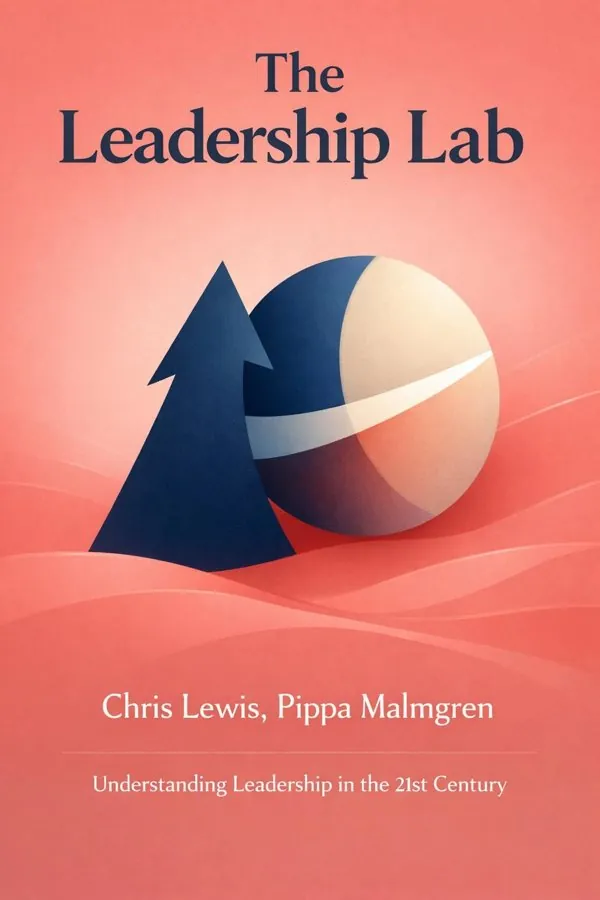
The Leadership Lab: Understanding Leadership in the 21st Century: Summary & Key Insights
by Chris Lewis, Pippa Malmgren
 10 min9 chaptersAudio available
Key Takeaways from The Leadership Lab: Understanding Leadership in the 21st Century
The first great challenge of modern leadership is accepting that instability is no longer an exception but the operating environment.
One of the book’s most memorable ideas is its central metaphor: leadership is a lab, not a stage.
A powerful leader can still make poor decisions if they misunderstand how the mind works.
Empathy is often dismissed as a soft trait, yet the book presents it as a hard advantage in an era of complexity.
Many organizations say they value innovation, but their cultures punish the very behaviors innovation requires.
What Is The Leadership Lab: Understanding Leadership in the 21st Century About?
The Leadership Lab: Understanding Leadership in the 21st Century by Chris Lewis, Pippa Malmgren is a leadership book spanning 11 pages. Leadership no longer operates in a stable, predictable environment. In The Leadership Lab, Chris Lewis and Dr. Pippa Malmgren argue that modern leaders must navigate a world defined by technological acceleration, geopolitical turbulence, economic uncertainty, and changing social expectations. The book asks a timely question: what kind of leadership works when the old playbooks no longer do? Their answer is that leadership today must become more experimental, more human, and more aware of the systems shaping our decisions. Rather than treating leadership as a fixed set of traits, the authors present it as a practice of continuous learning, reflection, and adaptation. They explore how cognitive bias, emotional intelligence, innovation, ethics, diversity, and communication all influence whether leaders succeed or fail. This perspective matters because organizations, governments, and communities increasingly depend on leaders who can make sound judgments under pressure while maintaining trust. Lewis brings expertise in communications, business, and organizational influence, while Malmgren contributes deep insight into economics, geopolitics, and technology. Together, they offer a broad, practical guide to leading effectively in a century of disruption.
This FizzRead summary covers all 9 key chapters of The Leadership Lab: Understanding Leadership in the 21st Century in approximately 10 minutes, distilling the most important ideas, arguments, and takeaways from Chris Lewis, Pippa Malmgren's work. Also available as an audio summary and Key Quotes Podcast.
The Leadership Lab: Understanding Leadership in the 21st Century
Leadership no longer operates in a stable, predictable environment. In The Leadership Lab, Chris Lewis and Dr. Pippa Malmgren argue that modern leaders must navigate a world defined by technological acceleration, geopolitical turbulence, economic uncertainty, and changing social expectations. The book asks a timely question: what kind of leadership works when the old playbooks no longer do? Their answer is that leadership today must become more experimental, more human, and more aware of the systems shaping our decisions. Rather than treating leadership as a fixed set of traits, the authors present it as a practice of continuous learning, reflection, and adaptation. They explore how cognitive bias, emotional intelligence, innovation, ethics, diversity, and communication all influence whether leaders succeed or fail. This perspective matters because organizations, governments, and communities increasingly depend on leaders who can make sound judgments under pressure while maintaining trust. Lewis brings expertise in communications, business, and organizational influence, while Malmgren contributes deep insight into economics, geopolitics, and technology. Together, they offer a broad, practical guide to leading effectively in a century of disruption.
Who Should Read The Leadership Lab: Understanding Leadership in the 21st Century?
This book is perfect for anyone interested in leadership and looking to gain actionable insights in a short read. Whether you're a student, professional, or lifelong learner, the key ideas from The Leadership Lab: Understanding Leadership in the 21st Century by Chris Lewis, Pippa Malmgren will help you think differently.
- ✓Readers who enjoy leadership and want practical takeaways
- ✓Professionals looking to apply new ideas to their work and life
- ✓Anyone who wants the core insights of The Leadership Lab: Understanding Leadership in the 21st Century in just 10 minutes
Want the full summary?
Get instant access to this book summary and 100K+ more with Fizz Moment.
Get Free SummaryAvailable on App Store • Free to download
Key Chapters
The first great challenge of modern leadership is accepting that instability is no longer an exception but the operating environment. Lewis and Malmgren show that leadership in the 21st century unfolds amid interconnected shocks: digital disruption, shifting geopolitics, rapid capital flows, public distrust, climate concerns, and changing workforce expectations. In earlier eras, leaders could often rely on established hierarchies, longer planning cycles, and relatively clear industry boundaries. Today, those assumptions break down quickly. A political event in one country can affect supply chains worldwide; a new platform can remake an industry in months; a social movement can change brand reputation overnight.
The authors argue that this changing context demands a different kind of mental model. Leaders cannot simply optimize for efficiency or preserve the status quo. They must learn to interpret weak signals, anticipate second-order consequences, and remain flexible when conditions change. This means becoming comfortable with ambiguity rather than waiting for certainty that never arrives. It also means balancing short-term performance with long-term resilience.
A practical example is how companies responded differently to remote work and digital collaboration. Some treated it as a temporary inconvenience and tried to preserve old routines. Others recognized it as a structural shift and redesigned communication, culture, hiring, and productivity systems. The latter were better prepared not because they predicted everything perfectly, but because they adapted faster.
The actionable takeaway is simple: stop asking how to restore the old normal, and start asking what capabilities your team needs to thrive in permanent change.
One of the book’s most memorable ideas is its central metaphor: leadership is a lab, not a stage. That insight challenges the outdated belief that leaders must always appear certain, polished, and in control. In a laboratory, people test hypotheses, learn from failures, examine evidence, and revise their assumptions. Lewis and Malmgren argue that this is exactly how leaders must operate in a complex world. When conditions are fluid, certainty can become dangerous. Experimentation becomes a strength.
This does not mean leaders should act randomly or abandon responsibility. Instead, they should adopt disciplined curiosity. They should run small tests before scaling big decisions, invite dissenting views, and treat setbacks as data rather than as personal humiliation. A laboratory mindset also changes organizational culture. It encourages people to surface problems early, propose unconventional ideas, and learn across functions instead of protecting turf.
Consider product development in a fast-moving market. A traditional leader may insist on perfecting a strategy behind closed doors before launch. A laboratory-minded leader might release a pilot, gather customer feedback, and adapt quickly. The same principle applies beyond business: public-sector leaders can test policy prototypes locally before broad rollout, and nonprofit leaders can experiment with different service models to improve outcomes.
The deeper lesson is that effective leadership is not about never being wrong. It is about building systems that help you discover what is right faster. The actionable takeaway: create one regular process in your organization for low-risk experimentation, reflection, and learning so adaptation becomes habitual rather than accidental.
A powerful leader can still make poor decisions if they misunderstand how the mind works. Lewis and Malmgren emphasize that cognitive bias is one of the hidden forces shaping leadership outcomes. Leaders often pride themselves on rationality, but real-world decisions are influenced by overconfidence, confirmation bias, groupthink, recency effects, status assumptions, and emotional framing. The danger is not merely individual error. When biases go unexamined, they become embedded in teams, strategies, and institutions.
The book encourages leaders to see decision-making as a discipline rather than a personal gift. Smart people are not immune to blind spots; in fact, expertise can make people more attached to their assumptions. Effective leaders therefore build mechanisms that challenge their own thinking. They ask who might disagree, what evidence is being ignored, and how incentives may be distorting the conversation.
For example, a senior executive may believe a new market expansion is obviously wise because early data looks promising. But if everyone around the executive fears contradicting them, warning signs may be ignored. A better process would include red-team reviews, pre-mortems, scenario planning, and diverse perspectives from people closer to customers or operations. In personal leadership, bias also matters when evaluating talent. Leaders may promote people who resemble themselves in background or style while overlooking less familiar forms of competence.
The core insight is that better decisions come less from confidence and more from structured humility. The actionable takeaway: before making an important decision, ask your team to identify three assumptions you may be wrong about and one reason the preferred plan could fail.
Empathy is often dismissed as a soft trait, yet the book presents it as a hard advantage in an era of complexity. Lewis and Malmgren argue that leaders who cannot understand the emotions, needs, and perceptions of others will struggle to build trust, motivate people, or interpret social change. Emotional intelligence is not about being agreeable all the time. It is about sensing what matters to different stakeholders and responding in ways that preserve dignity, connection, and clarity.
In modern organizations, leaders rarely succeed through authority alone. They lead across cultures, generations, disciplines, and digital channels. Employees want meaning, flexibility, and respect. Customers care about authenticity and values. Communities scrutinize corporate behavior. Under these conditions, empathy becomes essential to communication, negotiation, conflict resolution, and culture building.
A leader managing a merger, for instance, may focus on legal integration and financial synergies while neglecting the anxiety employees feel about identity, status, and job security. That emotional neglect can produce resistance, rumor, and disengagement even if the strategy is sound. By contrast, a leader who listens carefully, acknowledges fears, and communicates honestly can reduce uncertainty and strengthen commitment. Empathy also improves innovation, because understanding people deeply is the starting point for creating products and services they actually need.
The authors do not suggest empathy should replace accountability. The strongest leaders combine compassion with standards. They understand people without losing direction. The actionable takeaway: in your next major conversation, spend more time diagnosing what the other person is experiencing than preparing your own response.
Many organizations say they value innovation, but their cultures punish the very behaviors innovation requires. Lewis and Malmgren argue that creativity is not the job of a small elite group. It is a leadership responsibility to build conditions where new thinking can emerge, be tested, and be translated into action. In times of rapid change, leaders who depend only on existing formulas are quietly choosing decline.
The authors connect creativity to openness, diversity of thought, and permission to challenge convention. Innovation rarely comes from repeating best practices in a changing environment. It often comes from recombining ideas across fields, paying attention to anomalies, and allowing people to question assumptions without fear. Leaders therefore need to protect exploratory time, reward curiosity, and avoid managing every process so tightly that imagination disappears.
A practical application can be seen in organizations facing digital disruption. A retailer, for example, may need to rethink not just its online store but the entire customer experience, supply chain, data strategy, and purpose of physical locations. That level of reinvention requires more than technical upgrades. It requires leaders who ask better questions, invite frontline insights, and are willing to experiment with business models that may initially seem uncomfortable.
Importantly, creativity is not opposed to discipline. The best innovation cultures pair freedom of thought with clear priorities, measurement, and follow-through. Leaders must separate productive experimentation from chaos. The actionable takeaway: identify one area where your team is following routine by habit rather than necessity, and challenge them to generate three alternative approaches within the next month.
Technology is not merely a tool leaders use; it is a force that reshapes the environment in which they lead. Lewis and Malmgren explore how digital platforms, data systems, automation, artificial intelligence, and always-on communication are transforming decision-making, competition, reputation, and human relationships. Leadership in this context requires more than technical literacy. It requires understanding how technology alters incentives, compresses time, and magnifies consequences.
One major implication is speed. Information now travels instantly, meaning leaders often face pressure to respond before they fully understand what is happening. Another is visibility. Internal behavior can quickly become external news, and public expectations around transparency have increased. A third is asymmetry: small actors can have outsized influence, whether through innovation, cyber risk, or viral communication. This means leaders must rethink control. They cannot rely on secrecy, slow messaging, or rigid command structures in the way many once did.
Technology also raises ethical questions. How should data be collected and used? When should automation replace human judgment, and when should it not? How do leaders prevent efficiency from eroding privacy, fairness, or human dignity? A company deploying AI in hiring, for example, must consider not only productivity gains but also potential bias, explainability, and trust.
The book encourages leaders to engage technology strategically rather than delegating it entirely to specialists. They do not need to be engineers, but they do need to understand the social and organizational effects of technical decisions. The actionable takeaway: for every major technology initiative, evaluate not just cost and efficiency, but also trust, ethics, and long-term cultural impact.
One of the book’s distinctive strengths is its insistence that leadership can no longer be understood only at the organizational level. Lewis and Malmgren show that broader geopolitical and economic forces increasingly shape what leaders can do and how quickly circumstances can change. Interest rates, trade tensions, energy markets, migration, regulatory shifts, military conflict, populism, and currency movements are not distant abstractions. They influence hiring, pricing, investment, supply chains, market access, and public sentiment.
Too many leaders focus narrowly on internal metrics and direct competitors while missing the larger system. The authors argue that this is dangerous in an interconnected world. A business strategy that looks sound in stable conditions may become fragile when exposed to geopolitical volatility. Likewise, public-sector leaders and civic leaders must understand economic realities if they want policy ambitions to succeed.
A practical example is global sourcing. An organization may build an efficient supply chain across multiple countries, only to discover that sanctions, export controls, regional tensions, or inflation shocks make that efficiency highly vulnerable. Leaders with a broader lens would diversify options, develop scenarios, and build resilience into critical operations. This systems perspective also applies to labor markets, investor expectations, and consumer behavior, all of which are influenced by macro conditions.
The key lesson is that leadership today requires external intelligence, not just internal management. Leaders must become skilled interpreters of the world beyond their walls. The actionable takeaway: add a regular geopolitical and economic review to strategic planning meetings so your decisions reflect the wider forces shaping risk and opportunity.
People do not follow leaders simply because of position; they follow because the leader’s message makes sense, feels credible, and aligns with shared values. Lewis and Malmgren argue that communication in the 21st century is not a matter of polished public relations alone. It is about narrative coherence, ethical consistency, and trust. In a noisy, skeptical environment, leaders must explain not only what they are doing but why it matters and how it connects to people’s concerns.
Narrative matters because humans understand complexity through stories. A strategy spreadsheet may satisfy analysts, but employees, customers, and citizens need a compelling account of where an organization is going and why change is necessary. Without that, confusion grows and rumors fill the gap. Yet narrative without ethics quickly collapses. If a leader’s story is disconnected from actual behavior, trust erodes faster than ever in a world of social media, leaks, and constant scrutiny.
The authors also stress responsibility. Leaders shape systems that affect livelihoods, communities, and public confidence. Ethical leadership therefore means considering consequences beyond immediate gain. A company that talks about sustainability while exploiting opaque supply chains invites reputational and moral failure. A government that communicates selectively during crisis may damage compliance and legitimacy.
Strong communication is clear, honest, and proportionate. It acknowledges uncertainty when necessary instead of pretending omniscience. It also leaves room for dialogue rather than merely broadcasting authority. The actionable takeaway: test your leadership narrative by asking whether your strategy, your values, and your day-to-day decisions tell the same story to the people you most need to trust you.
The future of leadership will belong to those who can draw strength from difference rather than fearing it. Lewis and Malmgren examine gender and diversity not as compliance topics but as central leadership issues. In complex environments, homogeneous leadership teams are more likely to share blind spots, reinforce existing assumptions, and miss emerging realities. Diversity, by contrast, broadens perception, improves problem-solving, and makes organizations more adaptive.
The authors suggest that inclusion is not achieved merely by representation at the surface. Leaders must create conditions where different experiences and viewpoints influence real decisions. That means examining promotion patterns, meeting dynamics, informal networks, and definitions of leadership itself. If organizations reward only one communication style, one career path, or one social profile, they may exclude valuable talent while believing they are meritocratic.
Gender is an especially important theme because leadership norms have historically been shaped around narrow expectations of authority. The book challenges the idea that effective leadership must always appear dominant, emotionally detached, or individually heroic. Many of the capabilities most needed today, such as listening, collaboration, adaptability, and social intelligence, flourish when organizations broaden their conception of who can lead and how leadership can be expressed.
This is not only a moral issue but a strategic one. Teams that reflect diverse markets and communities are better equipped to understand them. The actionable takeaway: audit one important decision process in your organization, such as hiring, promotion, or strategy review, and identify where different voices are invited symbolically but not truly influencing outcomes.
All Chapters in The Leadership Lab: Understanding Leadership in the 21st Century
About the Authors
Chris Lewis is a business leader, communications strategist, and founder of the global marketing and communications agency LEWIS. He has written extensively on leadership, creativity, branding, and organizational influence, with a particular interest in how leaders communicate in times of change. Dr. Pippa Malmgren is an economist, author, and former presidential advisor known for her expertise in global economics, geopolitics, public policy, and the impact of technology on society. She has advised governments, institutions, and business leaders on how large-scale economic and political forces shape decision-making. Together, Lewis and Malmgren bring a rare combination of practical leadership insight and global strategic perspective, which gives The Leadership Lab both managerial relevance and intellectual breadth.
Get This Summary in Your Preferred Format
Read or listen to the The Leadership Lab: Understanding Leadership in the 21st Century summary by Chris Lewis, Pippa Malmgren anytime, anywhere. FizzRead offers multiple formats so you can learn on your terms — all free.
Available formats: App · Audio · PDF · EPUB — All included free with FizzRead
Download The Leadership Lab: Understanding Leadership in the 21st Century PDF and EPUB Summary
Key Quotes from The Leadership Lab: Understanding Leadership in the 21st Century
“The first great challenge of modern leadership is accepting that instability is no longer an exception but the operating environment.”
“One of the book’s most memorable ideas is its central metaphor: leadership is a lab, not a stage.”
“A powerful leader can still make poor decisions if they misunderstand how the mind works.”
“Empathy is often dismissed as a soft trait, yet the book presents it as a hard advantage in an era of complexity.”
“Many organizations say they value innovation, but their cultures punish the very behaviors innovation requires.”
Frequently Asked Questions about The Leadership Lab: Understanding Leadership in the 21st Century
The Leadership Lab: Understanding Leadership in the 21st Century by Chris Lewis, Pippa Malmgren is a leadership book that explores key ideas across 9 chapters. Leadership no longer operates in a stable, predictable environment. In The Leadership Lab, Chris Lewis and Dr. Pippa Malmgren argue that modern leaders must navigate a world defined by technological acceleration, geopolitical turbulence, economic uncertainty, and changing social expectations. The book asks a timely question: what kind of leadership works when the old playbooks no longer do? Their answer is that leadership today must become more experimental, more human, and more aware of the systems shaping our decisions. Rather than treating leadership as a fixed set of traits, the authors present it as a practice of continuous learning, reflection, and adaptation. They explore how cognitive bias, emotional intelligence, innovation, ethics, diversity, and communication all influence whether leaders succeed or fail. This perspective matters because organizations, governments, and communities increasingly depend on leaders who can make sound judgments under pressure while maintaining trust. Lewis brings expertise in communications, business, and organizational influence, while Malmgren contributes deep insight into economics, geopolitics, and technology. Together, they offer a broad, practical guide to leading effectively in a century of disruption.
More by Chris Lewis, Pippa Malmgren
You Might Also Like

Extreme Ownership
Jocko Willink
10 min
Dare to Lead
Brene Brown
10 min
Leaders Eat Last
Simon Sinek
10 min
The 21 Irrefutable Laws of Leadership
John Maxwell
10 min
Start With Why
Simon Sinek
10 min
How to Lead When You're Not in Charge
Clay Scroggins
10 minBrowse by Category
Ready to read The Leadership Lab: Understanding Leadership in the 21st Century?
Get the full summary and 100K+ more books with Fizz Moment.